

Does the traditional banking sector’s 10-property limit reflect the true potential of your investment strategy, or is it merely an arbitrary ceiling on your professional growth? Many high-net-worth individuals find that as they scale, the protracted 60-day underwriting cycles and rigid personal income requirements of conventional rental property loans become significant impediments to strategic capital allocation. You recognize that the intrinsic value of a well-managed portfolio should dictate its financing, yet you’re often tethered to outdated debt-to-income metrics that ignore the reality of sophisticated wealth preservation.
This guide provides a comprehensive framework for navigating institutional capital in 2026, focusing on the transition from personal liability to asset-based strength. You’ll learn to utilize Debt Service Coverage Ratio (DSCR) models to secure scalable capital and achieve faster closing times that align with institutional standards. We’ll examine the specific mechanisms of bespoke financing that allow for disciplined portfolio optimization and the generation of superior risk-adjusted returns beyond the limitations of retail banking.
Key Takeaways
- Understand the fundamental transition from consumer-grade mortgages to professional asset-based lending to ensure long-term portfolio scalability.
- Master the Debt Service Coverage Ratio (DSCR) framework to align your acquisition strategies with the risk-adjusted return metrics prioritized by institutional lenders.
- Evaluate the strategic equilibrium between cost of capital and speed of execution when selecting rental property loans to optimize your capital allocation.
- Learn to structure a comprehensive “investor kit” and utilize bridge financing to facilitate the seamless execution of the Buy, Rehab, Rent, Refinance (BRRRR) cycle.
- Discover how a partnership with a disciplined steward like JGL Capital LLC provides the bespoke financial architecture necessary for navigating complex real estate transactions.
The Evolution of Rental Property Loans: Moving Beyond Traditional Banking
By 2026, the Florida real estate market has reached a level of maturity where reliance on consumer-grade financial products is no longer viable for institutional-grade growth. The transition from consumer-centric mortgages toward professional, asset-based lending represents a fundamental shift in how sophisticated investors manage their capital. While understanding mortgage loan basics remains necessary for entry-level participants, the seasoned professional requires a framework that prioritizes the income-generating potential of the property rather than the personal debt-to-income (DTI) ratio of the individual borrower. This shift toward specialized rental property loans has accelerated as investors seek to bypass the inefficiencies of retail banking, focusing instead on the intrinsic value of their acquisitions.
The role of private capital has become the primary engine for liquidity in high-growth corridors like Miami and Orlando. Unlike traditional banks that view every borrower through a lens of personal liability, private money brokers analyze the risk-adjusted returns of the specific asset. This transition allows for a more disciplined approach to wealth preservation, where the property’s performance dictates the terms of the leverage. It’s a strategic evolution that replaces the rigid, one-size-fits-all model with bespoke capital structures designed for rapid portfolio expansion.
The Limitations of Conventional Financing
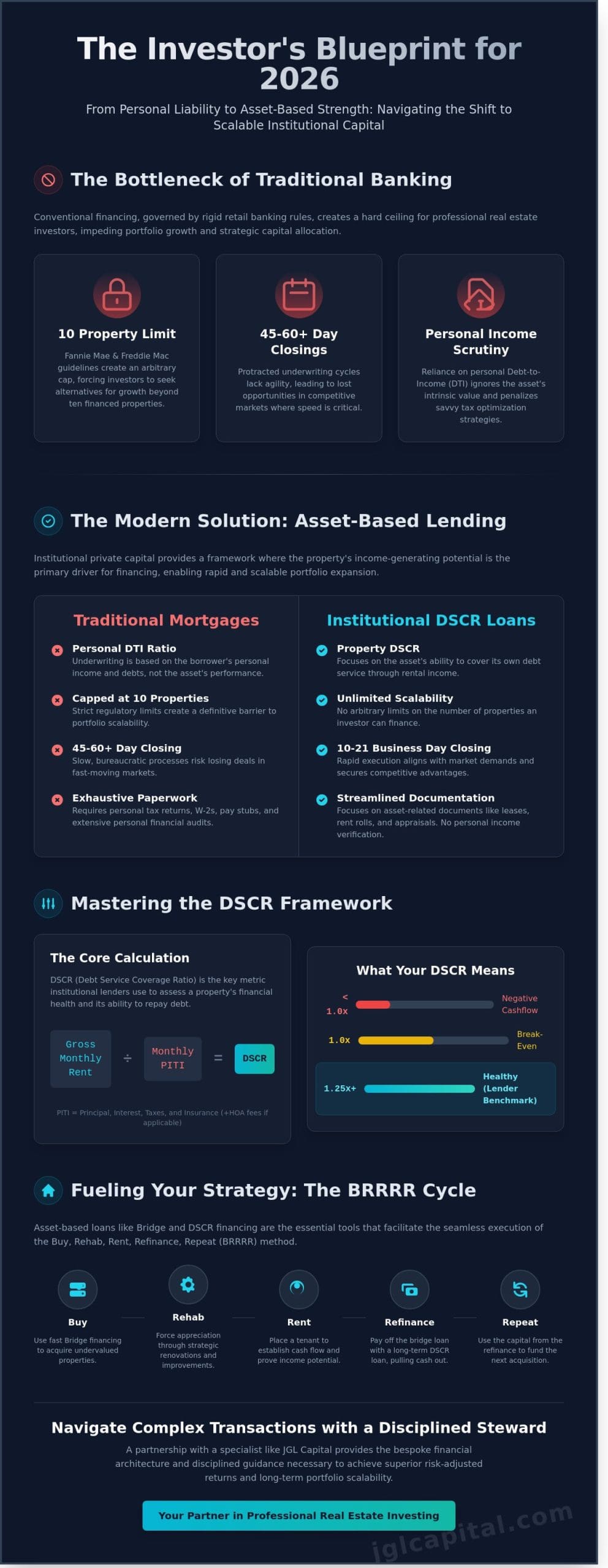
Traditional institutions operate under rigid regulatory frameworks, specifically the Fannie Mae and Freddie Mac guidelines that often restrict an investor to a maximum of 10 financed properties. This 10-loan cap creates a hard ceiling for scalability, forcing growing firms to seek alternative avenues. Bank underwriting cycles, which frequently extend beyond 45 days, lack the agility required in competitive Florida markets where speed is the standard. The exhaustive audit of personal tax returns creates unnecessary friction, as it often penalizes investors who utilize legal tax depreciations to optimize their cash flow. These systemic delays can result in lost opportunities and diminished competitive advantages.
The Rise of Private Money and Asset-Backed Solutions
Private capital provides the liquidity necessary for rapid rental property loans deployment without the constraints of personal income verification. By focusing on the debt service coverage ratio (DSCR), lenders prioritize the property’s ability to cover its own debt obligations through generated rent. This model allows for closing timelines as short as 10 business days, a significant improvement over the 60-day windows common in retail banking. It positions the real estate asset as the primary collateral, enabling a more precise alignment of interests between the lender and the strategic investor. This asset-backed approach fosters a sense of security, ensuring that growth is predicated on property performance rather than personal credit capacity.
The DSCR Framework: Evaluating Loans Based on Asset Performance
Institutional lenders determine the viability of a project by analyzing its capacity to generate surplus cash flow after all debt obligations are met. This methodology prioritizes risk-adjusted returns, ensuring that the asset itself serves as the primary security for the transaction. For those refining their rental property investment strategies, understanding this framework is mandatory. By 2026, the reliance on property performance rather than personal W-2 income will become the standard for high-net-worth portfolio expansion. This shift reflects a move toward analytical rigor, where the property’s ability to sustain itself outweighs the borrower’s individual employment history.
Calculating the DSCR for Optimal Financing
The calculation is a simple yet profound metric for assessing financial health. DSCR is the ratio of net operating income to total debt service. To arrive at this figure, lenders divide the gross monthly rental income by the monthly PITI, which includes principal, interest, taxes, insurance, and any applicable association fees. While a 1.0x ratio indicates a break-even point, a 1.25x ratio is currently viewed as the benchmark for a healthy, low-risk investment. This margin of 25% provides the necessary liquidity to absorb unexpected maintenance or vacancy periods without compromising the debt service. In more competitive markets, some institutions may accept a 1.20x ratio, but the higher threshold remains the gold standard for long-term stability.
Benefits of DSCR-Based Underwriting
Underwriting based on the asset’s performance offers several strategic advantages that traditional financing cannot match. It removes the barrier of personal employment verification, which is often a hurdle for self-employed entrepreneurs or those with complex tax returns. Investors can secure rental property loans through LLCs or other corporate entities. This structure facilitates robust asset protection and clear separation of personal and professional liabilities. Because these loans aren’t restricted by the 10-property limit found in traditional GSE guidelines, the potential for scalability is virtually infinite. It’s a system designed for growth, allowing for a more disciplined approach to bespoke financing solutions that align with long-term wealth preservation and institutional-grade portfolio management.
- Asset-Centric Focus: Approval depends on property income, not personal debt-to-income ratios.
- Corporate Flexibility: Loans are closed in the name of an LLC to mitigate personal risk.
- Unlimited Scalability: Investors can expand their holdings without the constraints of conventional lending caps.
Strategic Comparison: Institutional Private Capital vs. Traditional Mortgages
Discerning investors evaluate capital allocation through a prism of long-term wealth preservation, distinguishing between the rigid frameworks of retail banking and the agile, bespoke nature of institutional private capital. Standardized retail avenues operate under the OCC Residential Mortgage Lending Standards, which prioritize standardized risk metrics over the unique cash-flow potential of individual assets. Agility defines success. While traditional lenders may offer a nominal interest rate 150 basis points lower than private alternatives, they frequently lack the velocity required for sophisticated rental property loans. The equilibrium between the cost of capital and speed of execution is vital; the ability to close a transaction within 10 to 14 days often secures a high-yield asset that would otherwise be lost to a cash-ready competitor.
Institutional private capital provides structural flexibility that retail products cannot replicate. Interest-only options for the initial 60 or 120 months of a loan term allow investors to maximize cash flow during the critical early years of asset stabilization. The common perception that private money is inherently more expensive fails to account for the risk-adjusted returns generated by rapid deployment. By utilizing balloon payments and tailored amortization schedules, a disciplined steward of capital can optimize liquidity while avoiding the restrictive debt-to-income requirements that often stymie growth in the traditional sector. Sophisticated investors increasingly deploy real estate bridge loans as a primary instrument for transitional capital optimization, ensuring that time-sensitive acquisitions aren’t lost to more nimble competitors who possess immediate liquidity.
The Institutional Advantage for High-Net-Worth Individuals
High-net-worth individuals managing portfolios exceeding $10 million require a quiet expert rather than a transactional clerk. Bespoke loan structuring for complex multi-family or mixed-use assets ensures that the debt facility aligns with the broader estate strategy. This partnership facilitates portfolio optimization by providing strategic oversight; it allows the borrower to maintain liquidity for subsequent acquisitions without the friction of traditional re-underwriting processes. We prioritize the delivery of tailored solutions that respect the complexity of diverse asset holdings. Investors seeking a rigorous framework for evaluating their financing options will find that a detailed strategic comparison of asset-backed loans for real estate capital allocation in 2026 provides the analytical foundation necessary for making informed decisions at scale.
Risk Mitigation and Strategic Stewardship
Professional underwriting serves as a primary tool for risk mitigation in the volatile 2024 Florida real estate market. Asset-based lenders perform rigorous due diligence to ensure that rental property loans are supported by sustainable debt service coverage ratios, typically targeting a 1.20x or 1.25x minimum. This disciplined approach aligns the interests of the brokerage and the borrower. It fosters a relationship built on the mutual goal of long-term value creation and capital preservation, ensuring that every asset can withstand a 10% market fluctuation without compromising the integrity of the portfolio.
Tactical Execution: Structuring Your Portfolio for Success
Efficiency in capital acquisition requires a standardized “investor kit” that functions as a comprehensive dossier for institutional review. This kit includes a detailed schedule of real estate owned (SREO), verified liquidity statements, and finalized organizational documents for the borrowing entity. Sophisticated operators utilize these kits to compress closing timelines to under 21 days. This speed is vital in competitive Florida markets where high-quality inventory doesn’t stay available for long. By presenting a transparent and organized financial profile, investors signal their reliability to institutional partners, ensuring a smoother path toward portfolio expansion. Cultivating relationships through real estate investment clubs that function as professional networking and capital allocation conduits can further enhance access to off-market deal flow and institutional-grade partnerships that accelerate this process.
From Bridge to Permanent Financing
The transition from asset acquisition to a long-term hold strategy often utilizes short-term bridge loans to facilitate the “Buy, Rehab, Rent, Refinance” (BRRRR) cycle. Professional operators deploy fix and flip loans to stabilize distressed assets before they migrate into permanent rental property loans. It’s a method that allows for the optimization of equity. By securing a 75% loan-to-value (LTV) ratio based on the after-repair value (ARV), investors can effectively recoup their initial capital while maintaining a cash-flowing asset. This strategic sequence ensures that capital remains fluid rather than being trapped in property equity, allowing for a more aggressive acquisition pace. Sophisticated investors who understand how bridge financing functions as a precision tool for transitional capital allocation gain a decisive edge in maintaining liquidity during property repositioning. For sophisticated investors seeking to identify bridge loan lenders who prioritize asset-based valuation over opaque fee structures, understanding the criteria for vetting these partnerships becomes essential for maintaining competitive advantage in the 2026 market.
Underwriting Requirements for Professional Investors
Institutional underwriting for income-producing properties prioritizes the asset’s performance alongside the sponsor’s operational history. Lenders scrutinize appraisal standards with specific focus on market rent schedules to validate the Debt Service Coverage Ratio. Maintaining a clean track record is essential; lenders look for a history of timely exits and consistent property management. To mitigate risk, we require a minimum liquidity reserve equal to six months of principal, interest, taxes, and insurance (PITI).
As the industry prepares for the 2026 regulatory shifts regarding commercial real estate capital requirements, maintaining high-tier underwriting standards is paramount. Investors who prioritize risk-adjusted returns over speculative growth will find themselves better positioned to secure rental property loans in a tighter credit environment. Precision in portfolio management isn’t just a preference; it’s a requirement for those seeking to build a lasting legacy in the Florida market.
Optimizing your portfolio requires a partner who understands the nuance of high-stakes capital allocation. Connect with our strategic advisors at JGL Capital to refine your investment strategy and secure the leverage your portfolio demands.
JGL Capital: Bespoke Financing for Sophisticated Real Estate Partners
JGL Capital operates as a disciplined steward of investment capital, providing the structural foundation necessary for sophisticated investors to scale their portfolios. With a 30-year legacy established in 1994, our firm has navigated three decades of market cycles, refining a methodology that prioritizes risk-adjusted returns and long-term stability. We reject the limitations of standardized lending products, opting instead for tailored capital allocation strategies that align with the specific nuances of complex real estate transactions. This commitment to strategic oversight ensures that our partners don’t just acquire assets; they build enduring legacies through precise funding structures. Our approach centers on the belief that every high-stakes investment deserves a customized framework rather than a generic solution.
A Partnership Rooted in Expertise
Success in the current Florida market requires more than just capital; it demands a discreet financial ally with a deep understanding of regional dynamics. While our reach extends nationally, we maintain a specialized focus on the Southeast, particularly the high-growth corridors of Florida where 22% of national net migration has concentrated according to 2023 demographic data. Our partners benefit from direct access to decision-makers, a structure that eliminates the bureaucratic delays common in traditional banking. This streamlined communication allows for expedited capital allocation, ensuring that rental property loans are structured and deployed with the precision required in competitive markets. We value the alignment of interests, treating every transaction as a step toward a decade-long partnership. For time-sensitive acquisitions where traditional banking timelines prove inadequate, our role as a strategic bridge lender enables immediate capital deployment while maintaining the analytical rigor necessary for long-term portfolio optimization.
Take the Next Step in Your Investment Journey
Initiating a partnership with JGL Capital begins with a comprehensive consultation to evaluate your portfolio optimization goals. We’ve refined our process to bridge the gap between initial inquiry and final closing, often reducing traditional timelines by 15% through our internal underwriting efficiencies. Our team analyzes the unique cash flow requirements of your acquisition to ensure the financing supports your broader strategic objectives. This methodical approach to due diligence ensures that capital is preserved and growth remains sustainable. We invite you to Partner with JGL Capital for your next rental property loan to experience a level of professional stewardship that transforms transactional borrowing into a strategic advantage for your real estate enterprise.
Optimizing Capital Allocation for the 2026 Market
The transition toward 2026 demands a departure from antiquated financing models in favor of sophisticated, asset-based evaluations. By prioritizing the Debt Service Coverage Ratio (DSCR) framework, which typically targets ratios above 1.20x, you’ll unlock liquidity that traditional banking institutions often restrict. Success in this evolving market hinges on your ability to leverage institutional private capital; this ensures your portfolio’s growth isn’t stifled by the limitations of conventional lending practices. For those seeking to develop a comprehensive understanding of real estate investing strategies that prioritize risk mitigation and capital preservation in the 2026 market, establishing a disciplined framework becomes essential for navigating the complex macroeconomic factors that will define the investment landscape.
JGL Capital provides the analytical rigor and strategic oversight necessary to navigate these high-stakes environments. With over 30 years of industry expertise, our firm delivers specialized asset-based underwriting that aligns with your long-term wealth preservation goals. From our Orlando-based headquarters, we provide national coverage to ensure your rental property loans are structured for maximum risk-adjusted returns. As the traditional banking sector’s share of commercial real estate debt contracts by approximately 25% by the conclusion of 2026, sophisticated investors must adapt their approach to capital funding for real estate through private capital allocation strategies that prioritize rapid deployment and bespoke asset-backed debt solutions. It’s time to move beyond transactional finance and embrace a partnership built on disciplined capital allocation and professional integrity.
Secure your next investment with JGL Capital’s bespoke rental property loans
We look forward to facilitating your continued success in the institutional real estate market.
Frequently Asked Questions
What is the minimum DSCR required for a rental property loan in 2026?
The minimum Debt Service Coverage Ratio for institutional rental property loans in 2026 typically sits at 1.20x. This specific threshold ensures the asset generates 20% more gross income than the total debt obligations. While select programs allow for a 1.00x ratio, these often require a 5% to 10% increase in the initial capital contribution to mitigate risk.
Can I get a rental property loan through my LLC?
Yes, it’s standard practice to close rental property loans within a business entity such as an LLC or Corporation to facilitate professional asset management. This structure protects personal assets and aligns with institutional standards for commercial liability. Approximately 95% of our professional partners utilize a Florida-registered LLC to hold their real estate assets for long-term growth.
How do rental property loans differ from residential mortgages?
Rental property loans differ from residential mortgages by prioritizing the asset’s cash flow over the borrower’s personal debt-to-income ratio. Traditional mortgages focus on personal earnings, whereas asset-based financing evaluates the property’s ability to cover its own debt. This distinction allows investors to scale portfolios without the 10-loan limit often imposed by government-sponsored entities.
What is the typical down payment for an asset-based rental loan?
The typical down payment for an asset-based rental loan ranges from 20% to 25% of the total purchase price. For properties with a DSCR above 1.25x, investors can often secure an 80% Loan-to-Value ratio. If the property requires renovation, the initial equity requirement might increase to 30% to maintain a conservative risk profile and ensure portfolio optimization.
Do rental property loans require personal tax returns?
No, DSCR programs don’t require personal tax returns or employment verification to qualify for financing. Lenders focus exclusively on the property’s gross monthly rent as verified by a Form 1007 appraisal report. This streamlined underwriting process relies on the property’s performance, making it an ideal solution for self-employed investors with complex tax filings.
What happens if the property’s rental income decreases after closing?
The original terms of the promissory note remain unchanged if the property’s rental income decreases after the loan has funded. The borrower’s obligation to meet the monthly principal and interest payments persists regardless of occupancy fluctuations or market shifts. Most institutional lenders require a liquidity reserve of 6 to 12 months of debt service to handle these scenarios.
How fast can a private money rental property loan be funded?
A private money rental property loan can be funded in 14 to 21 days once the appraisal and title work are completed. This timeline is 50% faster than traditional banking institutions, which often require 45 to 60 days for committee approval. Our disciplined approach to due diligence ensures that capital allocation occurs with both precision and the necessary speed.
Are there limits on the number of properties I can finance?
There are no theoretical limits on the number of properties an investor can finance through institutional DSCR programs. Unlike conventional loans that cap at 10 properties, asset-based lenders focus on total exposure, often allowing for portfolios exceeding $20 million in aggregate value. This flexibility supports the long-term wealth preservation goals of our high-net-worth partners.