

For the institutional investor, the most profound risk in the 2026 capital market isn’t found in asset volatility; it’s the definitive loss of value caused by the inertia of traditional banking institutions. You’ve likely experienced the frustration of a 75-day approval cycle that renders time-sensitive opportunities unreachable, particularly when rigid credit-based underwriting ignores the intrinsic strength of the real estate itself. It’s a systemic friction that necessitates the strategic deployment of a bridge lender to facilitate the immediate acquisition of high-value assets. This specialized form of capital allocation allows you to bypass the bureaucratic constraints of conventional finance, ensuring that your investment objectives are met with both speed and analytical rigor.
We recognize that the current financial environment demands a more disciplined and responsive approach to liquidity than most conventional lenders can provide. This article provides a sophisticated framework for understanding how private credit secures strategic advantages and optimizes risk-adjusted returns for professional investors. We’ll examine the specific mechanisms of asset-based approvals and the methodical transition to permanent debt structures, reinforcing your position as a seasoned steward of capital in an increasingly competitive global environment.
Key Takeaways
- Understand the critical distinction between conventional residential financing and the sophisticated, short-term liquidity solutions required for professional portfolio optimization.
- Examine why asset-backed underwriting provides a superior framework for capital deployment compared to the protracted, credit-centric verification processes of traditional institutional lenders.
- Discover how a specialized bridge lender evaluates the intrinsic collateral value and the viability of exit strategies to ensure seamless transitions for multi-family and commercial assets.
- Identify high-leverage scenarios where private capital serves as a strategic catalyst for managing complex transitions and securing competitive advantages in the 2026 real estate market.
- Learn the essential criteria for selecting a lending partner whose historical track record and transparent fee structures align with your long-term objectives for wealth preservation.
Defining the Bridge Lender as a Strategic Liquidity Partner
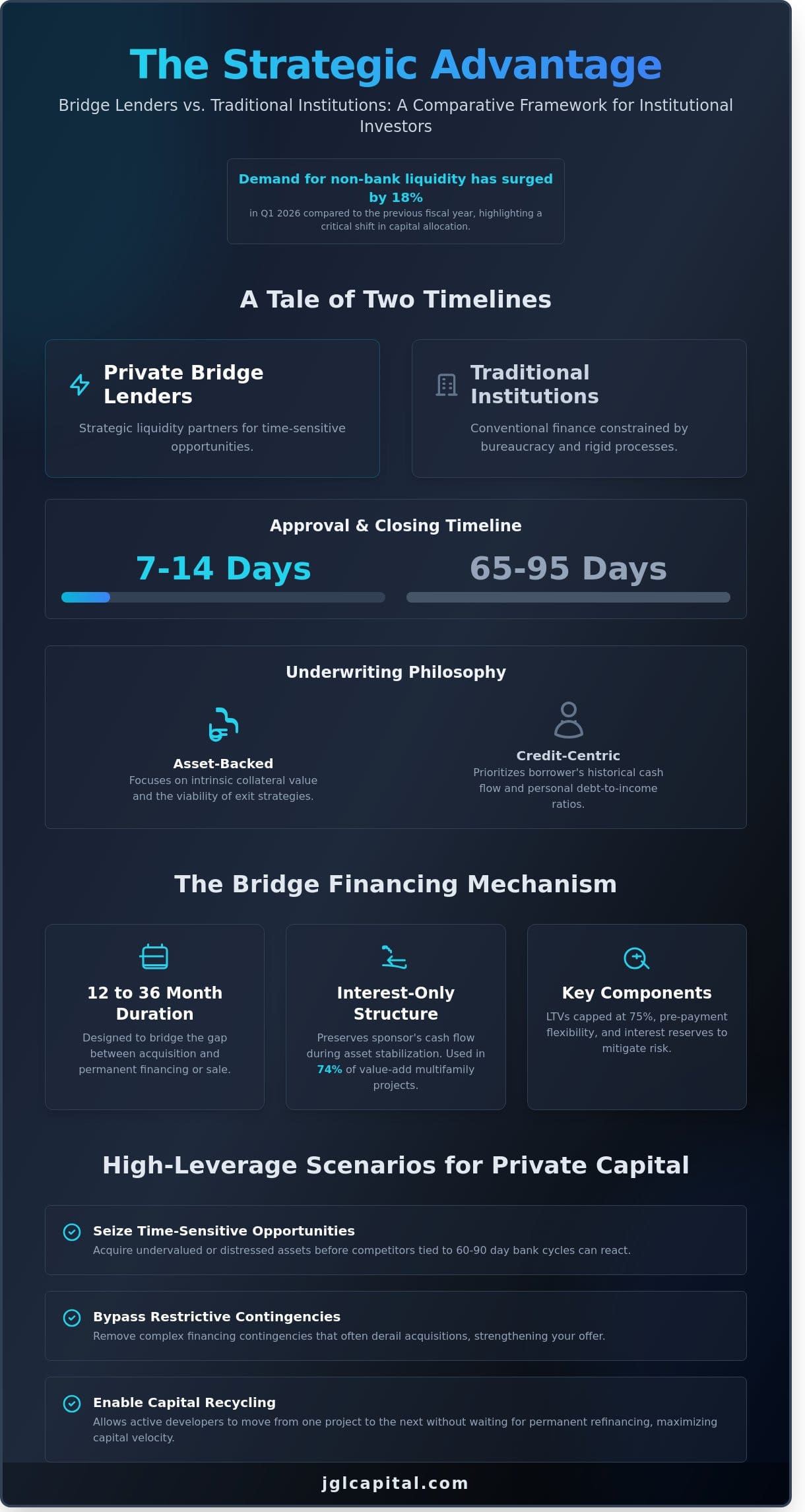
A bridge lender serves as a specialized architect of liquidity, providing the sophisticated capital necessary to navigate complex market inefficiencies. It’s a role that demands analytical rigor and a deep understanding of risk-adjusted returns. In the Q1 2026 financial environment, where the Federal Funds Rate has stabilized at a 4.25% baseline, the demand for non-bank liquidity has surged by 18% compared to the previous fiscal year. This evolution clearly separates professional investment bridge financing from common residential swing loans. While a swing loan addresses a temporary consumer need, institutional bridge capital acts as a precision tool for portfolio optimization. According to a standard bridge loan definition, these instruments provide the temporary capital required to fulfill immediate obligations until permanent financing or an asset sale is finalized. For the institutional sponsor, this speed of execution is the primary currency of the modern transaction.
Understanding the Bridge Financing Mechanism
The structural integrity of a bridge loan rests upon its 12 to 36 month duration and a clearly articulated exit strategy. Most institutional bridge lenders deploy capital through interest-only structures; this preserves the sponsor’s cash flow during the critical asset stabilization phase. This mechanism allows for the seamless coverage of the gap between acquisition and the procurement of permanent debt. It’s a disciplined approach to capital allocation. By the midpoint of 2026, 74% of value-add projects in the multifamily sector utilized this interest-only model to maximize internal rates of return. Key components of these structures include:
- Loan-to-Value (LTV) ratios typically capped at 75% to ensure equity alignment.
- Pre-payment flexibility that allows for early exits without punitive fees.
- Interest reserves that mitigate the risk of debt service shortfalls during renovations.
The Strategic Utility of Short-Term Capital
Speed of execution represents a formidable competitive advantage in high-stakes real estate. When an undervalued or distressed asset enters the market, the ability to close within 10 to 14 business days provides a distinct edge over competitors tethered to 60-day bank cycles. Strategic bridge financing allows investors to bypass the restrictive mortgage contingencies that often derail complex acquisitions. It’s about stewardship and foresight. Active developers utilize these funds for capital recycling, which enables them to move from one project to the next without waiting for the slow machinery of permanent refinancing. This velocity of capital defines a successful partnership. It ensures that equity is never stagnant, but rather consistently deployed toward the highest and best use.
Bridge Lenders vs. Traditional Institutions: A Comparative Framework
Institutional capital allocation requires a rigorous examination of the structural differences between conventional banking and private credit. While traditional lenders prioritize the borrower’s historical cash flow and personal debt-to-income ratios, a bridge lender evaluates the intrinsic value and future potential of the underlying real estate. This distinction is particularly evident in 2024, as institutional banks have increased their closing windows to an average of 65 to 95 days due to heightened regulatory scrutiny. Private debt providers maintain the agility to fund within 7 to 14 days, providing a critical advantage in competitive markets. Comparing bridge loans to traditional financing reveals that the trade-off between interest rates and execution certainty is a core component of sophisticated portfolio optimization. The higher cost of capital is a strategic fee paid for the removal of financing contingencies that would otherwise derail a complex acquisition.
Asset-Backed Underwriting Philosophies
Professional bridge lending operates on a philosophy of collateral strength rather than personal financial history. Lenders focus heavily on the Loan-to-Value (LTV) ratio, often capping at 75% for stabilized assets, and the After-Repair Value (ARV) for value-add projects. This approach reduces the emphasis on individual credit scores, which can be a significant bottleneck in traditional underwriting. When property viability is the primary driver, the lender becomes a strategic partner in the project’s success. Investors seeking a comprehensive understanding of how asset-backed loans compare across real estate capital allocation strategies will find that this collateral-centric philosophy provides a superior framework for deploying institutional-grade capital without the constraints of personal income verification. For investors seeking this level of precision, exploring bespoke capital solutions ensures that opportunity isn’t lost to bureaucratic delay. The alignment of interests is centered on the asset’s ability to generate a risk-adjusted return through a clear 12-month or 24-month exit strategy.
Speed and Certainty of Execution
The administrative hurdles inherent in traditional banking, such as committee-based approvals and exhaustive personal audits, often jeopardize time-sensitive acquisitions. Private money brokers utilize streamlined due diligence processes that focus on title clarity and appraisal accuracy. It’s common for a 50-unit multi-family asset to require a closing within 20 days to satisfy a seller’s requirements in a competitive bid. A traditional bank rarely meets this timeline; however, a bridge lender provides the necessary liquidity to secure the asset. This certainty of execution allows developers to negotiate better purchase prices. Sellers often value the reliability of a quick closing over a slightly higher offer that may fail during a 60-day bank appraisal period. By removing the friction of institutional bureaucracy, private capital serves as a catalyst for rapid portfolio growth.
The Mechanics of Asset-Based Risk Assessment
Bridge lenders prioritize the underlying collateral’s intrinsic value over the borrower’s static balance sheet. This disciplined capital allocation requires a rigorous analysis of the property’s lifecycle. In 2026, where cap rates have stabilized after the volatility of the early 2020s, a bridge lender must exercise heightened strategic oversight. They ensure that every dollar deployed is secured by tangible, recoverable value. This methodology mirrors institutional liquidity facilities, such as The Federal Reserve’s Main Street Lending Program, which utilized similar structural safeguards to maintain economic stability during periods of market dislocation. By focusing on the asset’s terminal value, the firm protects its partners from the erosive effects of speculative market shifts.
Evaluating the Exit Strategy
A bridge lender’s primary concern isn’t the commencement of the loan, but its conclusion. A viable exit strategy serves as the cornerstone of the underwriting process; it necessitates a clear, documented path to either asset disposition or permanent financing. Most institutional borrowers target a transition into long-term rental property loans once the asset achieves stabilized occupancy. Underwriters assess market liquidity for specific asset classes, such as multi-family or industrial flex space, by examining 24-month absorption rates and current debt-yield requirements from life insurance companies. Without a secondary source of repayment, the capital remains at risk. It’s the lender’s duty to verify that the proposed exit is realistic within the 12 to 36-month term provided.
Property-Specific Underwriting Criteria
Operational due diligence in 2026 demands a granular review of property-level performance metrics. Analysts scrutinize current cash flow potential alongside projected Debt Service Coverage Ratios (DSCR), often requiring a minimum 1.25x coverage on the take-out loan. Property condition reports and environmental assessments are non-negotiable components of the risk-mitigation framework. These technical audits prevent capital erosion caused by unforeseen deferred maintenance or structural deficiencies. After-Repair Value represents the projected market valuation of a property following the completion of a defined renovation or stabilization program, serving as the definitive benchmark for loan-to-value calculations. This metric allows the bridge lender to quantify the equity cushion available at the point of maximum exposure. Through this analytical rigor, the firm ensures that the capital stack remains optimized throughout the entire investment horizon.
Strategic Scenarios for Engaging a Private Bridge Lender
Identifying the precise moment to deploy short-term capital requires a sophisticated understanding of asset lifecycles and prevailing market volatility. Institutional investors often engage a bridge lender when the agility of execution dictates the success of a high-stakes acquisition, prioritizing speed over the long-term interest rates associated with conventional debt. During the Q3 2024 fiscal cycle, approximately 38% of middle-market real estate transactions utilized private debt to bypass the protracted underwriting timelines typical of traditional banking institutions. For sophisticated practitioners seeking to optimize their approach to these complex market dynamics, understanding comprehensive real estate investing strategies and insights for 2026 provides the analytical framework necessary to navigate evolving capital allocation opportunities.
Bridging the Gap in New Construction
Capital allocation during the pre-development phase represents a significant hurdle for even the most seasoned developers, as they often face an 8 to 14-month window where land must be secured and site preparation finalized before permanent financing structures become viable. A bridge lender provides the liquidity necessary for environmental remediation and entitlement processes, ensuring that the developer doesn’t lose control of a site during bureaucratic delays. This strategic runway effectively links the initial land acquisition to more permanent new construction loans, allowing for a seamless transition into the primary build phase once all permits are secured.
Commercial and Portfolio Transitions
Transitioning underperforming assets into stabilized, income-generating properties demands a disciplined capital stack that accounts for temporary fluctuations in cash flow. In the current 2024 investment climate, value-add strategies in the multi-family sector frequently target a 12% to 18% increase in net operating income through targeted capital improvements and operational efficiencies. Specialized bridge loan lenders facilitate these transitions by providing non-recourse debt that recognizes the future appraised value of the asset rather than its current distressed state. This approach is essential for several strategic objectives:
- Securing off-market deals that require a 10-day closing window to outperform competing institutional bids.
- Funding tenant improvements and leasing commissions in commercial office repositioning projects where vacancy rates are temporarily high.
- Stabilizing debt-service coverage ratios to meet the stringent requirements of long-term agency financing or life company debt.
Fix-and-flip investors operating in competitive urban markets also rely on this capital to maintain a decisive edge during the acquisition phase. When a sponsor identifies a distressed asset in a high-velocity market, the capacity to present a non-contingent, cash-equivalent offer frequently results in a purchase price discount ranging from 5% to 10%. By leveraging the specialized expertise of a private lender, these investors can execute rapid renovations and exit the position within a 6-month timeframe, significantly enhancing their internal rate of return through the efficient use of leverage. Sophisticated market participants increasingly rely on real estate bridge loans as a primary instrument for transitional capital optimization, ensuring that time-sensitive acquisitions of distressed multi-family assets aren’t lost to more nimble competitors who possess immediate liquidity. Complementing this capital strategy with access to curated peer networks through real estate investment clubs provides institutional sponsors with a powerful channel for sourcing off-market deal flow and identifying co-investment partners before opportunities reach the broader market.
Selecting a Bridge Lending Partner for Portfolio Stewardship
Selecting a bridge lender requires a rigorous evaluation that extends far beyond the immediate terms of a preliminary sheet. Investors must scrutinize a firm’s historical performance across multiple economic cycles, specifically looking for a track record that spans at least 30 years. This longevity demonstrates a capacity to maintain liquidity during periods of severe market volatility, such as the 2008 financial crisis or the rapid interest rate adjustments seen throughout 2023 and 2024. A disciplined partner provides more than just capital; they offer a sophisticated understanding of diverse asset classes ranging from multi-family developments to complex industrial re-positioning projects. It’s about finding a firm that values analytical rigor over aggressive expansion.
Assessing Track Record and Stewardship
Reliability in funding is the most critical metric for any institutional borrower. You should inquire about a lender’s primary capital sources to ensure that commitments aren’t subject to the whims of secondary market fluctuations or sudden warehouse line pullbacks. Transparency remains the cornerstone of this professional relationship. A reputable firm articulates fee structures and closing points with absolute clarity, typically ranging from 1% to 3% depending on specific risk profiles, without burying costs in opaque administrative charges. This level of honesty transforms the lender from a mere transactional vendor into a dedicated steward of the investor’s portfolio. Consider these key questions during due diligence:
- How did the firm manage its portfolio during the 2020 liquidity crunch?
- What percentage of their current bridge loans are funded through internal discretionary capital?
- Can they provide case studies of successful exits in asset classes similar to your own?
The Path to Capital Optimization
JGL Capital prioritizes the alignment of interests to facilitate long-term wealth preservation. We don’t view financing as a one-off event. It’s a collaborative effort to optimize the entire capital stack. Our bespoke solutions are tailored to the specific cash flow requirements of each asset, ensuring that the debt service coverage ratio remains healthy throughout the transitional phase. This disciplined approach prevents the over-leveraging that often leads to capital erosion in high-interest environments.
For principals and institutional partners seeking a sophisticated bridge lender to navigate current market complexities, the next step involves a comprehensive portfolio review. We focus on building lasting legacies through careful, deliberate action rather than speculative trends. Engaging in a strategic dialogue today secures the foundation for a future of disciplined growth and capital efficiency. Our team stands ready to provide the strategic oversight necessary to turn complex real estate challenges into stabilized, high-performing assets.
Navigating Market Volatility with Precision and Strategic Oversight
Real estate capital optimization requires a departure from rigid, institutional lending models in favor of agile, asset-focused strategies. By prioritizing the intrinsic value of the underlying asset over traditional credit metrics, a sophisticated bridge lender facilitates rapid execution and preserves project momentum during critical transition periods. As traditional banking institutions retreat from complex real estate transactions, sophisticated investors increasingly turn to strategic capital funding for real estate to maintain their competitive edge in an evolving market landscape. JGL Capital brings over 30 years of industry expertise to every transaction; this ensures that capital allocation remains disciplined and aligned with the overarching objectives of long-term wealth preservation. We don’t view these arrangements as mere transactions; they’re foundational components of a broader investment philosophy centered on asset-backed security. Our strategic partnership model treats every allocation as a commitment to portfolio stewardship. This methodology provides the necessary liquidity to navigate complex market cycles while maintaining a rigorous focus on risk-adjusted returns. It’s through this analytical lens that we help our partners secure their financial legacies and build lasting value. Investors seeking a comprehensive understanding of bridge financing as a transitional real estate capital strategy will find that this disciplined approach to short-term liquidity management is essential for maintaining portfolio momentum across market cycles. We invite you to consult with JGL Capital for bespoke bridge financing solutions that align with your vision for growth. Your portfolio deserves a partner committed to excellence.
Frequently Asked Questions
What is the primary difference between a bridge lender and a traditional bank?
The primary distinction lies in the underwriting focus; a bridge lender prioritizes the underlying asset’s collateral value while traditional banks emphasize the borrower’s historical cash flow and global debt service. Traditional institutions typically require 60 to 90 days for approval processes. A bridge lender executes the same transaction within 10 to 14 business days. This agility allows investors to capture time-sensitive opportunities that traditional regulatory frameworks don’t support.
How long does it typically take a bridge lender to fund a transaction?
A bridge lender typically funds a transaction within 7 to 14 business days from the execution of the term sheet. This expedited timeline stems from a streamlined due diligence process that focuses on the property’s current and stabilized valuation. While a conventional commercial mortgage might linger in committee for 45 days, the bridge model utilizes private capital to ensure a closing occurs before the expiration of a purchase contract’s feasibility period.
What are the standard interest rates and fees for a bridge loan in 2026?
In the 2026 fiscal year, standard interest rates for bridge financing fluctuate between 8.75% and 11.5% based on the risk profile of the asset. Origination fees generally range from 100 to 250 basis points of the total loan facility. These costs reflect the premium for liquidity and the lender’s assumption of short-term market volatility. Most facilities utilize the Secured Overnight Financing Rate (SOFR) as a benchmark plus a spread of 400 to 600 points.
Can a bridge lender help with new construction projects?
Bridge lenders frequently support new construction by providing the necessary capital to reach the vertical development phase or to cover cost overruns. These loans often cover up to 75% of the total project cost, allowing developers to break ground while permanent financing is finalized. By utilizing a bridge lender, a developer can secure the site and begin site work 4 months faster than if they waited for a traditional construction loan.
What is an exit strategy and why is it critical for a bridge loan?
An exit strategy is the pre-defined mechanism for debt retirement, typically involving a property sale or a transition to long-term permanent financing. It’s the most critical component of the underwriting process because it demonstrates how the bridge facility will be extinguished within the 12 to 36-month term. Lenders require a 1.25x Debt Service Coverage Ratio on the projected permanent loan to ensure the exit is mathematically viable.
Do bridge lenders require a high credit score for approval?
Bridge lenders don’t mandate the 740+ FICO scores required by institutional banks, focusing instead on the borrower’s experience and the asset’s equity cushion. A credit score of 660 is often sufficient if the project maintains a 65% Loan-to-Value ratio. The emphasis remains on the sponsor’s track record of completing at least 3 similar projects rather than their personal credit utilization or minor historical setbacks. Professionals seeking a deeper analysis of how asset-backed loans eliminate the constraints of personal credit verification will find that this collateral-first methodology is increasingly central to institutional-grade capital deployment in 2026.
Is it possible to use a bridge loan for a multi-family property acquisition?
Acquiring a multi-family property with a bridge lender is a standard strategy for value-add investors seeking to renovate units and increase Net Operating Income. This capital structure allows for an 80% Loan-to-Cost ratio on a 100-unit complex, providing the funds for both the acquisition and the capital expenditure budget. Once the occupancy reaches 90%, the borrower can transition to an agency loan through Fannie Mae or Freddie Mac.
What happens if the property does not sell or refinance before the bridge loan expires?
If a property fails to sell or refinance before the maturity date, the borrower typically faces a default or must negotiate a formal extension. Most bridge contracts include a 6-month extension option for a fee equal to 1% of the principal balance. If no extension is available, the lender may initiate foreclosure proceedings within 30 days to protect their capital allocation and recover the outstanding debt.