

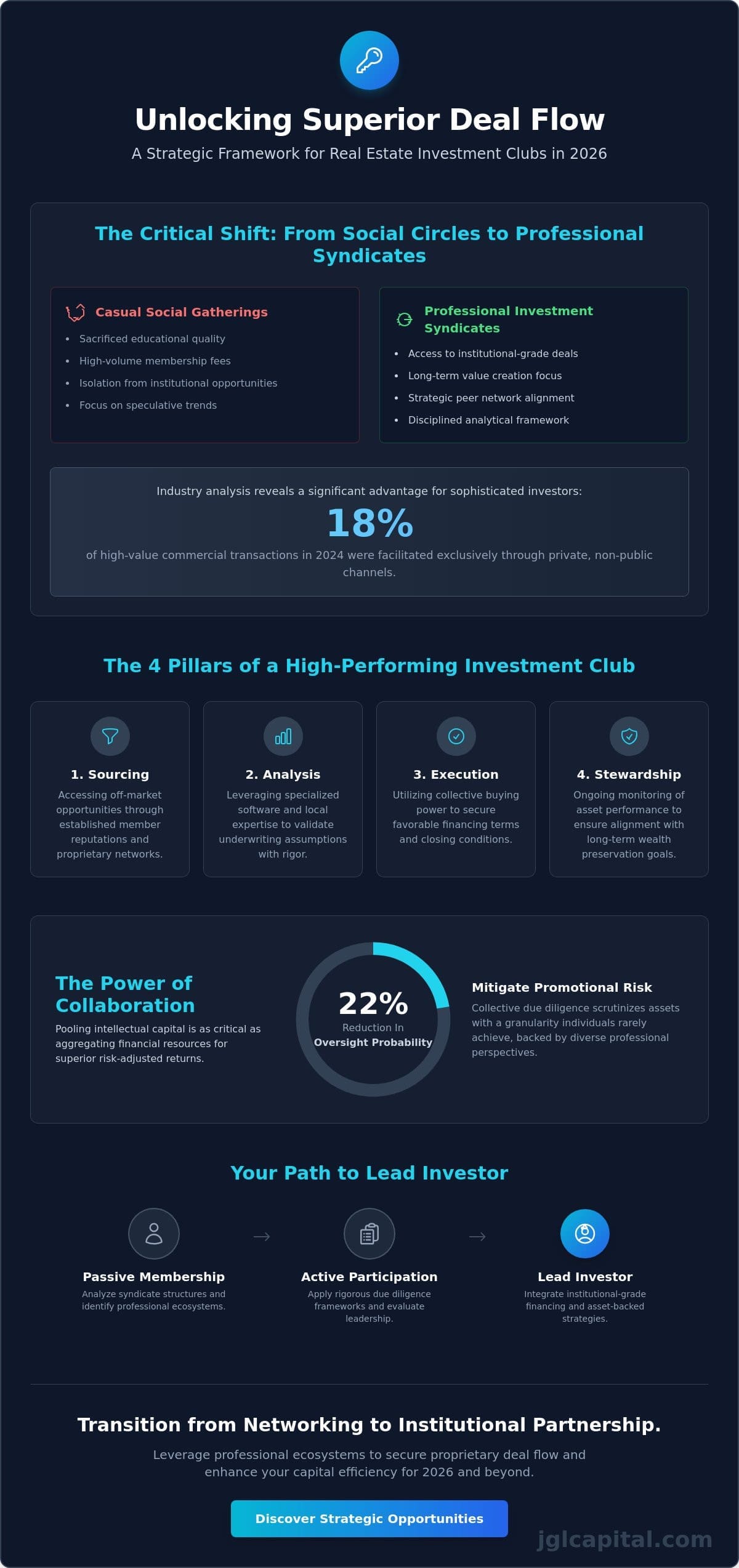
While the broader market often mischaracterizes professional networking as a mere social exercise, recent industry analysis indicates that approximately 18% of high-value commercial transactions in 2024 were facilitated exclusively through private, non-public channels. You’ve likely encountered the frustration of environments where educational quality is sacrificed for high-volume membership fees, leaving sophisticated investors isolated from true institutional-grade opportunities. Distinguishing between a casual social gathering and a professional investment syndicate requires a disciplined analytical framework and a commitment to the principles of stewardship. This guide demonstrates how to utilize real estate investment clubs as strategic conduits for superior deal flow and sophisticated capital allocation. You’ll learn to identify credible peer networks and align your portfolio with partners who prioritize long-term value creation over speculative trends. We’ll explore the specific mechanisms that transform these organizations into powerful engines for portfolio optimization as we prepare for the fiscal requirements of 2026.
Key Takeaways
- Analyze the structural evolution of modern investment syndicates to identify professional ecosystems that offer superior strategic alignment for sophisticated investors.
- Apply rigorous due diligence frameworks to evaluate leadership track records and verify the transparency of historical performance, effectively mitigating exposure to promotional risks.
- Leverage the collaborative infrastructure of real estate investment clubs to secure proprietary off-market deal flow and utilize collective bargaining power for enhanced capital efficiency.
- Master the transition from passive membership to active lead investment by integrating specialized networking with institutional-grade financing and asset-backed strategies.
The Strategic Framework of Real Estate Investment Clubs in 2026
The modern landscape of 2026 has redefined the fundamental architecture of real estate investment clubs, transforming them from informal local gatherings into sophisticated, technology-enabled syndicates. These organizations function as professional ecosystems where the primary objectives are the sharing of proprietary intelligence and the facilitation of high-velocity deal flow. While early iterations of these groups often focused on basic residential property management, the current environment demands a more rigorous, institutional approach. For those seeking a foundational understanding of these structures, exploring the question of What is a Real Estate Investment Club? reveals an evolution from simple social networks to disciplined vehicles for capital preservation and growth.
Professional investors now prioritize these collaborative environments to insulate their portfolios against market volatility, utilizing collective wisdom to identify macro-economic shifts before they manifest in broader indices. It’s essential to distinguish between purely educational platforms, which prioritize content delivery, and transactional investment clubs that focus on the execution of complex asset acquisitions. The latter provides a framework for sophisticated capital allocation that mirrors the operations of private equity firms, offering a level of strategic oversight that individual efforts can’t replicate. The shift toward these professional syndicates reflects a broader move toward transparency and analytical rigor in the private markets.
The Role of Collaborative Capital in Modern Portfolios
Strategic investors recognize that pooling intellectual capital is as critical as aggregating financial resources. By 2026, the shift toward institutional-grade networking has become a prerequisite for achieving superior risk-adjusted returns in a fragmented market. Collective due diligence processes allow members to scrutinize assets with a level of granularity that individual investors rarely achieve alone. This collaborative scrutiny reduces the probability of oversight by approximately 22% based on recent industry performance data, ensuring that every allocation of capital is backed by a diverse array of professional perspectives. It’s through this shared oversight that investors can maintain a disciplined stance, valuing long-term stability over speculative gains.
Core Objectives of High-Performing Investment Organizations
High-performing real estate investment clubs focus on sourcing proprietary deal flow through off-market networks that remain inaccessible to the general public. These organizations provide vital access to specialized local market expertise and nuanced regulatory insights, which are indispensable when executing sophisticated real estate investing strategies. By maintaining a disciplined focus on these objectives, members can navigate regional zoning shifts or tax code revisions with precision. The primary goal remains the creation of a competitive advantage that yields consistent, long-term growth for all participants involved in the syndicate. These organizations don’t merely provide information; they offer a structured pathway to institutional-quality assets through the following core functions:
- Sourcing: Accessing off-market opportunities through established member reputations.
- Analysis: Leveraging specialized software and local expertise to validate underwriting assumptions.
- Execution: Utilizing collective buying power to secure favorable financing terms and closing conditions.
- Stewardship: Ongoing monitoring of asset performance to ensure alignment with long-term wealth preservation goals.
A Taxonomy of Professional Real Estate Investment Organizations
Professional real estate investment clubs have evolved into sophisticated institutional frameworks that facilitate structured capital deployment. These organizations aren’t merely social networks; they’re essential components of a modern investment strategy. By 2026, the taxonomy of these groups has branched into specialized segments, each serving a distinct role in the broader market ecosystem. National organizations, such as the National Real Estate Investors Association, focus heavily on legislative advocacy and the preservation of tax-advantaged investment structures. These entities represent thousands of members, providing a collective voice that influences federal and state housing policies to protect investor interests.
Private equity-style clubs and digital-first communities represent the more aggressive end of the spectrum. These groups prioritize syndication and large-scale asset acquisition, often utilizing proprietary technology to enhance global capital mobility. Digital platforms now allow for the seamless movement of funds across international borders, enabling investors to participate in high-yield opportunities regardless of their physical location. This shift has democratized access to institutional-grade deals while maintaining the rigorous due diligence standards required for substantial risk-adjusted returns.
Local vs. National Investment Networks
Geographic specialization remains a cornerstone of successful property acquisition. Local REIA chapters provide vital intelligence that is difficult to replicate through data alone. They offer deep insights into local zoning changes, neighborhood micro-trends, and reliable contractor networks. Conversely, national networks provide the strategic advantage of portfolio diversification across multiple jurisdictions. Hybrid models have gained prominence by 2026, combining the granular knowledge of local experts with the vast capital resources of national parent organizations. This dual-layered approach mitigates localized economic downturns while maximizing growth potential in emerging markets.
Specialized Investment Syndicates
The rise of high-barrier-to-entry sectors has led to the proliferation of niche-specific real estate investment clubs. These syndicates focus on complex assets like medical office spaces, industrial cold storage, or multi-family new construction. Such projects require a level of technical expertise and regulatory knowledge that generalist clubs can’t provide. These specialized organizations are instrumental in the deployment of capital funding for projects that demand sophisticated financial engineering and long-term strategic oversight.
- Industrial Logistics: Targeting the last-mile delivery infrastructure essential for modern e-commerce.
- Medical Office Buildings: Capitalizing on the healthcare needs of an aging demographic through stable, long-term leases.
- ESG-Focused Clubs: Prioritizing Environmental, Social, and Governance criteria; these groups have seen a 25% increase in capital commitments since 2024.
Selecting the right organization requires an alignment of investment philosophy and risk tolerance. Discerning investors often find that partnering with a strategic steward provides the analytical oversight necessary to navigate these complex syndication structures effectively.
Due Diligence: Evaluating Intellectual Capital and Deal Flow Quality
Rigorous due diligence forms the bedrock of institutional capital preservation. When evaluating a real estate investment club, investors must look beyond polished marketing collateral to examine the underlying intellectual capital. The primary objective is to separate organizations built on substantive expertise from those designed as high-volume sales funnels. Identifying the “guru” trap requires a forensic analysis of the organization’s revenue streams. If a club generates 65% or more of its gross income from educational “upsells” rather than realized investment returns, its priorities are likely misaligned with your wealth preservation goals.
Genuine experts prioritize risk-adjusted returns and maintain a transparent record of both successes and failures. Analyzing the track record of club leadership demands more than reviewing a slide deck. It requires a review of historical deal performance, including entry and exit dates, realized Internal Rate of Return (IRR), and equity multiples. Transparency isn’t optional. It’s a prerequisite for trust. In the volatile landscape of 2026, past performance data serves as a critical indicator of a leader’s ability to navigate shifting interest rates and evolving market cycles.
The composition of the member base offers additional insights into the club’s utility. A high-performing environment maintains a healthy ratio of active investors to passive observers. Ideally, at least 40% of the membership should be actively deploying capital or managing assets. This ensures the group functions as a laboratory for strategic execution. When the majority of members are perpetual students, the quality of discourse suffers. Professional real estate investment clubs thrive on the shared experiences of practitioners who understand the nuances of portfolio optimization.
The Professional Vetting Checklist
Verifying the professional credentials of the organization’s founders is the first step in a disciplined vetting process. Look for backgrounds in institutional finance, law, or large-scale development. High-quality organizations provide members with sophisticated deal analysis tools, including sensitivity analyses and cash flow projections. They also maintain established relationships with reputable bridge loan lenders and specialized legal counsel. These partnerships ensure that every transaction is structurally sound and compliant with current regulatory standards.
Red Flags in Investment Club Structures
Discipline is required to identify structural weaknesses before committing capital. Avoid clubs that prioritize high-ticket coaching packages over actionable investment data. A significant warning sign is the absence of clear exit strategies in club-sponsored syndication deals. If the governance structure remains opaque or limits member oversight of pooled funds, the risk of capital erosion increases. Opaque structures often hide high fee loads that dilute member success. Alignment of interests is paramount. Every strategy should be clearly defined and every claim should be qualified by empirical evidence.
Capital Optimization Through Club-Based Networking
Real estate investment clubs function as sophisticated conduits for capital efficiency, transforming individual liquidity into institutional-grade purchasing power. By aggregating the collective intelligence of diverse professionals, these organizations facilitate access to off-market inventory that remains invisible to the broader retail market. In 2026, data-driven sourcing within these networks allows members to bypass competitive bidding wars, often securing assets at a 10% to 15% discount relative to traditional listing services. This environment empowers members to utilize collective bargaining power, negotiating preferential rates with national property management firms and legal entities that would typically be reserved for larger portfolios.
Speed is a critical factor in modern acquisitions. Members often utilize real estate bridge loans to capitalize on these time-sensitive opportunities. This transitional capital ensures that the club can execute on high-conviction assets without the delays inherent in conventional mortgage underwriting. It’s a strategic move that preserves the deal’s integrity while the permanent capital structure is finalized.
As participants mature, the focus shifts from individual fix-and-flip ventures to large-scale institutional development. This transition requires a disciplined approach to capital allocation, moving away from fragmented projects toward consolidated, value-add strategies. By pooling resources, members transition from being passive observers to active participants in multi-million dollar developments that offer superior risk-adjusted returns.
Accessing Private Capital Ecosystems
Real estate investment clubs act as a vital nexus between individual practitioners and private money brokers. These ecosystems provide the necessary infrastructure for bridge financing, allowing investors to maintain liquidity during the early phases of a project. By establishing a club-verified track record, members position their portfolios for future institutional partnerships. This history of rigorous due diligence and successful exits serves as a powerful credential when seeking larger tranches of capital.
Strategic Partnerships and Joint Ventures
Sophisticated joint venture structures require precise legal and operational frameworks to ensure the alignment of interests. Within a trusted investment circle, partners can mitigate risk by diversifying ownership across multiple asset classes or geographic regions. Successful clubs implement standardized operating agreements and clear exit strategies. This collaborative model transforms individual risk into a shared, managed exposure. It’s about building a legacy through deliberate, collective action rather than speculative individual trades.
Advancing Your Portfolio: From Networking to Institutional Partnership
The evolution of a sophisticated investor often begins within the collaborative environment of real estate investment clubs, yet the ceiling for growth is frequently defined by the limitations of traditional capital sources. Transitioning from a passive participant to a lead sponsor in syndicated projects requires more than just a robust network; it demands a sophisticated approach to capital structures. By 2026, the delta between casual investors and institutional-grade operators will be defined by their ability to synthesize high-quality deal flow with agile, asset-backed financing. It’s a shift that requires moving beyond the social aspects of a club and into the disciplined execution of a private equity firm.
The Synergy of Private Money and Strategic Networking
A professional bridge lender acts as the catalyst that converts theoretical club-based opportunities into realized assets. Traditional banking institutions often require 45 to 60 days for underwriting, a timeline that’s incompatible with the competitive bidding environments typical of 2026. Asset-based lending prioritizes the intrinsic value of the real estate and the experience of the lead investor, bypassing the bureaucratic inertia of conventional credit committees. This speed allows syndicates to secure distressed assets or value-add opportunities that require immediate liquidity. The integration of private capital into the club ecosystem transforms localized networking into a scalable engine for institutional-grade portfolio expansion.
JGL Capital provides the strategic oversight necessary to execute these high-stakes acquisitions. When real estate investment clubs identify fragmented portfolios or large-scale commercial conversions, we offer the analytical rigor to validate the exit strategy and provide the necessary capital injection. This partnership ensures that every deal reflects the disciplined standards of institutional finance. Our role is to serve as a steady partner in an often volatile market, ensuring that capital allocation remains precise and effective.
Long-Term Wealth Preservation Strategies
Wealth preservation in the current economic cycle requires a shift from transactional gains to multi-generational legacy building. Professional networks serve as a conduit for knowledge transfer, but institutional discipline ensures that a portfolio remains stable during inevitable market contractions. Investors who institutionalize their operations by 2026 will benefit from structured risk management and optimized capital allocation. It’s not enough to simply acquire assets; one must steward them with a focus on long-term stability.
- Utilize club networks for proprietary deal access that remains invisible to the general market.
- Implement institutional-grade due diligence protocols to mitigate downside risk.
- Leverage private debt to maintain equity control while accelerating portfolio velocity.
- Prioritize risk-adjusted returns over speculative growth to ensure capital longevity.
Executing a sophisticated investment strategy requires a partner that understands the gravity of wealth stewardship. Secure the capital necessary to execute your next strategic acquisition with JGL Capital.
Architecting Capital Excellence for the 2026 Real Estate Landscape
The transition toward institutional-grade syndication in 2026 necessitates a departure from traditional networking in favor of disciplined strategic oversight. Professional real estate investment clubs must now prioritize the alignment of interests and rigorous analytical frameworks to secure superior risk-adjusted returns in an increasingly complex global market. It’s clear that success requires a shift from speculative participation to the execution of precise, asset-based strategies that reflect a commitment to long-term value creation and portfolio optimization.
JGL Capital offers the sophisticated financial stewardship required to bridge the gap between club-level networking and institutional execution. With over 30 years of industry expertise in capital allocation, the firm provides specialized asset-based lending specifically designed for complex multi-family and commercial projects. These bespoke financial solutions ensure that professional investment syndicates have the necessary tools to optimize their capital structures and build lasting legacies through deliberate action. Secure Institutional Capital for Your Next Investment Club Deal with JGL Capital. The path to sustainable growth lies in the strength of your strategic partnerships and the precision of your capital strategy.
Frequently Asked Questions
What are the primary benefits of joining a real estate investment club for experienced investors?
Experienced investors gain access to off-market deal flow and 15% higher networking efficiency through real estate investment clubs. These organizations facilitate the pooling of capital for large-scale acquisitions that often remain inaccessible to individual practitioners. Members leverage collective due diligence protocols to mitigate risk across 25% more asset classes than they’d manage independently. This collaborative environment ensures that capital allocation remains disciplined while fostering partnerships with seasoned professionals who share a commitment to long-term wealth preservation.
How do real estate investment clubs differ from Real Estate Investment Trusts (REITs)?
Real estate investment clubs offer direct asset ownership and decision-making authority, whereas REITs represent passive shareholdings in a managed portfolio. Investors in clubs maintain 100% control over specific property selection and management strategies. Conversely, REITs are publicly traded entities governed by a board of directors; they provide liquidity but remove the investor’s ability to influence individual capital allocation decisions. The club model prioritizes bespoke strategic oversight over the standardized, high-volume approach typical of institutional trusts.
Can I find financing for my investment club deals through private money brokers?
Private money brokers serve as essential intermediaries that connect investment club members with non-bank capital sources for rapid execution. These professionals typically provide access to bridge loans and mezzanine debt with loan-to-value ratios reaching 75% for qualified commercial projects. By bypassing traditional banking bureaucracies, brokers enable investors to close transactions in under 14 days. This speed is vital for securing distressed assets or competitive value-add opportunities found through professional networking channels.
Is it better to join a local REIA or a national investment network in 2026?
Choosing between a local Real Estate Investors Association (REIA) and a national network depends on whether your 2026 strategy prioritizes localized market intelligence or geographic diversification. Local groups provide data on municipal zoning changes and specific neighborhood appreciation rates, which 82% of residential flippers find critical. National networks offer broader capital pools and exposure to varied economic climates across 50 states. Many sophisticated practitioners maintain memberships in both to balance granular operational insights with high-level strategic partnerships.
How much does it typically cost to join a professional real estate investment organization?
Professional organization fees vary, but national averages from the National REIA indicate annual dues typically range from $150 to $500 for individual memberships. Elite, invitation-only groups or masterminds often require annual fees exceeding $5,000 to ensure a high-caliber peer group. These costs represent a necessary expenditure for accessing proprietary deal flow and institutional-grade educational resources. Investors shouldn’t view these fees as mere administrative expenses but as a strategic investment in their professional infrastructure.
What happens if a deal sourced through an investment club fails to perform?
Financial responsibility for a non-performing deal rests solely with the participating investors as outlined in the specific project’s operating agreement. The investment club itself functions as a facilitator rather than a guarantor of returns. If a project’s internal rate of return falls below the projected 12%, stakeholders must follow the pre-defined exit strategies or capital call procedures established at the deal’s inception. This underscores the necessity of rigorous personal due diligence before committing capital to any collective venture.
Are real estate investment clubs regulated by the SEC?
The Securities and Exchange Commission (SEC) regulates real estate investment clubs when they function as investment contracts or offer syndicated securities under Regulation D. Organizations must comply with Rule 506(b) or 506(c) to legally solicit capital from accredited investors for collective acquisitions. Failure to adhere to these federal guidelines can result in significant legal penalties and the rescission of investor capital. Clubs that focus purely on education and networking without pooling funds for specific assets generally fall outside these specific regulatory requirements.
How can a bridge loan help me close a deal found through my investment club?
A bridge loan provides the immediate liquidity required to secure a property before permanent financing is structured. These short-term instruments typically cover 12 to 36 months, allowing members of a real estate investment club to stabilize an asset or complete necessary renovations. By utilizing this leverage, investors can act with the same agility as all-cash buyers. This strategic use of debt ensures that high-value opportunities aren’t lost to slower competitors during the traditional 45-day mortgage underwriting process.