

The 12% contraction in private construction lending during the third quarter of 2025 proved that a lender’s balance sheet strength is ultimately secondary to their commitment to the partnership when market conditions shift. For the institutional-grade investor managing a diverse portfolio, the search for the best fix and flip lenders must move beyond superficial interest rates to focus on the structural reliability of the capital stack. You recognize that unexpected capital calls or opaque draw schedules don’t just delay construction; they actively erode the internal rate of return on your most promising assets. This reality requires a disciplined approach to capital allocation that prioritizes stability and transparency over the lowest-cost provider.
This strategic evaluation provides a rigorous framework for identifying capital partners who prioritize analytical rigor and property-specific value over restrictive, bureaucratic underwriting. You’ll discover the top-tier criteria required to ensure your financing remains a stable foundation for growth rather than a source of operational friction. We’ll examine the specific methodologies used to evaluate asset-based liquidity, providing you with the insights needed to select a partner that facilitates the rapid scaling of multiple concurrent projects through bespoke financial solutions.
Key Takeaways
- Analyze the 2026 transition from speculative flipping toward institutional-grade redevelopment and the resulting impact on asset-backed lending strategies.
- Master the critical KPIs required to evaluate capital partners, focusing on the sophisticated interplay between leverage thresholds and property-centric underwriting models.
- Identify the best fix and flip lenders by discerning the strategic advantages of specialized brokerage versus the limitations of direct institutional lending in a fragmented market.
- Review a high-margin multi-family case study to understand how rigorous asset-based due diligence can optimize capital allocation for complex projects.
- Discover the benefits of bespoke financing solutions that prioritize the intrinsic value of the real estate asset over the constraints of traditional credit-score rigidity.
The Evolution of the Fix and Flip Lending Landscape in 2026
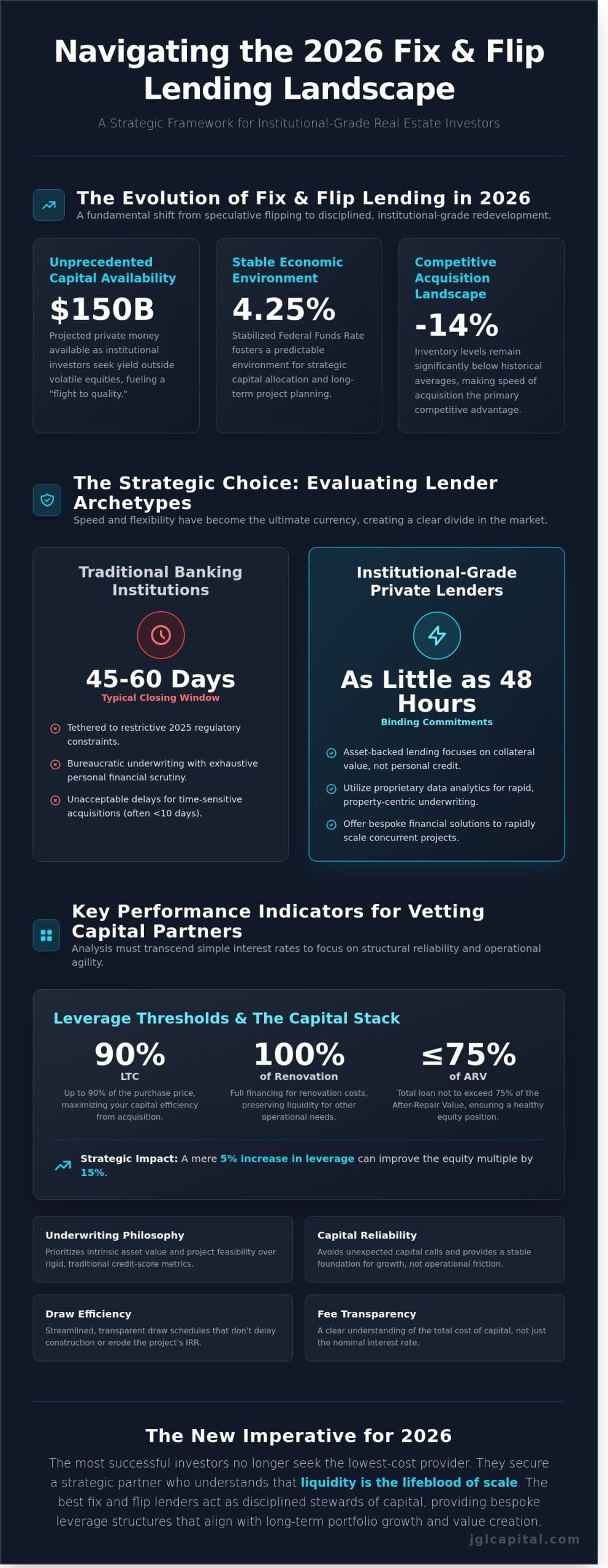
The 2026 real estate environment marks a definitive transition from the fragmented, speculative nature of early-decade property flipping toward a sophisticated model of institutional-grade redevelopment. As of the first quarter of 2026, the stabilization of the Federal Funds Rate at 4.25% has fostered a predictable environment for strategic capital allocation. Identifying the best fix and flip lenders now requires an assessment of their ability to facilitate large-scale portfolio optimization rather than merely funding isolated residential transactions. This shift reflects a broader maturation of the market where disciplined redevelopment has replaced high-volume, low-margin speculation.
Market Dynamics and Capital Allocation
By mid-2026, private money availability has reached a projected $150 billion as institutional investors seek yield outside of volatile equities. Lenders have initiated a rigorous flight to quality, prioritizing developers who maintain a verified track record of at least 15 successful exits within the previous 36 months. This preference isn’t merely a trend; it’s a structural requirement for risk mitigation. Traditional banking institutions continue to underserve this sector because they remain tethered to 2025 regulatory constraints that mandate 45-day to 60-day closing windows. These delays are unacceptable for developers targeting value-add residential projects where the window for acquisition is often less than 10 days.
Why Speed is the Ultimate Currency
In a competitive landscape where inventory levels remain 14% below historical averages, the opportunity cost of delayed funding is the primary threat to a developer’s internal rate of return. Institutional-grade lenders have responded by integrating proprietary data analytics into their underwriting, allowing them to provide binding commitments in as little as 48 hours. Asset-backed lending serves as the primary mechanism for rapid capital deployment in 2026. This streamlined approach bypasses the exhaustive personal financial scrutiny that characterizes conventional mortgages, focusing instead on the intrinsic value of the collateral and the feasibility of the renovation budget.
For the sophisticated investor, the best fix and flip lenders are those who act as strategic stewards of capital. They prioritize capital preservation through rigorous project vetting and offer bespoke leverage structures that align with long-term portfolio growth. It’s no longer about finding the lowest interest rate; it’s about securing a partner who understands that liquidity is the lifeblood of scale. This partnership model ensures that capital remains both accessible and disciplined, providing a foundation for building lasting legacies through careful, deliberate redevelopment.
Key Performance Indicators for Evaluating Fix and Flip Capital Partners
The selection of the best fix and flip lenders requires a granular analysis of capital structures that transcend simple interest rate comparisons. Sophisticated investors prioritize the total cost of capital and the operational agility of the funding partner over nominal pricing. This strategic evaluation centers on five primary metrics: leverage thresholds, underwriting philosophy, capital reliability, draw efficiency, and fee transparency. Each factor contributes to the preservation of project margins and the mitigation of liquidity risks. For institutional investors seeking a comprehensive framework to navigate these complexities, the institutional investor’s checklist for evaluating fix and flip lenders provides essential metrics for assessing capital partner stability and operational transparency.
Leverage and the Capital Stack
Maximizing cash-on-cash returns necessitates a leverage model that balances risk with growth. Institutional partners frequently provide 90% of the purchase price (LTC) and 100% of the renovation costs; provided the total loan doesn’t exceed 75% of the after-repair value (ARV). These structures often include interest reserves to preserve liquidity during the initial 120 days of the project. While some investors might explore HUD homebuying programs for entry-level acquisitions, institutional-grade fix and flip projects require bespoke private debt solutions that accommodate complex renovation holdbacks. The relationship between high leverage and risk-adjusted returns is delicate; a 5% increase in leverage can improve the equity multiple by 15% but requires more stringent strategic oversight.
Operational Reliability and Draw Management
A lender’s operational efficiency directly influences the project’s Internal Rate of Return (IRR). A delay of 10 days in a draw disbursement can increase carry costs by 0.75% of the total project budget on an annualized basis. The best fix and flip lenders utilize proprietary technology platforms to facilitate 24 to 48 hour inspection turnarounds. This speed ensures that contractors remain on-site and project timelines remain intact. Institutional stability is a prerequisite for capital reliability; it prevents the catastrophic funding freezes observed during the 2023 banking volatility. Capital partners with diverse, committed credit facilities offer a level of security that smaller, transactional lenders can’t match. JGL Capital remains a disciplined steward of capital, prioritizing bespoke investment solutions that align with long-term wealth preservation goals.
Underwriting philosophies vary between property-centric models, which prioritize the asset’s intrinsic value, and borrower-centric models that focus on the sponsor’s liquidity. Transparency in fee structures remains paramount. Investors must scrutinize term sheets for hidden administrative costs or processing fees that can exceed $2,500 per transaction. Identifying these costs early ensures that the projected net profit remains accurate throughout the project lifecycle. By maintaining a rigorous focus on these performance indicators, investors can cultivate partnerships that support scalable portfolio growth.
Navigating the Strategic Choice: Direct Institutional Lenders vs. Private Money Brokers
The prevailing assumption that direct engagement with a lender inherently produces superior financial outcomes is a fallacy in the sophisticated 2026 debt market. While institutional-grade investors often seek the perceived simplicity of a direct relationship, this approach frequently ignores the structural inefficiencies of a fragmented private money ecosystem. Identifying the best fix and flip lenders requires more than a cursory review of advertised rates; it demands a deep understanding of how capital is sourced and deployed. Brokers serve as strategic intermediaries who neutralize the information asymmetry prevalent in the middle-market lending space. They facilitate bespoke financing solutions that a single lender, bound by a specific balance-sheet mandate, simply cannot accommodate.
The Limitations of Direct Lender Alignment
Direct lenders are bound by rigid mandates and specific risk-appetite “buy boxes” that rarely fluctuate to accommodate unique project variables. Relying on a single balance-sheet lender creates a precarious single-point-of-failure in a developer’s capital supply chain. If a lender’s internal cost of capital increases or their concentration limits are reached, an investor’s entire pipeline may stall. These institutional constraints often necessitate strict adherence to Dodd-Frank Act appraisal requirements, particularly for assets targeted for rapid disposition within a 180-day window. Such regulatory rigor, while essential for market stability, can be navigated more effectively through a partner who understands the nuances of federal oversight and its impact on valuation timelines. For sophisticated investors seeking to dispel common misconceptions about capital efficiency and velocity, understanding strategic approaches to home flipping loans provides essential clarity on optimizing risk-adjusted returns through high-leverage, non-dilutive capital structures.
The Broker as a Disciplined Steward of Capital
JGL Capital leverages thirty years of institutional memory to curate debt structures that align with the long-term objectives of our partners. We don’t merely facilitate transactions; we provide strategic oversight to ensure that capital allocation remains optimized across a diverse portfolio. The best fix and flip lenders are often those who operate quietly within specific niches, and a broker’s role is to bridge the gap between these discreet capital sources and the investors who require them. While brokerage fees represent an upfront cost, the value created through reduced interest carry and higher leverage ratios often yields a net-positive impact on the internal rate of return. We manage the complexity of multiple lender relationships, allowing the developer to focus on the physical execution of their value-add strategy. This partnership model transforms a transactional necessity into a disciplined engine for wealth preservation.
Case Study Analysis: Optimizing Capital Allocation for High-Margin Projects
The execution of a 32-unit multi-family redevelopment in a high-growth corridor requires more than just capital; it necessitates a sophisticated alignment between the developer’s vision and the lender’s risk appetite. In a project finalized in Q3 2025, an institutional investor secured a $14.5 million acquisition with a $4.2 million renovation budget. The best fix and flip lenders differentiate themselves in these scenarios by moving beyond surface-level appraisals to conduct rigorous, asset-based due diligence. This process involves a granular analysis of sub-market absorption rates and a 0.5-mile radius comparable study to establish a definitive After Repair Value (ARV) of $24.8 million.
To optimize capital allocation, the bridge loan was structured at 85% Loan-to-Cost (LTC), which limited the developer’s initial equity requirement to approximately $2.8 million. This liquidity preservation allowed the sponsor to maintain a secondary reserve for operational contingencies. During the 16-month construction phase, the lender coordinated a monthly draw schedule tied to verified milestones, ensuring that the general contractor maintained consistent momentum. The final phase involved transitioning the asset into a permanent debt facility once the occupancy reached 94%, effectively recycling the initial capital for subsequent acquisitions.
The Anatomy of a Successful Deal Structure
In this scenario, balancing the 85% LTC against a 72% ARV threshold provided a necessary safety margin for the lender while maximizing the borrower’s leverage. When unforeseen supply chain disruptions delayed the window installation by 50 days in late 2025, the lender’s strategic oversight allowed for a brief interest-only extension that protected the project’s net margins. By selecting a partner capable of such nuanced adjustments, the developer realized a 24.6% increase in the project’s internal rate of return (IRR) compared to standard bridge financing.
Lessons in Institutional Partnership
Lender flexibility remains a cornerstone of successful redevelopment when project scopes evolve due to structural discoveries or local zoning shifts. Clear communication between the developer, the broker, and the lending institution is non-negotiable to prevent capital bottlenecks that stall construction. Building a legacy in real estate requires repeatable financing structures that prioritize long-term value creation over transactional speed. Investors seeking to scale their portfolios should evaluate bespoke capital solutions that align with their specific risk-adjusted return profiles.
JGL Capital: Facilitating Bespoke Financing Solutions for Sophisticated Property Developers
Since 1994, JGL Capital has maintained strategic oversight within the private money sector, building a legacy of stability that spans over three decades. We’ve refined a lending model that prioritizes the intrinsic value of real estate assets over the rigid, often arbitrary constraints of traditional credit scoring. This disciplined approach ensures that sophisticated developers aren’t hindered by fluctuating personal financial metrics when the underlying asset is sound. Our underwriting team focuses on the project’s viability and the developer’s historical performance. It’s a philosophy rooted in the belief that capital should be a catalyst for growth, not a barrier to entry.
We’ve established a reputation as one of the best fix and flip lenders by streamlining the transition from initial application to final closing for national portfolios. Our internal systems manage the complexities of capital allocation so you can focus on site execution. We act as a disciplined steward of your project’s financial health, ensuring every dollar deployed aligns with your long-term wealth preservation goals. Our 92% retention rate among institutional partners reflects this unwavering commitment to professional excellence and analytical rigor.
The JGL Capital Advantage
Investors gain access to a diverse pool of institutional capital specifically structured for asset classes like new construction, multi-family units, and large-scale renovations. We don’t settle for standardized loan products that ignore the nuances of a specific market. Our veterans apply 32 years of risk-management expertise to every deal, providing the security needed for high-stakes developments. By leveraging our deep-seated industry relationships, we offer loan-to-cost ratios reaching up to 85% for qualified developers, ensuring your liquidity remains optimized for future acquisitions.
Commencing Your Strategic Partnership
The journey begins with a private consultation to identify your portfolio’s strategic objectives and specific capital requirements. We provide a transparent fee structure that eliminates hidden costs; this ensures our interests remain fully aligned with your project’s profitability. You’ll typically receive a formal term sheet within 48 hours of document submission. Take the next step toward optimized capital allocation with JGL Capital. We’re ready to facilitate your next high-yield acquisition through a partnership built on analytical rigor and mutual success.
Securing Competitive Advantage in the 2026 Capital Markets
Navigating the 2026 real estate landscape demands a rigorous approach to capital allocation. Identifying the best fix and flip lenders isn’t merely a transactional task; it’s a strategic necessity for institutional-grade investors who prioritize risk-adjusted returns and portfolio optimization. Success in today’s high-stakes environment hinges on the distinction between volume-driven brokers and disciplined, direct institutional partners. By leveraging 30+ years of industry expertise and a specialized focus on asset-backed lending, sophisticated developers can secure the liquidity required for complex, high-margin projects across the United States. For investors targeting specific regional markets with unique regulatory frameworks and market dynamics, understanding fix and flip loans Florida strategies becomes essential for optimizing capital allocation in high-growth corridors. JGL Capital provides the analytical rigor and bespoke financing solutions necessary to maintain stewardship over your growing portfolio. It’s vital to align with a partner that values precision and long-term value creation over speculative trends. Our nationwide service for institutional and high-net-worth investors ensures that your capital remains deployed effectively in any market condition. We’re ready to help you build a lasting legacy through disciplined investment strategies and professional partnership.
Secure Your Strategic Capital Partner with JGL Capital Today
Frequently Asked Questions
What defines the best fix and flip lender in 2026?
The best fix and flip lenders in 2026 prioritize certainty of execution and sophisticated capital structures over mere interest rate competition. These institutions typically offer up to 90% Loan-to-Cost (LTC) and 75% After Repair Value (ARV) while maintaining a transparent draw process that avoids liquidity bottlenecks. For the institutional-grade investor, the ideal partner provides a dedicated asset management team and a streamlined legal framework that facilitates closing in under 10 business days.
How do fix and flip loan rates compare to traditional mortgage rates?
Fix and flip financing carries a premium of 350 to 550 basis points over standard 30-year residential mortgages. While a traditional conforming loan might hover around 6.5% in early 2026, short-term bridge capital for distressed assets typically ranges from 9.75% to 12.25%. This higher cost reflects the accelerated risk profile and the lender’s commitment to rapid capital deployment without the exhaustive 45-day underwriting cycles required by federal banking regulations.
Can I qualify for a fix and flip loan with a low credit score?
Asset-based lenders prioritize the underlying collateral’s profitability, yet 82% of institutional providers still require a minimum FICO score of 660 for their premier programs. If your score falls below this threshold, you can still secure capital by providing a 25% to 30% down payment or demonstrating a track record of 5 successful exits within the last 24 months. It’s a strategy where capital preservation is balanced against the borrower’s historical performance rather than just a credit report.
What is the typical timeline for closing a fix and flip loan with a private lender?
The standard closing window for a private bridge loan spans 7 to 14 days from the submission of a complete application. This timeline is significantly shorter than the 35-day average for commercial bank loans as of January 2026. Efficient lenders utilize internal valuation models and pre-approved legal counsel to bypass the bureaucratic delays inherent in traditional retail banking environments.
How do rehab draws work and how quickly are funds released?
Rehab funds are distributed through a reimbursement model where the lender releases capital after specific construction milestones are verified. Once an inspector confirms 100% completion of a line item, such as rough-in plumbing or roof replacement, the lender typically initiates a wire transfer within 24 to 48 hours. This disciplined oversight ensures that the project’s capital allocation remains aligned with the physical progress of the renovation.
What is the difference between LTC and LTV in fix and flip financing?
LTC represents the percentage of the total project cost the lender will fund, while LTV or ARV focuses on the property’s value at a specific point in time. Most of the best fix and flip lenders will cap their exposure at 85% of the purchase price plus 100% of the renovation costs, provided the total loan doesn’t exceed 75% of the projected post-renovation value. Understanding this distinction is vital for optimizing your equity contribution and maximizing your internal rate of return.
Do fix and flip lenders require a personal guarantee?
Most institutional lenders require a personal guarantee to align the interests of the borrower with the successful execution of the business plan. This “bad boy carve-out” or full-recourse provision ensures that 95% of bridge loans are backed by the sponsor’s personal balance sheet. While non-recourse options exist for entities with over $10 million in liquid assets, they often come with a 150-basis point increase in the interest rate to compensate for the lender’s heightened risk.
Why should I use a private money broker instead of going direct to a lender?
A sophisticated broker provides strategic oversight by navigating a network of 50 or more capital providers to find the most advantageous terms for your specific portfolio. Rather than being limited to one institution’s rigid criteria, you gain access to bespoke solutions that can save 1% to 2% in origination fees. It’s an efficient way to outsource the capital-raising function, allowing you to focus on asset acquisition and project management while the broker handles the complex debt structuring. For investors operating in specific regional markets, understanding state-specific lending nuances through specialized Florida fix and flip loan programs can provide additional competitive advantages in high-growth markets.