

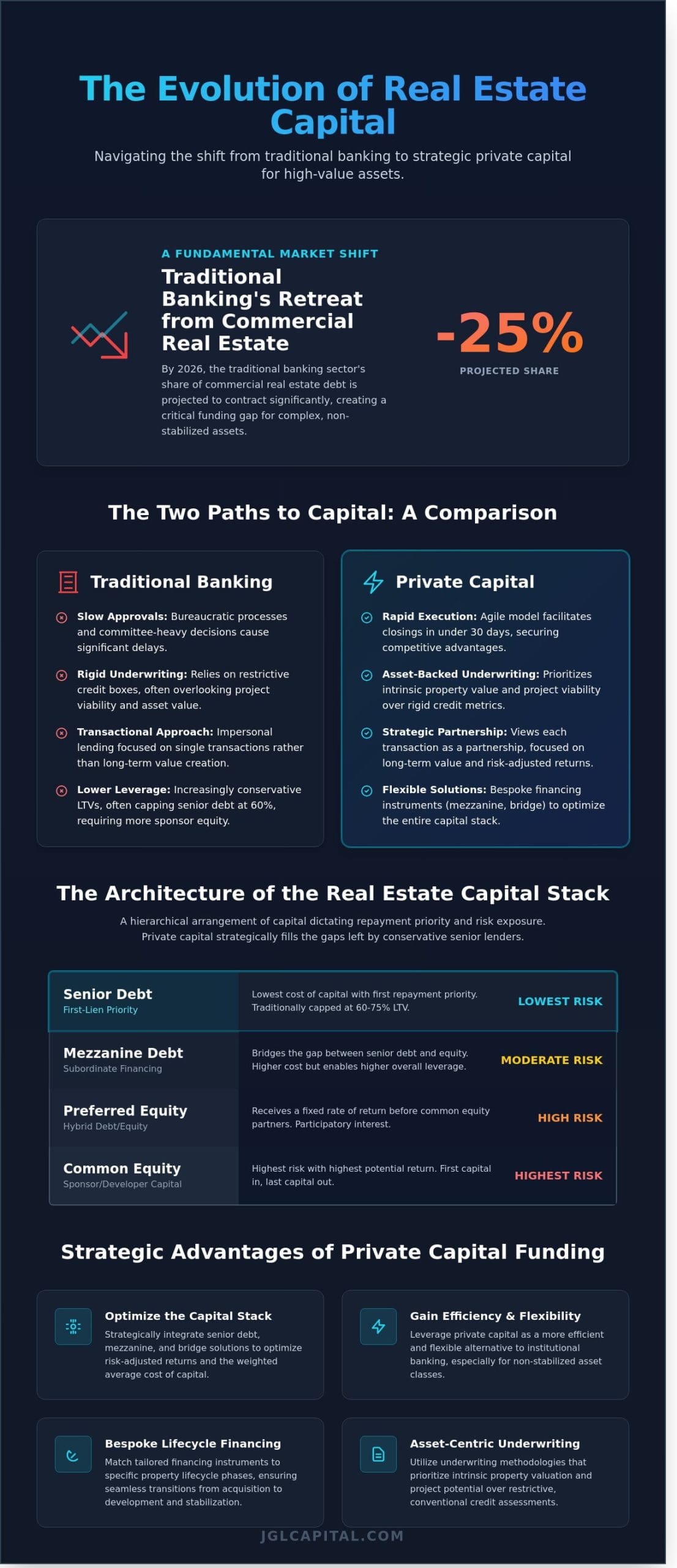
By the conclusion of 2026, the traditional banking sector’s share of commercial real estate debt is projected to contract by approximately 25%, as institutional lenders retreat from complex, non-stabilized assets. You’ve likely experienced the friction of slow approvals and rigid underwriting that stifles the momentum of high-stakes development projects; it’s a reality where capital inefficiency often dictates the ceiling of your portfolio’s growth. This guide details how to optimize your real estate capital stack through sophisticated private capital funding strategies and bespoke asset-backed debt solutions.
By aligning with a disciplined steward of capital, you can transition from transactional borrowing to a strategic partnership that prioritizes risk-adjusted returns and long-term value creation. We’ll explore the specific mechanisms of rapid bridge financing and the analytical frameworks necessary to secure reliable liquidity in a volatile market. This shift toward private capital allocation represents a fundamental evolution in how sophisticated investors maintain their competitive advantage through precision and strategic oversight.
Key Takeaways
- Analyze the sophisticated hierarchy of the real estate capital stack to optimize risk-adjusted returns through the strategic integration of senior debt and mezzanine solutions.
- Evaluate the distinct advantages of private capital funding as a more efficient and flexible alternative to traditional institutional banking for non-stabilized asset classes.
- Identify the critical necessity of matching bespoke financing instruments to specific phases of the property lifecycle, ensuring seamless transitions from acquisition to development.
- Utilize asset-based underwriting methodologies that prioritize intrinsic property valuation and project viability over conventional, restrictive credit assessments.
- Adopt a disciplined framework for capital allocation derived from thirty years of institutional expertise and rigorous analytical stewardship.
Understanding Capital Funding within the Private Real Estate Ecosystem
Capital funding represents the provision of structured debt or equity instruments specifically designed for the acquisition, development, and optimization of high-value real estate assets. In the current fiscal environment of 2026, this discipline has matured beyond simple lending into a sophisticated framework of capital allocation. Capital funding is a strategic mechanism for portfolio scaling. It requires a deep understanding of real estate economics to ensure that every dollar deployed aligns with broader institutional objectives and risk-adjusted return profiles.
The Role of Private Capital in Modern Real Estate
Private capital serves as the essential connective tissue in contemporary property finance. It effectively bridges the gap between sponsor equity requirements and the increasingly conservative thresholds of senior debt providers. In competitive national markets, where transaction windows often close within 30 days, private funding facilitates a level of speed that traditional institutions cannot replicate. This agility is vital. High-stakes commercial transactions require immediate liquidity to secure prime assets before market shifts occur. For institutional partners, the ability to access reliable capital without the delays of committee-heavy banking processes is a significant competitive advantage. Sophisticated sponsors who also leverage real estate investment clubs as strategic conduits for deal flow and capital allocation gain an additional edge by accessing high-value opportunities through private, non-public channels.
Key Components of Real Estate Capital Funding
Understanding the architecture of a deal requires a clear differentiation between debt-based and equity-based funding structures. Debt-based capital provides senior or mezzanine positioning with fixed obligations, while equity-based funding involves a participatory interest in the asset’s long-term appreciation. Precision in these structures is paramount. We focus heavily on two critical metrics:
- Loan-to-Value (LTV) Ratios: These determine the level of leverage relative to the appraised market value, typically hovering between 65% and 75% for stabilized assets in 2026.
- Loan-to-Cost (LTC) Ratios: This metric is vital for development projects, as it measures the loan amount against the total budget for construction and acquisition.
By maintaining a disciplined approach to these ratios, investors ensure that their capital stack remains resilient against market volatility. This methodical focus on leverage and cost control is what defines successful capital allocation in the modern era.
The Architecture of the Capital Stack: Senior Debt, Mezzanine, and Bridge Solutions
The hierarchical arrangement of capital within a real estate transaction dictates both the priority of repayment and the threshold for risk exposure. At the base of this structure, senior debt remains the primary vehicle for capital funding in stabilized asset classes, typically securing a first-priority lien. Institutional lenders in 2024 and 2025 often capped senior loan-to-value (LTV) ratios at 60 percent, necessitating additional layers for sponsors seeking higher leverage. By segmenting the capital stack, sophisticated investors can optimize their weighted average cost of capital while maintaining a disciplined approach to risk-adjusted returns.
A well-structured capital stack generally adheres to a four-tier hierarchy:
- Senior Debt: First-lien priority with the lowest cost and lowest risk profile.
- Mezzanine Debt: Subordinate to senior debt, often secured by a pledge of equity interests.
- Preferred Equity: Priority over common equity in cash flow distributions and liquidation.
- Common Equity: The highest risk layer, which captures the greatest portion of the project’s upside.
Leveraging Bridge Capital for Market Agility
Agility in the 2026 real estate market requires immediate access to liquidity, a demand often met by specialized bridge loan lenders who prioritize execution speed over the exhaustive underwriting typical of traditional banks. These transitional facilities utilize interest-only structures to maximize cash flow during the critical value-add phase. Once the asset achieves a stabilized debt service coverage ratio (DSCR) of 1.25 or higher, the sponsor typically initiates a refinance into long-term, permanent financing. This sequence allows for the rapid capture of off-market opportunities that’d otherwise be lost to more cumbersome institutional processes. Sophisticated sponsors seeking to maximize portfolio agility should also evaluate how real estate bridge loans function as a strategic instrument for transitional capital optimization across multiple asset classes.
Subordinate Debt and Equity Considerations
Mezzanine financing serves as a strategic bridge between senior debt and equity, allowing developers to limit their capital contribution while retaining control of the project. This layer sits subordinate to the senior lender but ahead of common equity, offering a middle-ground solution for capital funding in high-growth developments. Managing these multiple layers of capital requires rigorous strategic oversight to ensure that intercreditor agreements don’t impede operational flexibility. For those seeking to refine their portfolio’s leverage profile, evaluating the alignment of interests between senior and subordinate partners is a fundamental step in the due diligence process. The precision with which these layers are calibrated directly influences the final internal rate of return (IRR) for all stakeholders involved.
Strategic Advantages: Private Capital Funding versus Traditional Institutional Lending
The divergence between institutional mandates and market realities creates a significant efficiency gap in the current real estate market. Traditional banks struggle with non-stabilized assets because their regulatory frameworks demand immediate yield and rigid compliance. Private capital funding operates on a different premise; it prioritizes the future value of the asset and the strategic vision of the sponsor rather than relying solely on historical cash flows or personal credit history.
Asset-based underwriting represents a fundamental shift in risk assessment. While institutional lenders fixate on personal credit scores, private partners evaluate the intrinsic worth of the property. This methodology allows for the deployment of capital into complex deals that don’t fit the standard bank profile. Speed of execution becomes a primary competitive advantage when high-quality assets require immediate commitment in national markets. In 2024, sponsors who utilized private capital secured assets at an average of 8% below market value by offering certainty of close within compressed timelines. Sponsors seeking to eliminate personal income verification requirements entirely should evaluate how asset-backed loans provide a sophisticated, property-centric alternative to conventional borrower underwriting in the 2026 capital environment.
Overcoming Institutional Rigidity
Sophisticated investors understand that higher interest rates are often a nominal trade-off for superior capital efficiency. The true cost of capital isn’t just the coupon rate. It includes the hidden expenses of bank delays, such as missed acquisition opportunities and mounting carrying costs. While a standard bank approval process often stretches beyond 65 days, private capital funding solutions typically reach the closing table within 10 to 14 business days.
- Capital Efficiency: Higher leverage ratios reduce the need for dilutive equity partners.
- Reduced Opportunity Cost: Rapid funding allows sponsors to lock in purchase prices before seasonal market shifts.
- Certainty of Execution: Private partners provide a level of reliability that institutional committees often lack during periods of market volatility.
The Value of a Strategic Bridge Lender
The relationship with a private partner is a form of high-level stewardship. The strategic role of a bridge lender extends far beyond the simple provision of liquidity. These partners help navigate complex title issues, zoning hurdles, or structural complications that would immediately disqualify a deal at a traditional bank. This collaborative approach ensures that capital allocation remains aligned with the long-term preservation of wealth.
A 2025 funding impasse involving a 150-unit multifamily conversion serves as a primary example of this value. A traditional lender withdrew 10 days before the closing date due to a minor zoning variance. A strategic bridge partner analyzed the risk-adjusted returns and structured a bespoke solution that allowed the sponsor to close on time. This level of creative capital allocation ensures that complex projects reach stabilization without the friction of institutional bureaucracy.
Optimizing Capital Allocation across the Real Estate Asset Lifecycle
Prudent capital allocation requires a rigorous alignment between the financing structure and the operational maturity of the underlying asset. During the initial acquisition and pre-development phase, speed remains the primary differentiator. Institutional investors often utilize high-velocity land or bridge loans to secure prime sites before traditional debt markets can respond. These instruments provide the necessary agility to execute on undervalued opportunities, though they’re viewed strictly as transitory measures before transitioning to more permanent structures. Effective capital funding at this stage isn’t merely about liquidity; it’s about the strategic positioning of the asset for future development. Sponsors who require a deeper understanding of how these instruments are deployed in time-sensitive acquisitions will find that a comprehensive review of real estate bridge loans as a framework for transitional capital optimization provides essential context for structuring these early-stage positions.
Funding Strategies for Development and Value-Add
Successful execution in value-add or major renovation initiatives depends on the meticulous management of draw schedules and interest reserves. Unlike core acquisitions, these projects require a nuanced understanding of Loan-to-Cost (LTC) versus Loan-to-Value (LTV) metrics. Institutional lenders in 2026 frequently prioritize LTC ratios of up to 85% for high-conviction renovations, provided the post-stabilization appraisal supports a conservative LTV profile. Private capital funding serves as the linchpin here, offering the flexibility to fund complex renovations that traditional banks might deem too speculative. Sponsors navigating these transitional phases benefit from understanding how bridge financing functions as a precision tool for capital allocation during property repositioning and value-add execution. Developers seeking non-recourse structures that bypass personal income verification should also consider how asset-backed loans enable dormant equity extraction and portfolio scaling without the constraints of conventional lender requirements.
Long-Term Portfolio Optimization
Sustained growth is achieved through the strategic recycling of equity. By utilizing Debt Service Coverage Ratio (DSCR) funding, sophisticated sponsors can extract capital from stabilized assets without the friction of traditional income verification. This methodology underscores the role of real estate investing as a vehicle for long-term wealth preservation. A disciplined approach to refinancing ensures that capital remains productive, allowing for the continuous expansion of a portfolio while maintaining a robust risk-adjusted return profile. It’s a method that values patience over speculation.
Bespoke Capital Funding Solutions: The JGL Capital Methodology
JGL Capital operates as a disciplined steward of private real estate capital, a role refined over a 30-year legacy of strategic financial expertise. Since 1996, our firm has applied rigorous analytical frameworks to the complexities of the global market, ensuring that every allocation of capital funding meets the highest institutional-grade standards. We don’t merely provide liquidity. Instead, we engineer tailored solutions that reflect the specific risk-adjusted return profiles required by our sophisticated partners. The transition from an initial inquiry to a disciplined closing is governed by a meticulous methodology that prioritizes precision, ensuring that strategic objectives are met without compromise.
A Partnership Rooted in Integrity and Performance
Exclusivity and discretion aren’t just operational preferences; they’re central to our capital allocation process. We believe that the alignment of interests between lender, broker, and investor is the only sustainable foundation for long-term value creation. By maintaining a selective portfolio, we ensure our strategic oversight remains concentrated and effective for every stakeholder involved. Our objective is building lasting legacies through deliberate and strategic partnership, rejecting the transactional nature of modern finance. This approach has allowed us to maintain a consistent track record across multiple economic cycles, proving that integrity and performance are inseparable components of wealth preservation.
Initiating Your Capital Strategy
Securing private capital funding requires a project presentation that mirrors the sophistication of the underlying asset. When you present a project for our consideration, the documentation must support a streamlined underwriting process to facilitate deep analytical review. We require several key components to begin our due diligence:
- A comprehensive executive summary detailing the project’s unique value proposition.
- Detailed pro forma financial projections covering a minimum five-year horizon.
- A clearly articulated exit strategy or refinancing plan.
- Full disclosure of the sponsor’s track record and current portfolio performance.
We evaluate assets based on their intrinsic value and their potential for sustained growth within the 2026 market landscape. Our team conducts a thorough review of your objectives to determine how our methodology can support your specific financial goals. To begin this professional engagement, you should engage with JGL Capital for a bespoke funding consultation. We look forward to exploring how our disciplined approach can provide the stability and expertise your project demands.
Architecting Sustainable Growth in the 2026 Real Estate Market
Navigating the complexities of the 2026 financial landscape requires a disciplined approach to capital allocation that transcends the rigid constraints often found in traditional institutional lending. Success hinges on a sophisticated mastery of the capital stack, where the strategic integration of senior debt and mezzanine solutions creates a foundation for resilient, high-performing portfolios. JGL Capital utilizes over 30 years of institutional financial expertise to provide capital funding that prioritizes property potential through meticulous, asset-based underwriting. Our national reach ensures that sponsors receive bespoke solutions tailored to the unique requirements of the real estate asset lifecycle, ensuring every strategy is clearly defined and every objective is met with precision. It’s through this analytical rigor and commitment to stewardship that we foster long-term value creation for our institutional partners. We invite you to Secure Strategic Capital Funding for Your Next Project and experience a partnership grounded in stability and deep-seated expertise. Your vision for property development and acquisition deserves a strategic ally that values integrity and professional excellence above all else. We look forward to building a lasting legacy together.
Frequently Asked Questions
What is the primary difference between capital funding and a traditional bank loan?
Capital funding differs from traditional bank loans by prioritizing the asset’s intrinsic value and strategic potential over the rigid credit requirements and prolonged underwriting cycles of depository institutions. While banks operate under strict Basel IV regulatory frameworks, private capital offers flexibility in structuring bespoke solutions. This approach allows sophisticated sponsors to execute complex transitions that don’t fit the standardized criteria of conventional lenders.
How does capital stack optimization impact investor returns?
Capital stack optimization maximizes risk-adjusted returns by balancing senior debt, mezzanine financing, and equity to lower the weighted average cost of capital. Through precise allocation, a sponsor can increase the internal rate of return by 200 to 400 basis points. This disciplined approach ensures that each layer of the investment is insulated against market volatility, providing a secure foundation for long-term wealth preservation.
Can capital funding be used for new construction and land acquisition?
Private capital providers offer the essential liquidity required for horizontal land development and vertical construction projects that traditional lenders often perceive as high-risk. In 2026, institutional allocators are increasingly targeting shovel-ready sites with approved entitlements. These partners offer non-recourse options that allow developers to preserve balance sheet strength during the 18 to 24-month build cycle without the constraints of restrictive bank covenants.
What are the typical interest rates for private capital funding in 2026?
Private capital rates in 2026 typically range from 8.5% to 12% for senior positions, depending on the Secured Overnight Financing Rate and the specific risk profile of the asset. Mezzanine and preferred equity tranches command higher yields, often exceeding 13%. These figures reflect the 2025 Federal Reserve pivot toward a stabilized interest rate environment, providing a predictable benchmark for institutional underwriting and strategic oversight.
Is capital funding available for multi-family and commercial assets?
What is the role of a bridge lender in a capital funding transaction?
A bridge lender provides short-term, interim financing that facilitates the transition of an asset from acquisition or distress to a stabilized state suitable for permanent financing. These lenders act as strategic partners during the 12 to 36-month stabilization period. They enable sponsors to execute value-add strategies, such as property renovations or tenant repositioning, before securing a long-term agency loan or life insurance company exit. For a comprehensive analysis of how these instruments function within a broader capital strategy, reviewing the mechanics of bridge financing as a transitional real estate capital solution provides essential institutional-grade context.
How quickly can capital funding be secured for a real estate deal?
Private capital transactions often close within 10 to 21 business days, providing a significant competitive advantage over the 60 to 90-day timelines typical of commercial banks. This accelerated cadence is vital for capturing time-sensitive opportunities in a volatile market. By streamlining the due diligence process and focusing on the underlying collateral, private partners ensure that sponsors don’t miss critical acquisition deadlines or lose earnest money deposits.
Does JGL Capital offer funding for owner-occupied residential properties?
JGL Capital doesn’t provide financing for owner-occupied residential properties; the firm’s mandate is strictly focused on commercial real estate and institutional-grade investment assets. The firm’s expertise lies in sophisticated capital allocation for the multi-family, industrial, and office sectors. By maintaining this professional focus, JGL Capital ensures the alignment of interests with high-net-worth individuals and institutional partners seeking strategic growth in commercial markets. Sponsors looking to expand their network and access institutional-grade deal flow should also explore how real estate investment clubs serve as professional networking vehicles for sophisticated capital allocation in the 2026 market environment.