

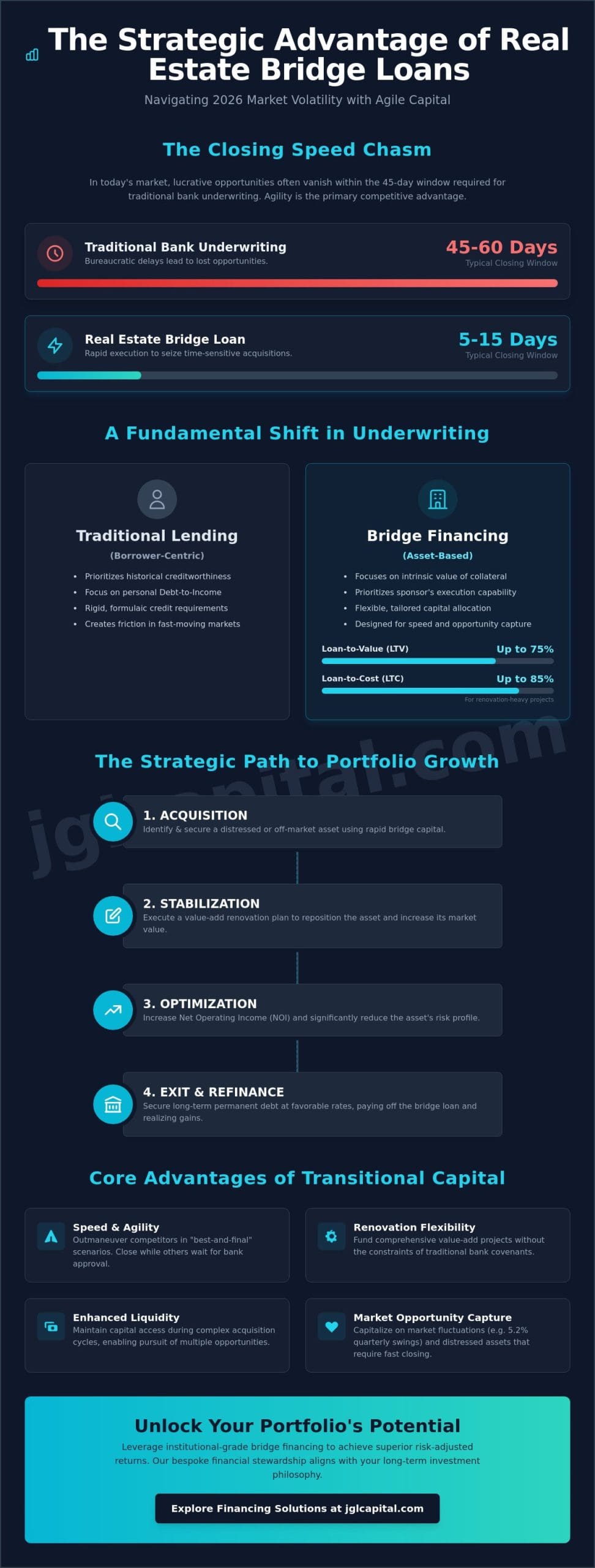
The institutional investor who prioritizes agility over conventional bureaucracy recognizes that the most lucrative opportunities in the 2026 market often vanish within the 45-day window typically required for traditional bank underwriting. While conventional financing remains a cornerstone of long-term stability, its inherent rigidity frequently creates liquidity gaps that stifle portfolio expansion and hinder the pursuit of risk-adjusted returns. Sophisticated market participants are increasingly utilizing real estate bridge loans as a primary instrument for transitional capital optimization, ensuring that time-sensitive acquisitions of distressed multi-family assets aren’t lost to more nimble competitors who possess immediate liquidity.
You’re likely aware that the current credit environment demands a more nuanced approach to leverage than the one-size-fits-all models of previous decades. This guide provides a comprehensive framework for utilizing bridge capital as a sophisticated tool for portfolio scaling and capital preservation. We’ll examine the strategic shift toward rapid asset acquisition and the specific operational strengths required to facilitate a seamless transition into permanent debt structures.
Key Takeaways
- Identify the strategic utility of real estate bridge loans as high-register, asset-backed vehicles designed to facilitate portfolio scaling and capital preservation in volatile markets.
- Analyze the shift toward asset-based underwriting standards where Loan-to-Value and Loan-to-Cost ratios dictate sophisticated capital allocation and institutional-grade risk assessment.
- Gain insights into the implementation process of transitional financing, encompassing precise deal screening and the rigors of comprehensive institutional due diligence.
- Formulate robust risk mitigation strategies to address the cost of private capital and secure a seamless transition toward permanent debt structures.
- Discover the competitive advantage of bespoke financial stewardship designed to align with long-term investment philosophies and achieve superior risk-adjusted returns.
The Strategic Utility of Real Estate Bridge Loans in 2026
Real estate bridge loans represent a sophisticated, short-term financing mechanism designed to facilitate the acquisition or stabilization of assets during critical transitional periods. Unlike retail “swing loans” that primarily serve individual homeowners, institutional-grade transitional capital provides the necessary leverage for complex commercial and multi-family projects. Understanding What is a Bridge Loan? requires an appreciation of its role as a liquidity tool. In the current 2026 fiscal environment, traditional lending institutions often exhibit a 45 to 60-day underwriting lag, which fails to meet the demands of high-velocity acquisition cycles. Private capital fills this void by prioritizing asset quality and the sponsor’s execution capability over rigid, formulaic credit requirements. This asset-backed approach ensures that capital remains available even when broader market liquidity tightens.
Transitional Capital vs. Permanent Financing
The primary distinction between bridge debt and permanent financing lies in the intended duration and the state of the underlying asset. Bridge loans aren’t designed for long-term hold periods; instead, they function as a tactical precursor to more stable instruments like rental property loans. This sequence allows investors to secure an asset quickly, execute a stabilization plan, and then transition to institutional capital with lower interest rates. A robust exit strategy remains the cornerstone of private capital allocation, ensuring that the transition to permanent debt occurs only after the asset’s risk profile has been significantly reduced. Successful sponsors use this period to optimize the property’s net operating income, creating a clear path toward permanent take-out financing through disciplined portfolio optimization.
The Economic Rationale for Short-Term Debt
Speed acts as a decisive competitive advantage in 2026’s “best-and-final” offer scenarios, where sellers prioritize certainty of closing above all else. Utilizing bridge capital enables sponsors to fund comprehensive value-add renovations, which directly enhances the final appraised value and improves the loan-to-value ratio for future refinancing. Bridge financing serves as a strategic bridge between initial acquisition and final asset stabilization.
- Bridging the gap between immediate capital needs and long-term financial stability.
- Enabling rapid execution in volatile markets where asset prices can fluctuate by 5.2% or more within a single quarter.
- Providing the flexibility to renovate and reposition assets without the constraints of traditional bank covenants.
- Maintaining liquidity during complex acquisition cycles that involve multiple stakeholders or distressed debt components.
By leveraging this agile debt, firms maintain the liquidity needed to capture distressed or off-market opportunities that would otherwise be lost to bureaucratic delays. This disciplined approach to capital allocation ensures that every dollar is deployed toward maximizing risk-adjusted returns while maintaining the agility required for institutional-grade growth. The reliance on real estate bridge loans has become a hallmark of modern investment strategies, offering a level of strategic oversight that traditional mortgage products simply can’t match in a fast-moving economy.
Underwriting Standards: Navigating Asset-Based Capital Allocation
Traditional banking institutions often prioritize the historical creditworthiness of the borrower, creating friction in fast-moving markets. In contrast, real estate bridge loans operate on a paradigm of asset-based capital allocation. This methodology centers the underwriting process on the intrinsic value of the collateral rather than the personal debt-to-income ratios of the sponsor. Lenders primarily utilize the Loan-to-Value (LTV) ratio, often capped at 75%, and the Loan-to-Cost (LTC) ratio, which may reach 85% for renovation-heavy projects, to mitigate risk. Understanding the Bridge Loan Mechanics allows sophisticated investors to leverage equity more efficiently than standard term loans permit. Private money brokers offer a more streamlined alternative to traditional bank underwriting by focusing on the speed of execution and the viability of the exit strategy. In commercial contexts, the Debt Service Coverage Ratio (DSCR) remains a critical metric; institutional lenders typically seek a minimum of 1.20x or 1.25x to ensure the asset’s cash flow can support its obligations.
The Priority of Property Value
Asset-based lenders meticulously evaluate the “as-is” value alongside the projected “after-repair” value (ARV). This dual-valuation approach relies on rigorous third-party appraisals to establish capital allocation limits. By utilizing sophisticated capital funding structures, sponsors can bypass the invasive personal income verification processes that characterize retail banking. It’s a method that prioritizes the asset’s potential, providing the necessary flexibility for rapid acquisitions. These structures allow for a more precise articulation of investment philosophies while maintaining strict risk-adjusted return profiles.
Borrower Requirements in Private Lending
While the asset is central, private lenders still require a baseline of professional competence. Developers must often demonstrate a track record of at least 5 successfully exited projects to access the most competitive institutional rates. Liquidity remains paramount; sponsors must maintain sufficient reserves to cover 12 months of interest payments and closing costs. This requirement ensures the stability of the project through its transitional phase. Successful investors view this relationship not as a simple debt obligation, but as a strategic partnership. This alignment of interests is fundamental to modern real estate bridge loans. For those seeking a disciplined steward of their next project, consulting with a specialist can clarify the path to an optimal capital structure. Discerning capital allocators who want to deepen their understanding of collateral-driven underwriting will find a rigorous framework in our analysis of asset-backed loans and their strategic role in real estate capital allocation.
Structuring the Transaction: A Comprehensive Implementation Guide
The deployment of capital through real estate bridge loans necessitates a disciplined framework that prioritizes speed without compromising the integrity of the underwriting process. This phase begins with a rigorous deal screening, where the sponsor’s track record and the asset’s exit strategy are scrutinized against current market volatility. Once a preliminary alignment is established, the issuance of a Letter of Intent (LOI) serves as the foundational document, outlining the fundamental economic parameters and the anticipated capital structure. Investors seeking a foundational understanding of these instruments may consult the Forbes guide to bridge loans, which delineates the primary advantages of short-term debt in transitional scenarios.
The due diligence phase is characterized by a meticulous examination of physical and legal risks. This involves commissioning Phase I environmental reports compliant with ASTM E1527-21 standards, conducting ALTA title searches to identify potential encumbrances, and performing exhaustive property inspections. In private money transactions, the “points and fees” structure typically ranges from 1% to 3% of the total loan commitment. These fees are not merely administrative costs; they reflect the risk premium associated with the lender’s ability to provide rapid liquidity. Closing logistics are engineered for efficiency, often facilitating capital deployment within a condensed 10 to 14-day window, a pace that traditional depository institutions rarely match.
Step-by-Step Execution of a Bridge Loan
Success in securing transitional capital depends on the quality of the initial submission package. Submitting a comprehensive executive summary and detailed pro forma projections to a bridge lender is the prerequisite for securing institutional-grade capital. Upon receipt of a commitment letter, the sponsor must evaluate the term sheet’s nuances, specifically regarding the “waterfall” of distributions and reserve requirements. The process culminates in the execution of final loan documents and coordination with escrow to ensure that funding occurs precisely when the acquisition or renovation schedule demands.
Optimizing Interest Rates and Terms
Strategic capital allocation requires a choice between interest-only payment structures and rolled-up interest options. While interest-only structures preserve monthly cash flow, rolled-up interest allows the borrower to capitalize the debt service into the loan balance, which is often ideal for non-cash-flowing assets. It’s vital to analyze the impact of prepayment penalties, as these can erode the risk-adjusted return if a project stabilizes ahead of schedule. For complex redevelopments, negotiating extension options is a critical risk mitigation tactic, providing a vital safety net if the 2024 construction supply chain or permitting timelines experience unforeseen delays.
Mitigating Risk and Optimizing Risk-Adjusted Returns
The primary critique of real estate bridge loans often centers on the nominal interest rate, which typically exceeds traditional senior debt by 300 to 500 basis points. However, sophisticated investors view this cost through the lens of capital optimization rather than simple expense management. By utilizing bridge debt, a sponsor can maintain a larger equity stake in a high-yield project, effectively avoiding the 20% to 30% equity dilution often required when bringing on preferred equity partners. This preservation of ownership directly enhances the long-term Internal Rate of Return (IRR) for the principal investor.
An empirical analysis of a $10 million value-add acquisition demonstrates the disparity between capital structures. A pure cash purchase might yield a 15% IRR over a 24-month stabilization period. Conversely, applying a bridge loan at 65% Loan-to-Value (LTV) can propel that IRR to 22% or higher, even after accounting for debt service. This delta represents the power of leveraged transitional capital to amplify returns while maintaining operational control. Sponsors seeking a comprehensive comparison of non-recourse structures and collateral-driven underwriting methodologies should review the strategic analysis of asset-backed loans for real estate capital allocation in 2026.
The Exit Strategy: The Core of Risk Management
Successful risk mitigation requires a granular analysis of the transition to long-term bridge loan lenders or traditional agency debt through institutions like Fannie Mae or Freddie Mac. A robust exit strategy involves more than a simple hope for appreciation; it necessitates a documented path to stabilization that meets the Debt Service Coverage Ratio (DSCR) requirements of permanent lenders. Contingency planning must account for 12 to 18 months of potential market volatility or supply chain disruptions that could delay construction milestones. The viability of a bridge loan is entirely dependent on the strength of the exit strategy.
Cost-Benefit Analysis of Speed vs. Rate
The opportunity cost of capital is a critical metric in high-velocity markets. Waiting for a 60-day bank approval process can result in the loss of a distressed asset priced 15% below market value. In this context, the speed of bridge financing becomes a strategic asset. Because these facilities are asset-backed, they’re frequently structured as non-recourse, which protects the investor’s personal balance sheet from systemic shocks. Additionally, the interest expenses associated with these loans provide significant corporate tax optimization, as they’re deductible against the asset’s generated income, lowering the effective cost of capital.
Strategic capital allocation requires a partner who understands the nuances of transitional assets. Secure your next acquisition with the precision of institutional-grade transitional capital.
Securing Institutional-Grade Bridge Financing with JGL Capital
JGL Capital leverages over 30 years of industry expertise to facilitate complex real estate transactions that require sophisticated capital structures, particularly through the deployment of real estate bridge loans. We offer a bespoke alternative to traditional lending, providing solutions tailored to the specific investment philosophies of our institutional and high-net-worth partners. Our firm operates with an unwavering commitment to stewardship and the long-term preservation of investor capital. This philosophy ensures that every deployment of debt is underpinned by rigorous analytical standards and a deep understanding of market cycles. We maintain a broad national reach while retaining the tactical agility of a private money boutique. This unique positioning allows us to execute with a level of precision that larger, more bureaucratic institutions often fail to achieve. We don’t just provide capital; we provide the certainty required to execute on high-conviction opportunities.
Our Approach to Capital Allocation
Effective capital allocation requires a fundamental alignment of interests between the lender and the borrower. We prioritize this synergy to ensure that our real estate bridge loans function as strategic tools rather than mere transactional debt. Our programs encompass a diverse range of asset classes, extending from ground-up new construction to multi-family bridge debt. Sophisticated investors choose JGL Capital for real estate investing success because we understand the nuances of value-add strategies and complex transitional phases. We focus on optimizing risk-adjusted returns, providing the necessary liquidity to stabilize assets or bridge the gap to permanent financing. Our team conducts thorough due diligence on every project, valuing the integrity of the asset as much as the strength of the sponsor. It’s a disciplined approach that ensures capital is deployed efficiently, supporting the long-term growth of our partners’ portfolios. Sponsors who prioritize deal flow and peer-level capital partnerships may also benefit from engaging with real estate investment clubs as strategic conduits for professional networking and institutional-grade capital allocation.
Initiating Your Partnership
The application process at JGL Capital is meticulously streamlined to meet the demands of time-sensitive acquisitions and recapitalizations. We recognize that in high-stakes real estate, execution speed is a critical component of value preservation. Borrowers receive direct access to senior decision-makers, which facilitates initial underwriting feedback within 48 hours and clear communication throughout the due diligence phase. This transparency reduces the friction and uncertainty often associated with private lending environments. By eliminating unnecessary layers of management, we provide authoritative answers and reliable funding timelines that sponsors can depend on. Our firm values the creation of lasting legacies through careful, deliberate action. Partner with JGL Capital for your next strategic acquisition.
Advancing Your Portfolio Strategy Through Disciplined Capital Allocation
The 2026 investment environment requires a sophisticated understanding of transitional financing to maintain a competitive edge in volatile markets. real estate bridge loans provide the necessary agility for asset repositioning, allowing investors to secure opportunities that traditional institutional lenders often overlook due to rigid credit requirements. By focusing on asset-based underwriting, JGL Capital ensures that the inherent value of your residential, multi-family, or commercial property remains the central pillar of the transaction. It’s a methodology that prioritizes the strategic utility of the asset over historical credit data.
With over 30 years of private money brokerage expertise, JGL Capital operates with a national reach to deliver bespoke capital solutions tailored to your specific risk-adjusted return objectives. Our firm functions as a dedicated steward of your interests, utilizing a disciplined approach to facilitate seamless wealth preservation and growth. You’ll benefit from a partnership grounded in analytical rigor and a deep-seated mastery of the lending landscape. We’re committed to helping you navigate complex capital structures with precision and integrity.
Secure Your Strategic Capital Allocation with JGL Capital Today
Frequently Asked Questions
How does a real estate bridge loan differ from a traditional mortgage?
Real estate bridge loans distinguish themselves from traditional mortgages through their accelerated deployment cycles and focus on the collateral’s intrinsic value rather than the borrower’s long-term credit profile. While a conventional bank loan prioritizes 30 year amortization schedules, a bridge facility serves as a short term instrument, typically spanning 12 to 36 months, to facilitate property stabilization. This transitional capital provides the agility required for complex transactions that standard institutional lenders often find too speculative for their rigid underwriting frameworks.
What are the typical interest rates for bridge loans in 2026?
Anticipated interest rates for bridge financing in 2026 are projected to remain between 8.5% and 11.5% based on current macroeconomic forecasts and Federal Reserve policy trajectories. These rates reflect the risk premium associated with non-recourse, short term capital compared to the lower yields of permanent financing. Investors must account for these spreads when calculating their risk-adjusted returns, as the cost of capital remains a primary driver in the feasibility of value-add real estate strategies.
Can I use a bridge loan for a new construction project?
Capital allocators often employ bridge financing to facilitate the initial phases of new construction, specifically for land entitlement or pre-development activities. These loans provide the necessary liquidity to bridge the gap until a developer secures a senior construction facility, which typically requires a higher degree of project maturity. By utilizing this strategic capital, sponsors can maintain project momentum while refining their long-term financing structures to optimize the overall cost of the capital stack.
What is the maximum Loan-to-Value (LTV) typically offered by bridge lenders?
The maximum Loan-to-Value ratio for most institutional bridge facilities generally settles at 75% of the asset’s current appraised value. In specific scenarios involving high-quality sponsors, lenders might extend this to 80% of the total cost basis to support significant capital improvement programs. This ceiling ensures that the lender maintains a disciplined equity cushion, protecting the investment against market volatility while providing the sponsor with sufficient leverage to execute their value-creation plan.
How fast can a bridge loan be funded compared to a bank loan?
Real estate bridge loans offer a significant temporal advantage, with funding cycles often concluding within 14 business days of the initial application. This speed contrasts sharply with the 90 day timelines common in traditional banking environments, where bureaucratic hurdles and committee reviews delay capital deployment. For investors pursuing time-sensitive acquisitions or distressed opportunities, this rapid execution is a critical component of their competitive strategy and overall portfolio optimization.
Is a personal guarantee required for asset-based bridge financing?
Institutional bridge financing is often structured as non-recourse debt, meaning the lender’s primary recourse is the underlying real estate asset rather than the personal balance sheet of the sponsor. However, most agreements include standard “bad boy” carve-outs that trigger personal liability in cases of fraud or gross negligence. This structure ensures a proper alignment of interests between the steward of capital and the investor, maintaining the integrity of the partnership throughout the investment lifecycle.