

In the institutional real estate market, the true cost of capital isn’t found in the interest rate but in the opportunity cost of a missed acquisition while waiting for traditional bank underwriting. You’ve likely experienced the frustration of seeing a high-value asset slip away because a conventional lender’s rigid requirements couldn’t match the speed of a time-sensitive transition, often leaving potential value unrealized. Sophisticated investors recognize that capital lock-up during property repositioning represents a significant barrier to achieving optimal risk-adjusted returns, necessitating a more agile approach to liquidity management. This guide provides an institutional-grade analysis of how bridge financing functions as a precision tool for capital allocation and portfolio optimization. According to the Mortgage Bankers Association’s 2023 year-end report, commercial lending volumes shifted significantly as investors sought more flexible, short-term solutions amidst market volatility. We’ll examine the strategic deployment of transitional capital to maintain liquidity and secure high-value assets before migrating to permanent debt structures. You’ll gain a sophisticated understanding of how to bridge the gap between acquisition and long-term capital preservation through disciplined strategic oversight.
Key Takeaways
- Understand the critical role of transitional capital instruments in providing immediate liquidity, enabling sophisticated investors to execute time-sensitive transactions within the broader context of real estate capital markets.
- Analyze the rigorous underwriting methodologies that prioritize collateral quality and definitive exit strategies, utilizing precise LTV and LTC ratios to optimize capital allocation.
- Explore the strategic advantages of bridge financing over traditional institutional lending, specifically regarding the compression of execution timelines and the flexibility of bespoke deal structuring.
- Identify strategic deployment opportunities for portfolio optimization, such as stabilizing distressed assets or securing the necessary runway for new construction before permanent funding.
- Discover how a partnership grounded in thirty years of asset-backed expertise can deliver tailored, institutional-grade solutions that align with long-term investment objectives.
Defining Bridge Financing in the Context of Real Estate Capital Markets
Within the sophisticated architecture of real estate capital markets, bridge financing represents a critical transitional instrument designed to facilitate the seamless acquisition or repositioning of institutional-grade assets. This form of capital serves as a strategic conduit; it provides immediate liquidity that allows sponsors to execute on time-sensitive opportunities where traditional underwriting timelines would prove prohibitive. A Bridge loan is fundamentally defined by its temporary nature, functioning as a short-term solution that anticipates a future liquidity event, such as a property sale or a permanent refinancing through an agency or CMBS lender.
The institutional importance of certainty of funds cannot be overstated in a competitive acquisition environment. Sellers frequently prioritize buyers who demonstrate the capacity to close within 15 to 30 days, a timeline that’s rarely achievable through conventional mortgage channels. By deploying bridge financing, investors secure a competitive advantage, ensuring they don’t lose high-value assets to more agile competitors while they finalize their long-term capital stack. This strategic oversight allows for the preservation of equity and the optimization of risk-adjusted returns during the initial phases of property ownership.
The Core Characteristics of Transitional Capital
Investment-grade bridge capital is defined by several specific structural elements that distinguish it from permanent debt. These characteristics are engineered to support the asset’s transition rather than its long-term operation:
- Short-term duration: Loan terms typically range from six to twenty-four months, though extensions may be negotiated based on specific project milestones.
- Asset-backed security: Lenders focus on the intrinsic value of the property and its post-renovation potential rather than historical cash flows.
- Interest-only structures: To preserve operational cash flow during the stabilization period, these loans rarely require principal amortization.
Bridge Financing vs. Swing Loans
While the term is often used interchangeably with swing loans in residential contexts, investment-grade bridge capital serves a distinct purpose for professional portfolios. Swing loans typically address the gap between two residential dwellings for an individual consumer; conversely, institutional bridge capital supports complex value-add strategies and commercial repositioning. Professional investors prioritize speed and flexible structural terms over traditional amortization schedules, recognizing that the cost of capital is secondary to the strategic advantage of securing a high-performing asset.
As we observe the evolution of the 2026 lending landscape, the shift toward private capital has become more pronounced. Traditional banking institutions have significantly tightened their balance sheets, creating a vacuum that disciplined private stewards of capital now fill. This transition reflects a broader trend toward bespoke, tailored solutions that align the interests of the lender and the sponsor, ensuring that capital allocation remains both precise and effective in volatile market conditions.
The Mechanics of Bridge Loans: Structuring Transitional Capital
The underwriting of bridge financing represents a fundamental departure from the rigid, credit-centric protocols of traditional depository institutions. While conventional banks prioritize historical debt service coverage and borrower liquidity, transitional lenders center their analysis on the collateral’s terminal value and the viability of the proposed exit strategy. This asset-based methodology allows sophisticated investors to leverage bridge financing when traditional capital markets remain inaccessible due to property vacancy or ongoing repositioning. Capital allocation is primarily governed by Loan-to-Value (LTV) and Loan-to-Cost (LTC) metrics. In most institutional scenarios, lenders provide up to 75% of the current appraised value or 85% of the total project cost, ensuring a substantial equity buffer remains in place to protect the principal.
Documentation requirements in private money environments are notably more streamlined than those in the retail banking sector. Lenders focus on the property’s physical condition, market feasibility, and the borrower’s experience in executing similar value-add projects. A bridge loan’s success depends entirely on its conclusion. Lenders require a robust take-out plan, which typically involves a transition to permanent financing through agency lenders or a strategic divestment once the asset reaches stabilized occupancy. Institutional partners seeking to optimize their capital allocation strategies often utilize these structures to maintain momentum in competitive markets.
The Asset-Based Underwriting Process
Underwriting focuses on the risk-adjusted return of the underlying real estate. Lenders conduct rigorous property appraisals and feasibility studies to validate the “as-stabilized” value. This process ignores temporary cash flow deficiencies, focusing instead on the property’s potential. Private money bridge loans offer a faster path to closing, often funding within 14 to 21 days, because they bypass the bureaucratic committees typical of traditional banks. The asset’s intrinsic worth provides the primary security. Investors seeking a deeper understanding of how collateral-driven underwriting compares across lending structures can benefit from reviewing a comprehensive analysis of asset-backed loans and their strategic role in real estate capital allocation.
Interest Rates and Fee Structures
Speed and flexibility command a premium. This is reflected in interest rates that typically sit 300 to 600 basis points above conventional commercial mortgages. Origination points and exit fees are standard, compensating the lender for the intensive due diligence required for transitional assets. An interest reserve is a designated portion of the loan proceeds held by the lender to cover monthly debt service payments during the renovation or stabilization period. These structures ensure the project remains solvent while improvements are underway. The firm’s commitment to transparency ensures that every fee is aligned with the project’s long-term value creation.
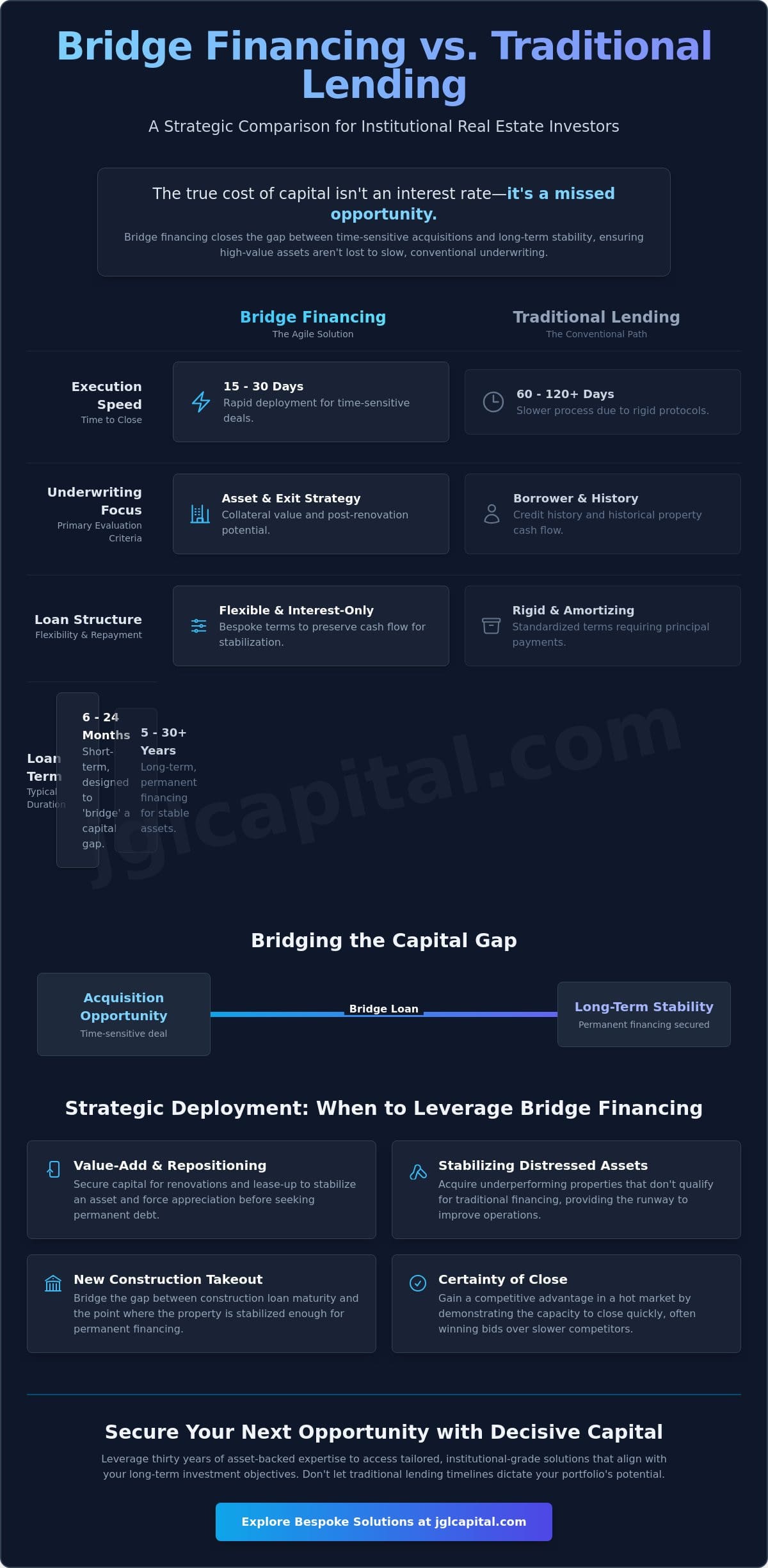
Comparative Analysis: Bridge Financing versus Traditional Institutional Lending
The divergence between institutional mandates and private capital agility defines the modern real estate landscape. While conventional commercial mortgages offer lower interest rates, their rigid underwriting frameworks often preclude participation in complex, time-sensitive acquisitions. A traditional bank’s procurement process typically spans 60 to 90 days. Conversely, bridge financing facilitates execution within 10 to 14 business days. This temporal advantage isn’t merely a convenience; it’s a strategic necessity when competing for distressed assets or off-market opportunities where sellers demand immediate certainty of closure.
Sophisticated investors recognize that the higher nominal cost of bridge capital is often offset by the preservation of equity value. Missing a high-yield opportunity due to administrative delays represents a permanent loss of potential returns. By bypassing the layers of committee-level bureaucracy inherent in institutional lending, investors secure the latitude required to execute value-add strategies that would otherwise remain unfunded. This flexibility extends to deal structuring, where custom terms can be tailored to the specific cash flow requirements of a unique asset class rather than adhering to one-size-fits-all loan covenants. Investors who cultivate robust peer networks through real estate investment clubs often gain early access to these off-market opportunities, further compressing the timeline between deal identification and capital deployment.
- Speed: Institutional lenders require months; bridge capital is deployed in days.
- Flexibility: Private lenders prioritize asset potential over rigid credit-score thresholds.
- Efficiency: Reduced “red tape” allows sponsors to focus on asset optimization rather than administrative compliance.
When Traditional Banks Fall Short
Institutional lenders prioritize historical credit performance and stabilized cash flows, often ignoring the intrinsic value of a turnaround project. These entities struggle to underwrite assets with occupancy rates below 70% or those requiring significant capital expenditures. This is where capital funding serves as a vital instrument. It provides the necessary liquidity for un-stabilized properties, allowing sponsors to bridge the gap between acquisition and permanent refinancing without the constraints of a credit-score-driven model.
Risk Mitigation and Strategic Oversight
Engaging with elite bridge loan lenders offers more than just capital; it provides a layer of strategic oversight. These partners conduct rigorous due diligence that mirrors the scrutiny of institutional players but with a focus on asset potential rather than just historical data. They understand the nuances of market cycles, helping sponsors calibrate their exit strategies. Balancing short-term debt with long-term portfolio objectives ensures that the transitional phase of an investment doesn’t compromise the overall stability of the entity’s balance sheet.
Strategic Deployment: When to Leverage Bridge Financing for Portfolio Optimization
The deployment of bridge financing serves as a sophisticated mechanism for capital allocation within a high-stakes real estate environment. Institutional investors and developers utilize this transitional capital to navigate the complexities of assets that do not yet qualify for permanent debt. This capital is vital when acquiring distressed properties that require immediate stabilization. For instance, a property with an occupancy rate below 75 percent often fails to meet the stringent requirements of traditional lenders. Bridge capital provides the necessary liquidity to execute a stabilization plan, renovate units, and increase the Net Operating Income (NOI) to a level that supports institutional underwriting.
Speed of execution remains a primary driver for these specialized funds. In competitive markets, the ability to close a transaction within 10 to 14 days is often the deciding factor in securing an asset. Bridge loans allow for this rapid movement; they bypass the lengthy due diligence periods typical of traditional banks. Additionally, these funds serve as a critical safety net when a current loan matures before an asset sale is finalized. This strategic bridge prevents technical defaults and preserves equity during the final stages of a disposition strategy.
- Acquiring Distressed Assets: Providing the capital needed for immediate physical or operational stabilization.
- Opportunistic Acquisitions: Facilitating rapid closings in time-sensitive, off-market transactions.
- Maturity Bridging: Maintaining asset control when a permanent loan expires during a sale process.
- Construction On-Ramps: Securing land or early-phase development before long-term financing is secured.
Bridge Financing for Value-Add and Fix-and-Flip Strategies
This transitional capital model facilitates the fix and flip loans Florida investors rely on to revitalize aging residential and commercial inventories. By utilizing short-term leverage, developers fund extensive renovations that ultimately increase the Debt Service Coverage Ratio (DSCR). It’s an essential step for transitioning into permanent rental property loans, where institutional capital demands proven cash flow and modernized physical standards. It’s a calculated method to maximize risk-adjusted returns through disciplined asset improvement.
Commercial and Multi-Family Transitions
In the commercial sector, bridge capital supports the repositioning of multi-family assets through tenant improvements and capital expenditures. It also plays a pivotal role in the early phases of new construction loans, providing the initial funding required before a project reaches the milestone for long-term development financing. A typical case study involves an acquisition bridge loan that carries an asset through a 12-month renovation period; the asset then transitions into stabilized permanent debt once the property achieves its target occupancy of 90 percent. Sophisticated market participants seeking a comprehensive framework for this approach can explore the strategic application of real estate bridge loans as a primary instrument for portfolio scaling and capital preservation.
To optimize your portfolio through sophisticated capital allocation, contact JGL Capital today for a strategic consultation.
Securing Bespoke Bridge Solutions through JGL Capital
The JGL Capital philosophy centers on asset-backed lending, a discipline we’ve refined through thirty years of institutional experience. We recognize that sophisticated investors require capital solutions that reflect the unique complexities of their portfolios. Our commitment to tailored capital allocation ensures that every transaction receives the analytical rigor necessary for long-term wealth preservation. We don’t just provide funds; we offer a strategic alignment that respects the gravity of high-stakes real estate management.
The real estate market of 2026 demands a strategic partner capable of navigating shifting interest rate environments and evolving property valuations. JGL Capital provides this stability. We don’t rely on the rigid frameworks of traditional banking. Instead, we function as a disciplined steward of capital, focusing on risk-adjusted returns and the underlying potential of transitional assets. Our expertise allows us to move from an initial inquiry to a funded transaction with a precision that honors your project’s timeline, typically closing within 14 to 21 days for qualified assets.
Why Investors Partner with JGL Capital
Sophisticated investors choose JGL Capital to access private capital pools that bypass the bureaucratic hurdles of conventional lending. Our methodology prioritizes property value and investment potential over personal credit scores, allowing for greater flexibility. As a specialized bridge lender, we act as a steward of your interests, ensuring that bridge financing serves as a catalyst for portfolio growth. Investors who want to understand how our collateral-first philosophy compares across lending products can explore our detailed breakdown of asset-backed loans for real estate capital allocation.
- Direct access to private capital reserves for rapid deployment.
- Underwriting focused on the 70% to 75% loan-to-value ratio of the asset.
- Strategic oversight that aligns our success with your project’s outcome.
Initiating Your Capital Strategy
Securing optimal terms requires thorough due diligence during the application phase. We expect a transparent presentation of project fundamentals and current market positioning. To facilitate a seamless process, you’ll need to present a compelling exit strategy. Whether your plan involves a permanent refinance or an asset sale, a clear path to liquidity is essential for securing favorable bridge financing rates. Contact JGL Capital today to discuss your next project.
Navigating the Future of Real Estate Capital Allocation
Real estate investors require more than just capital; they need a strategic framework that aligns with long-term portfolio optimization. By utilizing this specialized capital, sophisticated market participants can bridge the gap between initial acquisition and the stabilization required for traditional institutional lending. This mechanism provides the necessary liquidity to execute value-add strategies while maintaining a focus on risk-adjusted returns. JGL Capital brings over 30 years of industry expertise in private capital markets to every transaction. Our asset-based lending model prioritizes property value over credit scores, ensuring that viable opportunities aren’t hindered by rigid traditional metrics. With a national reach, we deliver bespoke solutions tailored to the unique requirements of both residential and commercial investors. Success in today’s market demands a disciplined steward of capital who values precision and strategic oversight. Investors who complement their capital strategy by engaging with professional real estate investment clubs gain access to the private deal flow and peer intelligence that further enhances portfolio performance. We invite you to partner with JGL Capital for your bridge financing needs as you build a lasting legacy. Your vision for growth deserves the analytical rigor of a seasoned institutional ally.
Frequently Asked Questions
What is the typical interest rate for bridge financing in 2026?
In 2026, interest rates for bridge financing generally range between 8% and 12% based on Federal Reserve projections that maintain a long-run federal funds rate of 2.9%. These rates reflect the risk-adjusted returns required for short-term capital allocation in transitional markets where liquidity is a primary concern. Borrowers should anticipate a spread of 400 to 600 basis points over the benchmark rate to account for the expedited underwriting process and the flexible nature of the debt.
How long does it take to close a bridge loan compared to a traditional mortgage?
Bridge loans typically reach a successful closing within 14 to 21 days, providing a significant advantage over traditional institutional mortgages that often require 45 to 60 days for completion. This accelerated timeline is essential for sponsors who must execute strategic acquisitions or meet strict contractual deadlines that don’t allow for lengthy bank approvals. The efficiency of this process stems from a focused due diligence period that prioritizes asset value and the sponsor’s track record over exhaustive personal financial audits.
Can I use bridge financing for a new construction project?
Investors frequently utilize bridge financing to fund the gap between initial land acquisition and the securing of a long-term take-out loan for ground-up developments. This capital structure often provides up to 75% of the total construction costs for developers who’ve already secured 100% of their municipal entitlements and permits. It’s an effective tool for maintaining project momentum while the sponsor finalizes the complex documentation required for permanent institutional financing.
What are the main requirements to qualify for a bridge loan?
Qualification for a bridge loan necessitates a minimum debt service coverage ratio of 1.20 and a clearly articulated exit strategy, such as a planned refinancing or a strategic asset sale. Lenders typically require a minimum equity stake of 20% to ensure a proper alignment of interests between the borrower and the capital provider. While credit scores remain a factor, the primary focus is the property’s potential for value creation and the sponsor’s ability to execute the proposed business plan within a 12 to 36-month window.
Is bridge financing available for multi-family property acquisitions?
Bridge financing is a standard instrument for multi-family acquisitions, particularly for assets requiring capital improvements to reach stabilized occupancy levels. Institutional lenders regularly deploy this capital for properties with 5 or more units where the sponsor intends to increase net operating income by at least 15% through strategic renovations. It’s the preferred choice for value-add investors who need flexible terms to bridge the period between acquisition and permanent agency financing from entities like Fannie Mae or Freddie Mac.
What happens if I cannot secure permanent financing before the bridge loan expires?
If a borrower fails to secure permanent financing before the term expires, they may face default interest rates that often increase by 5% or the immediate execution of a forced sale provision. Most institutional contracts include a 6-month extension option, provided the borrower pays an extension fee typically equal to 1% of the principal balance and maintains a loan-to-value ratio below 70%. It’s crucial to initiate the refinancing process at least 180 days before the maturity date to avoid these punitive measures.
Are bridge loans only for distressed properties?
Bridge loans aren’t exclusive to distressed assets; they’re frequently applied to high-quality properties undergoing a change in use or a rapid change in ownership. In 2023, industry data indicated that 40% of bridge capital was allocated to stabilized assets where the borrower prioritized speed of execution over long-term interest costs. This capital serves as a strategic tool for opportunistic acquisitions where the ability to close in under 20 days is more valuable than the higher cost of capital.
How does the LTV ratio affect my bridge financing options?
The loan-to-value ratio dictates both the interest rate spread and the required debt yield for the transaction. Most institutional lenders cap their exposure at 75% LTV, as higher ratios increase the risk profile and necessitate a premium of 150 to 200 basis points on the annual interest rate. Maintaining an LTV below 65% often allows for more favorable terms and a reduction in the required interest reserve, which directly improves the sponsor’s cash-on-cash return during the transitional period.