

In the current 2026 fiscal environment, the true barrier to entry for property acquisition isn’t a lack of capital, but rather the reliance on antiquated institutional underwriting that prioritizes a borrower’s personal history over the intrinsic value of the asset. This systemic friction often makes securing loans for first-time real estate investors feel like an exercise in futility when dealing with traditional retail banks. You’ve likely encountered the frustration of a lost deal because a conventional lender moved too slowly or demanded two years of rental income history that you don’t yet possess.
This guide provides a sophisticated framework for accessing private capital markets, allowing you to leverage asset-based lending to launch your portfolio with the precision of an institutional firm. We’ll examine the mechanics of Debt Service Coverage Ratio (DSCR) and bridge financing, the implications of the 2026 ROAD to Housing Act, and the strategic advantages of a disciplined capital partnership. By shifting your focus toward asset potential, you can secure reliable funding and begin the deliberate process of long-term value creation.
Key Takeaways
- Distinguish between the retail homebuyer and the professional investor by prioritizing speed of execution and capital liquidity in competitive acquisition environments.
- Navigate the complexities of loans for first-time real estate investors through asset-based underwriting, which evaluates the intrinsic merit of the property rather than a borrower’s investment history.
- Evaluate the strategic utility of bridge and fix-and-flip financing as essential vehicles for securing transitional assets and executing renovation strategies.
- Mitigate the risks of lost opportunities by aligning with private capital partners who offer a streamlined alternative to the often-prohibitive delays of traditional banking.
- Establish a disciplined foundation for your portfolio by leveraging the analytical rigor and thirty-year institutional expertise of a dedicated capital steward.
Navigating the Landscape of Loans for First-Time Real Estate Investors in 2026
The transition from a retail homebuyer to a professional real estate investor requires a fundamental reorientation of one’s financial philosophy. While a primary residence purchase focuses on personal debt-to-income ratios, the professional arena demands an analytical focus on the property’s income-generating potential. In 2026, the market is defined by increased regulatory oversight, such as the ROAD to Housing Act, which has constrained institutional competition but also tightened traditional bank lending criteria. Consequently, securing loans for first-time real estate investors now necessitates a move toward private capital markets where speed and liquidity serve as primary competitive advantages.
In a landscape where high-quality inventory remains scarce, the ability to close a transaction within days rather than months isn’t just a convenience; it’s a structural necessity. Traditional banks, burdened by complex underwriting processes that prioritize personal income history, often fail to meet the temporal demands of the modern market. Asset-based lending addresses this inefficiency by shifting the focus to the “deal merit,” which is the quantifiable potential of the asset itself. This shift allows emerging investors to compete with established entities by leveraging the strength of the property rather than the length of their personal resume.
The Evolution of Investment Capital
Private capital has evolved to fill the void created by conservative institutional regulations that often disregard the nuances of property development. This real estate investing overview highlights how professional participants utilize diverse capital stacks to mitigate risk while maximizing growth. JGL Capital, with over 30 years of industry expertise, operates as a disciplined steward in this space, providing a streamlined alternative to traditional lending. Modern underwriting now prioritizes projected Debt Service Coverage Ratios (DSCR) and localized demand metrics over simple credit scores. This analytical rigor ensures that capital is deployed where it can generate the most significant worth.
Identifying Your Investment Objective
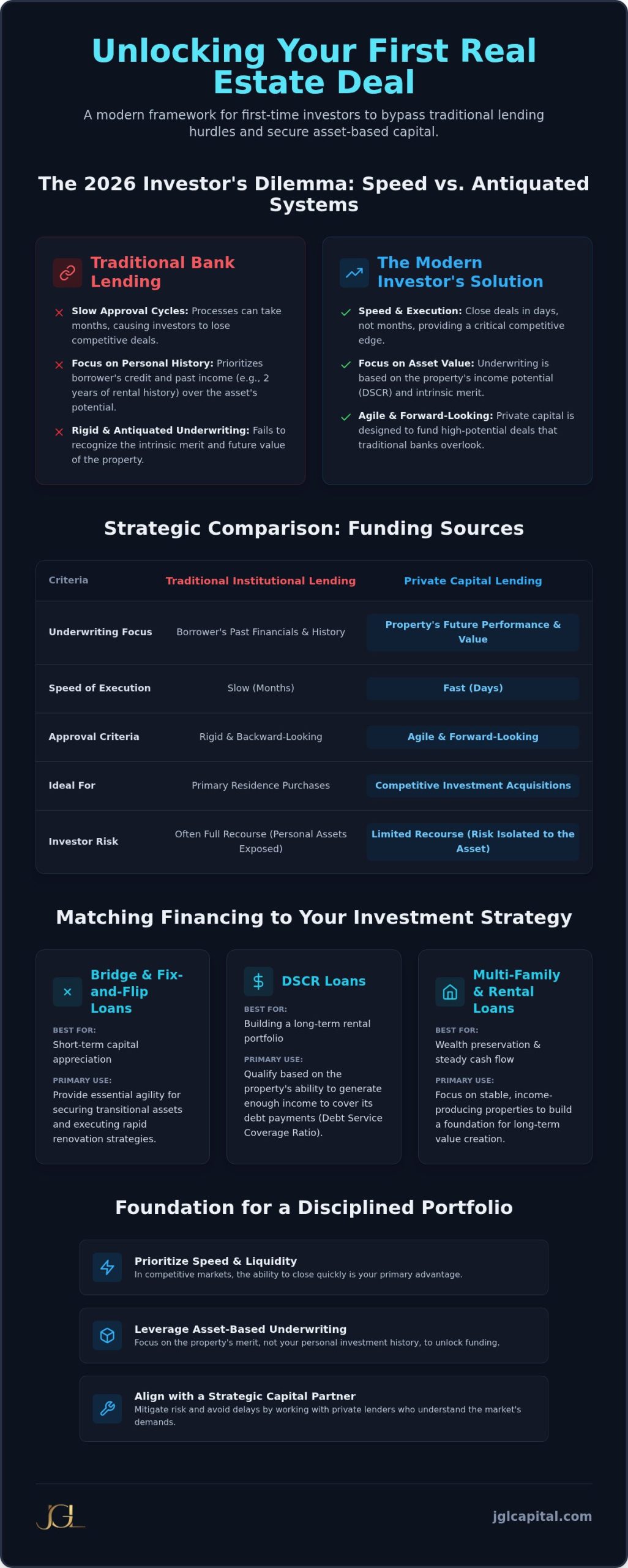
Success begins with a clear alignment between the financing vehicle and the intended exit strategy. A disciplined acquisition philosophy requires the investor to distinguish between long-term rental holds and short-term capital appreciation projects. For instance, loans for first-time real estate investors seeking short-term gains are best served by fix and flip loans or bridge loans, which provide the agility needed for rapid renovation. Conversely, those focused on wealth preservation should opt for multi-family or rental property loans that emphasize steady cash flow. Matching the specific loan product to the asset’s lifecycle ensures that capital remains a tool for value creation rather than a source of structural friction.
Private Capital vs. Traditional Institutional Lending: A Strategic Comparison
Securing capital for property acquisition involves a nuanced evaluation of the trade-off between the nominal cost of debt and the absolute speed of execution. While traditional institutional lending offers lower interest rates, the “hidden costs” of prolonged approval cycles often result in missed opportunities and stalled deal flow. For those seeking loans for first-time real estate investors, the strategic advantage of private capital lies in its ability to isolate risk to the investment asset itself. This is often achieved through limited-recourse structures that protect the investor’s personal balance sheet from the liabilities of a specific project.
The fundamental difference in risk assessment defines these two paths. Traditional mortgage underwriters focus on the borrower’s past financial behavior, whereas private lenders prioritize the future performance and intrinsic value of the asset. This forward-looking perspective is essential for investors who identify high-potential properties that don’t meet the rigid criteria of conventional banking. By prioritizing the merits of the deal, private capital facilitates a more agile approach to portfolio growth. It’s a method that values the generation of worth over the preservation of a paper trail.
Traditional Bank Loans: The Conservative Path
Traditional bank loans represent a conservative strategy characterized by rigorous documentation requirements, including multi-year personal tax returns and strict Debt-to-Income (DTI) thresholds. In 2026, with conventional 30-year fixed-rate mortgages for investment properties averaging between 7.38% and 7.88% APR, the financial barrier remains high for those without a significant established track record. Institutional lenders also frequently impose caps on the total number of properties a single borrower can finance. While SBA loan programs provide alternative avenues for certain business-related real estate, they rarely accommodate the rapid timelines required for competitive residential acquisitions. The resulting delays can be fatal to a transaction’s success.
Private Money and Hard Money: The Professional Alternative
Private money and hard money lenders operate under a different risk paradigm, prioritizing Loan-to-Value (LTV) and After-Repair Value (ARV) over personal credit history. These lenders typically fund up to 65% to 75% of the property’s value, necessitating a 25% to 35% down payment from the investor. Although interest rates for these short-term vehicles range from 9.5% to 12.5%, the speed of funding allows investors to secure distressed assets before they reach the open market. For those operating in high-demand regions, engaging with hard money lenders Florida provides the necessary liquidity to execute on time-sensitive opportunities. By establishing a relationship with a disciplined capital partner, you can move from a reactive posture to a proactive acquisition strategy that focuses on long-term growth.
Primary Financing Vehicles for Emerging Real Estate Portfolios
Selecting the appropriate financing vehicle requires a rigorous alignment between capital structure and the asset’s lifecycle. For those entering the market, loans for first-time real estate investors must be evaluated based on their ability to facilitate specific exit strategies, whether that involves immediate capital appreciation or long-term wealth preservation. In the 2026 credit environment, the distinction between short-term transitional capital and long-term debt service coverage ratio (DSCR) products has become the cornerstone of institutional-grade portfolio management. Professional investors prioritize the flexibility of the loan’s terms to ensure that the financing remains a catalyst for growth rather than a structural hindrance.
Long-term holds are increasingly financed through DSCR loans, which bypass personal income verification by focusing on the property’s ability to cover its own debt obligations. As of July 2026, DSCR rates for well-qualified borrowers average between 7.00% and 7.50%. This product is particularly effective for those who don’t have the two-year landlord history typically required by conventional institutions. By qualifying based on the asset’s performance, investors can scale their portfolios without the limitations of personal debt-to-income ratios.
Bridge Loans for Strategic Acquisitions
Bridge capital serves as a vital tool for securing properties that require immediate liquidity before permanent financing can be arranged. Understanding what is a bridge loan is essential for investors who need to move quickly on competitive assets. These short-term, interest-only vehicles allow for rapid acquisition, providing a window of 12 to 24 months to stabilize the asset or secure a long-term mortgage. With interest rates for these products currently ranging from 9.5% to 12.5%, the value lies in the speed of execution and the ability to capture equity in a high-velocity market.
Fix and Flip Loans: Funding the Renovation Cycle
Capitalizing on distressed assets requires a financing partner that understands the nuances of construction escrow and draw schedules. When utilizing fix and flip loans Florida, investors benefit from capital that covers both the purchase price and the renovation costs. This strategy requires a disciplined cost analysis to ensure that the after-repair value (ARV) justifies the debt service. Funding is typically released in stages, or “draws,” as specific renovation milestones are verified, ensuring that the capital is deployed efficiently throughout the project’s duration.
New Construction Loans for First-Time Developers
Building value from the ground up necessitates a more complex capital stack that manages the gap between land acquisition and vertical completion. Engaging with new construction loans allows emerging developers to finance the entire development lifecycle. These loans require a high level of project management and a clear feasibility assessment. While traditional banks often retreat from new developments during periods of regulatory change, private capital remains a steady steward for well-vetted projects that demonstrate significant market demand and structural integrity.
The Asset-Based Underwriting Process: From Evaluation to Funding
The asset-based underwriting process represents a deliberate departure from the document-heavy, borrower-centric models favored by retail institutions. For those pursuing loans for first-time real estate investors, this methodology is designed to prioritize the structural integrity and financial viability of the property over personal income history. This process moves through five distinct phases: preliminary deal analysis, comprehensive property valuation, internal review of project projections, title and documentation verification, and finally, capital disbursement. Each stage is characterized by a commitment to precision, ensuring that the alignment of objectives between the capital partner and the investor remains intact throughout the transaction lifecycle.
Unlike the rigid approval cycles of traditional banks, which often stall due to personal tax return audits, asset-based lending focuses on the merit of the specific deal. This allows for a streamlined progression from the initial submission to the final closing. By focusing on the asset’s potential, the underwriting process becomes a collaborative effort to verify that the project is grounded in realistic financial projections and a viable exit strategy.
The Importance of the Executive Summary
A well-crafted executive summary serves as the primary instrument for articulating a project’s value proposition to a capital partner. It is here that the investor details the acquisition cost, renovation budget, and anticipated return on investment with analytical clarity. Beyond simple numbers, the summary presents the “story” of the asset, providing the lender with the necessary context to assess risk and feasibility. This document is not merely a formality; it is a strategic tool that facilitates the approval process by demonstrating a disciplined approach to asset management and a clear understanding of the local market dynamics.
Understanding Loan-to-Cost (LTC) vs. Loan-to-Value (LTV)
Understanding the distinction between Loan-to-Cost (LTC) and Loan-to-Value (LTV) is critical for determining the maximum leverage available for a specific acquisition. While LTV focuses on the property’s appraised value, LTC evaluates the loan amount relative to the total project cost, including purchase and renovation. In the 2026 market, lenders typically require first-time investors to maintain “skin in the game,” often funding up to 75% of the property’s value while requiring a 25% down payment. This requirement ensures that the investor remains a dedicated steward of the capital, while also emphasizing the necessity of maintaining cash reserves for unforeseen project contingencies. To begin your acquisition process with a partner that values speed and stability, apply for asset-based financing today.
Establishing a Strategic Alliance with JGL Capital
The pursuit of institutional-grade performance requires more than just access to capital; it necessitates a relationship with a partner that shares your commitment to disciplined growth. At JGL Capital, we view the process of securing loans for first-time real estate investors as the inception of a long-term strategic alliance rather than a mere financial transaction. Our philosophy is rooted in the principles of disciplined stewardship and the delivery of highly customized solutions that reflect the unique objectives of each partner. By prioritizing analytical rigor over marketing hyperbole, we ensure that every loan structure is designed to preserve and generate worth within your emerging portfolio.
Leveraging over 30 years of industry expertise, JGL Capital provides the stability and depth of knowledge required to navigate the complexities of the 2026 real estate market. Our national service coverage allows us to support acquisitions across diverse jurisdictions, providing a consistent level of professional oversight regardless of the asset’s location. We empower investors by providing a streamlined alternative to the conservative constraints of traditional banking, focusing our underwriting on the intrinsic value of the property. This asset-focused approach allows you to scale your operations with the confidence that your capital partner is as invested in the project’s success as you are.
A Collaborative Approach to Worth Creation
Moving beyond the transactional models favored by many tech-first competitors, JGL Capital emphasizes a collaborative approach to the creation of value. We don’t treat our partners as entries in a database; instead, we provide personalized, professional guidance that aligns with your specific acquisition goals. This high-touch service model is essential for those seeking loans for first-time real estate investors, as it provides a layer of institutional expertise that can be the difference between a successful closing and a lost opportunity. Our ability to customize loan structures, whether for a multi-family acquisition or a complex new construction project, ensures that your financing is a precise tool for portfolio expansion.
Taking the Next Step in Your Investment Journey
The transition to professional real estate investment is a significant undertaking that demands a reliable capital partner capable of executing with speed and precision. Initiating a consultation with our senior strategic advisors is the first step toward establishing a foundation for long-term growth. In a volatile market, the value of a quiet expert who relies on established history and intellectual capital cannot be overstated. We invite you to experience the benefits of a disciplined capital partnership and begin the deliberate process of building a lasting legacy. By aligning your objectives with our expertise, you can secure the funding necessary to launch your first project and establish a trajectory for sustained success. Contact JGL Capital to discuss your strategic financing requirements and begin the generation of long-term worth.
Securing the Foundation of Your Real Estate Legacy
Establishing a foothold in the 2026 property market requires a departure from conventional retail mindsets in favor of institutional-grade strategy. The shift toward asset-backed underwriting allows you to leverage the intrinsic value of real estate, bypassing the systemic delays inherent in traditional banking. By selecting financing vehicles that align with your specific exit strategies, you ensure that capital remains a tool for steady advancement rather than a source of structural friction.
JGL Capital offers the stability of over 30 years of industry expertise, utilizing specialized asset-backed underwriting and national capital allocation capabilities to support your growth. Obtaining loans for first-time real estate investors represents the first step in a deliberate journey toward the creation and preservation of worth. We encourage you to Consult with our Strategic Advisors at JGL Capital to begin a collaborative relationship grounded in analytical rigor and integrity. Your path to a lasting real estate legacy starts with a disciplined approach to capital.
Frequently Asked Questions
How much down payment is typically required for a first-time investment loan?
The down payment requirements for loans for first-time real estate investors typically range from 25% to 35% when utilizing private capital. While traditional institutional products may allow for 15% to 25%, these often carry more restrictive personal documentation requirements that can hinder rapid acquisition. Maintaining a significant equity position ensures an alignment of interests between the investor and the capital provider, providing a structural buffer against market volatility.
Do I need a high credit score to qualify for a private money loan?
Private money lenders prioritize the intrinsic value of the asset over the borrower’s personal credit history. While a high score is not the primary determinant for approval, most DSCR programs in 2026 require a minimum of 660, though some programs accommodate scores as low as 640. The emphasis remains on the property’s ability to generate sufficient cash flow to service the debt, rather than the investor’s past consumer behavior.
What is the difference between hard money and a traditional investment mortgage?
Hard money functions as a short-term, transitional vehicle designed for speed and asset-based evaluation, with terms typically spanning 12 to 24 months. Traditional investment mortgages are long-term instruments that focus heavily on the borrower’s debt-to-income ratio and multi-year tax history. Hard money allows for rapid acquisition in competitive environments, whereas traditional mortgages offer lower interest rates at the cost of a prolonged approval cycle.
Can I get a loan for a fix-and-flip project if I have no previous experience?
First-time investors can secure fix-and-flip financing by presenting a disciplined project proforma and a realistic renovation budget. Private lenders evaluate the feasibility of the renovation and the projected after-repair value rather than requiring an extensive track record. Establishing a relationship with an experienced capital partner provides the necessary liquidity to execute your first renovation project with the support of institutional-grade underwriting.
How fast can a private money loan be funded compared to a bank?
Private money loans are typically funded within five to ten business days, providing a significant competitive advantage over traditional banks. Conventional institutional processes often span 30 to 60 days due to complex underwriting and personal financial audits. This streamlined execution allows investors to secure properties in high-velocity markets where speed of closing is often the primary factor in securing a successful deal.
Are there prepayment penalties on bridge or fix-and-flip loans?
Short-term bridge and fix-and-flip loans are generally structured without prepayment penalties to facilitate rapid property exits upon project completion. These vehicles are designed for transitional phases, such as renovation or stabilization, and allow the investor to refinance or sell the asset once the value is realized. It’s essential to verify the specific terms within each loan agreement to ensure they align with your anticipated project duration.
What documents are required for an asset-based loan application?
Asset-based lending requires documentation that focuses on the project’s viability, including a detailed executive summary and a comprehensive renovation budget. Investors must also provide the purchase contract, entity formation documents, and proof of liquidity for the down payment. This process avoids the exhaustive personal tax return audits common in retail banking, prioritizing the strategic merits and income potential of the real estate asset.
How does a DSCR loan work for someone buying their first rental property?
A DSCR loan qualifies a property based on its rental income relative to the debt obligations, rather than the investor’s personal income. This is a dominant choice for loans for first-time real estate investors because it bypasses the need for a documented two-year landlord history. If the projected rental income exceeds the debt service by the lender’s required ratio, the asset is considered a viable candidate for long-term financing.