

An institutional rejection is rarely a definitive verdict on the viability of a real estate acquisition; rather, it’s a reflection of the rigid, regulatory constraints that govern traditional balance sheets. When a bank denied investment property loan now what becomes the immediate concern, the risk of losing earnest money deposits grows as closing deadlines loom. You recognize the frustration of seeing a high-value project dismissed due to personal debt-to-income ratios or the strict 25% down payment requirements often mandated for multi-unit properties in the current May 2026 market.
This guide provides a strategic framework to navigate these financial complexities by leveraging asset-based capital structures that prioritize property performance over personal credit limitations. You’ll learn how to secure reliable funding through bridge or rental property loans that emphasize risk-adjusted returns and strategic oversight. We will also analyze how to adapt to recent shifts, such as the March 18, 2026, Fannie Mae updates regarding condo project eligibility, to ensure your path to portfolio optimization remains unencumbered by institutional inertia.
Key Takeaways
- If a bank denied investment property loan now what remains your primary concern, you must first decode the Adverse Action Notice to distinguish between borrower-level constraints and property-specific valuation issues.
- Transition your financing strategy toward the Debt Service Coverage Ratio (DSCR) to prioritize the intrinsic value and income-generating potential of the collateral over personal income verification.
- Learn to construct a Bespoke Deal Summary that effectively articulates project-level profitability and risk-adjusted returns to institutional-grade alternative capital partners.
- Implement a disciplined five-step recovery framework designed to preserve transaction velocity and secure alternative capital through a focus on asset-based underwriting and strategic stewardship.
Decoding the Adverse Action Notice: Why Institutional Underwriting Fails Investors
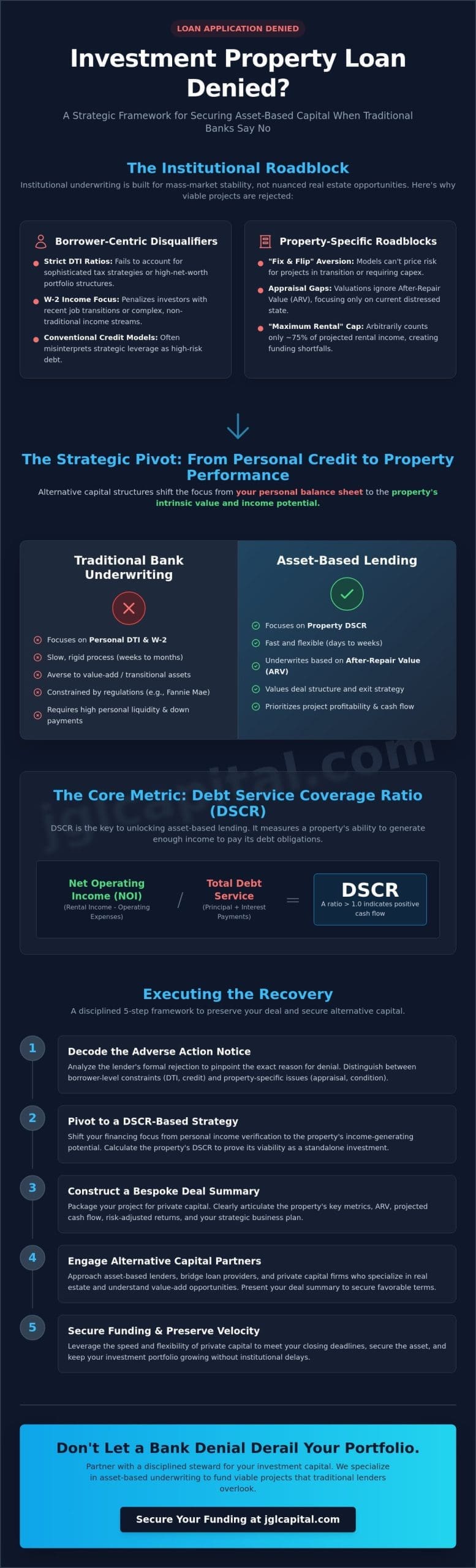
The receipt of an Adverse Action Notice, a formal notification mandated by the Equal Credit Opportunity Act, often marks a critical juncture for the sophisticated real estate investor. This document serves as more than a simple rejection; it’s a regulatory disclosure that outlines the specific reasons an institutional lender has declined to extend credit. When a bank denied investment property loan now what becomes the immediate concern, understanding this notice is the first step toward a strategic pivot. The institutional underwriting process is designed for mass-market stability rather than the nuanced evaluation of high-yield real estate assets. Consequently, many viable projects are discarded because they do not fit into the narrow, algorithmic boxes of conventional finance.
The current lending environment in May 2026 has become increasingly restrictive. Following the issuance of Fannie Mae Lender Letter LL-2026-03 on March 18, 2026, lenders have begun preparing for the retirement of the Limited Review process, which takes full effect on August 3, 2026. This regulatory shift forces a more exhaustive Full Review for nearly all applications, increasing the likelihood of denial for properties that lack historical documentation. Additionally, institutional portfolio concentration limits often dictate lending decisions regardless of a project’s merit. If a bank has reached its internal cap for a specific geographic region or asset class, it’ll issue a denial to maintain its risk-adjusted returns, effectively penalizing the investor for the bank’s own lack of liquidity.
Identifying Borrower-Centric Disqualifiers
Traditional banks rely heavily on Debt-to-Income (DTI) ratios that fail to account for the sophisticated tax strategies employed by high-net-worth individuals. While an investor’s portfolio might show significant capital appreciation, a traditional lender’s focus on “seasoned funds” and W-2 income verification often triggers red flags during recent job transitions or business restructuring. These institutions frequently struggle to interpret complex tax returns, leading to a rejection based on a perceived lack of liquidity that doesn’t reflect the investor’s actual financial strength. Conventional credit scoring models also fail to recognize the strategic use of leverage, often penalizing investors for the very debt that is driving their portfolio optimization.
Evaluating Property-Specific Roadblocks
Institutional underwriting is notoriously averse to assets requiring significant capital expenditures. Banks typically reject properties intended for “fix and flip” intervention because their models cannot accurately price the risk of a project in transition. This is particularly evident in appraisal gaps, where a bank’s valuation ignores the After-Repair Value (ARV) and instead focuses on the current, distressed condition of the asset. Furthermore, scaling investors often encounter a “maximum rental” cap, where a bank refuses to count more than 75% of projected rental income toward qualification, a standard confirmed by industry reports as of January 12, 2026. This arbitrary haircut can bridge the gap between a successful acquisition and a financing failure, regardless of the property’s intrinsic value.
The Strategic Pivot: Evaluating Alternative Capital Structures
When an investor encounters a scenario where a bank denied investment property loan now what becomes the central strategic question, the path forward requires a shift from personal income-based underwriting to a more sophisticated asset-backed capital allocation model. While the Adverse Action Notice requirements ensure a level of transparency regarding the rejection, they don’t offer a solution for the resulting liquidity gap. Private capital fills this void by prioritizing the intrinsic value of the real estate and the project’s projected cash flow over the borrower’s personal tax returns. This pivot is essential in 2026, as traditional depository institutions continue to struggle with balance sheet volatility and rigid regulatory oversight.
The primary advantage of alternative capital structures lies in their inherent flexibility and speed. Traditional banks often operate with a bureaucratic inertia that can jeopardize time-sensitive acquisitions, especially when investor home purchases are showing increased competition, as seen in the 2% rise in Q4 2025. In contrast, commercial real estate loans from private sources provide bespoke terms that accommodate complex deal structures, such as multi-layered ownership or unconventional collateral. This high-velocity capital allows investors to maintain transaction momentum, ensuring that earnest money deposits aren’t forfeited due to institutional delays.
Bridge Loans for Transitional Capital
For investors facing immediate financing gaps, the strategic guide to transitional real estate capital highlights bridge financing as a critical tool for short-term liquidity. These loans serve as a temporary solution, securing the asset while long-term permanent financing is being restructured or the property is being stabilized. By utilizing interest-only structures, bridge lending maximizes short-term cash flow, allowing the investor to focus capital on property improvements rather than principal reduction. It’s a disciplined approach to wealth preservation during the transitional phases of an investment lifecycle.
Hard Money as a High-Velocity Tool
Opportunistic acquisitions often require a level of agility that traditional lenders simply can’t match. Engaging with hard money lenders provides a viable path for properties in poor condition or those requiring rapid closure. Because hard money is fundamentally asset-centric, the focus remains on the collateral’s value rather than the borrower’s immediate liquidity or credit score. This makes it an indispensable resource for fix-and-flip projects where the bank’s refusal to recognize After-Repair Value (ARV) would otherwise stall the project. Evaluating these bespoke funding solutions ensures that your portfolio growth remains dictated by market opportunity rather than institutional red tape.
Asset-Based Lending: Prioritizing Collateral over Personal Credit
The transition from institutional rejection to capital certainty requires an embrace of asset-based underwriting. When a bank denied investment property loan now what remains the central question, the solution often resides in the Debt Service Coverage Ratio (DSCR). This metric displaces personal income as the primary arbiter of creditworthiness, allowing for a more precise articulation of a project’s viability. Private capital evaluates the intrinsic value of an asset, prioritizing its ability to generate risk-adjusted returns rather than relying on historical tax returns that may not reflect current liquidity. This approach is particularly advantageous for investors who have exceeded the ten-property limit common in conventional finance or those seeking fix and flip loans where the After-Repair Value serves as the fundamental anchor for capital allocation.
By focusing on the collateral, asset-based lending bypasses the personal debt-to-income (DTI) constraints that frequently stall growth for high-net-worth individuals. While traditional banks often apply a 75% haircut to projected rental income, as noted in reports from January 12, 2026, private lenders look at the actual cash flow potential. This alignment of interests ensures that the financing structure supports long-term wealth preservation. It allows investors to scale their portfolios without being penalized for the strategic use of leverage, provided the underlying assets maintain a disciplined margin of safety.
The DSCR Framework for Rental Portfolios
The Debt Service Coverage Ratio is calculated by dividing the property’s Net Operating Income (NOI) by its total debt service. Sophisticated private lenders generally prefer a ratio above 1.2x, which indicates that the property generates 20% more income than is required to cover mortgage obligations. This framework offers several strategic advantages:
- Elimination of Personal DTI: Qualification is based on the property’s performance, not the investor’s personal monthly expenses.
- Unlimited Scalability: Investors aren’t restricted by the arbitrary caps on the number of financed properties that govern conventional mortgage liquidity.
- Efficient Processing: By removing the need for exhaustive personal financial audits, the timeline from application to funding is significantly compressed.
Financing New Construction and Development
For developers facing institutional hesitation, new construction loans from private sources provide a level of strategic oversight that traditional banks cannot match. These loans utilize a disciplined draw schedule, where capital is released in phases based on verified construction milestones. This process ensures project completion while mitigating the risks associated with deferred maintenance or budget overruns. Partnering with a lender who understands the development lifecycle, rather than a mere mortgage processor, transforms the financing relationship into a form of high-level stewardship, ensuring that every dollar allocated contributes directly to value creation.
Executing the Recovery: A 5-Step Guide to Securing Alternative Funding
The moment of institutional rejection requires immediate, disciplined action rather than a passive acceptance of the bank’s verdict. When the question of bank denied investment property loan now what arises, the investor must pivot toward a strategic recovery framework that prioritizes speed and asset-based clarity. This process begins with an exhaustive audit of the institutional failure to determine if the hurdle was a matter of borrower eligibility or a fundamental misunderstanding of the property’s value. By following a structured five-step approach, you can transition from a stalled transaction to a successfully funded acquisition.
You must request a full copy of the appraisal and the formal statement of denial reasons immediately. This data allows for a precise identification of whether the rejection was driven by borrower-level metrics or property-specific valuation gaps. Once this information is secured, the next priority is preparing a Bespoke Deal Summary that highlights project-level profitability and risk-adjusted returns. This summary should be supported by a Project Executive Summary containing detailed contractor bids and clearly defined exit strategies, such as a refinance into a long-term rental property loan or a strategic sale. Vetting private money brokers for institutional-grade reliability ensures that your capital partner possesses the necessary stability to reach the finish line. Unlike traditional banks, private capital often operates on an accelerated timeline, frequently reaching a closing within 7 to 14 days, which is essential for preserving transaction momentum.
Step 1 & 2: Audit and Re-Framing
Analyzing an appraisal for specific clerical errors or inappropriate comparable selections provides the necessary leverage to challenge a low valuation that may have triggered the initial denial. You should pivot your narrative to highlight the strength of your professional real estate entity, emphasizing an LLC structure and a documented track record of successful capital allocation. This shift signals to private lenders that they’re partnering with a disciplined investor rather than a retail borrower. Maintaining transparent documentation of all previous project successes further solidifies your position as a seasoned steward of capital.
Step 3, 4 & 5: Selection and Execution
Evaluating loan terms requires a focus on the total cost of capital, including points and fees, rather than a singular obsession with interest rates. The submission process for asset-backed loans relies heavily on high-quality property photography and a comprehensive scope of work to facilitate a rapid underwriting decision. Finalizing the deal involves a coordinated walkthrough and closing process that satisfies the rigorous standards of private money stewards. If you require a partner to navigate this transition, evaluate our bespoke funding solutions to secure the capital your project deserves.
JGL Capital: A Disciplined Steward for Your Investment Capital
JGL Capital stands as a seasoned strategic partner, bringing over 30 years of industry expertise to the resolution of complex financing challenges. When a bank denied investment property loan now what dictates your next strategic move, our firm provides the stability and analytical rigor required to preserve your project’s momentum. We operate on a philosophy that prioritizes the intrinsic value of the real estate and the demonstrated track record of the investor over the rigid, often arbitrary, red tape of traditional depository institutions. Our commitment to the alignment of interests ensures that every capital allocation we facilitate is designed to support long-term wealth creation and portfolio optimization.
We provide bespoke lending solutions that address the full spectrum of real estate development and acquisition. Whether your project involves complex multi-family financing, time-sensitive bridge loans, or the specialized requirements of new construction, JGL Capital delivers a level of strategic oversight that transactional competitors cannot match. Our approach is rooted in transparency and speed, recognizing that in the high-stakes environment of 2026, transaction velocity is often as critical as the cost of capital itself. By focusing on the underlying value of the collateral, we ensure that your path to scaling a portfolio remains unencumbered by the personal credit constraints that frequently stall conventional mortgage applications.
Institutional Rigor in Private Lending
JGL Capital applies institutional-grade analytical rigor to every deal, ensuring that risk-adjusted returns are meticulously calculated before any capital is deployed. We serve as a discreet partner for high-net-worth individuals and institutional developers who require a sophisticated alternative to the bureaucratic delays of conventional banking. Our streamlined underwriting process focuses on the fundamental strengths of the asset, allowing us to bypass the common roadblocks that lead to institutional rejection. This disciplined approach transforms the lending relationship from a simple service provision into a form of high-level partnership where your success is the primary metric of our performance.
Securing Your Next Allocation
Establishing a partnership with a reliable private capital source offers long-term benefits that extend far beyond a single transaction. It provides a foundation for rapid scaling and ensures that you’re never limited by the shifting liquidity constraints of the traditional mortgage market. We encourage you to engage in a formal consultation to discuss your specific capital needs and explore how our bespoke solutions can support your legacy. Establishing this connection now ensures that when opportunistic acquisitions arise, your capital is already positioned for deployment. Engage JGL Capital for a sophisticated review of your investment property loan requirements.
Advancing Your Portfolio Beyond Institutional Constraints
The transition from an institutional rejection to a successfully funded acquisition requires a pivot from traditional income-based underwriting to a disciplined, asset-centric strategy. By prioritizing the Debt Service Coverage Ratio and the intrinsic value of the collateral, you bypass the personal debt-to-income limitations that often impede high-velocity growth. When a bank denied investment property loan now what becomes the primary strategic question, the solution lies in aligning with a partner that values project-level profitability and the investor’s track record. JGL Capital leverages over 30 years of strategic industry expertise to provide nationwide capital allocation for complex real estate projects, ensuring that your transaction velocity remains undisturbed by bureaucratic delays.
Securing a sophisticated capital partner is the most critical step in building a lasting legacy through real estate. Our asset-based underwriting prioritizes the performance of the property, providing a reliable alternative to the rigid constraints of the 2026 mortgage market. Partner with JGL Capital for a strategic evaluation of your investment financing needs. Your pursuit of long-term wealth preservation and portfolio optimization deserves a partner who shares your commitment to excellence and analytical rigor. We’re ready to help you transform institutional rejection into a catalyst for strategic growth.
Frequently Asked Questions
What are the most common reasons a bank denies an investment property loan in 2026?
Institutional lenders primarily deny loans due to rigid Debt-to-Income (DTI) requirements or the 25% down payment mandates for multi-unit properties. Regulatory updates, specifically Fannie Mae Lender Letter LL-2026-03 effective March 18, 2026, have forced lenders into more exhaustive Full Reviews. These shifts often disqualify properties with deferred maintenance or those in regions where the bank has already reached its internal capital allocation caps.
Can I still get a loan if my Debt-to-Income (DTI) ratio is too high for a bank?
You can secure financing despite a high Debt-to-Income ratio by utilizing asset-based lending structures such as Debt Service Coverage Ratio (DSCR) loans. These programs prioritize the property’s Net Operating Income over your personal financial liabilities. Because the underwriting focuses on the asset’s ability to generate risk-adjusted returns, your personal DTI becomes a secondary consideration. This allows for portfolio optimization without the constraints of traditional institutional balance sheets.
How quickly can a private money lender fund a deal after a bank denial?
Private money lenders typically facilitate funding within 7 to 14 days, providing a high-velocity alternative to the 30 to 45 day timelines common in traditional banking. This speed is essential when a bank denied investment property loan now what becomes a race against expiring earnest money deadlines. By utilizing a streamlined underwriting process that emphasizes collateral value, private capital ensures that transaction momentum is preserved even during periods of market volatility.
What is the difference between a bridge loan and a traditional mortgage for an investor?
A bridge loan provides short-term, transitional capital designed to secure an asset while permanent financing is restructured or the property is stabilized. Unlike traditional mortgages, which focus on long-term amortization and borrower creditworthiness, bridge loans often utilize interest-only structures to maximize short-term cash flow. This flexibility allows investors to execute complex acquisitions that don’t yet meet the rigid criteria of institutional depository lenders.
Is it possible to secure a loan for a property in poor condition that failed a bank inspection?
Securing capital for distressed properties is possible through fix and flip loans that specifically account for the After-Repair Value (ARV). While institutional lenders often reject properties with significant rehabilitation needs, private capital provides the strategic oversight necessary to fund these opportunistic acquisitions. These asset-centric programs prioritize the project’s eventual profitability, ensuring that properties requiring intervention receive the necessary capital allocation for successful revitalization.
What documents do I need to provide for an asset-based loan application?
Asset-based loan applications require a professional Bespoke Deal Summary, property photographs, and a detailed scope of work rather than exhaustive personal tax returns. You’ll also need to provide entity documentation for your LLC and a summary of your previous real estate track record. This documentation allows the lender to conduct thorough due diligence on the property’s performance and your ability to execute the proposed investment strategy.
How do interest rates for private money compare to traditional institutional rates?
Interest rates for private capital are generally higher than traditional institutional rates, reflecting the increased risk and accelerated speed of the funding process. As of May 7, 2026, the national average 30-year fixed APR sits at 6.54%, with investment property premiums typically adding 0.5% to 1%. Private money rates accommodate the flexibility and stewardship required for complex deals that don’t fit these conventional, low-yield institutional models.
Will a bank denial affect my ability to get a loan from a private lender?
A bank denial has no negative impact on your ability to secure private capital, as private underwriters operate under a different set of risk-assessment principles. We recognize that institutional rejections are often the result of rigid regulatory constraints rather than a verdict on a project’s viability. When a bank denied investment property loan now what is the concern, focusing on the intrinsic value of the collateral allows private lenders to provide a reliable path to funding that bypasses the bureaucratic hurdles of traditional banking.