

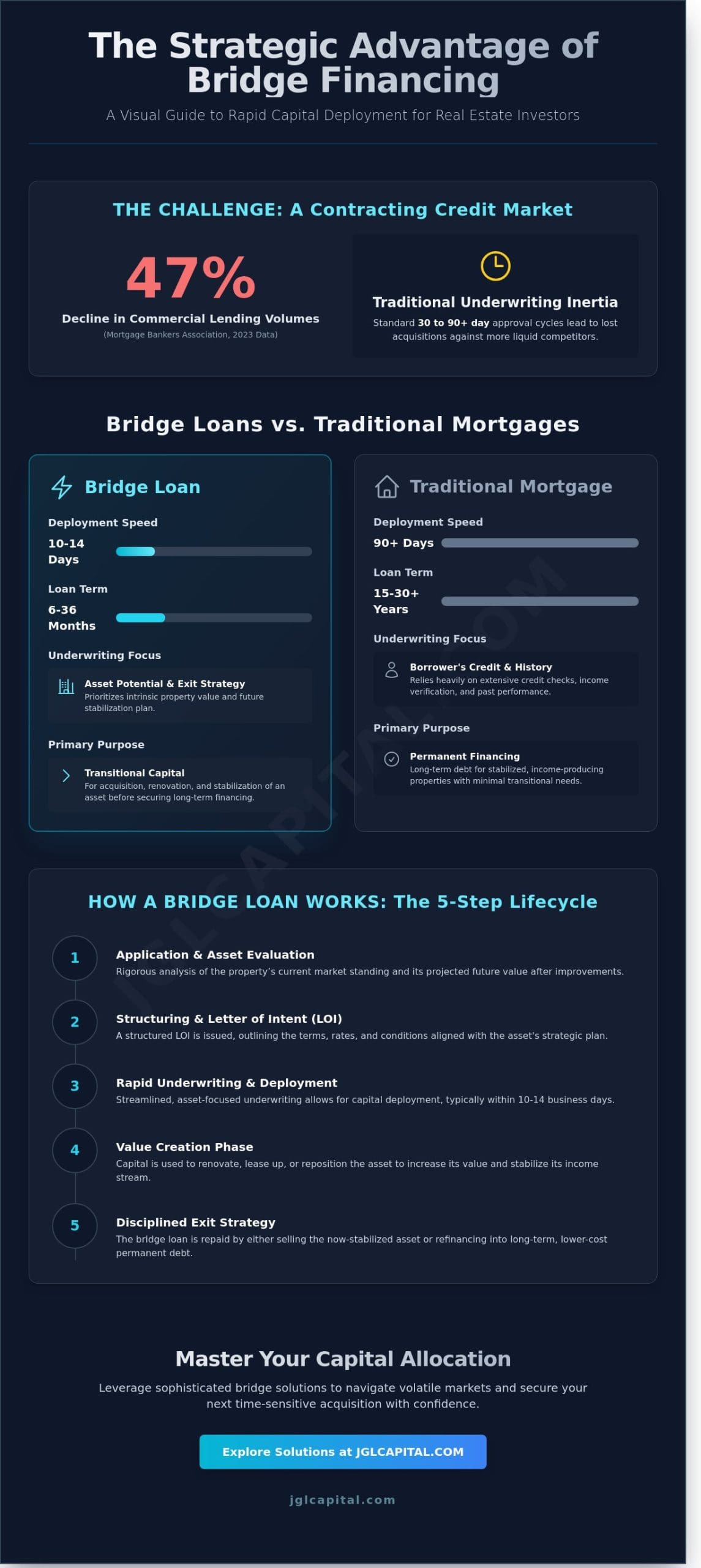
In the current climate of institutional volatility, the greatest threat to a portfolio’s growth is often the inertia of traditional banking. According to the Mortgage Bankers Association’s 2023 data, commercial lending volumes declined by 47 percent; a shift that underscores the necessity for more agile financial instruments. You likely recognize that waiting for a standard thirty day underwriting cycle can result in the loss of a premier acquisition to a more liquid competitor. To maintain a competitive advantage, it’s essential to understand exactly how does a bridge loan work as a mechanism for rapid capital deployment and strategic repositioning.
This guide provides the analytical framework you need to master the mechanics of bridge financing and optimize your capital allocation across complex real estate portfolios. We’ll explore how to leverage the intrinsic value of an asset rather than relying solely on traditional credit scores, ensuring you can execute time sensitive acquisitions with confidence. By the conclusion of this analysis, you’ll possess a clear roadmap of the end to end process, from the initial structuring of the capital stack to the execution of a disciplined exit strategy.
Key Takeaways
- Define the strategic utility of bridge financing as a sophisticated, short-term instrument for navigating transitional periods within a real estate portfolio.
- Examine the operational lifecycle and mechanics to comprehend how does a bridge loan work in practice, beginning with rigorous asset evaluation and the issuance of a structured Letter of Intent.
- Develop a disciplined implementation strategy by assessing the cost of capital against the projected risk-adjusted returns of specific property acquisitions.
- Analyze the intricate financial components of bridge solutions, including the correlation between deployment speed and the total cost of capital.
- Gain insights into leveraging asset-based lending expertise to prioritize property potential and strategic value creation over conventional borrower history.
Defining the Strategic Utility of Bridge Financing
Bridge financing serves as a sophisticated, short-term, asset-backed instrument designed to provide liquidity during critical transitional periods. Unlike permanent debt, this form of capital facilitates the acquisition or stabilization of assets that do not yet meet the rigid criteria of conventional institutional lenders. To understand how does a bridge loan work, one must view it as a specialized tool for capital allocation; it prioritizes the underlying collateral value over the exhaustive credit-heavy underwriting typically found in retail banking. This asset-based lending model allows sophisticated investors to bypass the bureaucratic delays of traditional finance, enabling the execution of time-sensitive acquisitions or complex renovations where speed is the primary determinant of success.
The fundamental essence of a Bridge loan lies in its role as transitional capital. It functions as a financial conduit, providing the necessary leverage to move an asset from its current state to a point of stabilization where long-term, lower-cost financing becomes accessible. In the context of high-stakes financial management, this capital is not merely a debt obligation but a strategic mechanism for value creation. It allows for the preservation of equity while maintaining the momentum required to secure opportunistic investments in volatile or compressed markets.
The Concept of Interim Capital Allocation
Investors utilize bridge loans to maintain high levels of liquidity during property transitions, ensuring that capital remains deployed in productive assets rather than being sidelined by lengthy approval cycles. In the 2024 real estate market, where transaction windows often close within 15 to 30 days, the ability to deploy private capital rapidly provides a decisive competitive advantage. This agility allows for the acquisition of distressed or under-managed properties that require immediate intervention to realize their risk-adjusted returns. Bridge loans function as a catalyst for strategic oversight and growth.
Bridge Loans vs. Traditional Mortgages
The distinction between bridge capital and traditional permanent financing is defined by both duration and the philosophy of risk assessment. While a conventional bank mortgage involves a multi-month approval process that often exceeds 90 days, private bridge capital can be deployed within 10 to 14 business days. This disparity in speed is a direct result of the streamlined underwriting focused on the asset’s exit strategy and future valuation. For those evaluating long-term debt structures, a detailed bridge loan mortgage comparison provides the necessary context for portfolio optimization.
Duration remains a key differentiator. Traditional mortgages are structured for decades; however, bridge loans are engineered for the short term, typically ranging from six months to three years. This limited timeframe reflects the instrument’s purpose as a temporary solution. Sophisticated borrowers recognize that how does a bridge loan work in practice is by providing a window of opportunity to renovate, lease up, or reposition an asset before transitioning to a permanent capital stack. This disciplined approach to debt ensures that the investor retains flexibility without being tethered to long-term constraints during the early stages of an asset’s lifecycle.
The Operational Mechanics: How a Bridge Loan Works in Practice
Understanding how does a bridge loan work requires a granular examination of the lifecycle from initial inquiry to the terminal exit. This process is characterized by a high degree of speed and asset-specific analysis; it distinguishes itself from the protracted timelines of conventional banking. According to data from the Mortgage Bankers Association in 2023, transitional lending continues to serve as a critical liquidity bridge in a market where traditional credit remains constricted. The journey begins with a rigorous application and preliminary asset evaluation where lenders analyze the property’s current market standing alongside its projected future value. This dual-track assessment ensures the capital allocation aligns with the asset’s intrinsic potential and the borrower’s strategic objectives.
- Step 1: Application and Evaluation. The borrower submits a comprehensive package detailing the asset’s current performance and the proposed value-add strategy.
- Step 2: Letter of Intent (LOI). The lender issues a formal document outlining the strategic oversight, interest rates, and loan-to-value parameters that will govern the transaction.
- Step 3: Underwriting and Due Diligence. A deep-dive investigation into the property’s title, environmental status, and physical condition ensures the collateral is sound.
- Step 4: Closing and Disbursement. Capital is deployed through a streamlined escrow process, often in as little as 10 to 14 days, providing the liquidity needed for immediate action.
- Step 5: Strategy Execution and Exit. The borrower implements their business plan, eventually transitioning to long-term financing or divesting the asset to satisfy the debt.
Underwriting and Asset Valuation Protocols
Institutional bridge lenders prioritize the intrinsic value of the collateral and Loan-to-Value (LTV) ratios over traditional metrics like personal credit history. In most scenarios, LTV ratios are restricted to 65% or 75% of the current appraised value to mitigate downside risk. For distressed assets or renovation projects, lenders heavily weight the After Repair Value (ARV), which projects the property’s worth following specific capital improvements. Assessing whether Is A Bridge Loan Right For You? involves a deep dive into these collateral requirements, as the clarity of the title and the precision of property condition reports are non-negotiable in asset-backed lending. This rigorous focus on the asset ensures that the financing is grounded in tangible value rather than speculative projections.
The Disbursement and Interest Accumulation Phase
The financial structure of transitional capital is designed to preserve cash flow during the critical early stages of an investment. Interest-only payments are the standard, allowing the borrower to focus resources on property stabilization rather than principal reduction. Many sophisticated structures incorporate interest reserves, where a portion of the loan proceeds is held in escrow to cover debt service for the first 9 to 12 months. This mechanism provides a safety net for projects with deferred occupancy or ongoing construction. Total capital costs are also influenced by “points” or origination fees, which typically range from 100 to 300 basis points of the total loan volume. A strategic partnership with a seasoned capital provider ensures these costs are transparent and aligned with the long-term preservation of wealth, allowing for a seamless transition to the next phase of the investment lifecycle.
Executing a Bridge Strategy: A Step-by-Step Implementation Guide
Executing a transitional capital strategy requires more than just securing funds; it demands a rigorous investment thesis tailored to the specific asset. Investors must first quantify the delta between the entry price and the projected terminal value after the bridge period. This analysis necessitates a precise calculation of the cost of capital against the risk-adjusted returns. Analyzing how does a bridge loan work in relation to a specific asset’s cash flow is the first step toward successful deployment. If the debt service coverage ratio (DSCR) doesn’t support the eventual refinance, the strategy is fundamentally flawed. Capital preservation is paramount. Successful capital allocation involves integrating the bridge loan into a complex capital stack to maximize leverage while maintaining a disciplined safety margin. In the 2024 lending environment, this often means targeting a 75% loan-to-value ratio to buffer against market fluctuations. Selecting a partner who prioritizes the alignment of interests ensures that the strategic oversight matches the investor’s long-term objectives.
Identifying the Transitional Funding Requirement
The first step involves diagnosing the specific nature of the capital deficiency. Is the need driven by a time-sensitive purchase-before-sale scenario or a heavy renovation requirement? Investors often utilize a bridge loan for home purchase when they must secure a high-value investment property before liquidating an existing asset. Determining the exact duration needed to secure permanent financing is critical. Most institutional bridge terms range from 12 to 36 months, providing the necessary runway to execute property improvements or stabilize occupancy rates. Understanding the mechanics of how a bridge loan works allows investors to anticipate interest-only payments and the impact of points on the overall yield. Precision in this phase prevents the erosion of equity through unexpected carrying costs.
Structuring the Exit Strategy for Capital Preservation
A bridge loan is a temporary conduit to a permanent destination; therefore, the exit strategy is the most vital component of the deal structure. The primary mechanism for repayment is usually a take-out loan or a specific sale event. Seasoned investors use these short-term vehicles to bridge to a long-term DSCR or conventional loan once the property meets stabilized underwriting criteria. Relying on a single exit path is risky. A disciplined steward of capital always maintains a secondary backup plan. If market volatility delays a sale, the investor must have the liquidity or extension options to carry the debt without eroding equity. This methodical approach ensures that the question of how does a bridge loan work is answered through the lens of strategic wealth creation and meticulous risk management.
Analyzing the Financial Implications and Risk-Adjusted Returns
Understanding how does a bridge loan work requires a granular analysis of the trade-off between premium pricing and the velocity of capital deployment. While traditional permanent financing prioritizes the lowest possible interest rate, transitional capital serves a different strategic objective. It’s designed to capture immediate market inefficiencies that would otherwise vanish during a standard 60-day underwriting cycle. The premium paid for bridge capital is, in essence, a purchase of time and certainty. In volatile environments, the cost of a missed acquisition often exceeds the spread between bridge rates and long-term debt.
The total cost of capital is a composite of several levers. Beyond the base interest rate, which often floats over a benchmark like SOFR, borrowers must account for origination points, exit fees, and processing costs. Analytical rigor is essential when calculating the impact of these factors on the project’s Internal Rate of Return (IRR). Because bridge loans are short-term instruments, the compression of these fees over a 12-month or 18-month period creates a higher effective annual rate. However, if the capital allows for a rapid renovation or stabilization that increases asset value by 20%, the nominal cost of the debt becomes a secondary concern to the value created.
Understanding Interest Reserves and Points
Points represent a percentage-based fee paid at closing, typically ranging from 1% to 3% of the total loan commitment. These fees compensate the lender for the accelerated underwriting and the higher risk profile of transitional assets. Most bridge structures utilize interest-only payments, which maximize cash flow during the critical execution phase of a business plan. For a detailed breakdown of current market pricing, consult the guide on bridge loan rates. Many institutional lenders also require an interest reserve, which is a set-aside portion of the loan proceeds used to service debt payments until the asset generates sufficient cash flow.
Mitigating Strategic Risks in Volatile Markets
Short-term financing introduces specific vulnerabilities, most notably maturity risk and market fluctuations. If interest rates rise or cap rates expand during the loan term, the planned exit strategy or refinancing may become less viable. A disciplined approach to asset selection remains the most effective defense. It’s common for sophisticated investors to maintain conservative Loan-to-Value (LTV) ratios, often between 65% and 70%, to provide an equity cushion against downward price adjustments. This margin of safety ensures that even if market conditions shift, the principal remains protected. When you’re ready to secure your next acquisition, you can discuss your capital allocation strategy with our team of specialists.
A successful bridge strategy relies on a clear, documented path to a capital event. Whether that event is a sale or a transition to permanent debt, the borrower’s ability to execute determines the ultimate risk-adjusted return. How does a bridge loan work for the long-term health of a portfolio? It acts as a catalyst, allowing the investor to reposition assets and optimize the capital stack before committing to a 10-year debt obligation. This deliberate pacing reflects a commitment to stewardship and the preservation of wealth through calculated, strategic action.
Partnering with JGL Capital for Sophisticated Bridge Solutions
JGL Capital brings three decades of specialized experience to the private money and commercial lending sector, providing a level of intellectual capital that distinguishes our firm from traditional retail lenders. By maintaining an asset-based philosophy, we prioritize the inherent potential and risk-adjusted returns of a property rather than focusing exclusively on the historical credit profiles of borrowers. This approach allows developers to secure transitional capital based on the strength of their vision and the value of the underlying collateral. Our streamlined methodology serves as a robust alternative to conventional banking, offering rapid funding timelines that are critical when market conditions demand immediate action. Property developers often find that bespoke financing programs, which are tailored to the unique lifecycle of a project, provide the agility necessary to convert opportunistic acquisitions into high-performing assets.
The Institutional Advantage of Private Capital
As a disciplined steward of capital, JGL Capital functions as a strategic ally for institutional partners and high-net-worth individuals who manage high-stakes transactions. We understand that portfolio optimization requires more than just capital; it necessitates a partner who appreciates the gravity of complex real estate cycles. Our national reach empowers investors to scale their portfolios across diverse jurisdictions while maintaining a singular, reliable point of contact. This institutional framework ensures that every allocation is governed by analytical rigor and a commitment to long-term wealth preservation. We prioritize the alignment of interests, ensuring that our strategic oversight reflects a deep understanding of the risks and rewards inherent in transitional real estate. It’s this commitment to stability that allows our partners to pursue ambitious growth strategies with confidence.
Streamlined Origination for High-Stakes Transactions
Efficiency in underwriting is paramount for property developers seeking to capitalize on time-sensitive opportunities. JGL Capital utilizes simplified documentation requirements to facilitate asset-backed bridge loans, ensuring that transparency remains a cornerstone of the entire process. While many investors ask what is a bridge loan to understand the foundational mechanics, our firm focuses on the sophisticated execution of these instruments. By removing the bureaucratic hurdles often found in traditional finance, we provide a clear path to closing without compromising on due diligence.
Understanding how does a bridge loan work within the context of a bespoke financing program is essential for developers who require capital tailored to specific project milestones. Our commitment to integrity and strategic oversight ensures that each transaction is executed with the precision required to build lasting legacies. We provide the following advantages to our clients:
- Rapid Capital Allocation: Access to funding within days rather than the months required by traditional institutions.
- Asset-Centric Underwriting: A primary focus on the after-repair value (ARV) and future income potential of the collateral.
- Customized Structures: Flexible terms that accommodate complex ownership hierarchies and special purpose entities.
This methodical approach to capital deployment reinforces our position as a leader in the private lending landscape. By bridging the gap between acquisition and permanent financing, we empower our clients to execute their business plans with precision and speed.
Optimizing Portfolio Growth Through Disciplined Transitional Capital
Navigating the complexities of transitional real estate requires more than just liquidity; it demands a sophisticated understanding of how does a bridge loan work within a broader investment thesis. By prioritizing asset-based underwriting and the intrinsic potential of a property, institutional investors can secure the capital necessary to execute time-sensitive acquisitions or complex renovations. Success in this specialized field depends on the meticulous alignment of short-term financing with long-term portfolio objectives. JGL Capital brings over 30 years of strategic expertise to every transaction, offering a disciplined approach to capital allocation that prioritizes the preservation of wealth. Our national reach ensures that developers across the United States have access to the professional oversight necessary for high-stakes projects. It’s through this rigorous analytical lens that we evaluate property value to ensure your strategy remains resilient in shifting markets. We invite you to partner with JGL Capital for strategic bridge financing solutions that reflect your commitment to excellence. Your vision for institutional growth deserves a partner who values integrity and precision as much as you do.
Frequently Asked Questions
How long does the typical bridge loan approval and funding process take?
Bridge loan funding typically occurs within 10 to 14 business days, though expedited transactions can reach fruition in as few as 5 days. This rapid timeline serves as a primary advantage for sponsors seeking to capitalize on immediate market opportunities. While traditional commercial mortgages often require 45 to 90 days for full underwriting, the streamlined nature of private capital allows for the swift deployment of resources.
What are the primary requirements for securing a bridge loan from a private lender?
Lenders prioritize the underlying asset’s intrinsic value and a well-defined exit strategy, typically requiring a minimum Loan-to-Value (LTV) ratio of 65% to 75%. While credit scores are reviewed, the focus remains on the property’s potential for value creation and the sponsor’s professional track record. Documentation generally includes a detailed business plan, current rent rolls, and evidence of liquidity to cover interest reserves during the transitional period.
Can a bridge loan be used for new construction or property renovations?
Bridge financing is frequently utilized for ground-up construction and heavy renovation projects where traditional permanent financing isn’t yet viable. Understanding how does a bridge loan work in these scenarios involves recognizing that capital is often released in draws based on pre-defined construction milestones. These funds facilitate the stabilization of an asset, allowing the sponsor to eventually transition into a long-term agency or CMBS loan.
What happens if I cannot sell my property before the bridge loan term ends?
If a property remains unsold at the conclusion of the term, sponsors typically seek a loan extension or pursue a refinance into a bridge-to-permanent product. Most bridge agreements include a specific extension option, often for a period of 6 to 12 months, provided the borrower pays an extension fee. Failure to secure these arrangements may result in the lender initiating foreclosure proceedings to recover the allocated capital.
Are bridge loan interest rates higher than traditional commercial mortgages?
Bridge loan interest rates are consistently higher than those of traditional mortgages, reflecting the increased risk and the short-term nature of the capital. According to 2023 industry benchmarks from Trepp, bridge rates often range from 200 to 500 basis points above the Secured Overnight Financing Rate (SOFR). This premium compensates the lender for providing rapid, flexible funding that institutional banks generally avoid due to strict regulatory constraints.
Is a down payment required for an asset-backed bridge loan?
A cash equity contribution is standard, with most lenders requiring a down payment of 20% to 35% of the total purchase price. This capital ensures an alignment of interests between the sponsor and the lender, protecting the portfolio against market volatility. In certain value-add scenarios, the lender might fund 100% of the renovation costs if the initial purchase price is sufficiently covered by the sponsor’s equity.
Can bridge loans be used for multi-family or commercial real estate acquisitions?
Bridge loans are ideal for the acquisition of multi-family complexes, office buildings, and industrial warehouses that require immediate capital for stabilization. Understanding how does a bridge loan work for commercial assets reveals that these instruments bridge the gap between acquisition and long-term financing. They provide the necessary liquidity to purchase underperforming properties, execute a capital improvement plan, and increase the Net Operating Income.
How do lenders calculate the maximum loan amount for a bridge transaction?
Lenders determine the maximum loan amount by evaluating the lower of the Loan-to-Cost (LTC) or the After-Repair Value (ARV), typically capping at 80% LTC. This calculation involves a rigorous analysis of the current appraised value and the projected value following the completion of the strategic business plan. By focusing on these metrics, lenders ensure that the debt remains properly collateralized throughout the entire life of the investment.