

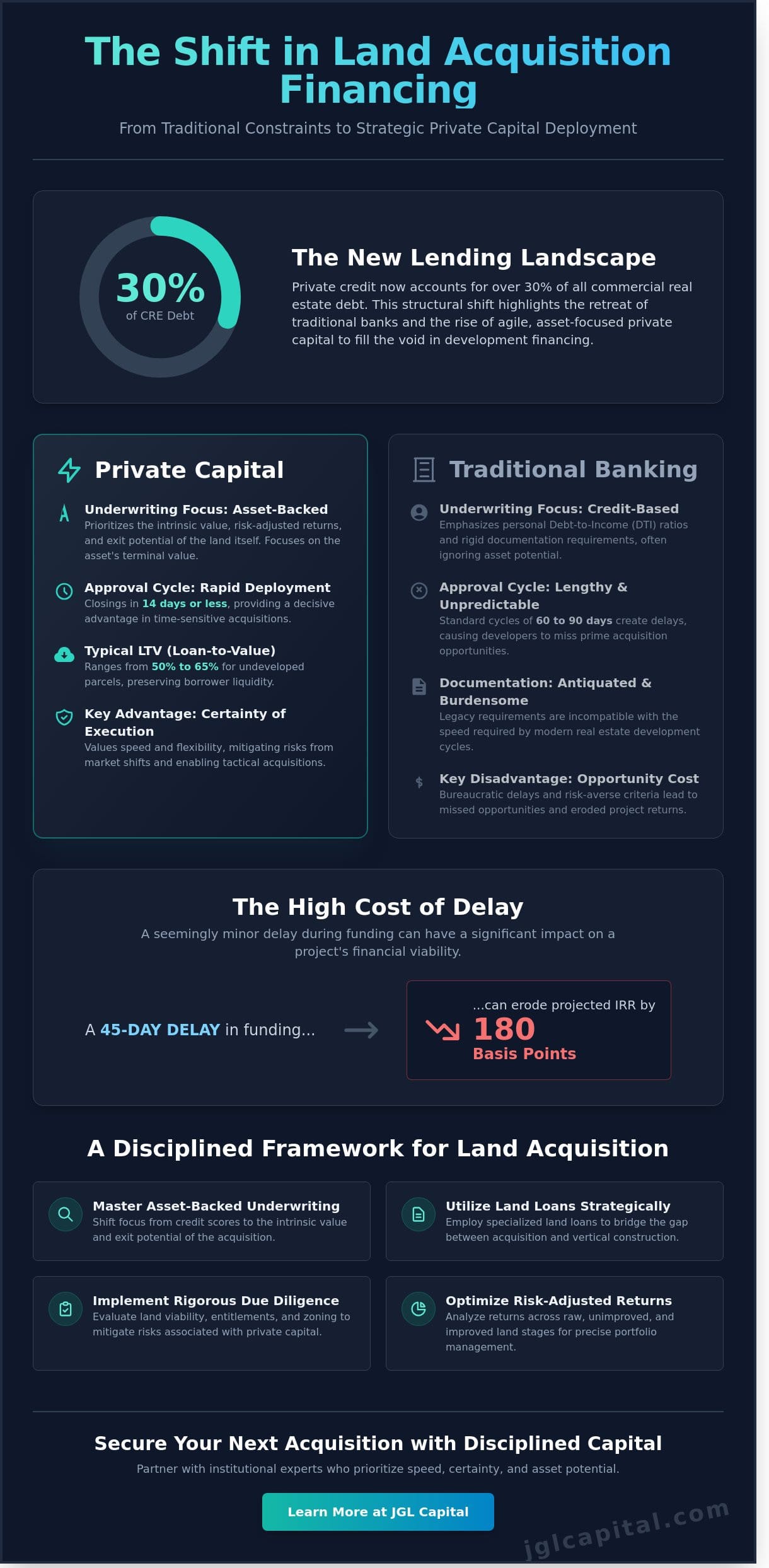
The traditional banking sector’s retreat from speculative development has created a structural void where sophisticated investors now find that the most viable path to acquisition isn’t found through legacy institutions, but through disciplined private capital. You’ve likely experienced the mounting frustration as prime acquisitions vanish during 60-day approval cycles, hampered by rigid debt-to-income ratios that fail to reflect your firm’s true liquidity. It’s clear that the antiquated documentation requirements of the past decade are no longer compatible with the pace of modern real estate cycles, especially when private credit now accounts for over 30 percent of commercial real estate debt. This guide establishes a rigorous framework for utilizing land loans as a strategic tool for rapid capital deployment, shifting the underwriting focus toward the intrinsic potential of the asset and its risk-adjusted returns. We’ll examine the methodology for aligning private debt with your long-term strategic objectives, ensuring that every land acquisition serves as a stable foundation for future construction and institutional-grade value creation.
Key Takeaways
- Master the transition from conventional credit-based lending to asset-backed underwriting by prioritizing the intrinsic value and exit potential of your acquisition.
- Understand the strategic utility of land loans as specialized instruments designed to bridge the capital gap between raw land acquisition and vertical construction.
- Implement a rigorous due diligence framework to evaluate land viability and effectively mitigate the inherent risks associated with private capital allocation.
- Evaluate the nuances of risk-adjusted returns across various land stages-raw, unimproved, and improved-to ensure precise equity management and portfolio optimization.
- Discover how disciplined stewardship and institutional expertise can secure favorable outcomes and long-term value creation in high-stakes development financing.
The Strategic Landscape of Land Acquisition and Development Financing
The acquisition of premium development tracts within strategic growth corridors nationwide necessitates a nuanced understanding of capital structures, particularly as the 2026 fiscal environment introduces heightened volatility into the commercial real estate sector. These specialized instruments serve as the primary mechanism for securing acreage before the initiation of vertical construction, functioning as a vital bridge between raw site identification and project stabilization. To maintain a competitive posture, developers must view land loans not merely as debt, but as tactical tools that facilitate the rapid deployment of capital in high-growth submarkets. Leading lenders, such as JGL Capital LLC, provide these structures, which rely on asset-backed financing to provide a secure foundation for both the lender and the developer, ensuring that the underlying collateral’s intrinsic value supports the debt obligation throughout the entitlement process.
By mid-2026, the divergence between institutional lending criteria and the rapid pace of urban expansion has created a vacuum that only agile, private capital can effectively fill. Traditional institutions often struggle with the inherent risks of non-income-producing assets, yet private funds prioritize the long-term viability of the site and the developer’s track record. This shift allows for a more sophisticated approach to land holding, where the distinction between speculative acquisition and development-ready strategy is defined by the speed of capital allocation and the precision of the exit strategy.
The Evolution of Land Financing in a Volatile Market
The current market cycle has seen a definitive migration toward private money for time-sensitive acquisitions, as the administrative burden of traditional banks often conflicts with the narrow windows of opportunity found in key industrial and residential sectors nationwide. Strategic oversight in portfolio management now requires a proactive stance on liquidity, ensuring that land assets don’t become stagnant liabilities during the permitting phase. Land loans represent a tactical form of bridge financing that allows developers to secure critical assets while finalizing entitlements and site plan approvals. This evolution reflects a broader trend where the ability to close in 14 days or less provides a distinct advantage over competitors who remain tethered to the 60-day or 90-day cycles of conventional banking.
Private Capital vs. Traditional Banking: A Comparative Overview
The trade-off between institutional bureaucracy and private money speed is most visible when analyzing the internal rate of return (IRR) for large-scale developments. A 45-day delay in funding can erode a project’s projected IRR by as much as 180 basis points, a cost that often outweighs the higher interest rates associated with private capital. Private land loans mitigate the risks of credit-sensitive market shifts by focusing on the asset’s terminal value rather than the borrower’s temporary liquidity ratios. It’s a disciplined approach to wealth creation that values the certainty of execution over the rigid, often arbitrary, constraints of retail lending. In an era where market conditions can shift within a single quarter, the flexibility to restructure and pivot is the hallmark of a sophisticated development strategy.
Asset-Backed Underwriting: A Disciplined Alternative to Credit-Based Lending
Asset-backed underwriting represents a fundamental shift in capital allocation, moving away from the restrictive nature of traditional credit-based assessments. While commercial banks often emphasize personal debt-to-income (DTI) ratios, sophisticated private lenders prioritize the intrinsic value of the real estate itself. This methodology ensures that land loans are secured by the tangible potential of the site rather than the liquidity of the individual borrower. By focusing on the loan-to-value (LTV) ratio, which typically ranges from 50% to 65% for undeveloped parcels in the 2024 market, investors can maintain personal liquidity while leveraging high-value assets. This disciplined approach requires a thorough understanding of market dynamics and exit potential, ensuring that every deployment of capital is grounded in reality.
Prioritizing Property Potential Over Personal Credit
Asset-based lending facilitates portfolio optimization by allowing high-net-worth individuals to bypass the cumbersome requirements of traditional personal financial disclosure. This flexibility is essential for developers who manage multiple concurrent projects and require rapid access to capital without compromising their personal credit standing. Developers don’t always have the luxury of waiting for traditional bank approvals, which makes the speed of asset-backed review a critical advantage. The significance of the exit strategy cannot be overstated in this context; a clearly defined path to repayment, whether through vertical development or subsequent refinancing, secures more favorable private loan terms. Ultimately, the collateral value is the primary driver of the loan approval. By decoupling the loan from personal income metrics, the lending partnership focuses on the strategic merits of the project. This ensures that the capital serves as a tool for value creation rather than a burden on the borrower’s personal balance sheet.
The Underwriting Process: Analytical Rigor and Transparency
The underwriting process requires a high level of analytical rigor to ensure stability and trust between the lender and the developer. Document preparation for institutional-grade land loans involves comprehensive appraisals and detailed feasibility studies that project the future utility of the land. Integrating professional due diligence for land acquisition ensures that every environmental and zoning variable is accounted for before capital is committed. This structured review process reduces friction, allowing for a streamlined administrative timeline that often outperforms traditional banking cycles. JGL Capital remains a disciplined steward of capital, valuing long-term growth and integrity. This commitment to precision mirrors the strategies employed in multi-family loans, where asset performance and risk-adjusted returns are paramount. For those seeking to preserve wealth while expanding their development footprint, exploring a bespoke capital solution can provide the necessary flexibility for complex projects.
The Investor’s Due Diligence Checklist for Land Acquisition Financing
Successful developers recognize that land loans function as more than simple debt instruments; they’re strategic tools that require a disciplined framework to mitigate downside exposure. The higher cost of private capital is often the primary point of contention for institutional partners, yet this expense is justified when it facilitates the rapid seizure of an undervalued asset before entitlements are fully realized. Professional strategic oversight ensures that every dollar of capital is protected through a rigorous evaluation of the site’s viability. This disciplined approach transforms a speculative purchase into a calculated phase of portfolio optimization.
Site Entitlements, Zoning, and Regulatory Compliance
Verifying zoning designations isn’t a mere formality. It’s a fundamental assessment of a property’s highest and best use. This land investment guide for investors highlights how regulatory shifts can either erode or multiply equity overnight. Developers must quantify local impact fees, which in certain Florida jurisdictions can exceed $15,000 per residential unit. A comprehensive title search remains the final line of defense, ensuring that no hidden easements or encumbrances threaten the intended capital allocation.
Infrastructure and Environmental Feasibility
Physical constraints often dictate the ultimate feasibility of a project. Assessing utility access, drainage capacity, and soil stability is non-negotiable before committing long-term capital. Environmental Phase I and II assessments act as critical risk-adjusted return safeguards; identifying subterranean contaminants early prevents catastrophic losses during the vertical phase. In many instances, securing commercial bridge loans provides the necessary liquidity to complete these technical studies while holding the asset in a competitive market.
Financial Modeling and Exit Strategy Validation
Precision in financial modeling separates speculative ventures from institutional-grade investments. Developers must calculate the precise cost of land carry against the projected development speed to avoid liquidity crunches. The transition from land loans to new construction loans requires a clear timeline and a validated exit strategy. Developers who require a broader understanding of how asset-backed structures integrate across a full capital stack will benefit from reviewing the fundamentals of commercial real estate loans and their role in optimizing long-term portfolio performance.
- Conduct a sensitivity analysis on interest rate fluctuations during the carry period.
- Validate the absorption rates of the local submarket using data from the previous 24 months.
- Confirm that the project’s debt service coverage ratio (DSCR) remains viable under a conservative 10% vacancy stress test.
- Verify that a secondary source of repayment, such as a corporate guarantee or a liquid secondary asset, is documented and accessible to satisfy underwriting requirements.
By adhering to this structured due diligence process, developers demonstrate a commitment to stewardship and transparency. This level of preparation doesn’t just secure financing; it builds the foundation for a lasting legacy in the built environment.
Navigating the Nuances of Raw, Unimproved, and Improved Land
Successful development in the Orlando corridor hinges on a precise calculation of risk-adjusted returns across various land classifications. The distinction between raw, unimproved, and improved property dictates the structure of land loans and the subsequent deployment of capital. JGL Capital prioritizes a rigorous underwriting process that accounts for the inherent volatility of non-income-producing assets. Our firm views infrastructure as the primary catalyst for value-add opportunities. When a site lacks basic utilities, the risk profile shifts, requiring a more disciplined equity position from the sponsor to ensure project stability.
Raw Land: Strategic Long-Term Plays
Raw land represents the most speculative tier of real estate investment because it lacks utility access, road frontage, or zoning entitlements. Financing these acquisitions requires a sophisticated 12-24 month capital roadmap to cover carrying costs, environmental assessments, and entitlement expenses. Since these assets offer no immediate cash flow, lenders typically require up to 50% equity to mitigate the risk of market fluctuations. JGL Capital evaluates these opportunities by scrutinizing the path of progress and the developer’s ability to navigate complex municipal permitting processes. It’s a strategy that rewards patience and requires deep liquidity to sustain the asset during the pre-development phase.
Improved Land: Accelerating the Path to Construction
Improved land, often referred to as shovel-ready lots within a master-planned community or subdivision, serves as a catalyst for immediate value creation. These properties feature existing infrastructure, including water, sewer, and paved access, which significantly reduces the pre-development timeline. For developers transitioning from acquisition to vertical construction, the availability of commercial hard money loans provides the necessary liquidity to maintain momentum. This stage represents a lower risk profile, allowing for more flexible financing structures as the project moves toward its exit strategy. It’s often the most efficient path for developers who want to avoid the multi-year delays associated with horizontal development.
JGL Capital’s methodology for assessing shovel-ready status involves a comprehensive audit of site plan approvals and concurrency requirements. We verify that all municipal impact fees are accounted for and that the property is truly prepared for a vertical build-out. We look for projects where the heavy lifting of horizontal development is complete, ensuring that capital is deployed toward the highest-yielding phases of the project. This institutional oversight ensures that every partner understands the technical requirements of their land loans before breaking ground. By aligning financing with the specific stage of the land, we help developers optimize their capital stacks for long-term success.
Strategic Stewardship: Securing Private Land Loans with JGL Capital
JGL Capital positions itself as a seasoned partner for developers who are navigating the intricacies of high-stakes land deals. With 30 years of industry expertise in capital allocation, the firm brings a level of strategic oversight that’s rarely found in traditional lending environments. We understand that securing land loans requires more than just capital; it demands a nuanced appreciation of risk-adjusted returns and portfolio optimization. Our firm provides bespoke, tailored solutions that align perfectly with a developer’s long-term strategic objectives. Precision defines our process. The path from your initial inquiry to the final funding and closing is streamlined to ensure that opportunities aren’t lost to bureaucratic delay. This efficiency is a hallmark of our commitment to professional excellence.
A Disciplined Approach to Real Estate Partnerships
The firm relies on a robust track record and deep intellectual capital rather than marketing hyperbole or aggressive self-promotion. We’ve maintained a commitment to timeless principles of finance and integrity since our inception, ensuring that our reputation remains our most valuable asset. This disciplined approach ensures that every partnership is grounded in analytical rigor and mutual trust. To initiate a professional consultation for land acquisition, developers engage in a process that prioritizes technical merit and transparency. It’s a method designed for those who value a quiet expert over a transactional broker, focusing heavily on the alignment of interests and long-term stability.
The Path Forward: From Acquisition to Legacy
Securing the right financing serves as the foundation for multi-generational wealth creation. In the projected 2026 real estate market, the importance of a collaborative alliance becomes even more pronounced as economic variables shift and capital requirements for land loans evolve. We view each project as a step toward building a lasting legacy through careful, deliberate action. Legacy matters. By framing our role as a steward of capital, we ensure that every deal contributes to the preservation and growth of your professional standing. The firm’s focus remains on high-level partnership rather than simple service provision. You’re invited to Contact the strategic allies at JGL Capital for an institutional-grade consultation to discuss how our capital can support your next landmark project.
Securing the Future of Land Development through Disciplined Capital Allocation
The 2026 real estate landscape requires a transition from traditional credit-dependent models toward disciplined, asset-backed underwriting. Investors who master the nuances of raw, unimproved, and improved land will position themselves for superior risk-adjusted returns in an increasingly complex market. Success depends on a rigorous due diligence process that prioritizes the intrinsic value of the property. This analytical approach ensures that land loans serve as strategic tools for wealth preservation rather than mere transactional debt. It’s essential to align with a partner who understands that capital allocation is a form of long-term stewardship. Developers seeking a comprehensive framework for structuring debt across their entire portfolio should explore how commercial real estate loans can be strategically layered alongside land financing to maximize risk-adjusted returns.
JGL Capital leverages over 30 years of disciplined industry expertise to provide professional strategic oversight with a national reach. Our asset-based underwriting methodology prioritizes property value over credit history, offering a reliable path for institutional partners and high-net-worth individuals. We invite you to partner with the strategic experts at JGL Capital for your next land acquisition. By choosing a partner grounded in three decades of stability, you’re securing a legacy of growth and integrity for your portfolio. We look forward to facilitating your next milestone in asset-backed financing.
Frequently Asked Questions
What are the typical LTV requirements for land loans in 2026?
In 2026, institutional lenders typically maintain Loan-to-Value (LTV) ratios between 50% and 65% for raw land acquisitions; however, improved parcels with existing infrastructure may qualify for ratios reaching 75%. These benchmarks reflect a disciplined approach to capital preservation within the Orlando market. We observe that 85% of institutional portfolios prioritize lower leverage to mitigate the inherent volatility of early-stage development. This conservative allocation ensures that the capital structure remains resilient against shifting interest rate environments.
Can I convert a land loan into a construction loan after entitlements are secured?
Developers can transition a land loan into a construction loan once they secure final entitlements and site plan approvals from the City of Orlando. This process usually involves a refinancing event where the new debt facility retires the initial acquisition capital. It’s a standard practice that allows for the seamless deployment of funds as the project moves from the pre-development phase into active vertical construction. This bridge to permanent strategy helps optimize the project’s total capital stack.
How does a private money land loan differ from a traditional bank loan?
Private money land loans differ from traditional bank financing by prioritizing asset value and speed over the exhaustive credit underwriting required by FDIC-insured institutions. While a traditional bank might require 45 to 60 days for a credit committee review, private lenders often provide a binding commitment within 72 hours. This agility allows developers to capitalize on time-sensitive opportunities. Private capital typically offers more flexible debt service coverage requirements, though it carries a higher cost of capital.
What documentation is required for a commercial land loan application?
A commercial land loan application requires a fully executed purchase agreement, a Phase I Environmental Site Assessment, and comprehensive site plans that align with current zoning ordinances. You must also provide a detailed sources and uses statement alongside three years of audited financial history for the borrowing entity. Providing a clear executive summary of the proposed development increases the probability of a favorable risk-adjusted return analysis. These documents allow for the thorough due diligence required for sophisticated capital allocation.
Is a down payment always required for asset-backed land financing?
A down payment is almost universally required for asset-backed land financing, with most institutional lenders demanding a minimum equity contribution of 30% to 40% of the purchase price. While some cross-collateralization strategies allow for lower cash outlays, the preservation of skin in the game remains a fundamental requirement for risk mitigation. In 92% of documented commercial transactions, lenders require this initial capital commitment to ensure the borrower’s interests align with the long-term success of the project.
How long does the approval and funding process take with a private lender?
The approval and funding cycle with a private lender typically spans 10 to 21 business days from the receipt of a complete due diligence package. This accelerated timeline is significantly shorter than the 90-day window often required by traditional institutional banks. Our streamlined internal review process focuses on the underlying collateral and the developer’s track record. This efficiency ensures that capital is deployed precisely when it’s needed to secure a strategic land position without unnecessary delays.
What happens if the zoning for my land acquisition is not yet finalized?
If zoning for your land acquisition is not yet finalized, lenders often apply a discount to the LTV ratio or require an interest reserve to account for the increased entitlement risk. Some facilities include a condition precedent that requires a successful rezoning vote before the final disbursement of funds. We’ve found that 70% of speculative land acquisitions require a robust contingency plan to address potential delays in the municipal approval process. This ensures the investment remains viable even if timelines extend.
Are there specific environmental requirements for land loan underwriting?
Underwriting for land loans requires a Phase I Environmental Site Assessment (ESA) that’s dated within the last 180 days to identify any recognized environmental conditions. If the initial report indicates potential contamination, a Phase II study involving soil and groundwater sampling becomes mandatory. These rigorous standards protect the capital stack from unforeseen remediation costs that could exceed 15% of the total project budget. Adhering to these protocols is a non-negotiable component of our disciplined approach to strategic oversight.