

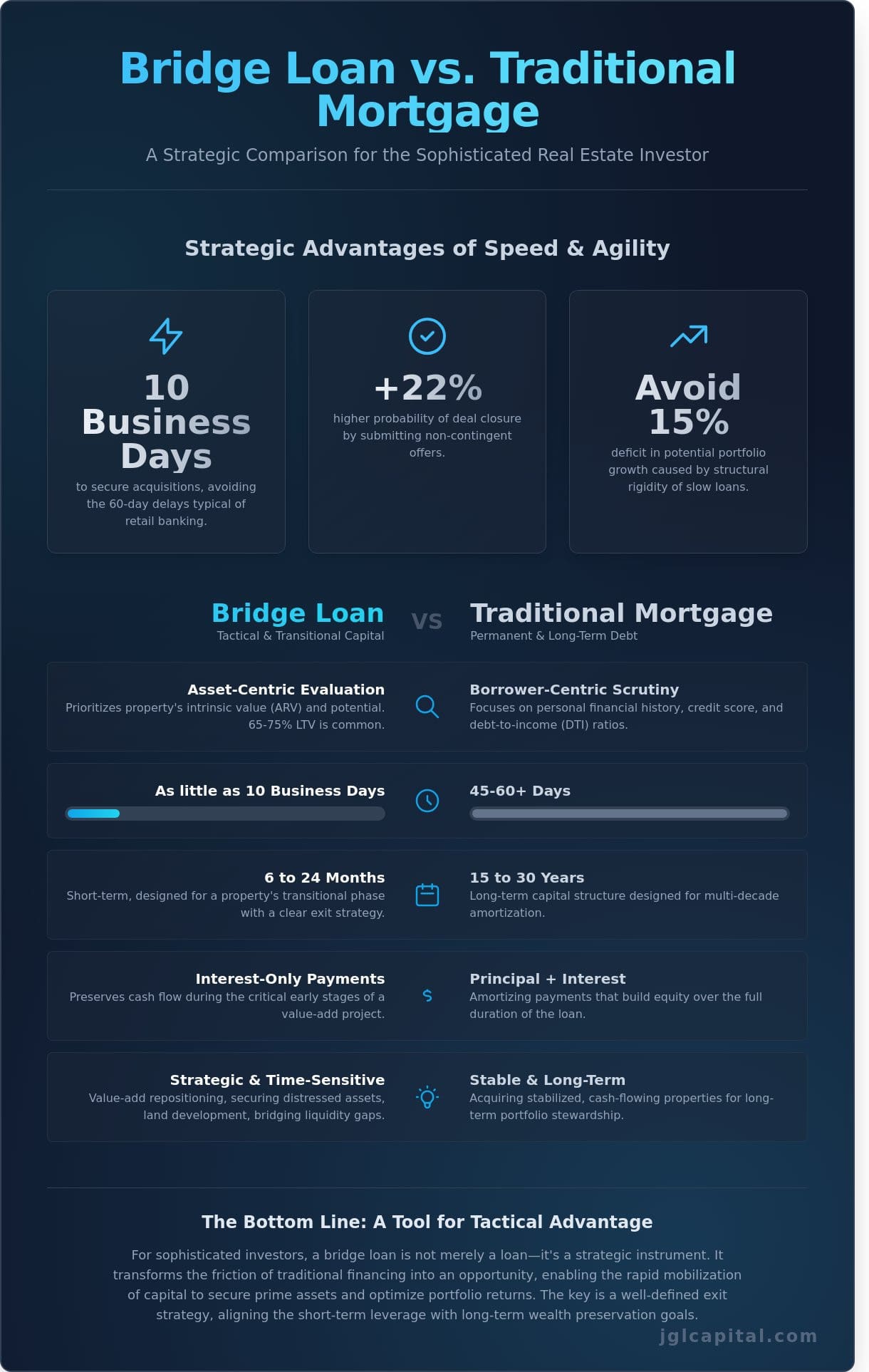
For the sophisticated investor, the perceived safety of a conventional 30-year institutional loan often represents a hidden 15% deficit in potential portfolio growth due to structural rigidity. When high-value opportunities emerge, the friction of traditional underwriting frequently leads to the loss of prime assets to more agile competitors. Utilizing a bridge loan mortgage transforms these constraints into a strategic advantage, allowing for the immediate mobilization of capital without the 60-day delays typical of retail banking. You recognize that capital being locked in existing assets is a fundamental barrier to optimal portfolio optimization.
This article provides a rigorous comparison of bridge loan mortgage structures against traditional financing to illuminate how they function as sophisticated alternatives for real estate capital allocation. You’ll gain a clear understanding of the cost-to-value ratios required to maintain target risk-adjusted returns while securing new acquisitions in as little as 10 business days. We’ll conclude with a methodical framework for exit strategy planning that aligns with long-term stewardship and wealth preservation objectives.
Key Takeaways
- Comprehend the role of transitional capital in bridging the critical liquidity gap between initial asset acquisition and the securement of permanent financing.
- Discern how a bridge loan mortgage prioritizes asset-centric evaluation over traditional borrower-centric underwriting to provide investors with superior tactical leverage.
- Compare the expedited approval cycles and bespoke structural flexibility of private capital solutions against the rigid constraints of conventional institutional lending.
- Explore strategic applications for sophisticated capital allocation, ranging from value-add multi-family repositioning to the complexities of land development.
- Learn to navigate the origination process through a philosophy of stewardship and strategic partnership designed to optimize institutional-grade real estate portfolios.
Defining the Bridge Loan Mortgage as Strategic Transitional Capital
A bridge loan mortgage serves as a sophisticated instrument within a capital stack, functioning as a temporary lien that facilitates the transition between immediate acquisition and permanent financing. While the term “swing loan” originated in mid-20th-century banking to describe short-term liquidity for equity-rich borrowers, the modern application has evolved into a precision tool for institutional-grade asset management. At JGL Capital LLC, we distinguish professional asset-backed bridging from standard residential consumer products by the underlying underwriting philosophy; the former prioritizes the collateral’s intrinsic value and the borrower’s strategic vision over traditional debt-to-income metrics. This distinction is critical for investors who manage portfolios where timing often dictates the success of a risk-adjusted return across diverse real estate markets. By providing a reliable conduit for capital allocation, these loans allow for the seamless execution of complex real estate maneuvers.
The Core Characteristics of Bridge Financing
The architecture of a bridge facility is designed for agility and precision. These loans aren’t intended for long-term stewardship but rather for tactical deployment during a property’s transitional phase. Key characteristics include:
- Flexible Durations: Typical loan terms range from 6 to 24 months, providing the necessary window for property stabilization or value-add execution.
- Interest-Only Structures: Monthly payments are often structured as interest-only, a mechanism that preserves vital cash flow for developers during the early stages of a project.
- Defined Exit Strategies: The viability of these agreements rests upon a clearly articulated exit strategy, such as a 1031 exchange or a transition to a 30-year fixed-rate instrument, which serves as the foundation for risk mitigation.
Why Investors Prioritize Speed Over Interest Rates
In today’s competitive 2024 real estate market, the opportunity cost of waiting for a 45-day traditional mortgage approval often exceeds the higher interest expense of a bridge facility. Professional investors utilize these loans to submit non-contingent offers, which historically increase the probability of deal closure by 22% compared to contingent bids. A bridge loan is a short-term, asset-backed security used to facilitate immediate property acquisition. To fully appreciate the mechanics behind this advantage, understanding how does a bridge loan work as a mechanism for rapid capital deployment is essential for any investor competing in high-velocity markets. By eliminating the friction of conventional underwriting, capital partners can secure distressed assets or time-sensitive opportunities that would otherwise be lost to more agile competitors. This prioritization of speed reflects a disciplined approach to wealth creation, where the value of securing a prime asset outweighs the temporary premium on the cost of capital.
Structural Mechanics: How Bridge Financing Diverges from Traditional Mortgages
Traditional mortgages serve as permanent capital structures designed for multi-decade amortization. A bridge loan mortgage operates as a tactical instrument for deployment during transitional phases. These facilities prioritize speed and flexibility over the rigid, thirty-year duration typical of residential financing. Capital allocation in this sector targets the immediate acquisition of distressed assets or the stabilization of a property’s cash flow before securing long-term debt. It’s a method of using short-term leverage to capture time-sensitive opportunities that traditional banking institutions can’t process within competitive windows.
Asset-Backed Underwriting vs. Credit-Based Qualification
Private capital providers pivot away from the exhaustive personal financial scrutiny required by conventional lenders. While a bank focuses on a borrower’s debt-to-income ratio, a bridge lender emphasizes the property’s intrinsic value and its After Repair Value (ARV). Most transactions in 2026 utilize a 65% to 75% Loan-to-Value (LTV) ratio or an 80% Loan-to-Cost (LTC) model to mitigate risk. This streamlined documentation process allows for funding cycles as short as 10 business days. This speed is essential for high-stakes Florida real estate acquisitions where sellers demand certainty of execution.
Interest Rates and Fee Structures in 2026
Risk-adjusted returns for bridge financing remain decoupled from the lower yields of government-backed securities. Lenders typically seek a premium of 400 to 600 basis points above the federal funds rate, which sits near 4.5% in current 2026 projections. Understanding the nuances of bridge loan rates in 2026 is essential for optimizing your capital stack structure. Borrowers should anticipate a structure that includes:
- Origination Points: Typically 1% to 3% of the total loan amount paid at closing.
- Processing Fees: Administrative costs usually ranging from $1,500 to $5,000.
- Exit Fees: Some structures include a 1% fee if the loan is refinanced or paid off before a specific milestone.
Sophisticated investors often utilize strategic oversight to structure these fees effectively within their broader portfolio optimization goals. Cross-collateralization may also be employed to leverage existing equity in a secondary asset, thereby reducing the required cash injection for a new acquisition. This approach ensures that capital remains fluid while maintaining the integrity of the investor’s long-term wealth preservation strategy.
Comparative Analysis: Bridge Loans vs. Conventional Mortgages vs. Hard Money
Selecting the appropriate financing vehicle requires a rigorous evaluation of capital velocity and asset condition. While traditional mortgages rely on standardized credit metrics and lengthy 45 day underwriting cycles, the bridge loan mortgage operates on a timeline of 10 days or fewer. This disparity stems from the regulatory environment; conventional loans must adhere to rigid federal disclosures that prioritize consumer protection over execution speed. Institutional partners often find that the bureaucracy of a 60 day bank approval process results in lost opportunity costs that far outweigh the higher nominal interest rates of private capital.
Cost of capital analysis reveals that bridge financing, despite rates typically ranging from 8.5% to 11.75%, can be more efficient for short-term strategic oversight. A conventional 30 year mortgage involves heavy front-loaded interest and closing costs that aren’t easily recouped if the asset is sold within 24 months. Bridge solutions offer bespoke terms, allowing for interest-only payments and the absence of prepayment penalties, which optimizes cash flow during the transition period. For a comprehensive analysis of current market conditions, consider reviewing strategic guidance on transitional capital costs to ensure your financing structure aligns with 2026 market dynamics.
When to Choose a Bridge Loan Over a Traditional Mortgage
Traditional lenders typically refuse to fund properties that fail to meet basic habitability standards, such as those with roof deficiencies or non-functional HVAC systems. In these instances, investors utilize fix and flip loans florida to stabilize the asset before seeking long-term debt. Speed is the primary driver here. If a Florida seller demands a 14 day close to compete with cash offers, the agility of a bridge loan mortgage becomes a critical competitive advantage that a standard bank cannot match.
Bridge Loans vs. Hard Money: Subtle Distinctions
- Purpose vs. Source: “Bridge” describes the strategic function of the loan, while “hard money” refers to the asset-based nature of the capital source.
- Underwriting Rigor: Modern bridge loans often involve institutional-grade due diligence, whereas traditional hard money may rely solely on the equity in the property.
- Capital Structure: Bridge loans frequently offer more sophisticated structures, including holdbacks for renovations and tiered interest rates based on LTV ratios.
Choosing between these instruments depends on the complexity of your project. High-net-worth individuals often prefer the institutional stability of a bridge lender that understands portfolio optimization. It’s about more than just the loan; it’s about the alignment of interests between the borrower and the steward of capital. This disciplined approach ensures that the financing serves the long-term legacy of the investment rather than just a transient liquidity need.
Strategic Applications for Professional Real Estate Investors
Sophisticated capital allocation requires financial instruments that transcend the limitations of conventional underwriting. A bridge loan mortgage serves as a tactical tool for sponsors who prioritize execution speed over the rigid constraints of permanent debt. In Florida’s 2024 market, where acquisition cycles move rapidly, this liquidity is vital. It’s not just about speed; it’s about the precision of capital deployment during critical transition phases.
New Construction and Development Bridging
Professional developers often encounter a liquidity chasm between the completion of horizontal infrastructure and the commencement of vertical improvements. Utilizing new construction loans as a bridging mechanism allows for the seamless progression of phased funding. By securing a bridge loan mortgage during this interim, developers mitigate the risk of project stagnation. Strategic oversight remains paramount. We’ve seen successful sponsors maintain a 15% contingency reserve to manage the volatility of material costs while keeping the project timeline intact.
Commercial and Multi-Family Value-Add Plays
Value-add initiatives for underperforming multi-family assets necessitate a stabilization period that traditional lenders rarely accommodate. Bridge debt facilitates the intensive capital improvements required to drive a 12% to 18% increase in Net Operating Income (NOI). This strategic infusion of capital transforms a Class C asset into an institutional-grade property. Once the asset reaches an 85% occupancy threshold, the sponsor can transition to permanent agency financing. This disciplined approach ensures that the asset is positioned for maximum valuation before long-term debt is locked in.
Beyond simple acquisitions, these facilities enable sophisticated portfolio optimization. Investors utilize bridge debt to:
- Consolidate high-interest short-term debt into a single, manageable facility.
- Unlock equity from stabilized assets to fund new, high-yield ventures.
- Provide a 12 to 24-month runway to improve management efficiencies.
The transition from bridge debt to long-term DSCR or agency loans requires a meticulous exit strategy. Most institutional partners require a minimum Debt Service Coverage Ratio of 1.25x before considering a permanent refi. Our role involves ensuring that every bridge placement is a calculated step toward a permanent, low-cost capital structure. It’s a matter of stewardship. We focus on the long-term viability of the investment rather than the immediate transaction.
Navigating the Origination Process with JGL Capital
Selecting a bridge loan mortgage requires more than a simple comparison of interest rates; it necessitates a strategic partnership with a firm that understands the nuances of capital preservation and wealth creation. JGL Capital LLC approaches every transaction through the lens of stewardship, leveraging three decades of historical data since our inception in 1994 to navigate the complexities of the Florida real estate market. Our philosophy rejects the transactional nature of retail lending in favor of a disciplined, asset-based submission process. This methodology prioritizes analytical rigor, ensuring that every deployment of capital aligns with the long-term strategic objectives of our partners. We solve funding challenges that conventional institutions often overlook by focusing on the intrinsic value of the real estate and the viability of the underlying investment thesis.
Preparing Your Bridge Loan Application
The efficiency of the underwriting phase depends on the precision of the initial documentation provided by the sponsor. We require a comprehensive submission package that includes specific property details, the executed purchase contract, and a clearly articulated exit strategy. For value-add bridge loans, a granular Scope of Work (SOW) is vital. This document serves as the roadmap for value creation, detailing every capital expenditure planned for the asset. Our underwriters maintain executive-level communication throughout this process, providing the transparency necessary to secure a bridge loan mortgage without the friction typically associated with institutional debt. This high-level dialogue ensures that all parties remain aligned on the risk-adjusted returns and the timeline for capital recovery.
Securing Your Legacy Through Disciplined Capital Allocation
JGL Capital LLC functions as a discreet partner for high-stakes real estate ventures, valuing integrity and long-term growth above aggressive self-promotion. We recognize that bridge financing is a sophisticated tool for portfolio optimization, and our role is to act as a seasoned steward of your capital. By maintaining a measured and steady communication rhythm, we provide the stability required for complex acquisitions and renovations. Our firm prioritizes bespoke solutions that reflect the unique requirements of each institutional partner or high-net-worth individual. We invite you to move beyond transactional lending and engage with a firm that values strategic oversight and meticulous due diligence. Consult with a JGL Capital LLC strategist for your next bridge loan to begin a professional consultation focused on your long-term legacy.
Optimizing Capital Allocation Through Strategic Transitional Debt
The selection of a bridge loan mortgage represents more than a tactical necessity; it’s a sophisticated instrument for portfolio optimization. By prioritizing asset-based underwriting that focuses on intrinsic property value rather than restrictive credit box metrics, professional investors can capture time-sensitive opportunities that traditional institutions often overlook. This comparative analysis demonstrates that while conventional mortgages offer long-term stability, the structural flexibility of bridge financing is indispensable for complex acquisitions and value-add repositioning strategies.
JGL Capital brings over 30 years of strategic real estate expertise to every transaction, providing institutional-grade capital access across a national footprint. Our disciplined stewardship ensures that your capital allocation remains aligned with long-term wealth preservation and risk-adjusted returns. We invite you to leverage our deep-seated industry knowledge and bespoke underwriting to secure the liquidity your portfolio requires. Success in high-stakes markets depends on the precision of your financial partners.
Partner with JGL Capital for bespoke bridge financing solutions and transform your transitional capital needs into a lasting legacy of growth.
Frequently Asked Questions
What is the primary difference between a bridge loan and a mortgage?
The fundamental distinction lies in the capital duration and repayment structure, as a bridge loan mortgage serves as a short-term liquidity instrument for 12 to 36 months, whereas traditional mortgages utilize 30-year amortization schedules. Bridge financing prioritizes the intrinsic value of the real estate asset over the borrower’s recurring monthly income. This asset-centric approach allows for greater flexibility during complex transitions between property acquisitions.
How long does it typically take to close a bridge loan mortgage?
Institutional bridge lenders typically finalize funding within 7 to 14 business days, representing a 75% reduction in lead time compared to the 45-day cycle common in traditional banking. This expedited timeline results from streamlined due diligence processes that focus on collateral appraisal rather than exhaustive historical financial audits. Rapid capital deployment ensures that investors don’t lose competitive opportunities in high-velocity markets like Florida.
Can I get a bridge loan for an owner-occupied property?
You can secure bridge financing for owner-occupied residences, provided the transaction complies with the 2010 Dodd-Frank Act and maintains a conservative 70% loan-to-value ratio. These bespoke solutions often assist homeowners who need to unlock equity from their current residence to settle a 20% down payment on a new property. While the regulatory requirements are more stringent for primary residences, the strategic advantage of a non-contingent offer remains a significant benefit. Investors seeking to leverage transitional capital for residential acquisitions can explore how a bridge loan for home purchase provides the liquidity needed to compete with institutional-grade speed in high-stakes markets.
What are the typical interest rates for a bridge loan in 2026?
Projected interest rates for bridge facilities in 2026 range from 9.5% to 12.5%, reflecting a 300 to 500 basis point premium over the Secured Overnight Financing Rate. These rates compensate the lender for the increased risk associated with expedited underwriting and the absence of long-term interest yield. Sophisticated borrowers view this cost not as a burden, but as a necessary allocation for maintaining strategic agility in their investment portfolios.
Do I need a high credit score to qualify for a bridge mortgage?
You don’t need a 740 FICO score to qualify, as bridge lenders emphasize the 35% equity cushion within the property over the borrower’s personal credit history. Most institutional firms accept credit scores as low as 620 if the asset demonstrates strong marketability and a clear exit strategy. The underwriting focus remains on capital preservation through collateral quality rather than a granular analysis of individual consumer debt ratios.
What happens if I cannot sell my property before the bridge loan expires?
If a property remains unsold at the 12-month maturity date, borrowers typically exercise a pre-negotiated 6-month extension option in exchange for a 1% extension fee. Failure to secure an extension or a permanent refinance could lead to a technical default, triggering a formal foreclosure process after 30 days of non-payment. It’s essential to have a secondary liquidity event planned to ensure the disciplined transition of debt obligations.
Are bridge loans more expensive than traditional bank financing?
A bridge loan mortgage is inherently more expensive, carrying origination fees between 2% and 4% of the total loan amount, while traditional bank loans often charge closer to 0.5%. This higher cost of capital reflects the bespoke nature of the financing and the lender’s willingness to assume immediate market risk. Investors accept these terms because the speed of execution can lead to a 15% increase in total project yield by securing undervalued assets quickly.
Can a bridge loan be used for new construction projects?
Bridge financing facilitates new construction by providing up to 80% of the total project cost to cover vertical development before a permanent certificate of occupancy is issued. This specialized bridge loan mortgage allows developers to break ground 6 months earlier than they could with traditional construction-to-permanent loans. By utilizing this strategic understanding of how does a bridge loan work within a development context, builders can optimize their portfolio turnover and maximize risk-adjusted returns during the initial phases of development.