

In the current high-stakes environment of institutional real estate, the velocity of capital deployment remains a more critical determinant of long-term success than the nominal cost of the debt itself. You likely recognize that traditional lending cycles, which often extend beyond 60 days, frequently jeopardize the stability of complex acquisitions or leave lucrative opportunities to more agile competitors. This systemic friction often prompts sophisticated investors to ask, what is a bridge loan, as they seek to navigate the gap between immediate capital requirements and permanent financing solutions. While conventional banks prioritize personal credit-based underwriting, institutional stewards understand that asset-backed agility is the cornerstone of portfolio optimization.
This analysis provides a rigorous examination of bridge financing as a tool for strategic oversight, detailing how transitional capital can stabilize capital stacks while maintaining deal momentum. We’ll explore the operational mechanics of private credit and the nuanced ways these instruments optimize risk-adjusted returns for the modern estate steward. By the end of this guide, you’ll possess the analytical framework necessary to deploy fast capital as a sophisticated lever for growth and wealth preservation.
Key Takeaways
- Understand the fundamental architecture of what is a bridge loan, specifically its role as a sophisticated, asset-backed instrument designed to provide immediate liquidity during critical transitional periods.
- Analyze the operational mechanics of bridge financing, from the nuances of capital origination to the strategic implications of fee structures within private capital markets.
- Identify strategic use cases for deploying bridge capital, including the acquisition of distressed assets and the execution of complex renovation projects that require rapid, flexible funding.
- Evaluate essential risk mitigation and exit strategies, focusing on the necessity of a structured ‘take-out’ loan or a clearly defined liquidation event to ensure long-term capital preservation.
- Discover how leveraging institutional expertise and streamlined property-focused underwriting can optimize your real estate portfolio through bespoke transitional financing solutions.
The Architecture of Bridge Financing: A Comprehensive Definition
In the sophisticated arena of institutional real estate, understanding what is a bridge loan requires a shift from viewing debt as a static burden to recognizing it as a dynamic tool for capital allocation. This financial instrument serves as a short-term, asset-backed vehicle designed to facilitate transitions where permanent financing isn’t yet viable. While retail borrowers often rely on personal creditworthiness, institutional bridge capital prioritizes the underlying collateral’s intrinsic value. This focus ensures that liquidity remains available during critical windows of property repositioning. In many high-level financial circles, practitioners refer to this as a “swing loan,” a term that captures the pendulum-like movement of capital as it swings from an initial acquisition toward a stabilized, long-term exit strategy.
A comprehensive definition of bridge loans highlights their utility in resolving temporary capital imbalances. Unlike traditional mortgages that span 15 to 30 years, bridge financing operates on a compressed timeline. It’s specifically engineered to provide immediate funding when a property’s current state, such as high vacancy levels or the need for physical rehabilitation, precludes it from qualifying for conventional bank debt. By utilizing this strategic oversight, investors can secure assets that require immediate intervention to unlock their full risk-adjusted returns.
Key Characteristics of Transitional Capital
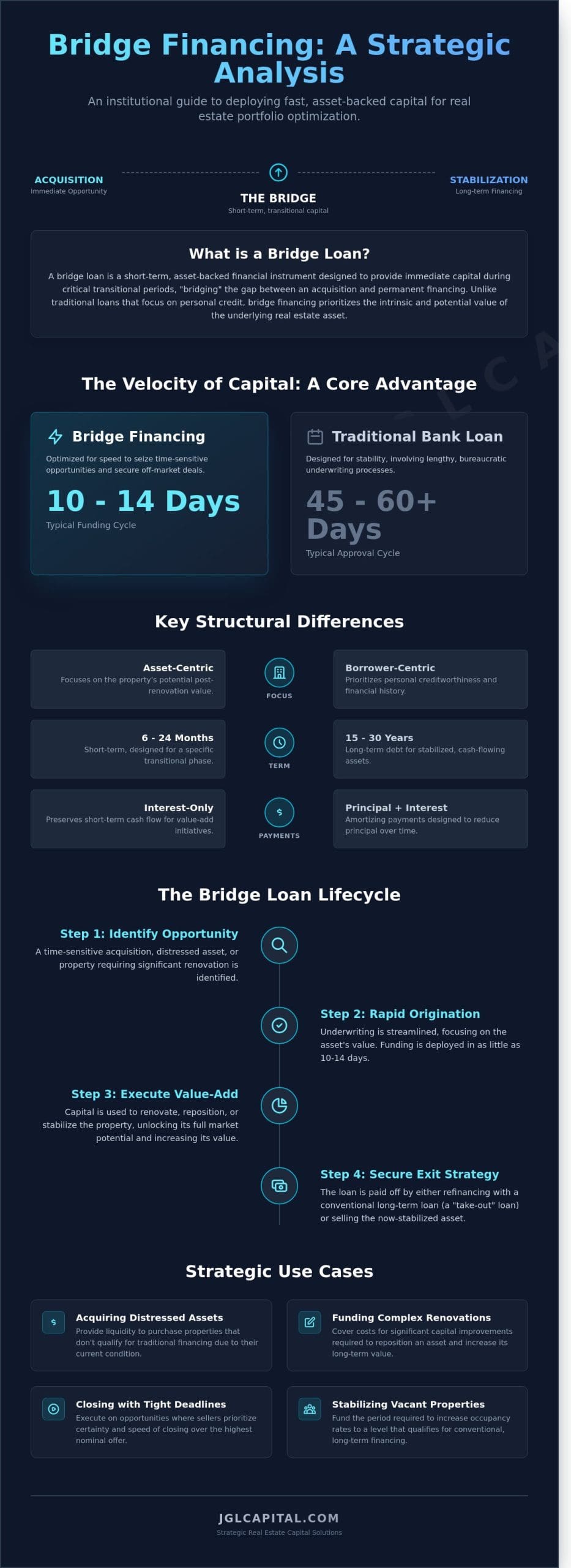
Professional real estate cycles demand agility, which is reflected in the structural nuances of bridge debt. These loans typically feature durations ranging from 6 to 18 months, though some bespoke arrangements allow for extensions based on specific project milestones. The underwriting process undergoes a fundamental shift; instead of a borrower-centric analysis, lenders perform an asset-centric evaluation. This methodology focuses on the property’s potential post-renovation value. Most bridge structures utilize interest-only payment models. This approach preserves short-term cash flow, allowing the steward of capital to reinvest operational funds directly into value-creation initiatives rather than principal reduction.
The Strategic Importance of Speed in Real Estate
Speed serves as a primary differentiator in competitive markets. While traditional banking institutions often require a 45 to 60 day approval cycle, bridge financing can frequently be deployed in as little as 10 to 14 days. This rapid execution is vital for securing off-market deals where sellers prioritize certainty of closing over the highest nominal offer. Capital velocity directly correlates with portfolio-wide ROI. When an investor can acquire, renovate, and refinance an asset within a 12-month window, the compounding effect on equity is significantly higher than through slower, conventional channels. This disciplined approach to timing ensures that portfolio optimization isn’t hindered by bureaucratic delays.
Operational Mechanics: How Bridge Loans Facilitate Capital Fluidity
Understanding the Operational Mechanics of private debt requires a shift from traditional retail lending mindsets toward a focus on asset-based valuation. A bridge loan functions as a temporary financing vehicle, typically spanning 12 to 24 months, designed to provide immediate liquidity during property transitions. When a sophisticated investor asks what is a bridge loan in a professional context, they’re really inquiring about the efficiency of capital deployment. The lifecycle begins with a rapid origination phase. Funding often occurs within 10 to 14 days. Once the loan is funded, the investor executes a value-add strategy, eventually exiting through a permanent refinance or a strategic divestiture. In the broader capital stack, bridge debt serves as senior secured debt, holding first-lien priority over equity and mezzanine layers.
Lenders utilize specific metrics to mitigate risk and ensure capital preservation. Loan-to-Value (LTV) ratios for these transitional assets often reside between 65% and 75% of the current market price. Conversely, Loan-to-Cost (LTC) focuses on the total project budget. This metric frequently covers up to 85% of the combined purchase and renovation expenses. This dual-pronged approach allows for a disciplined assessment of the risk-adjusted returns associated with the project.
Underwriting the Asset, Not the Individual
Institutional lenders prioritize the property’s intrinsic value and its projected performance over the borrower’s personal financial history. While credit scores provide context, the primary focus remains on the “As-Is” value and the After-Repair Value (ARV). Investors must present comprehensive documentation to secure funding. This includes detailed pro-formas, independent appraisal reports, and a granular scope of work. This rigorous analysis ensures the capital allocation aligns with the property’s ultimate revenue potential. It’s a process that values the viability of the deal above all else.
Interest Rates and Fee Structures
The pricing for these instruments reflects the expedited speed and increased risk profile of transitional real estate. Interest rates often range from 8% to 12% in current market conditions. Borrowers also encounter origination fees, commonly referred to as “points,” which typically range from 1% to 3% of the total loan amount. When evaluating what is a bridge loan for a specific project, one must calculate the total cost of capital over a 12-month horizon. Some agreements include “minimum interest” clauses that guarantee a specific return for the lender. Others offer “open” terms that allow for early payoff without penalty. This flexibility is essential for maintaining portfolio optimization and ensuring the alignment of interests between the lender and the sponsor. For a comprehensive analysis of current market conditions and pricing structures, sophisticated investors should examine bridge loan rates in 2026 to ensure their capital allocation strategy remains competitive.
Discerning investors often seek a strategic partner to navigate these complex financial structures and secure bespoke capital solutions.
Strategic Use Cases: Deploying Bridge Capital in Real Estate Development
Institutional real estate investment requires a nuanced understanding of capital structures. When traditional depository institutions retreat due to rigid habitability requirements, bridge financing provides the necessary liquidity for distressed asset acquisition. These instruments are particularly effective for assets currently failing to meet conventional standards. In the context of high-velocity “Fix and Flip” operations, a bridge loan encompasses both the initial purchase price and the subsequent capital improvement budget. This dual-purpose allocation allows developers to preserve their internal rate of return (IRR) while executing a comprehensive renovation strategy. Understanding what is a bridge loan and its specific role in short-term debt markets is essential for maintaining momentum in competitive real estate markets. It’s a tool that bridges the gap between a property’s current state and its highest and best use.
For developers focusing on ground-up projects, bridge capital mitigates the funding hiatus between land entitlement and the commencement of vertical construction. This phase often requires a flexible debt partner willing to underwrite the future value of the site rather than its current cash flow. Commercial property stabilization remains another primary driver for bridge utilization. Investors leverage these funds to transition an asset from a lower occupancy rate, such as 65%, to a stabilized level exceeding 92%. This process facilitates a more favorable long-term refinancing scenario once the asset reflects its true market value. Investors seeking to deepen their understanding of asset-backed debt structures should explore commercial real estate loans as a complementary framework for evaluating permanent capital solutions alongside transitional financing.
Stabilization and Value-Add Strategies
Strategic oversight of a value-add project necessitates immediate access to capital for tenant improvements and leasing commissions. These expenditures are critical for attracting high-quality credit tenants. Bridge loans also serve as a tactical “rescue” mechanism. If a primary lender doesn’t perform 72 hours before a scheduled closing, bridge financing prevents the loss of a substantial earnest money deposit. This agility is vital for those pursuing New Construction Loans as part of a broader development portfolio. The focus remains on speed and certainty of execution.
Bridge Loans for Multi-Family Acquisitions
The transition from a high-yield acquisition phase to permanent agency debt requires a disciplined financial bridge. Fannie Mae and Freddie Mac typically require 90 days of stabilized historical performance before committing to long-term financing. Bridge capital covers the initial 12 to 36 months of ownership, providing the liquidity needed for immediate capital expenditures (CapEx) upon takeover. Additionally, these loans assist in managing the rigorous 180-day timeline associated with 1031 exchanges. By securing bridge debt, an investor ensures the replacement property is acquired within the statutory window, preserving the tax-deferred status of the transaction. It’s a sophisticated method for managing capital allocation while defining what is a bridge loan in a practical, wealth-preserving context.
Risk Mitigation and Exit Strategies: Evaluating the Bridge vs. Conventional Debt
The deployment of bridge capital is a calculated maneuver that demands a precise terminal objective. For the sophisticated investor, understanding what is a bridge loan involves recognizing it as a precursor to a more permanent capital structure. Without a verified ‘Take-Out’ loan or a clear liquidation event, the risk of equity erosion increases. Sophisticated capital stewards often compare these instruments to bridge loan mortgages to determine which structure offers the requisite flexibility for their specific portfolio optimization goals. If a property fails to achieve its projected valuation or can’t be refinanced within the contractual term, the investor faces the prospect of default or the necessity of a costly extension. Rigorous due diligence ensures the asset maintains sufficient debt service coverage during this transitionary phase.
Developing a Robust Exit Strategy
Refinancing into permanent Debt Service Coverage Ratio (DSCR) or conventional commercial instruments remains the most prevalent exit for high-net-worth investors. The sale of the asset serves as the primary alternative, particularly in value-add scenarios where the investor has achieved a significant appreciation in basis. Contingency planning is vital; for instance, the Federal Reserve’s 2023 interest rate adjustments demonstrated how market volatility can disrupt even the most disciplined refinancing timelines. Investors should maintain a secondary exit path to mitigate the impact of unforeseen renovation delays or shifting cap rates. It’s essential to analyze the 2024 market trends to ensure the asset’s exit cap rate remains realistic under current economic conditions.
Bridge Loan vs. Traditional Mortgage
The primary distinction lies in the velocity and focus of the underwriting process. Bridge capital typically reaches fruition within 7 to 14 days, whereas traditional institutional mortgages often require 45 days or more to close. While conventional lenders prioritize the borrower’s personal income and credit history, bridge providers focus heavily on the intrinsic value of the asset and its post-renovation potential. This speed carries a higher cost of capital, reflecting the increased risk and the expedited nature of the funding. Traditional mortgages offer lower interest rates but lack the agility required for competitive acquisition environments. When evaluating what is a bridge loan in the context of a fast-moving market like Orlando, the trade-off between cost and speed becomes a matter of strategic capital allocation. Investors seeking to bypass the standard 45-day underwriting cycles of depository institutions should explore how a bridge loan for home purchase can provide the liquidity needed to compete with institutional-grade speed. Understanding the current bridge loan rates in 2026 is essential for making informed decisions about when the premium cost of transitional capital justifies the competitive advantage it provides.
Ensuring your investment is backed by a disciplined exit strategy is paramount for long-term wealth preservation. Secure your capital allocation strategy with JGL Capital today.
Asset-Backed Solutions: Navigating Transitional Financing with JGL Capital
JGL Capital LLC operates with the institutional discipline required for high-stakes real estate investment, leveraging over thirty years of specialized expertise in private capital allocation. Our approach to financing ignores the bureaucratic friction common in traditional banking, focusing instead on the intrinsic value of the underlying asset. By prioritizing property-level metrics and exit strategy viability, we provide a streamlined underwriting experience that rewards sophisticated investors. We maintain a rigorous standard of analytical depth, ensuring that every deployment of capital aligns with the long-term wealth preservation goals of our partners.
The firm’s advantage lies in its ability to offer tailored financial solutions to developers, professional flippers, and commercial entities. These bespoke structures aren’t merely products; they’re strategic tools designed to bridge the gap between acquisition and permanent stabilization. Understanding what is a bridge loan through the lens of JGL Capital LLC means recognizing it as a high-velocity instrument for portfolio optimization. We provide the liquidity necessary to secure distressed assets or time-sensitive opportunities that traditional lenders often overlook due to rigid regulatory constraints.
A Partnership Focused on Value Creation
Our firm functions as a disciplined steward of capital, moving beyond the limitations of transactional lending to offer strategic oversight. We don’t just provide debt; we foster partnerships built on the alignment of interests. Through our national network of private capital, we facilitate funding for a diverse array of property types, including multi-family residential, retail centers, and industrial facilities. This breadth of access ensures that our clients receive risk-adjusted returns that reflect the true potential of their projects. For investors seeking a more localized perspective on regional depth, our guide on Hard Money Lenders in Florida details our specific strategies for capital allocation within the Sunshine State.
Securing Your Bridge Loan Today
Initiating the funding process with JGL Capital LLC begins with a formal consultation. During this phase, we work to define your strategic objectives and identify the precise capital needs of your acquisition. We value precision over speed, yet our internal efficiencies allow for the rapid issuance of term sheets once due diligence commences. Many investors ask what is a bridge loan in the context of a closing timeline; at JGL Capital LLC, it’s a commitment to an expedited path toward funding. Our team focuses on the following milestones to ensure a successful closing:
- Strategic Objective Definition: Aligning the loan structure with your 12 to 24-month project milestones.
- Asset Valuation: A comprehensive analysis of the property’s current state and post-renovation market position.
- Rapid Term Sheet Issuance: Providing clear, authoritative terms that allow you to move forward with confidence.
- Expedited Closing: Utilizing our internal legal and underwriting resources to meet aggressive contract deadlines.
Preparing for your next project requires a strategic ally who understands the gravity of your investment. JGL Capital LLC remains committed to delivering the intellectual and financial capital necessary to build lasting legacies in the real estate sector. We invite you to experience a partnership defined by integrity, expertise, and a relentless focus on value creation.
Optimizing Portfolio Growth Through Strategic Transitional Financing
Mastering the complexities of what is a bridge loan involves more than understanding temporary liquidity; it requires a disciplined approach to capital allocation during critical transitional phases. These specialized instruments serve as a vital mechanism for maintaining momentum when conventional debt structures prove too rigid or slow. By prioritizing the intrinsic value of the underlying asset, sophisticated investors can secure the necessary funding for both residential and commercial real estate loans without the burden of personal income requirements. This focus on collateral allows for a more streamlined path toward project completion and stabilization across diverse markets, particularly when integrated with broader real estate investing strategies that emphasize long-term value creation.
JGL Capital acts as a seasoned steward of your investment objectives, bringing over 30 years of industry expertise to every transaction. Our national reach ensures that your projects receive the analytical rigor they deserve, regardless of their geographic location or asset class. We’re committed to providing the strategic oversight required to navigate complex real estate environments with confidence and precision. You can rely on our institutional knowledge to facilitate seamless transitions and long-term wealth preservation through bespoke financing structures that align with sophisticated real estate investing methodologies.
Secure Strategic Capital for Your Next Deal with JGL Capital
It’s the right moment to align your vision with a partner who values integrity and proven results.
Frequently Asked Questions
What is a bridge loan and how does it differ from a traditional mortgage?
A bridge loan is a short-term financial instrument, typically lasting 12 to 24 months, designed to provide immediate liquidity until a borrower secures permanent financing. Understanding what is a bridge loan allows investors to distinguish it from a traditional mortgage, which focuses on 30-year amortization and strict debt-to-income ratios. This capital solution prioritizes the asset’s intrinsic value and the feasibility of the transition, enabling execution within 10 to 14 business days.
How long does it typically take to secure funding for a bridge loan?
Securing bridge funding typically requires a period of 10 to 15 business days from the initial application to the final disbursement of capital. This compressed timeline is significantly shorter than the 45 to 60 days required for conventional commercial loans. Because the underwriting process focuses on collateral valuation and the borrower’s track record, experienced lenders can expedite due diligence to meet the demands of fast-moving real estate markets.
What are the common interest rates for real estate bridge financing in 2026?
Projections from industry analysts indicate that bridge financing rates in 2026 will likely fluctuate between 8.5% and 11.5% for most institutional-grade projects. These rates are traditionally benchmarked against the Secured Overnight Financing Rate, which serves as a baseline for short-term private debt. Investors should anticipate a premium of 300 to 500 basis points over standard commercial rates to account for the increased liquidity and expedited execution these loans provide.
Can I get a bridge loan based solely on the property value without a credit check?
While the underlying asset serves as the primary security, most institutional lenders still require a credit review to assess the borrower’s history of financial stewardship. It’s rare to find a reputable lender that bypasses credit entirely, as a FICO score below 620 often signals a risk that complicates the eventual exit strategy. However, the property’s loan-to-value ratio, often capped at 75%, remains the most critical factor in the capital allocation decision.
What is an exit strategy and why is it mandatory for bridge financing?
An exit strategy is a clearly defined plan to retire the debt, usually through the sale of the asset or refinancing into a long-term mortgage. Understanding what is a bridge loan requires recognizing its temporary nature; without a viable exit, the risk of default increases significantly. Lenders mandate this strategy to ensure the preservation of capital and to verify that the project’s terminal value can support the total debt obligation.
What happens if I cannot pay off the bridge loan by the end of the term?
Failing to satisfy the debt by the maturity date typically triggers default provisions, which may include penalty interest rates increasing by 5% or more. In some instances, lenders may offer a 6-month extension if the borrower has demonstrated significant progress toward the exit strategy and pays an extension fee of 1% to 2%. If a resolution isn’t reached, the lender will initiate foreclosure proceedings to recover the invested capital through the sale of the collateral.
Are bridge loans available for new construction projects?
Bridge financing is frequently utilized for new construction, specifically for the vertical phase of development after horizontal infrastructure is complete. These loans provide the necessary capital to reach the point of stabilization, at which time the developer can transition to a permanent mini-perm or take-out loan. In 2025, approximately 35% of middle-market developers utilized short-term private debt to maintain project momentum during construction delays.
How much of a down payment is required for an investment bridge loan?
Institutional bridge lenders generally require a down payment of 20% to 30% of the total purchase price. This ensures the borrower has sufficient skin in the game to align their interests with the lender’s risk-adjusted return objectives. While some programs offer up to 90% loan-to-cost for experienced renovators, a 25% equity contribution remains the industry standard for stabilizing the portfolio’s risk profile and ensuring long-term project viability. Investors who want to deepen their understanding of the mechanics behind these instruments can explore how does a bridge loan work as a mechanism for rapid capital deployment and strategic repositioning across complex real estate portfolios.