

The assumption that bridge loan rates merely track the Federal Funds Rate has become a costly misconception for institutional sponsors managing complex asset transitions in 2026. While the 10-Year Treasury Yield remains a foundational metric, the true cost of transitional capital is increasingly shaped by the specific risk-adjusted returns required by private credit funds rather than the rigid parameters of traditional commercial banks. You’ve likely found that the sluggish pace of legacy underwriting can jeopardize a project’s internal rate of return; the requirement for a more agile, sophisticated approach to capital allocation is now a fundamental necessity for maintaining a competitive edge.
This strategic guide offers a rigorous analysis of the factors currently influencing bridge loan rates, providing the clarity needed to manage multi-layered financing structures without sacrificing your exit strategy. You’ll gain a comprehensive understanding of how to minimize points and fees while ensuring your capital stack is optimized for long-term stability. We’ll detail the precise mechanisms of contemporary debt markets and the specific steps required to execute a seamless transition from bespoke bridge financing to permanent capital, ensuring the continued stewardship of your investment portfolio.
Key Takeaways
- Analyze the intricate correlation between federal interest rate benchmarks and private lending to anticipate shifts within the 2026 macroeconomic landscape.
- Comprehend how loan-to-value ratios and diverse property classifications function as the fundamental levers influencing current bridge loan rates.
- Assess the critical trade-offs between the rapid execution of private capital and the rigorous underwriting standards characteristic of institutional bridge financing.
- Discover advanced strategies for capital structure optimization and cross-collateralization to effectively reduce transitional capital costs and preserve equity.
- Align with institutional-grade expertise to access bespoke capital solutions designed for the rigorous demands of high-stakes real estate maneuvers.
The Landscape of Bridge Loan Rates in 2026
The current fiscal year requires a disciplined approach to capital allocation, particularly as institutional investors seek to navigate the complexities of property acquisition in a shifting economy. A Bridge loan serves as the primary mechanism for securing short-term, asset-backed financing when traditional liquidity channels prove too cumbersome or slow. In 2026, the determination of bridge loan rates is no longer a simple reflection of prime interest; it’s a sophisticated calculation of risk-adjusted returns that accounts for immediate asset liquidity and projected exit strategies. While consumer-grade swing loans focus on residential relocation, professional investment bridge capital operates on a different plane, prioritizing the preservation of opportunity cost for high-stakes real estate maneuvers.
The Function of Transitional Capital
Speed is the primary currency of the modern real estate market. Institutional partners utilize bridge financing to execute time-sensitive acquisitions that would otherwise be lost to the prolonged due diligence cycles of conventional banks. This capital provides the critical link between the initial acquisition and the eventual permanent capital allocation, allowing for property stabilization or repositioning. Bridge loans function as a sophisticated instrument for portfolio optimization, enabling investors to capture value in volatile environments while maintaining long-term strategic flexibility. By securing these funds, a firm can act with the decisiveness of a cash buyer while preserving its primary liquidity reserves.
2026 Market Volatility and Rate Benchmarks
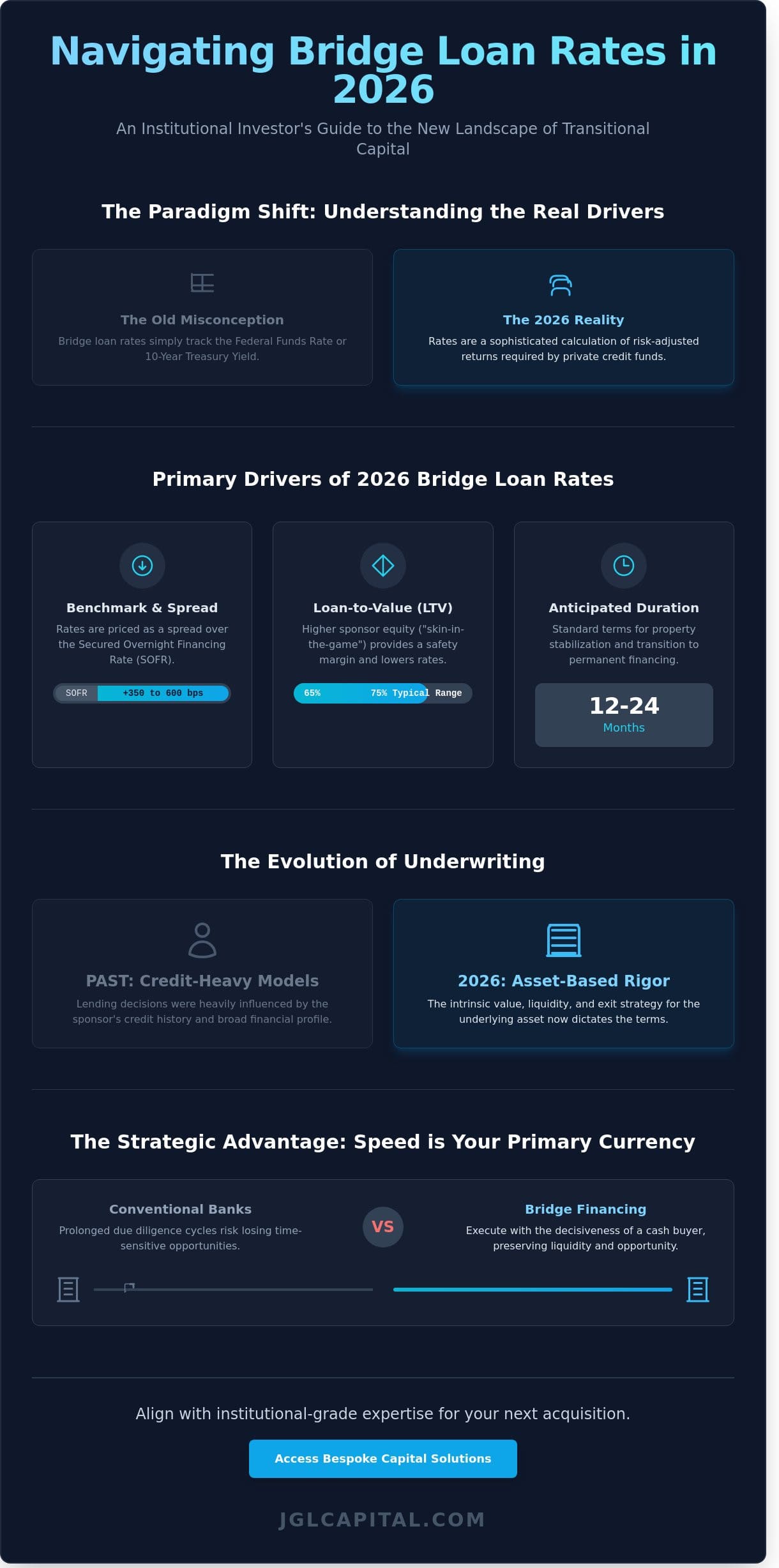
The Secured Overnight Financing Rate (SOFR) continues to serve as the foundational benchmark for private bridge pricing throughout 2026. As inflation expectations fluctuate, the short-term yield curve for asset-based lenders has become increasingly sensitive to federal interest rate benchmarks. This volatility has prompted a definitive shift in underwriting philosophies. Lenders have largely abandoned the credit-heavy models of previous decades, moving toward a rigorous asset-based underwriting approach where the intrinsic value of the collateral dictates the terms. This transition ensures that capital remains available for high-quality assets even when broader market sentiment remains cautious. The primary drivers of current bridge loan rates and pricing include:
- The spread over SOFR, which typically ranges between 350 and 600 basis points for institutional-grade projects in the current quarter.
- The anticipated duration of the bridge period, with 12-month to 24-month terms being the standard for 2026.
- The loan-to-value (LTV) ratios, which have stabilized near 65% to 75% to mitigate downside risk.
The correlation between these benchmarks and private lending rates reflects a broader trend toward transparency in the shadow banking sector. Sophisticated borrowers now look beyond the nominal interest rate, evaluating the total cost of capital including origination fees and exit penalties. This analytical rigor is essential for maintaining the integrity of a long-term investment strategy. By aligning with a disciplined steward of capital, investors can ensure that their transitional financing remains a tool for growth rather than a source of unforeseen liability.
Primary Determinants of Bridge Loan Interest Rates
The pricing of transitional capital reflects a sophisticated intersection of asset-specific risk and the sponsor’s operational proficiency. Capital providers don’t view bridge loan rates as static figures; instead, they function as risk-adjusted returns that fluctuate based on the probability of a successful execution plan. As of the Q4 2025 market cycle, institutional lenders have tightened their underwriting standards, placing increased weight on the liquidity of the collateral and the clarity of the borrower’s path to stabilization.
Loan-to-Value and Capital Stack Positioning
The Loan-to-Value (LTV) ratio remains the most influential mechanism for aligning the interests of the lender with the equity sponsor. Higher levels of “skin-in-the-game” correlate with lower interest rates because they provide a wider margin of safety against market volatility. Market data indicates that Bridge loan interest rates typically scale in direct proportion to the complexity of the capital stack; for instance, the presence of subordinate liens or mezzanine debt can increase the primary rate by 150 to 300 basis points to account for the heightened inter-creditor risk. When a sponsor maintains an LTV below 65%, the capital provider’s risk-adjusted return is secured by a robust equity cushion, often resulting in compressed spreads.
Asset Class and Market Liquidity
The underlying property type dictates the inherent risk premium of the bridge facility. Multi-family assets currently command the most competitive bridge loan rates due to their consistent cash flows and high institutional demand. In contrast, land development or specialized industrial projects involve higher risk profiles because their liquidation value is more sensitive to economic shifts. Lenders evaluate the “stabilization period,” which is the projected timeframe required to bring the asset to its highest and best use. For a fix-and-flip project, a 12-month stabilization period is standard, whereas a complex new construction bridge might require 24 to 36 months of interest reserves to mitigate carry risk during the lease-up phase.
The Strategic Importance of the Exit Strategy
Underwriting the viability of the exit strategy is paramount for any disciplined capital provider. A bridge loan is, by definition, a temporary solution, and its pricing is heavily influenced by the credibility of the “take-out” financing or the eventual sale. If a sponsor presents a committed permanent financing letter or demonstrates a Debt Service Coverage Ratio (DSCR) above 1.25x upon stabilization, the lender’s risk premium is significantly reduced. This analytical rigor ensures that the transition from short-term debt to long-term capital is seamless. Institutional partners seeking a disciplined approach to capital allocation often prioritize these metrics to ensure long-term portfolio stability and the successful preservation of wealth through every phase of the property lifecycle.
Comparative Analysis: Private Money vs. Institutional Bridge Financing
The landscape of transitional finance in 2026 necessitates a rigorous evaluation of capital sources, as the delta between institutional and private capital has widened in both cost and utility. While bridge loan rates offered by traditional banks may appear lower on a headline basis, the total cost of capital often tells a different story. Institutional lenders operate within a rigid framework of regulatory compliance; this creates friction that can jeopardize time-sensitive acquisitions. Private money lenders provide a strategic alternative by prioritizing asset value and execution velocity over the exhaustive borrower-centric documentation required by traditional repositories.
The primary value proposition of private bridge lending lies in its speed of execution. In a market where off-market opportunities require closing within 10 to 14 business days, the 60 or 90-day cycles of a traditional bank are functionally obsolete. Sophisticated investors recognize that the premium paid on the interest rate is a strategic allocation to secure an asset that would otherwise be lost to a more agile competitor. This disciplined approach to capital management values the certainty of closing as a primary risk-mitigation tool. Investors who have deployed a bridge loan for home purchase understand firsthand how bypassing the standard 45-day underwriting cycles of depository institutions can be the decisive factor in securing a time-sensitive acquisition.
Traditional Bank Limitations in Transitional Scenarios
Traditional financial institutions face significant hurdles due to evolving capital adequacy requirements and internal risk-weighting models. This regulatory friction often causes banks to shy away from new construction loans during the high-risk early phases of development. Beyond the interest rate, bank financing carries hidden operational costs through restrictive covenants. These may include:
- Stringent cash sweep provisions that limit liquidity.
- Onerous quarterly reporting requirements that drain administrative resources.
- Prepayment penalties that restrict the borrower’s ability to exit into permanent financing.
The Private Money Advantage for Sophisticated Investors
Private capital providers utilize streamlined due diligence processes that emphasize the underlying property’s pro forma potential. This asset-focused underwriting allows for tailored solutions in complex real estate investing structures; this includes entities with multiple tiers of ownership or foreign equity partners. While fundamental principles of how interest rates are determined still apply to the broader market, private lenders have the latitude to price risk based on the specific merits of a project rather than a standardized credit score matrix. Sponsors who want to master the mechanics of transitional finance should understand how does a bridge loan work as a mechanism for rapid capital deployment, particularly when leveraging asset intrinsic value over traditional credit metrics.
Choosing a private partner fosters a relationship-based lending environment. This discreet, strategic partnership offers long-term value that transcends a single transaction. By aligning interests through bespoke capital solutions, investors gain a steward of capital who understands the nuances of portfolio optimization and the necessity of rapid, decisive action in a volatile 2026 economy.
Strategic Considerations for Mitigating Bridge Loan Costs
Sophisticated investors recognize that bridge loan rates aren’t static figures; they’re variables influenced by the perceived risk profile of the sponsor and the underlying asset’s projected performance. Optimizing the capital structure serves as the primary lever for cost reduction. By increasing the equity contribution or securing secondary financing, sponsors can effectively reduce the senior loan-to-value (LTV) ratio. Lower LTV ratios frequently trigger tiered pricing models where institutional lenders offer more competitive spreads. Cross-collateralization provides another sophisticated avenue for rate compression. By pledging additional equity from stabilized assets within a diversified portfolio, a borrower lowers the lender’s loss-given-default metric, often resulting in a more favorable interest rate environment.
Improving the Loan Profile
The selection of a capital partner is a critical decision that influences the entire project lifecycle. Engaging with professional hard money lenders florida ensures that the deal structure aligns with regional market dynamics, which enhances credibility during the rigorous underwriting process. A comprehensive project pro-forma, supported by third-party feasibility studies, reduces the risk premium. Lenders in 2026 prioritize sponsors who demonstrate a 100 percent track record of executing value-add strategies. This historical performance serves as a proxy for future success, allowing seasoned managers to leverage their asset management history to negotiate superior terms.
Navigating Points and Closing Fees
Total capital allocation strategies must account for the friction costs associated with closing. Origination fees typically range from 1 to 3 percent of the total loan amount, yet their timing significantly impacts the internal rate of return (IRR). Sponsors should evaluate the following cost components:
- Up-front Points: These impact initial liquidity and are paid at the closing table.
- Exit Fees: These “back-end” costs are deferred until the loan is settled, preserving capital during the renovation or stabilization phase.
- Administrative Costs: This includes processing, underwriting, and legal fees that must be scrutinized for transparency.
Pre-payment penalties, often structured as minimum interest requirements or yield maintenance clauses, can erode the ROI of short-term projects if the exit occurs earlier than projected. It’s essential to identify and eliminate unnecessary “junk fees” that don’t add value to the transaction. Precise documentation and a disciplined approach to the loan estimate ensure that capital is preserved for the project’s primary objectives. Consult with JGL Capital to refine your 2026 financing strategy and optimize your cost of capital.
JGL Capital: Bespoke Bridge Solutions for National Investors
JGL Capital operates at the intersection of institutional discipline and specialized real estate expertise. With over thirty years of experience in the private capital markets, the firm serves as a strategic steward for investors navigating the complexities of transitional finance. Our approach isn’t merely transactional. We prioritize the alignment of interests to ensure that every capital allocation serves the broader objective of wealth preservation. By providing tailored capital solutions, we assist partners in managing the volatility of bridge loan rates while maintaining a focus on long-term portfolio appreciation.
The firm’s reputation is built on a foundation of analytical rigor. We understand that the transition from acquisition to stabilization requires more than just liquidity; it requires a partner who understands the underlying mechanics of asset-backed lending. JGL Capital streamlines this progression, moving assets from the bridge phase toward permanent financing structures with precision and foresight. Our team focuses on the delivery of risk-adjusted returns, ensuring that each bridge facility acts as a stable foundation for future growth rather than a temporary fix.
The JGL Capital Underwriting Philosophy
Our underwriting methodology emphasizes the intrinsic value of the real estate asset over fleeting market sentiment. We reject speculative trends, opting instead for timeless financial principles that have governed successful capital management for decades. This disciplined framework allows us to offer a bridge loan mortgage structure that supports institutional-grade portfolios. By focusing on rigorous data analysis, we ensure that our partners are positioned to withstand shifts in the 2026 economic environment. Every project undergoes a meticulous review process to confirm that the strategic objectives of the investor remain the primary driver of the financing arrangement.
Securing Your Next Strategic Acquisition
Engaging with JGL Capital begins with a sophisticated evaluation of your specific capital requirements. Our national reach enables us to fund diverse property types across the United States, from multi-family developments to industrial logistics hubs. We don’t provide off-the-shelf products. Instead, we offer bespoke financing quotes that reflect the unique profile of each acquisition.
As you evaluate current bridge loan rates and prepare for your next deployment of capital, consider the value of a seasoned strategic ally. Our commitment to integrity and strategic oversight ensures that your transitional capital needs are met with the highest level of professional excellence. Partner with a disciplined steward of capital to build a lasting legacy through careful, deliberate action. Contact our team today to discuss how our intellectual capital can support your next institutional acquisition.
Securing Strategic Advantage in the 2026 Capital Markets
Navigating the complexities of bridge loan rates in 2026 requires a disciplined approach to capital allocation and a deep understanding of the spread between private and institutional lenders. Market projections from the Mortgage Bankers Association indicate that commercial mortgage originations will stabilize as the Federal Reserve’s long-term terminal rate remains the primary anchor for debt pricing. Investors must prioritize asset-focused underwriting and rigorous strategic oversight to mitigate the costs associated with transitional capital. JGL Capital leverages over 30 years of industry expertise to provide national funding capability for complex real estate transactions. Our firm maintains a commitment to analytical rigor and the delivery of bespoke solutions that align with your portfolio optimization goals. We’ve established a reputation as a disciplined steward of capital, ensuring that your capital structure remains resilient against market volatility. We invite you to Consult with JGL Capital for a Bespoke Bridge Financing Solution that secures your legacy in a shifting economic environment. Your vision for long-term growth deserves a partner who values precision and integrity above all else.
Frequently Asked Questions
How are bridge loan rates calculated compared to traditional mortgages?
Bridge loan rates are fundamentally structured as a premium over floating-rate benchmarks like the Secured Overnight Financing Rate, which differs from traditional mortgages that typically track 10-year Treasury yields. These private credit instruments command a 300 to 600 basis point spread to compensate for the expedited execution and transitional risk inherent in short-term capital. This pricing model reflects the flexibility institutional lenders provide during complex asset repositioning cycles where speed is the primary requirement.
What is the typical term length for an investment-grade bridge loan?
Investment-grade bridge facilities typically maintain a primary duration of 12 to 24 months, though 36-month structures are common for larger commercial redevelopments. Most agreements incorporate one or two six-month extension options, provided the borrower meets specific debt service coverage ratio milestones. This timeframe allows for the successful execution of value-add strategies or the stabilization of net operating income before you secure permanent agency financing through traditional channels.
Can I secure a bridge loan if I have a low credit score but high property equity?
Institutional bridge lenders prioritize the underlying collateral’s intrinsic value and the borrower’s equity stake over traditional FICO metrics. Even with a credit score below 650, you can often secure funding if the property demonstrates a robust exit strategy and the loan-to-value remains under 65%. This collateral-centric underwriting allows for the deployment of capital in scenarios where traditional banking institutions’ rigid credit overlays would otherwise prevent a successful closing. To fully leverage this asset-based approach, it helps to understand how does a bridge loan work as a strategic instrument for capital deployment independent of conventional credit score matrices.
What are “points” in a bridge loan and how do they affect the total cost?
Points represent a one-time origination fee that serves as a primary component of the lender’s yield, usually totaling 1% to 2% of the facility’s par value. These fees increase the effective annual percentage rate beyond the nominal interest rate, impacting the total cost of capital at the moment of closing. For a $10 million facility, 2 points would equate to an upfront $200,000 capital allocation, which is typically deducted from the initial disbursement.
Is a bridge loan appropriate for a new construction project?
A bridge loan is an appropriate instrument for the “temporary certificate of occupancy” phase or when transitioning from a construction loan to permanent financing. While ground-up development usually requires specialized construction debt, bridge capital facilitates the lease-up period or covers cost overruns during the final 12 months of a project. This strategic use of funds ensures the developer maintains momentum while the asset reaches the stabilization required for institutional take-out financing.
What happens if I cannot refinance the bridge loan before the term expires?
If a borrower fails to retire the debt by the maturity date, the loan agreement typically mandates a transition to a default interest rate. This rate can be 5% higher than the original coupon, reflecting the increased risk to the lender’s capital position. To avoid this, sophisticated sponsors negotiate extension hurdles or seek a bridge-to-bridge refinance, though this often necessitates a fresh injection of equity to satisfy updated loan-to-value requirements.
Are bridge loan rates fixed or variable in the 2026 market?
Prevailing bridge loan rates in 2026 are predominantly variable, utilizing the 30-day Secured Overnight Financing Rate as a base rate to mitigate interest rate volatility. While fixed-rate products exist for stabilized assets with terms under 18 months, the majority of transitional capital utilizes interest rate caps to protect the borrower against sudden market shifts. This structure ensures that the cost of capital remains aligned with current macroeconomic conditions while providing the lender with a consistent risk-adjusted return.
What is the minimum LTV required to qualify for the best bridge loan rates?
Securing the most favorable bridge loan rates requires a conservative loan-to-value ratio, typically capped at 60% to 65% of the appraised “as-is” value. Lenders offer lower spreads to sponsors who demonstrate significant skin in the game, as this equity cushion reduces the probability of loss given default. In the current 2026 credit environment, maintaining an LTV below these thresholds is the most effective way to optimize the cost of transitional capital and ensure institutional interest.