

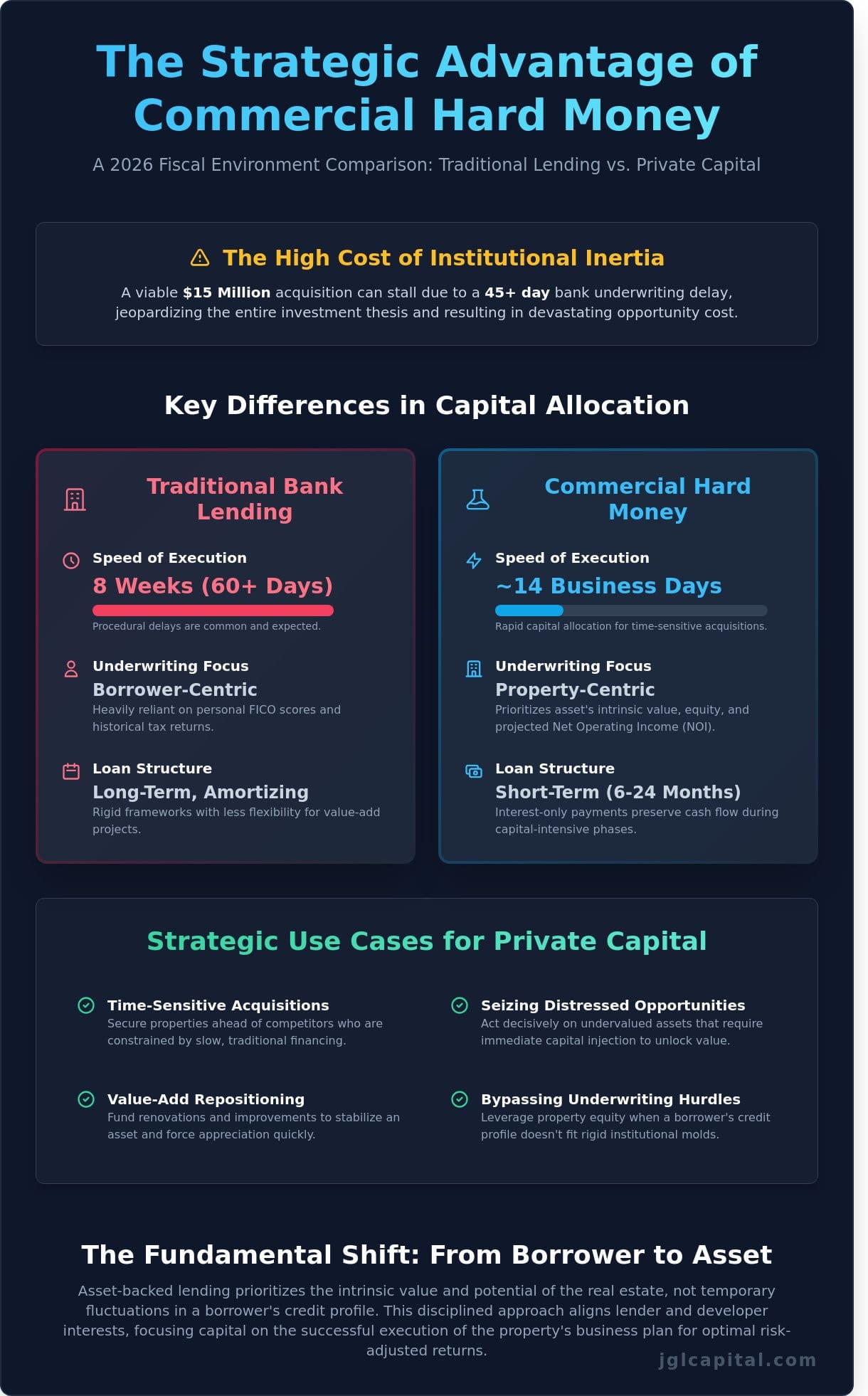
In the current 2026 fiscal environment, the true cost of capital isn’t measured solely by basis points; it’s defined by the devastating opportunity cost of institutional inertia. While traditional lenders remain tethered to rigid, credit-centric frameworks that often disregard the intrinsic value of high-potential assets, sophisticated investors understand that agility is a prerequisite for successful capital allocation. You’ve likely experienced the frustration of a viable $15 million acquisition stalling due to a 45-day bank underwriting delay, where the lack of a responsive partner threatens the integrity of your entire investment thesis. Utilizing commercial hard money loans offers a sophisticated alternative for those who require rapid liquidity without the constraints of conventional debt structures.
We’ll provide the analytical rigor necessary to master these asset-backed financing vehicles to secure the capital required for high-stakes real estate developments. You’ll gain a comprehensive understanding of how to leverage property equity to bypass traditional underwriting hurdles, ensuring your portfolio remains resilient and poised for growth. This guide details the strategic shift from transactional borrowing to a disciplined partnership model, focusing on risk-adjusted returns and the precise execution of your long-term wealth preservation goals.
Key Takeaways
- Understand how commercial hard money loans facilitate a fundamental shift from borrower-centric to property-centric underwriting, enabling the rapid allocation of capital for time-sensitive acquisitions.
- Analyze the mechanics of asset-based underwriting to determine how the loan-to-value ratio serves as a primary instrument for mitigating risk in complex real estate developments.
- Identify strategic scenarios where the agility and precision of private capital offer a distinct competitive advantage over the procedural delays inherent in traditional institutional lending.
- Master the art of structuring sophisticated loan request packages that emphasize viable exit strategies to ensure optimal risk-adjusted returns on every deployment.
- Leverage the benefits of a bespoke brokerage approach to secure tailored capital solutions that align with the long-term stewardship of your investment portfolio.
Defining the Role of Commercial Hard Money in Strategic Capital Allocation
In the fiscal environment of 2026, where traditional lending institutions often retreat from market volatility, the Hard money loan serves as a critical instrument for sophisticated capital allocation. These vehicles function as short-term, asset-backed financing secured primarily by real estate equity, facilitating a fundamental shift from borrower-centric to property-centric underwriting. This transition is vital; by prioritizing the underlying asset’s performance, commercial hard money loans offer a path to liquidity that conventional credit markets often lack. As the 10-year Treasury yield maintains its 4.1% average through the first quarter of 2026, private capital remains the primary stabilizer for developers seeking to maintain portfolio velocity.
Bridge financing acts as a temporary yet robust support structure, ensuring that institutional partners can execute acquisitions without the 60-day delays typical of regional banks. By securing capital against the intrinsic value of the property, investors can navigate the 2026 interest rate environment with greater agility. This allows for the immediate seizure of distressed opportunities or time-sensitive repositioning projects that require rapid funding cycles.
The Core Characteristics of Private Commercial Debt
- Short-term duration: These loans typically span a window of six to twenty-four months, providing the necessary runway for asset stabilization.
- Interest-only payment structures: It’s a strategic choice that preserves monthly cash flow for developers during intensive capital expenditure phases.
- Speed of execution: While traditional lenders require eight weeks for due diligence, private entities often close within 14 business days.
Asset-Backed vs. Credit-Based Financing
Property equity functions as the primary security for the lender, effectively mitigating the risk associated with the borrower’s personal financial history. In this framework, personal FICO scores play a diminished role in the underwriting process. This is particularly relevant in 2026, as institutional investors prioritize the projected Net Operating Income of an asset over the sponsor’s historical tax returns. Asset-backed lending is a strategy that prioritizes the intrinsic value of the real estate over the financial history of the borrower.
By focusing on the collateral’s liquidation value and its potential for value-add appreciation, commercial hard money loans provide a level of flexibility that credit-based models don’t permit. This disciplined approach to underwriting ensures that capital is deployed where it’s most productive, regardless of temporary fluctuations in a borrower’s credit profile. It’s a methodology that aligns the interests of the lender and the developer, focusing entirely on the successful execution of the property’s business plan.
The Mechanics of Asset-Based Underwriting for Commercial Real Estate
Asset-based underwriting represents a fundamental shift from traditional credit-centric models. It’s a method that prioritizes the intrinsic value of the collateral over the borrower’s personal financial history. When evaluating commercial hard money loans, institutional lenders focus on the “Hard Asset” to determine the ultimate viability of the capital allocation. This process involves a granular analysis of the property’s physical condition, its location within a specific submarket, and its potential for income generation. In the 2026 market, where interest rates have stabilized but valuations remain sensitive, this analytical rigor ensures that every investment is backed by a tangible margin of safety.
The due diligence process for industrial, retail, and multi-family assets requires a specialized approach for each class. Industrial properties are scrutinized for ceiling heights, loading dock ratios, and proximity to logistical hubs. Retail assets undergo a rigorous review of tenant mix and anchor stability. For multi-family properties, lenders look at historical occupancy rates and the demographic trends of the surrounding area. Traditional Commercial real estate loans often rely on rigid credit boxes, but the flexibility of hard money allows for a focus on the property’s future potential. This is most evident in commercial rehabilitation projects, where the After-Repair Value (ARV) serves as the benchmark. Lenders typically cap their exposure at 75% of the ARV, ensuring that the project remains well-capitalized even if market conditions shift during the renovation phase.
Determining the Loan-to-Value (LTV) Threshold
Capital allocation in the 2026 fiscal landscape requires a disciplined approach to leverage. Typical LTV ranges for most commercial assets currently fluctuate between 55% and 70%, reflecting a cautious but opportunistic lending environment. Industrial properties often qualify for the higher end of this spectrum because of their consistent demand; conversely, office assets often face stricter 55% limits due to structural shifts in workforce distribution. It’s common for institutional investors to utilize cross-collateralization, pledging additional properties to secure higher total loan amounts and optimize their portfolios. If you’re looking to maximize your leverage through strategic asset-backing, you can explore bespoke financing solutions with our team.
The Role of Debt Service Coverage Ratio (DSCR) in Hard Money
While the hard asset provides the security floor, the Debt Service Coverage Ratio (DSCR) ensures the property can sustain its own debt obligations. Lenders typically look for a ratio of 1.25x or higher to provide a sufficient buffer against market volatility. This metric is particularly vital for those understanding DSCR for rental property loans as it dictates the viability of long-term cash flow strategies. For multi-family properties, this analysis includes a review of current rent rolls and projected market escalations to confirm that the interest payments are well-covered. It’s a safeguard that aligns the interests of the lender and the borrower, ensuring the project’s long-term solvency.
Strategic Deployment: When to Utilize Hard Money Over Traditional Bank Debt
The deployment of private capital represents a tactical pivot from the rigid constraints of institutional lending. Traditional banks often require exhaustive historical data and personal guarantees, a process that can consume 60 to 90 days in a standard underwriting cycle. This bureaucratic inertia creates a vacuum where agile investors utilize commercial hard money loans to seize undervalued assets. In the 2026 fiscal environment, the ability to bypass traditional committees is a competitive necessity. Private debt focuses on asset-backed security and the viability of the exit strategy rather than the borrower’s immediate liquidity profile. This shift allows for the financing of complex entity structures, such as irrevocable trusts or multi-layered LLCs, without the invasive scrutiny that halts conventional approvals. Understanding the nuances of Hard money lending rules and regulations ensures that these transactions remain compliant while maintaining the necessary speed for capital preservation.
Institutional delays aren’t merely an inconvenience; they represent a quantifiable opportunity cost. If a prime commercial asset offers a 12% discount for a 10-day close, the temporary interest premium of a private bridge loan is a negligible expense compared to the equity gained at acquisition. By prioritizing speed, an investor transforms a potential liability into a strategic advantage, securing assets that would otherwise be lost to cash-heavy competitors. Investors seeking a deeper understanding of how asset-backed structures compare to conventional debt can benefit from reviewing a comprehensive guide to commercial real estate loans and capital allocation strategies in 2026.
Time-Sensitive Acquisitions and 1031 Exchanges
Investors facing the 45-day identification window of a 1031 exchange don’t have the luxury of extended bank approvals. Missing these statutory deadlines triggers immediate capital gains tax liabilities, often exceeding 20% of the realized gain. Commercial hard money loans provide the requisite speed to satisfy the 180-day exchange cycle, functioning as a bridge until permanent financing is secured. This “cash-like” agility is particularly vital in bidding wars where a 14-day closing guarantee often outweighs a higher, but contingent, institutional offer.
Financing Value-Add and Distressed Properties
Conventional lenders typically reject assets with a vacancy rate exceeding 40% or those requiring significant structural remediation. These institutions view deferred maintenance as a risk rather than an opportunity for value creation. Private capital, however, thrives in these repositioning scenarios. Investors can use bridge financing to stabilize a retail or office asset, increasing the Net Operating Income (NOI) before transitioning to a long-term agency loan. For those specializing in residential-to-commercial conversions or rapid renovations, this Strategic guide to fix and flip loans provides a roadmap for executing these high-yield strategies. By leveraging the asset’s post-renovation value, investors maximize their internal rate of return without tying up excessive personal capital.
How to Structure a Commercial Hard Money Loan for Maximum ROI
Maximizing the internal rate of return on high-stakes property acquisitions requires a surgical approach to loan architecture. It’s not enough to simply secure capital. Sophisticated investors must engineer the debt to align with the asset’s specific value-add trajectory. Properly structured commercial hard money loans serve as a bridge to long-term stability, provided the borrower maintains a disciplined focus on the total cost of capital and the eventual liquidity event.
Preparing the Professional Loan Executive Summary
A sophisticated loan request package functions as a technical blueprint for the lender. It must feature high-resolution property imagery, three-year pro-forma financials, and market comparables from the preceding 180 days. Lenders prioritize data over narrative. Presenting a pro-forma that demonstrates a minimum 1.25x debt service coverage ratio (DSCR) instills immediate confidence. The summary should also emphasize the borrower’s track record, specifically highlighting at least five similar asset-class projects completed within the last decade. Clearly defining the use of funds, such as a $2.5 million allocation for structural rehabilitation or a $750,000 reserve for tenant improvements, ensures the lender understands how the capital will drive asset appreciation.
Defining the Exit Strategy
The exit strategy is the most scrutinized component of any bridge financing request. Lenders in 2026 prioritize the “Take-Out” loan or a definitive liquidation event. By Q4 2026, the refinancing landscape is expected to favor assets with stabilized occupancy exceeding 92%. A clear exit strategy reduces perceived risk, which often translates into a 50 to 100 basis point reduction in the interest rate. It’s the borrower’s responsibility to prove that the asset’s post-renovation valuation supports a conventional refinance at a 70% loan-to-value (LTV) ratio. Without a viable transition to permanent debt or a sale, the high cost of bridge capital will eventually erode the project’s equity cushion.
Managing Points and Origination Fees
Managing the total cost of capital involves a precise calculation of origination fees. These points, typically ranging from 1% to 5% of the gross loan amount, represent a significant drag on yield if they aren’t structured with foresight. Sophisticated borrowers often negotiate to roll these fees into the total loan balance. This preserves upfront liquidity for operational needs or unexpected site expenses. Efficient capital management is detailed in our Strategic guide to private capital allocation. When utilizing commercial hard money loans, every percentage point must be weighed against the projected increase in Net Operating Income (NOI). If the cost of capital exceeds the projected cap rate compression, the project’s viability must be reassessed.
To optimize your next project’s financial structure and ensure institutional-grade execution, speak with our capital allocation experts.
Executing Your Capital Strategy with JGL Capital
JGL Capital brings a thirty-year legacy to the specialized field of capital origination. We don’t subscribe to the rigid, one-size-fits-all methodologies that often characterize direct lending institutions. Our firm operates as a sophisticated bridge between institutional-grade opportunities and the private capital markets. We prioritize a bespoke brokerage model. This approach ensures that your specific investment objectives dictate the financing structure, rather than the limitations of a single balance sheet. By acting as a disciplined steward of your capital strategy, we align our interests with your long-term portfolio optimization and risk management goals.
Professionalism in this sector requires more than just access to funds. It demands a deep understanding of market cycles and asset-backed security. Our team provides the analytical rigor necessary to navigate high-stakes environments. We maintain a commitment to timeless financial principles, ensuring that every commercial hard money loans structure we facilitate is grounded in realistic valuations and clear exit strategies. This dedication to precision has established our reputation as a trusted ally for high-net-worth individuals and institutional partners alike.
Tailored Solutions for Complex Commercial Scenarios
Our expertise encompasses the full spectrum of high-stakes real estate, including multi-family complexes, industrial hubs, and large-scale 2026 developments. We understand that a warehouse in a logistics corridor requires a different risk-adjusted return profile than a stabilized apartment building. For those engaged in ground-up projects, our strategic guide for real estate developers provides deeper insights into how we mitigate construction-related volatility. Our underwriting process isn’t a simple checklist; it’s an analytical deep dive into the unique nuances of each asset. This precision allows us to secure commercial hard money loans that reflect the true value of your collateral while providing the liquidity you require. For investors specifically focused on apartment complexes and rental properties, our comprehensive guide to multi-family loans and private capital allocation offers specialized insights into maximizing returns within this asset class.
The JGL Advantage: Precision and Professionalism
Efficiency defines our operational philosophy. We facilitate the seamless transition from initial application to final funding within a compressed window of five to seven business days. This speed doesn’t come at the expense of rigor. Instead, it’s the result of accessing a broad spectrum of private capital through a single, institutional partner. Our strategic oversight ensures that every closing is executed with surgical precision. We manage the complexities of the lending landscape so you can focus on asset management and wealth preservation. We invite you to partner with JGL Capital for your next commercial acquisition and experience a standard of professionalism that honors your financial legacy.
- Thirty years of proven expertise in capital origination and strategic allocation.
- Access to diverse private capital pools through a single institutional relationship.
- Funding timelines optimized for the 2026 market, typically closing in five to seven business days.
- Bespoke underwriting that accounts for the specific nuances of multi-family and industrial assets.
Optimizing Your Capital Stack for the 2026 Financial Landscape
Navigating the complexities of high-stakes real estate requires a disciplined approach to asset-backed financing that transcends simple liquidity. Successful investors recognize that the strategic deployment of capital is most effective when it’s grounded in analytical rigor and precise underwriting. By prioritizing the intrinsic value of the collateral, you’re able to secure opportunities that traditional banking structures often fail to accommodate. Integrating commercial hard money loans into your broader portfolio strategy provides the agility needed to capture time-sensitive acquisitions while maintaining a focus on risk-adjusted returns.
JGL Capital serves as a seasoned steward of your investment goals, leveraging over 30 years of industry expertise to facilitate complex transactions across the nation. We’ve refined our process to ensure that speed doesn’t compromise diligence; it’s why we provide pre-approval within 24 to 48 hours for diverse asset classes. Our commitment to bespoke solutions ensures that your capital allocation aligns perfectly with your long-term legacy. Secure Institutional-Grade Capital for Your Next Commercial Transaction. Your next successful acquisition is within reach when you partner with a firm that values integrity and sophisticated strategy.
Frequently Asked Questions
What are the typical interest rates for commercial hard money loans in 2026?
Interest rates for commercial hard money loans in 2026 typically range from 9.75% to 13.50% based on current Treasury yield projections. These rates reflect the risk-adjusted returns required for non-institutional capital in a shifting economic climate. Investors should expect a 2% premium over 2024 benchmarks.
This pricing structure ensures the alignment of interests between the lender and the borrower while accounting for potential market volatility in the industrial and multifamily sectors. The specific rate depends on the asset’s location and the borrower’s clear exit strategy.
How much down payment is required for a commercial hard money loan?
A standard down payment for these transactions involves a capital contribution of 25% to 35% of the total asset value. Lenders prioritize a maximum Loan-to-Value ratio of 75% to preserve equity cushions. For a $5,000,000 acquisition, a borrower’s liquid equity requirement would sit at $1,250,000 minimum.
This disciplined approach to leverage safeguards the portfolio against 10% market corrections. It ensures long-term stability for all strategic partners involved in the financing, emphasizing a commitment to prudent capital allocation rather than speculative growth.
Can I get a commercial hard money loan with a low credit score?
Borrowers can secure financing with credit scores as low as 580 because the underwriting process prioritizes the liquidation value of the real estate. Since these are asset-backed structures, the property’s potential for value creation outweighs the individual’s credit history. We’ve seen successful capital allocation for projects where the borrower faced a 2024 bankruptcy but held a 40% equity position.
The collateral remains the primary security for the loan. This allows for a focus on the asset’s performance rather than personal financial setbacks that don’t impact the property’s intrinsic value.
How fast can a commercial hard money loan be funded?
Funding typically occurs within 10 to 14 business days once the title report and environmental assessments are finalized. This accelerated timeline serves as a primary advantage for those utilizing commercial hard money loans to capture time-sensitive opportunities. Traditional bank financing often requires 60 to 90 days for similar approvals.
By streamlining the due diligence process, we provide the agility needed for complex acquisitions. This speed allows investors to deploy capital immediately to secure a competitive position in high-demand markets like Austin or Phoenix.
What types of commercial properties qualify for hard money financing?
Qualifying assets include multifamily housing with 5 or more units, industrial facilities, retail strips, and medical office buildings. We exclude specialized properties like gas stations that carry 15% higher environmental risk profiles. A common example involves a 50-unit apartment complex needing immediate renovations before traditional refinancing.
These properties offer the tangible value required for disciplined asset-based lending. They provide a clear path toward portfolio optimization and long-term growth through strategic oversight and value creation. Investors seeking to expand beyond improved properties can also explore land loans as a strategic tool for rapid capital deployment in raw and transitional asset acquisitions.
Are there prepayment penalties on commercial hard money loans?
Prepayment penalties are common and usually consist of a 6-month minimum interest clause or a 3-2-1 percentage step-down structure. If you’re repaying a $2,000,000 loan in the first 90 days, you’ll still owe the interest for the initial 180-day period. This ensures the lender achieves their projected risk-adjusted returns.
It’s a standard mechanism used to maintain the predictability of cash flows within a managed investment vehicle. These terms are clearly defined at the outset to ensure transparency and trust between all parties.
What is the difference between a commercial bridge loan and a hard money loan?
The main distinction lies in the underwriting focus; bridge loans require stabilized debt service coverage ratios while commercial hard money loans focus on the raw equity. Commercial bridge loan financing offers lower rates, often 3% below hard money, but demands more rigorous financial disclosures. Hard money serves as the initial tool for rapid acquisition.
Once the property reaches 90% occupancy, the borrower typically transitions into a bridge facility to lower their cost of capital. This progression represents a logical step in the lifecycle of a sophisticated investment strategy.
What documentation is required for an asset-based commercial loan?
Asset-based financing requires a current 12-month rent roll, a preliminary title report, and a Phase I Environmental Site Assessment. You’ll also need to provide the LLC’s Articles of Organization and a detailed budget for any planned capital improvements. These documents allow for a precise calculation of the property’s Net Operating Income.
Providing a clear 3-year exit strategy is also vital for ensuring the strategic alignment of all parties. This disciplined documentation process reflects the analytical rigor necessary for successful wealth preservation and growth.