

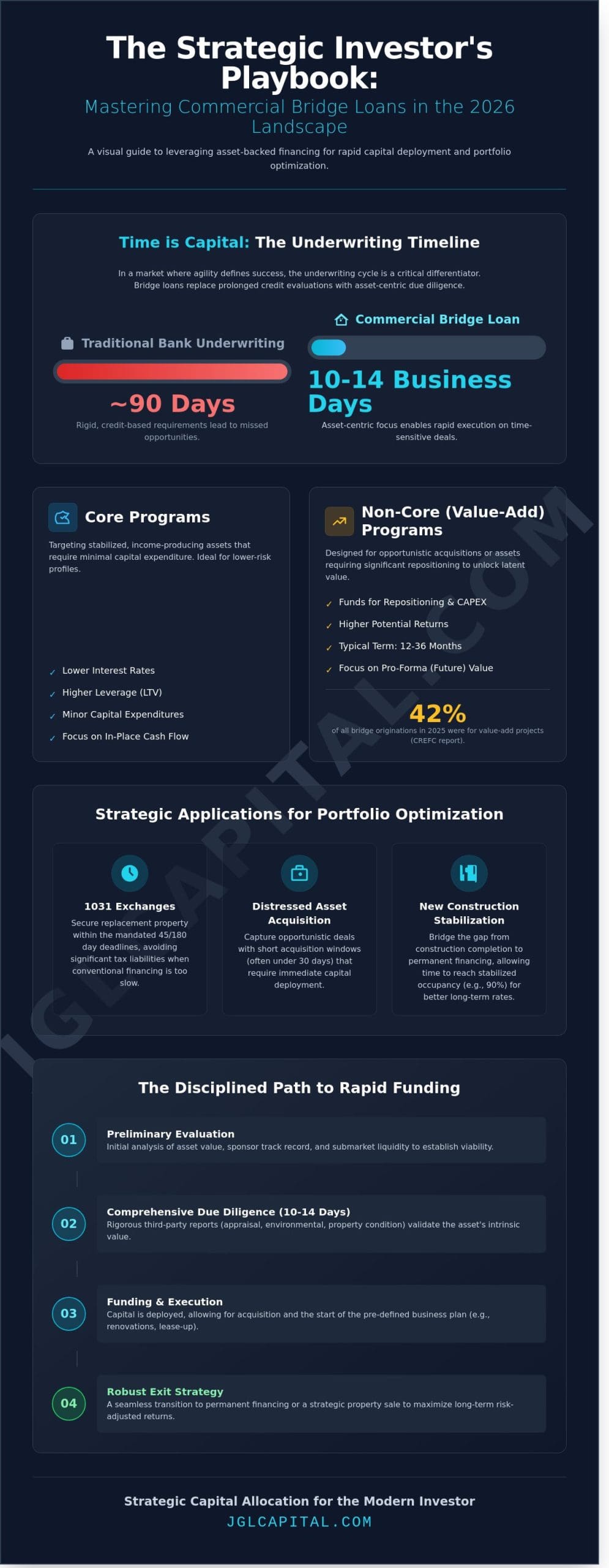
In an era where institutional agility defines the boundary between market leadership and obsolescence, the traditional 90-day bank underwriting cycle has become a structural liability for the sophisticated investor. Data from the 2024 Mortgage Bankers Association reports indicated a significant shift toward alternative lending as traditional credit tightening persisted into the mid-2020s. Securing a commercial bridge loan is no longer a niche tactic; it’s a disciplined instrument for those who refuse to let rigid, credit-based requirements derail time-sensitive acquisitions. You’ve likely recognized that the current financial environment demands a departure from the inertia of conventional lending, especially when high-stakes opportunities require immediate execution and a partner who understands the intrinsic value of the underlying asset.
This analysis provides a rigorous framework for deploying asset-backed financing to secure rapid capital, allowing you to bridge the gap to permanent stabilization while maximizing risk-adjusted returns on value-add projects. We’ll examine how strategic capital allocation through private debt facilitates seamless property transitions and unlocks latent value. This guide promises to detail the precise mechanisms for securing rapid funding that bridges the gap to permanent financing or a strategic property sale, ensuring your portfolio remains resilient and your investment legacy is preserved in a competitive 2026 landscape.
Key Takeaways
- Understand how a commercial bridge loan functions as a sophisticated short-term instrument within the capital stack to facilitate rapid institutional acquisitions and asset repositioning.
- Identify strategic methodologies for leveraging bridge capital to capture time-sensitive opportunities and stabilize distressed properties through disciplined portfolio optimization.
- Analyze the evolving landscape of 2026 interest rate benchmarks, focusing on the transition to SOFR-based floating rates and the nuanced application of LTV versus LTC metrics.
- Gain insight into the rigorous institutional underwriting process, emphasizing the critical role of preliminary evaluations and comprehensive third-party due diligence reports.
- Develop a robust framework for executing pre-defined exit strategies that ensure a seamless transition into permanent financing while maximizing long-term risk-adjusted returns.
The Fundamentals of Commercial Bridge Financing: A Strategic Overview
A commercial bridge loan serves as a temporary, asset-backed capital solution designed to facilitate the acquisition or repositioning of institutional real estate. Within the 2026 capital stack, this debt instrument occupies a critical position between equity and senior permanent financing. It provides the liquidity necessary to secure assets during periods of market transition. Unlike traditional permanent mortgages that prioritize long-term cash flow stability, bridge financing focuses on the immediate intrinsic value and the future potential of the property. The 2026 market cycle isn’t a time for hesitation. Characterized by a 15 percent increase in transaction volume following the stabilization of benchmark rates in late 2025, this environment necessitates a high level of financial agility. It’s a tool for precision, acting as a disciplined mechanism for capital allocation when traditional windows remain closed.
The Mechanism of Asset-Backed Lending
Institutional bridge lending prioritizes the underlying asset as the primary security for capital preservation. This asset-centric underwriting model allows lenders to bypass the exhaustive personal credit evaluations that often delay traditional bank financing. Property value supersedes individual balance sheets in this framework. By focusing on the collateral’s tangible worth, firms can accelerate the due diligence timeline to a window of 10 to 14 business days. This speed is a prerequisite for competitive bidding in high-demand urban corridors where delays result in lost opportunities. The process emphasizes a few critical factors:
- Direct valuation of current and pro-forma net operating income.
- Evaluation of the sponsor’s specific track record in similar asset classes.
- The immediate liquidity and historical performance of the local submarket.
This disciplined approach ensures that capital remains tethered to real-world value rather than speculative projections. It allows for a more fluid movement of funds, ensuring that the stewardship of capital remains the highest priority during the underwriting phase.
Core vs. Non-Core Bridge Programs
Investors must distinguish between core and non-core bridge programs to align with their specific risk-adjusted return profiles. Core programs typically target stabilized assets requiring minor capital expenditures. These offer lower interest rates and higher leverage for the borrower. Non-core programs focus on value-add opportunities or opportunistic acquisitions where the asset requires significant repositioning. According to the 2025 Commercial Real Estate Finance Council reports, value-add projects accounted for 42 percent of all bridge originations. Selecting the appropriate program depends on the projected investment horizon, which usually spans 12 to 36 months. A commercial bridge loan tailored to a non-core strategy allows for the execution of a bespoke business plan. It provides the runway needed to reach stabilized occupancy before transitioning to permanent debt. This strategic oversight ensures that every deployment of capital is a deliberate step toward long-term wealth preservation and portfolio optimization.
Strategic Applications in Real Estate Portfolio Optimization
Institutional investors recognize the commercial bridge loan as a precision instrument for capital allocation, particularly when traditional debt markets demonstrate excessive rigidity or slow processing times. These vehicles provide the necessary liquidity to secure distressed assets where the acquisition window often closes within 30 days. In the context of 1031 exchanges, investors must identify replacement property within 45 days and close within 180 days. A bridge structure ensures these rigid federal mandates are met without the risk of significant tax liabilities. For properties transitioning from new construction to permanent rental occupancy, bridge financing serves as a stabilizing force. It allows the asset to reach a 90% occupancy threshold before the sponsor locks in long-term, lower-interest debt.
Facilitating Value-Add Strategies
Strategic property improvements require a nuanced approach to capital deployment. By utilizing future advance structures, sponsors can draw down funds as specific renovation milestones are achieved. This preserves the project’s internal rate of return by avoiding interest payments on undrawn capital. Improving the Debt Service Coverage Ratio (DSCR) from a sub-1.0 level to an institutional-grade 1.25 or higher remains a core objective for non-performing assets. For instance, a 200-unit multifamily complex requiring $3 million in immediate capital expenditures can be repositioned through bridge debt to achieve the market-rate rents necessary for permanent agency financing. This methodical stewardship of capital ensures that every dollar spent contributes directly to asset appreciation and long-term stability. When dealing with larger multifamily portfolios, investors often benefit from specialized multi-family loans designed for private capital allocation that provide the flexibility needed for complex value-add strategies.
Capital Deployment Speed as a Competitive Advantage
The opportunity cost of waiting 60 to 90 days for a conventional bank approval can be catastrophic in high-competition markets. Institutional sellers often accept lower purchase prices from buyers who demonstrate the ability to close via private bridge capital. It’s a strategy that eliminates the appraisal and underwriting hurdles common in traditional banking. Integrating this debt into a broader capital allocation strategy allows for a more aggressive acquisition pace. By securing an asset quickly, a firm can begin the stabilization process months earlier than competitors. This effectively increases the risk-adjusted return on the initial investment. Speed is not merely a convenience. It’s a tactical advantage that allows for the capture of mispriced assets in volatile markets. Success depends on execution. Professional investors prioritize certainty over the incremental interest savings of slower, more traditional financing routes.
Analyzing Terms, Rates, and Complex Capital Structures
Securing a commercial bridge loan in 2026 requires a granular understanding of how capital is priced and structured within a post-LIBOR environment. The transition to the Secured Overnight Financing Rate (SOFR) as the primary benchmark has introduced a new level of transparency, yet it demands more sophisticated modeling from sponsors. Most institutional lenders now utilize the CME Group’s 1-Month Term SOFR, adding a credit spread that reflects the specific risk profile of the underlying asset. This floating-rate structure aligns the cost of capital with broader market conditions, though it necessitates a disciplined approach to interest rate management.
Capital allocation strategies are heavily influenced by the interplay between Loan-to-Value (LTV) and Loan-to-Cost (LTC) metrics. In the current 2026 credit environment, institutional lenders frequently cap LTC at 75% or 80% for value-add projects, ensuring the sponsor maintains significant equity throughout the stabilization phase. While LTV provides a snapshot of current collateral worth, LTC offers a more accurate reflection of the total capital stack during a renovation or repositioning. Interest-only periods are a standard feature of these structures, allowing investors to maximize short-term cash flow by deferring principal amortization until the asset reaches its target occupancy or valuation. Sponsors seeking a broader perspective on how these structures fit within a diversified debt portfolio can benefit from reviewing commercial real estate loans and their role in strategic capital allocation in 2026 to ensure their financing approach is fully optimized.
The total cost of capital extends beyond the base interest rate. A comprehensive analysis must account for the following fee structures:
- Origination Fees: Typically ranging from 1% to 2% of the total loan amount, paid at closing.
- Exit Fees: Often structured as a percentage of the commitment, these are sometimes waived if the sponsor refinances through the same institution.
- Extension Options: Critical for project flexibility, these usually require a fee of 25 to 50 basis points for an additional six to twelve months of term.
Floating vs. Fixed Rate Considerations
Managing interest rate risk is paramount in a sophisticated investment portfolio. While fixed rates offer predictability, most bridge financing remains floating to allow for prepayments without heavy yield maintenance penalties. Investors often utilize interest rate caps, which are derivative instruments that provide a ceiling on monthly debt service. These hedges are essential when SOFR volatility is high, as they protect the project’s debt service coverage ratio from unexpected market shifts.
The Nuances of Non-Recourse Debt
Non-recourse structures are the preferred vehicle for institutional-grade investments because they protect the sponsor’s broader balance sheet. The lender’s recovery is limited to the asset itself, except in cases involving “bad boy” carve-outs. These triggers, which include fraud, environmental indemnification, or voluntary bankruptcy, remain standard in 2026 loan documents. In some instances, a partial guarantee may be negotiated to reduce the interest rate spread by 25 to 50 basis points, offering a strategic trade-off between personal liability and capital pricing.
The Underwriting Process and Strategic Partnership
The transition from a preliminary inquiry to a funded commercial bridge loan requires a disciplined synthesis of asset valuation and borrower capability. This process initiates with the “soft quote” phase, where lenders perform a rapid internal assessment of the property’s current net operating income and its projected stabilization. During this 48 to 72 hour window, the lender evaluates the capitalization rate against 2026 market benchmarks to determine if the requested leverage aligns with institutional risk appetites. Once the term sheet is executed, the focus shifts to a rigorous due diligence period where third-party reports become the foundation of the credit memo.
Professional underwriting relies on the precision of independent assessments. These include MAI-certified appraisals, Phase I Environmental Site Assessments adhering to ASTM E1527-21 standards, and Property Condition Assessments (PCA) that detail immediate and deferred maintenance costs. A sophisticated lender doesn’t merely collect these documents; they analyze the data to mitigate tail risks. By balancing the borrower’s historical track record with the property’s intrinsic potential, the lender creates a capital structure that supports the asset’s lifecycle. Moving toward closing requires a methodical synchronization of legal counsel, title agents, and insurance providers to ensure the transaction meets the high-register standards of institutional finance.
The Importance of Strategic Alignment
A bridge lender functions as a strategic ally rather than a simple vendor. This relationship thrives on transparency, particularly when articulating the “underwriting narrative” to ensure absolute certainty of funding. When borrowers provide clear, empirical data regarding their exit strategy, it fosters a synergy that often bridges the gap between traditional bank financing and commercial hard money loans. This alignment ensures that the capital provided isn’t just a temporary fix, but a deliberate tool for value creation.
Documentation and Compliance Standards
Institutional-grade review demands a meticulously organized “deal book.” This dossier must include three years of audited financial statements, detailed rent rolls, and a comprehensive business plan. Most 2026 structures utilize Special Purpose Entities (SPEs) to isolate the asset from external liabilities, a requirement that necessitates precise legal drafting. Satisfying regulatory frameworks, including Anti-Money Laundering (AML) and Know Your Customer (KYC) protocols, is non-negotiable. Every document serves to reinforce the firm’s position as a disciplined steward of capital.
To secure a capital partner who values analytical rigor and institutional precision, consult with the specialists at JGL Capital.
Navigating the Exit Strategy: Ensuring Long-Term Value Creation
A commercial bridge loan serves as a tactical instrument; its efficacy remains contingent upon a rigorous exit protocol established at the time of origination. Sophisticated sponsors recognize that the bridge is a transitional phase, not a terminal solution. In the capital markets of 2026, where interest rate volatility persists, the timing of a transition to permanent debt is paramount. A successful exit requires a binary focus: either the stabilization of the asset to qualify for long-term financing or a strategic disposition that captures the value created during the bridge period. Common exit pathways include:
- Permanent Refinancing: Transitioning to CMBS, Life Company, or Agency debt once the asset meets stabilized debt-service coverage ratio (DSCR) benchmarks.
- Strategic Disposition: Executing a sale to institutional buyers who seek stabilized, cash-flowing assets with lower risk profiles.
- Recapitalization: Bringing in new equity partners or mezzanine debt to replace the initial bridge capital while retaining long-term ownership.
Strategic property sales allow investors to maximize equity returns upon stabilization, particularly when the asset’s Net Operating Income (NOI) has been optimized through capital improvements. Bridge lenders play a pivotal role in new construction loans as projects reach operational maturity, providing the necessary runway to achieve occupancy targets before permanent take-out. This phased approach ensures that the developer isn’t forced into a premature sale or a sub-optimal permanent loan before the property’s full value is realized.
Mitigating Refinancing Risk
Securing a seamless transition to permanent capital requires constant monitoring of market conditions. It’s essential to build “extension options” into the initial commercial bridge loan agreement; these provide a safety net if market liquidity shifts or if stabilization takes longer than anticipated. Analysts must rigorously evaluate debt yield requirements, often targeting a 10% threshold for future agency or CMBS take-outs. This foresight prevents a capital gap when the bridge loan matures, ensuring the asset remains adequately levered without requiring unforeseen equity injections.
The JGL Capital Approach to Bespoke Solutions
JGL Capital brings 30 years of expertise to every transaction, anticipating potential exit hurdles long before they manifest. We don’t just provide capital; we act as the disciplined steward of your real estate vision. By tailoring capital structures to the unique lifecycle of each investment, we align our interests with yours. This commitment to strategic oversight ensures that every client is positioned to capture long-term growth. We prioritize analytical rigor over speculative trends, reinforcing our reputation as a seasoned partner in wealth preservation and capital allocation.
Securing Long-Term Value Through Disciplined Capital Deployment
Navigating the intricate credit landscape of 2026 demands a profound understanding of how sophisticated debt instruments facilitate large-scale asset transformation. Utilizing a commercial bridge loan serves as a critical mechanism for bridging the gap between immediate capital requirements and the eventual realization of an asset’s intrinsic value. Institutional investors must prioritize a rigorous approach to underwriting and the articulation of a definitive exit strategy to mitigate volatility. It’s this commitment to analytical precision that ensures capital allocation remains aligned with the overarching goals of portfolio optimization and wealth preservation.
JGL Capital provides the stability and deep-seated expertise necessary to manage high-stakes financial environments. With over 30 years of industry-leading expertise in private capital brokerage, our firm delivers bespoke solutions that reflect a disciplined approach to asset-backed risk management. Partner with JGL Capital for your next strategic acquisition to leverage our institutional oversight and commitment to value creation. We’re prepared to assist you in executing a deliberate strategy that secures your financial legacy.
Frequently Asked Questions
What is the typical duration of a commercial bridge loan in 2026?
In the fiscal environment of 2026, the typical duration of a commercial bridge loan spans 12 to 36 months. This timeframe provides the necessary latitude for sponsors to execute value-add programs or stabilize occupancy before transitioning to permanent financing. While 12 month terms are standard for rapid repositioning, many institutional facilities include two 6 month extension options to accommodate unforeseen delays in capital improvement schedules. It’s a structure that prioritizes operational flexibility.
How do lenders determine the maximum loan amount for a bridge facility?
Lenders determine the maximum facility size by analyzing the Loan-to-Value (LTV) and Loan-to-Cost (LTC) ratios, typically capping senior debt at 75% of the appraised stabilized value. This rigorous underwriting process evaluates the underlying asset’s current performance against its projected future cash flows. By benchmarking against the 2025 industry standards for debt yield, which often require a minimum of 8%, institutions ensure the capital allocation remains aligned with risk-adjusted return profiles.
Can a commercial bridge loan be used for land acquisition or development?
A commercial bridge loan serves as a viable instrument for land acquisition and pre-development activities when the sponsor demonstrates a clear path to construction financing. Lenders often limit exposure to 50% of the land’s current market value to mitigate the inherent volatility of unentitled property. This strategic financing allows developers to secure prime parcels while completing the 18 to 24 month entitlement process required by municipal authorities. Investors seeking a more comprehensive framework for this asset class can explore land loans structured for asset-backed financing in 2026 to align private capital with their development timelines. It’s a tactical move for well-capitalized firms.
What are the primary differences between bridge loans and hard money loans?
The primary distinction lies in the cost of capital and the depth of institutional underwriting. Bridge facilities generally offer interest rates 2% to 4% lower than traditional hard money lenders because they prioritize the asset’s long term viability over mere collateral liquidation value. While hard money focuses almost exclusively on the 65% LTV threshold, bridge financing integrates a comprehensive review of the sponsor’s balance sheet and operational track record. This creates a more sophisticated partnership.
Is it possible to secure a bridge loan for a property with a low DSCR?
Securing a bridge facility for a property with a Debt Service Coverage Ratio (DSCR) below 1.0 is possible when the financing is structured to support a transition or stabilization phase. Lenders frequently utilize interest reserves to cover debt service obligations during the initial 12 months of the hold period. This mechanism ensures the investment remains viable while the sponsor implements strategic leasing initiatives to improve the property’s net operating income. It’s an essential tool for asset recovery.
What happens if the property is not sold or refinanced before the bridge loan matures?
Failure to exit the facility by the maturity date typically triggers a default interest rate, which can increase the cost of capital by 500 basis points. Sponsors who haven’t secured a permanent takeout or sale by the 36 month mark may face foreclosure proceedings or be forced into a discounted asset disposition. To prevent this, disciplined managers negotiate extension options at the term’s inception to provide a 12 month liquidity buffer. It’s a critical component of risk mitigation.
Are there prepayment penalties associated with commercial bridge financing?
Most commercial bridge financing structures include a minimum interest period, often referred to as yield maintenance, which typically spans the first 6 to 12 months of the term. If a sponsor chooses to exit the position before this window expires, they’re required to pay the remaining interest due for that period. After this initial lockout phase, many institutional bridge loans allow for penalty free prepayment to facilitate a seamless transition to long term capital. It’s about balancing liquidity needs.
How does the current SOFR rate affect the cost of a commercial bridge loan?
The Secured Overnight Financing Rate (SOFR) acts as the benchmark index for the majority of floating-rate bridge facilities, directly dictating the monthly interest obligation. As the Federal Reserve adjusted targets in late 2025, the spread over SOFR, usually ranging from 300 to 600 basis points, determines the total cost of capital. Fluctuations in this rate necessitate the use of interest rate caps to protect the project’s internal rate of return from sudden market volatility. It’s a standard hedge.