

What if there is no written partnership agreement? That alone does not determine whether a business can secure funding after a partnership dispute. The answer depends on factors such as state default rules, who has authority to act, whether the conflict is disrupting operations, and how clearly the business’s assets and finances can be understood. The dispute may remain between partners, but its effects on control, cash flow, contracts, or property can shape a financing review.
It is understandable to focus first on the disagreement itself, but the business’s ability to operate and present a coherent financial picture also matters. This article explains how an agreement, or the absence of one, can affect a financing request; what operational risks may prompt questions; and how the dispute and financial stability fit into the review. Clear records and responsible business operations can make the financing discussion more grounded while the partners address the conflict.
Key Takeaways
- Review any partnership agreement for decision-making authority, dispute procedures, and limits on a partner’s ability to act for the business.
- Assess how the conflict affects business operations, including management decisions, contracts, cash flow, and continuity.
- Avoid unilateral actions involving business assets or funds that could deepen the dispute or disrupt operations.
- Present a clear picture of the business’s financial stability and ongoing needs when exploring financing options.
1. Reviewing partnership agreements and dispute-resolution clauses
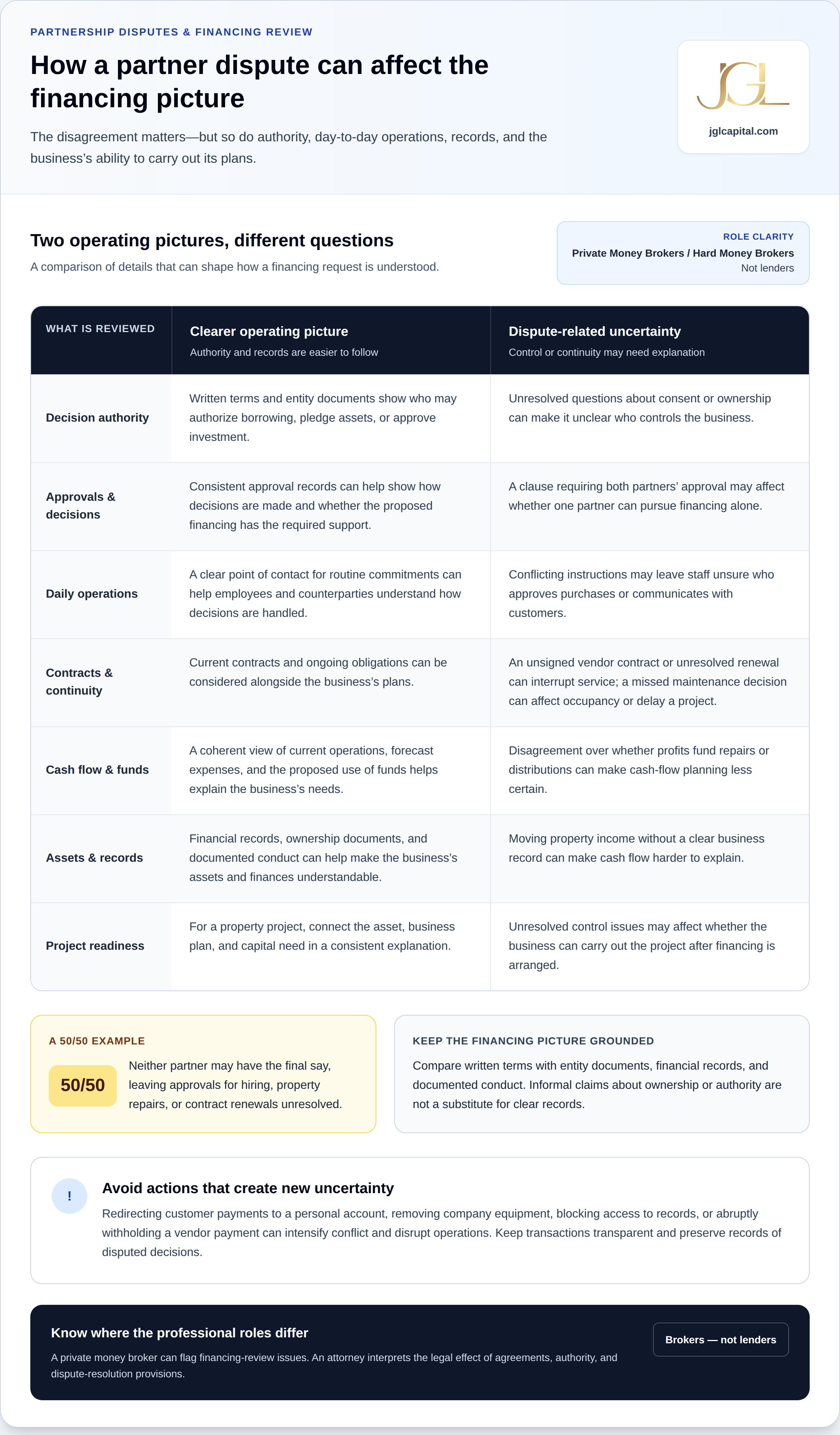
A private money broker can review partnership documents to identify who may authorize borrowing, pledge business assets, and approve new investment. The review may also clarify each partner’s responsibilities, capital commitments, withdrawal rights, and decision-making limits. For example, a clause requiring both partners’ approval may affect whether one partner can pursue financing alone. Comparing written terms with entity documents, financial records, and the partners’ conduct can reveal inconsistencies that complicate a financing review.
Partnership agreements affect borrowing and investment by defining who can commit the business and what approvals are required. Clear authority and consistent records can make a request easier to assess. Unresolved disagreements about consent or ownership may raise questions about who controls the business.
Without a written agreement, state default partnership rules may govern the business. The Internal Revenue Service generally describes a partnership as two or more persons carrying on a trade or business and sharing profits and losses. A broker considers how the partners’ documented arrangements compare with their contributions and stated expectations, while distinguishing financial records from informal claims about ownership or authority.
Shareholder agreements require a related but distinct review. A broker can compare ownership records, voting provisions, transfer restrictions, and capital terms with the proposed transaction. Investment expectations should be assessed against signed documents and documented conduct, rather than assumed from one partner’s recollection. For example, records of prior approvals for property financing may help clarify past practice, but they do not replace written terms.
Legal risks can arise if a partner borrows without required consent, misrepresents authority, or breaches fiduciary responsibilities. A dispute-resolution clause may require negotiation, mediation, or arbitration; arbitration can result in a binding decision. Litigation may also affect control or property rights. A broker can flag these issues for the financing review, while an attorney interprets their legal effect. Written provisions for approval thresholds, deadlock resolution, buyouts, and dissolution can reduce ambiguity before a financing decision.
2. Partnership disputes and operational effects
A partnership dispute can disrupt ordinary decisions before it changes the business’s financial position. In a 50/50 partnership, neither partner may have the final say, leaving approvals for hiring, property repairs, or contract renewals unresolved. A missed maintenance decision can affect occupancy or delay a project; an unsigned vendor contract can interrupt service. These practical effects matter because financing depends partly on whether the business can continue operating and support its stated plans.
Ownership disputes can also complicate decisions about profits, distributions, and reinvestment. If one partner expects profits to fund repairs while another wants distributions, cash-flow planning may become less certain. A financing review considers whether current operations, forecast expenses, and the proposed use of funds are consistent. It also considers whether disputed authority could prevent the business from carrying out the project after financing is arranged.
Conduct during a dispute can affect employee confidence and business continuity. For example, conflicting instructions from two partners may leave staff unsure who approves purchases or communicates with customers. A clear, consistent explanation of how decisions are being handled can help employees stay focused on their responsibilities. Partners should not use company resources to advance personal interests; a partner’s duty of loyalty includes acting for the partnership’s benefit.
Negotiation or mediation may help partners resolve specific operational questions without turning each decision into a confrontation. They can agree on who handles routine commitments, how urgent expenses are approved, and which unresolved issues will be addressed later. That structure gives employees and counterparties a consistent point of contact while the dispute continues. It can also make current operations easier to explain during a financing discussion.
For a property project, the financing conversation should connect the dispute’s operational effects to the asset, business plan, and capital need. A commercial real estate loan may be relevant when a business seeks property-backed financing, but unresolved control issues still need clear treatment in the project’s presentation.
3. Avoiding harmful self-help actions during a dispute
During a partnership dispute, unilateral action can create new problems beyond the original disagreement. A partner who redirects customer payments to a personal account, removes company equipment, or blocks access to business records may intensify conflict and disrupt operations. A partner’s duty of loyalty requires acting for the partnership’s benefit, not using its opportunities or assets for personal advantage. Keep business transactions transparent and preserve records of disputed decisions.
Do not treat disagreement as permission to stop meeting ordinary business obligations. If a vendor contract is due for renewal, abruptly withholding payment may disrupt service or deepen the conflict. If a partner disputes an expense, document the issue and follow the agreement’s approval or resolution process. If the agreement is silent, an attorney can assess the facts and explain options before a partner changes account access or control.
Self-help measures can also complicate a financing request. For example, moving property income without a clear business record can make cash flow harder to explain. A lender reviewing the transaction may need to understand who authorized the change and where the funds went. Maintain consistent account records, preserve relevant communications, and do not alter documents. These steps can help distinguish ordinary business activity from actions taken during the dispute.
Before pursuing dissolution, withholding funds, or restricting a partner’s access, consult an attorney about potential consequences and available procedures. A court may authorize temporary control measures to protect business interests, and an injunction may prevent a partner from withdrawing funds or dissolving a partnership without mutual consent. These examples are not a substitute for legal advice; they show why a unilateral response can have serious effects. A measured approach helps the business meet its obligations, preserve a clear record, and avoid creating a separate dispute over conduct.
4. Financial stability during partner conflicts
Depending on the property, business purpose, and financial presentation, options may include commercial real estate financing arranged through a private money broker. A broker helps organize the request and present the property, cash flow, and intended use of funds to prospective lenders. The broker is not the lender; the selected lender makes the financing decision. For a business seeking funding after a partnership dispute, a clear account of current operations can help explain the request.
Whether a company can obtain business-purpose financing without every partner’s approval depends on its governing documents, authority provisions, and applicable rules. If joint approval is required, one partner acting alone may prompt a dispute over authorization. The financing review should clarify who can sign, what consent is required, and whether that authority is contested.
A partner’s ability to raise capital or sell an ownership stake also depends on governing documents and any transfer or approval restrictions. A proposed investor may need clarity about voting rights, ownership, and how the conflict could affect the investment. Selling a stake without addressing those terms may create another point of contention instead of resolving the original dispute.
Business credit and financing eligibility may be affected if conflict disrupts revenue, payments, account access, or reliable financial records. A dispute alone does not establish the company’s ability to repay. Prospective lenders assess its financial position, assets, obligations, and proposed transaction. Clear records can help distinguish a temporary management issue from an ongoing weakness in operations.
A private money broker can organize the financing presentation around the property, requested capital, repayment plan, and documented authority to proceed. This gives prospective lenders information to assess the request without making the broker a lender or legal adviser. When seeking funding after a partnership dispute, the presentation should also explain how the conflict affects control and the project’s next decisions.
For property-backed financing, discuss commercial real estate financing with a private money broker who can help present the opportunity and its operational context.
JGL Capital
JGL Capital LLC is a private money broker, not a lender. It can help frame a business-purpose real estate financing request when a partnership conflict affects the business’s plans. The request can present the property, intended use of funds, financial position, and any unresolved questions about authority or control clearly to prospective lenders.
Depending on the project, relevant options may include commercial real estate financing, Bridge Loans, New Construction Loans, or Multifamily Loans. JGL Capital LLC can help match the financing request to the property and business purpose, while the partners address the dispute through an appropriate resolution process.
If the business is considering property financing amid a partner conflict, contact JGL Capital LLC to discuss the request.
Move the financing conversation forward
Securing funding after a partnership dispute involves more than presenting a financing request. The business also needs to show how it will make decisions, preserve value, and move its plans forward while the partners address their differences. A clear account of the project and the business’s current position gives the financing discussion a practical focus, without treating financing as a substitute for resolving the dispute.
JGL Capital is a private money broker, not a lender. It helps organize business-purpose real estate financing requests, including New Construction Loans, Multifamily Loans, and Bridge Loans, for consideration by prospective lenders. The next step is a focused discussion about the property, the purpose of the financing, and how the partnership conflict affects the project.
Contact JGL Capital to discuss funding for your project. A measured financing conversation can help you consider a path forward while keeping the business’s priorities in view.
Frequently Asked Questions
What if there is no partnership agreement?
The business may still be governed by state default rules and its formation documents. Start by identifying the entity type, state of formation, ownership records, and any written amendments or resolutions. For example, meeting minutes or signed consent forms may clarify how partners handled earlier decisions. An attorney can assess how those records relate to the current dispute and explain which rules apply before a partner commits the business to financing.
The Next 48 Hours: What Information Should You Have Ready for a Funding Review?
During the next 48 hours, organize the property details, financing purpose, ownership information, current obligations, and a concise account of the dispute’s effect on operations. Gather available bank and credit-card statements for the past three years, along with recent financial statements and property records. A clear timeline of disputed decisions can help explain control issues without mixing allegations with verified business facts.
Understanding Your Legal Position: What Are Your Rights and Obligations?
Your rights and obligations depend on the business structure, applicable state rules, governing documents, and conduct during the dispute. Distinguish authority to manage daily operations from authority to borrow, transfer assets, or change ownership. An attorney can assess those questions against the specific records. Do not assume a partner’s past practice automatically authorizes a new transaction.
What If You Don’t Have a Written Agreement?
Without a signed agreement, collect other records showing how the partners understood ownership, contributions, decision-making, and distributions. Formation filings, tax records, emails, meeting notes, and prior approvals can help establish the history of the relationship. These materials may not settle the legal question, but they give counsel a fuller account and help a financing review identify unresolved authority or ownership issues.
What documents do lenders require after a partnership dispute?
Document requests vary by lender, property, and transaction. A financing review commonly considers entity documents, ownership records, financial statements, bank statements, property information, title and insurance materials, and the proposed use of proceeds. Dispute-related records, such as a signed settlement or current court order, may clarify authority when relevant. Present consistent facts and identify unresolved issues accurately.
How can mediation or a buyout resolve a dispute and restore access to funding?
Mediation gives partners a structured setting to negotiate practical terms, such as who controls daily decisions or how a project proceeds. A buyout can clarify ownership when one partner exits, provided the parties document the agreed terms and resulting authority. Neither step automatically restores financing access; the business still needs a coherent ownership position, authority to proceed, and a financing request that reflects its current circumstances.