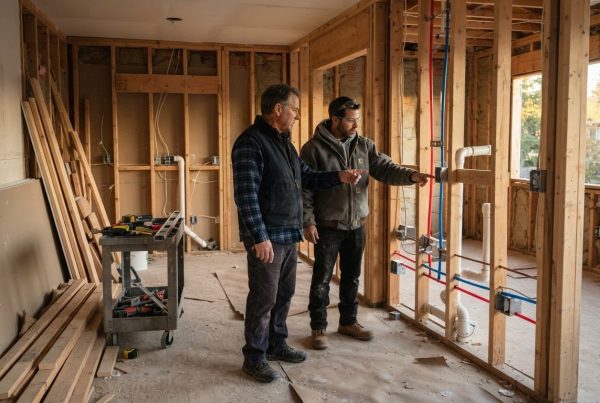

A construction delay doesn’t automatically end a project, but it can put financing at risk before the work is complete. A loan extension isn’t automatic: the borrower requests it, and the lender decides whether the revised schedule, remaining costs, and property value support approval. When an extension or the existing loan no longer fits the work left to do, refinancing may be another option to explore.
When a project falls behind, the missed completion date is hard to ignore. But lenders will also want to understand what caused the delay and whether the project can meet its next milestones. We’re private money brokers, not lenders, and we help clients look at financing options for situations like this. Here, I’ll cover how delays can affect extensions, underwriting, valuation, and cost-to-complete estimates, and why an updated schedule matters. I’ll also explain how a construction refinance may help address a funding gap when the current loan can’t carry the project through completion.
Key Takeaways
- A construction loan extension requires lender approval, so delays are best addressed before the loan deadline and funding becomes constrained.
- Refinancing decisions can turn on the project’s current value, remaining debt, revised schedule, and a credible plan for repayment.
- A detailed cost-to-complete assessment helps show whether available financing can cover the remaining work and whether the project can reach completion.
- Clear milestones, updated builder schedules, and realistic completion targets help lenders assess the project’s progress and financing needs.
Construction Loan Extension: What Happens When Your Build Is Delayed?
A build can run past the term of its construction loan. When that happens, the remaining work may not have the expected draws available. An extension isn’t automatic; the lender has to approve it.
If the loan has matured or defaulted, you might ask for a modification or extension, or look into refinancing to pay off the existing debt. As Private Money Brokers / Hard Money Brokers, we can review the project and put its financing needs in front of potential lenders. The lender, not us, decides whether to approve the request.
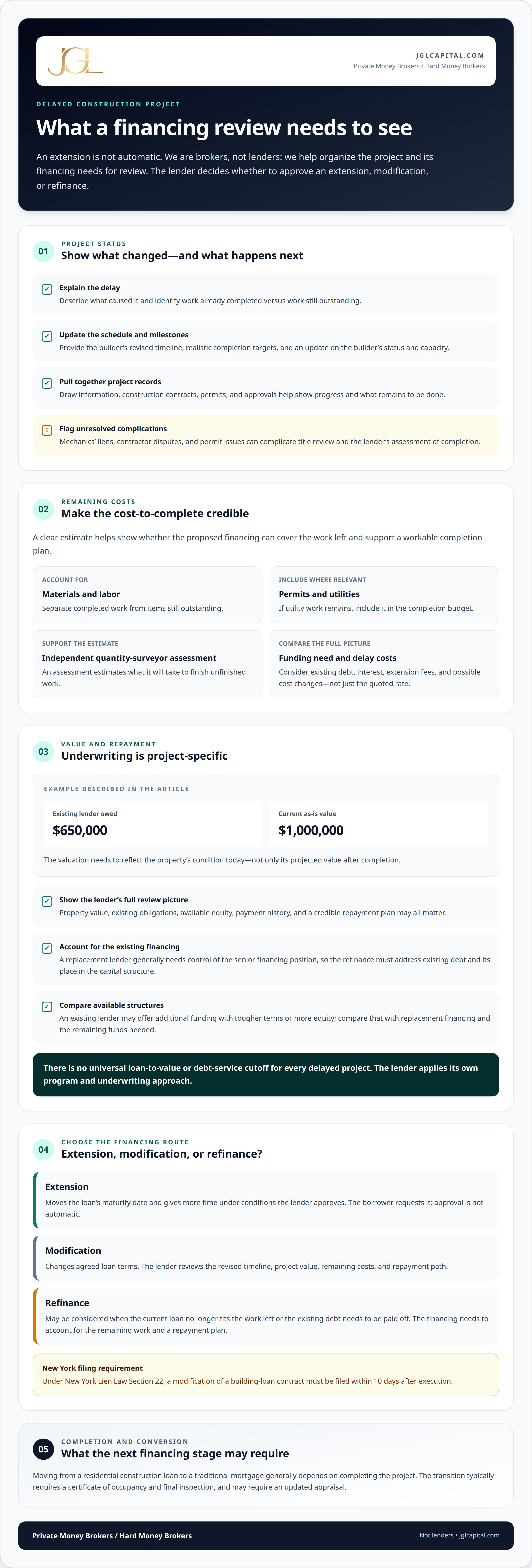
For a mid-construction application, we’ll look at the revised schedule, the budget for the remaining work, the builder’s status and capacity, the updated valuation, and the repayment plan. Project records, draw information, and construction contracts help show what’s done and what still needs to be finished.
Moving from a residential construction loan to a traditional mortgage generally depends on completing the project. The transition typically requires a certificate of occupancy and final inspection, and may require an updated appraisal.
Comparing Private-Loan Costs with Delay Costs
When a project is delayed, it’s worth comparing the cost of private financing with the cost of leaving the work idle or underfunded. Delays can add interest and bring further cost changes. A lender may also account for capitalized interest and extension fees.
We can help compare those obligations with the money needed to finish, and assess whether the proposed financing fits a workable completion and repayment plan. It’s a project-by-project comparison, not just a look at the quoted interest rate.
Modifying Loan Contracts and Extensions
A modification changes the agreed loan terms. An extension gives you more time under conditions the lender approves. The borrower makes the request, and the lender reviews the revised timeline, project value, remaining costs, and repayment path.
We can help organize the request around what caused the delay, what work is complete, and what funds are needed to finish. Under New York Lien Law Section 22, a modification of a building-loan contract must be filed within 10 days after execution.
Mechanics’ liens and contractor disputes can complicate title review and the lender’s assessment of claims against the project. Permits and approvals also affect the timeline and remaining work. Unresolved issues can make it harder to assess completion and conversion to permanent financing.
Underwriting and property valuation
Underwriting is the review of whether the project can support the requested debt and has a realistic way to repay it. There isn’t one loan-to-value or debt-service threshold that fits every delayed project. The lender looks at its own program, the property’s value, existing obligations, and the plan for repayment.
Negotiating an Extension and Meeting Requirements
An extension moves the loan’s maturity date, but the lender has to approve it and may set conditions. When you make the request, explain what caused the delay, lay out the revised timeline, and account for remaining costs, capitalized interest, extension fees, and potential cost changes.
Property value matters, too. A lender may decline an extension if the loan is above its acceptable loan-to-value ratio. As private money brokers, we can help organize the project information for review; the lender decides whether the payment history, available equity, and completion plan meet its requirements.
Loan-to-Value and Debt-Service Requirements
Loan-to-value compares the debt with the lender’s valuation, while debt-service analysis looks at how the loan will be repaid. There’s no universal cutoff for construction refinances. The lender’s underwriting approach and the project’s repayment source both matter.
TCW describes a project where the existing lender was owed $650,000 against a current as-is value of $1,000,000. The point is simple: a valuation needs to reflect the property’s condition today, not just its projected value after completion.
A new lender generally needs control of the senior financing position, so existing debt has to be addressed in a mid-construction refinance. An assignment from the exiting lender may not solve the issue on its own. The replacement financing has to account for the existing facility and its place in the capital structure.
An existing lender may be willing to provide additional funding, but could require tougher terms or more equity. Comparing that option with replacement financing helps show how each structure affects the project’s remaining funds and repayment plan.
Remaining work budgets and cost-to-complete estimates
When you’re looking at a refinance, it helps to get a clear picture of the debt already in place and the work still ahead. A realistic cost-to-complete estimate can show whether the financing is enough to get the project over the finish line.
Assessing Costs to Complete
An independent quantity-surveyor assessment estimates what it will take to finish the unfinished work. As private money brokers, we’re not lenders; we can help organize that estimate and the builder’s update so the lender can assess whether the proposed financing fits what’s left to do.
The review should separate work that’s done from what’s still outstanding, including materials, labor, and permit-related expenses where relevant. If utility work is still on the list, for example, the budget needs to account for it, not treat the structure as nearly finished.
A refinancing facility may replace existing senior debt and sometimes mezzanine debt, with its size based on the cost to finish. The lender may also look at an updated valuation and repayment plan, so the estimate needs to reflect both the actual work left and the financing structure.
Managing Cost Overruns and Shortfalls
A cost-to-complete shortfall means the available funds won’t cover the remaining work. If costs rise, a lender’s completion test may no longer work, and the project could be left without enough financing to reach its next milestone.
A revised budget should spell out what changed, such as a contractor change or increased material needs, and how the remaining work will be paid for. The lender can then assess whether the proposed structure covers the gap and supports a credible repayment plan.
Completion guarantees and guarantor protections depend on the signed loan documents. As private money brokers, we’re not lenders, but we can help review what those documents say about completion obligations, cost overruns, and release conditions. Don’t assume a guarantor’s responsibility ends when construction does.
Timing matters. When the schedule slips, we can start organizing the cost assessment, builder updates, valuation, and repayment plan right away instead of waiting for the completion deadline. That gives the lender a clearer picture while there may still be options to consider.
Project milestones and construction delays
Project milestones tie visible progress to when financing is needed. A realistic schedule shows what’s done, what’s left, when funds are needed, and whether the original loan term still makes sense.
Banks, construction lenders, and private-money lenders may consider refinancing a delayed project, depending on the project’s condition and their underwriting. JGL Capital LLC is a private money broker, not a lender. We present projects to financing sources for consideration.
Milestones should show work that can be verified, not just a target finish date. An updated schedule, for example, can show that framing is complete while utility connections, inspections, or material deliveries are still pending. That gives financing sources a clearer picture of whether a delay affects one remaining task or the project’s path to completion.
Approval timing can change the whole sequence. Building plans may be expected to take a month or two, but approval can take six months. If that pushes construction past the original timeline, the financing plan may need to cover a longer stretch before completion, sale, or mortgage conversion.
Construction loans for larger projects may last up to 18 months. Conventional single-close construction loans sold to Fannie Mae have a total construction-period cap of 18 months, including extensions. That’s why milestones need to fit the loan program, not a schedule drawn up before the delays came into view.
Refinancing options depend on the state and project type. Local approvals and property use affect the timeline and underwriting, and residential, multifamily, and commercial projects each need a financing structure that fits their completion plan.
For a delayed project, a broker can pull together the revised schedule, remaining-work assessment, current valuation, and repayment plan for financing sources to review. If the existing facility ends before practical completion or sell-down, financing sources may consider a new facility based on the remaining work and project status.
If your original milestones no longer fit the financing term, talk with JGL Capital LLC about delayed-project financing.
JGL Capital: New Construction Loans
JGL Capital is a private money broker, not a lender. We work with investors whose construction plans have hit delays and help them explore financing options. If your current loan no longer fits the work left to do or the updated timeline, New Construction Loans, Bridge Loans, and Commercial Real Estate Loans may be worth discussing.
For multifamily developments, we also arrange multifamily financing. The right path depends on the property, where the project stands, remaining costs, and how you plan to repay. We can help put those details in front of potential lenders for review.
If your project has been delayed and you’d like to review financing options, get in touch. We can talk through where things stand and what comes next.
Set the Next Financing Decision in Motion
Refinancing a project with construction delays is about figuring out what needs to happen next, not just revisiting the original schedule. A straightforward conversation about the financing can help sort out the revised plan, what still needs to be paid for, and where you want the project to go.
Before moving ahead, think about what the project needs next and whether the financing fits. The structure should make sense for the property, the work left to do, and how you plan to repay it. That gives a broker a practical starting point for discussing possible options with financing sources.
JGL Capital is a private money broker, not a lender. If you want to talk through your project and its financing needs, contact JGL Capital to discuss your project. We can start with what’s going on and see what options may fit.
Frequently Asked Questions
Can a construction loan be extended?
Yes, a construction loan can be extended if the lender approves the borrower’s request. Extensions may be arranged for a few months at a time, depending on the lender and loan program, and may involve a fee. A useful request ties the added time to specific work, such as completing inspections or utility connections, rather than relying only on a new target date.
Can you refinance during construction?
No, a mid-construction refinance is a structured financing review, not an unexplained leap. The new lender assesses the existing debt, project status, funds needed to finish, and repayment plan. A private money broker can organize the transaction and present it to potential lenders, but each lender independently determines its underwriting, terms, and approval based on the project and borrower.
Can you refinance a construction loan if the project is delayed?
Yes, refinancing a project with construction delays may be possible when a lender considers the project, requested financing, and repayment plan supportable. A contractor change, delayed permit, or revised completion date should be reflected in the project narrative and schedule. For example, a delay caused by a pending inspection calls for a different timeline explanation than one caused by a builder’s financial difficulty.
Can a construction loan be extended or modified instead of refinanced?
Yes. The existing lender can consider changing the maturity date, adjusting other loan terms, or providing additional funding; a refinance instead replaces existing debt with a new facility. If the lender remains supportive, a modification may preserve the current financing relationship. Compare the remaining work, available equity, revised repayment plan, and how each option addresses outstanding loan obligations.
What documents do lenders require to refinance an unfinished project?
Requirements vary by lender and transaction, but a financing package commonly includes the current loan statement, construction budget, draw history, contracts, invoices, and updated project schedule. Lenders also assess property value, builder status, repayment plan, and relevant borrower information. For example, a revised contractor agreement can clarify responsibility for unfinished work, while permit records show which approvals remain outstanding.
How do cost overruns and remaining construction costs affect refinancing approval?
Cost overruns affect the requested loan size and whether the project can be completed with the proposed financing. Lenders compare available funds with a credible estimate of the remaining work, then consider project value and repayment. If the budget shows a gap, explain its source, such as additional equity or a revised scope, rather than presenting an incomplete funding plan.