

The financing structure matters as much as the renovation plan. For investors deciding how to finance a large rehab project, the key is to determine whether acquisition or refinance costs should be financed alongside renovation expenses, then match repayment to the property’s intended exit. A flip and a rental may require similar construction work, but they call for different financing horizons and lender considerations.
It is easy to focus on the purchase price and contractor budget while overlooking how funds are released and when repayment begins. Those details shape project cash flow, the renovation schedule, and the flexibility available if unexpected work arises.
This article explains how US rehab financing works, how purchase or refinance costs may be combined with renovation funding, and how investors can assess options for fix-and-flip or rental projects. It also compares short-term rehab financing with approaches structured around longer-term property income, helping you evaluate options against your project scope and exit plan.
Key Takeaways
- Rehab financing can combine property acquisition or refinancing with renovation costs, while funds may be released in stages as work progresses.
- Loan programs differ in their eligibility and occupancy requirements, so the property’s intended use can shape which financing paths fit.
- Match the financing term and repayment approach to the plan: a resale timeline for a flip or ongoing rental income for a hold.
- JGL Capital is a private money broker, not a lender, and can help investors explore bridge financing for renovation projects.
What Are US Rehab Loans and How Do They Work?
For a large home rehabilitation, options include FHA 203(k), FHA Title I, standard mortgages, and investor-focused hard money, bridge, or construction loans. The right structure depends on occupancy, project scope, and whether the financing must cover purchase costs as well as improvements.
Rehab Loans Compared With Other Financing
A rehab loan includes renovation costs in financing, while a standard mortgage typically finances the property without a dedicated renovation budget. Construction loans fund building work, but their structure may differ from financing an existing property’s purchase and repairs. Investors can use hard money, bridge, or construction loans for large projects; each assesses the project and repayment plan differently. That distinction matters when the property needs work before it can be occupied, rented, or sold.
Funding Released in Portions
Rehab funds may be held after closing and released as work progresses. Proceeds can be placed in a controlled account, with draws tied to documented progress or inspected milestones. Contractors may therefore receive payment in stages rather than all at once. A planned draw schedule helps coordinate cash flow with renovation phases, while the number and timing of releases depend on the lender’s structure and the project scope.
FHA 203(k) loans combine a home’s purchase cost and renovation expenses in one mortgage. Eligible borrowers may qualify for a 3.5% down payment, subject to program criteria. FHA renovation rules are designed for eligible residential properties, rather than investor flips or rental acquisitions.
Both require the approved renovation work to be completed within six months of closing. Standard projects also require an FHA-approved 203(k) consultant.
FHA Title I Property Improvement Loans may suit homeowners with limited equity. When a contractor completes the work, funds can cover labor and materials; for do-it-yourself projects, they cover materials only.
State or local grants, tax credits, and utility incentives may also support eligible rehabilitation work. These are separate from loans, and availability and eligible improvements depend on the location and program.
What is a rehab loan for real estate investors?
For investors, a rehab loan connects property condition, renovation scope, borrower qualifications, and a defined repayment plan. Program eligibility also depends on whether the property will be occupied, rented, or resold.
Loan Terms and Repayment
Loan terms define the repayment schedule, interest structure, and conditions for releasing renovation funds. Review them during the application process, since the exit plan must support repayment through a sale, refinance, or rental income.
Underwriting for private rehab financing may weigh collateral strength and project feasibility alongside the borrower’s credit profile. The review can include the scope of work, budget estimates, contractor background, local market analysis, and exit strategy. For a rental property, DSCR financing assesses the relationship between expected rental income and debt obligations; a ratio of 1.0 means income covers those obligations, while ratios above 1.25 may qualify for better terms. DSCR lenders’ minimum credit scores generally start around 620, though requirements vary.
Fannie Mae HomeStyle is another renovation-mortgage option, with eligibility and loan limits governed by its program criteria. Occupancy plans and borrower qualifications are relevant when comparing it with investor-focused financing. The application and closing timeline also differs by loan structure: FHA 203(k) loans may take up to 90 days from application to closing, while conventional renovation mortgages may take 30 to 60 days.
Renovation Financing Documentation
Renovation financing documents describe the property’s current condition, proposed work, costs, and contractors. A well-organized file helps the lender assess feasibility and determine how renovation funds may be released.
Applications commonly include an itemized scope, renovation budget, contractor bids, and information about the contractor’s experience. An appraisal may estimate the property’s value after approved work is complete. Permit requirements depend on local rules, while inspections may document completed milestones before a draw is released. Some rehab programs require an experienced third-party contractor or restrict do-it-yourself labor, so identify who will perform each task in the work plan.
Before closing, the borrower should understand repayment obligations, draw conditions, and any requirements tied to project completion. For commercial projects, commercial real estate financing can be considered alongside the property’s scope and intended exit.
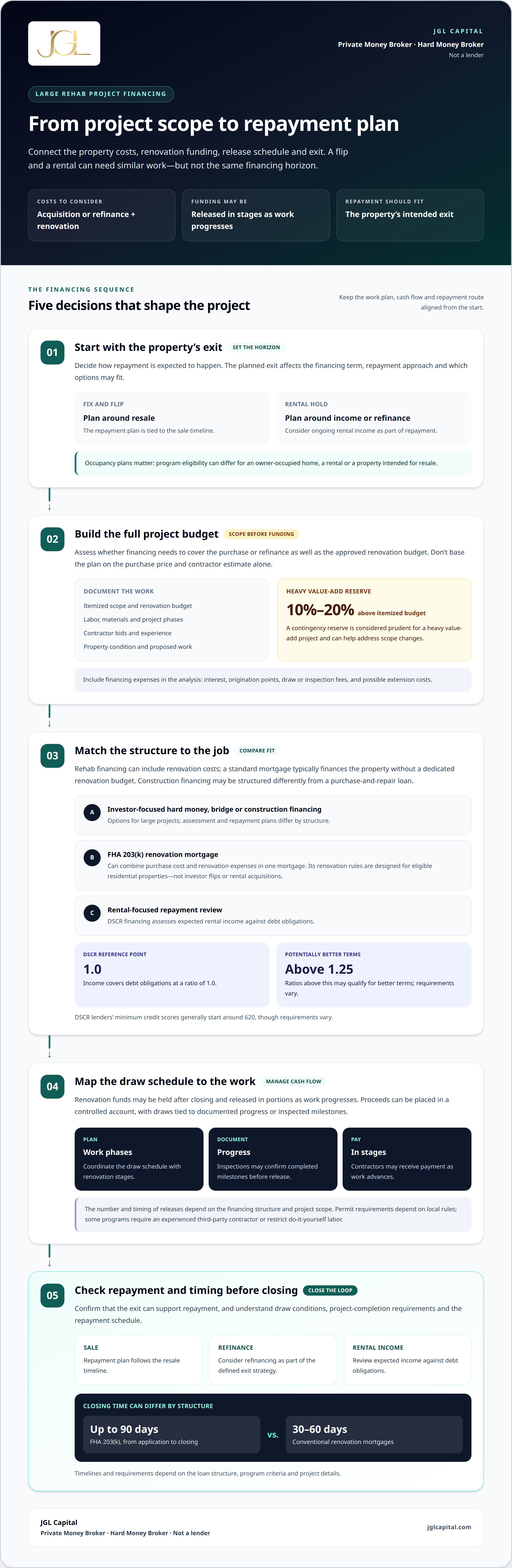
Combining purchase or refinance financing with renovation costs
Rehab financing can combine an acquisition or refinance with an approved renovation budget. For investors considering how to finance a large rehab project, the full investment analysis should include the project schedule, reserves, and financing expenses, not just the purchase price and contractor estimate.
Project Estimates and Contingency Reserves
A detailed contractor estimate defines planned work, expected costs, and the basis for renovation funding. For a heavy value-add project, a contingency reserve of 10% to 20% above the itemized budget is considered prudent. That reserve can help address scope changes without leaving essential work unfunded.
A clear estimate separates labor, materials, and project phases, making costs easier to assess against the property’s intended use and exit.
Financing Fees and Drawn-Fund Interest
Financing costs may include interest, origination points, draw or inspection fees, and extension costs. Understanding how these expenses add up is part of how to finance a large rehab project: they affect the capital needed through completion and the project’s carrying costs.
With rehab financing, interest accrues only on funds that have been drawn. A phased release can therefore affect interest expense as work proceeds, while the draw schedule shapes when contractors can pay suppliers and subcontractors. Include expected loan payments and service charges in the cost model, and account for possible extensions if delays change the planned timeline.
For a purchase, financing may combine acquisition costs and approved repairs in one project structure. For a refinance, the analysis also considers the existing mortgage payoff and how renovation proceeds will be released. In either case, the lender’s funding basis and draw conditions affect how much capital is available at each stage.
Build the estimate around the complete investment: acquisition or payoff, approved improvements, contingency, financing charges, and time to finish. Compare the contractor’s schedule with the expected draw process. A contractor expecting 50% upfront may face a cash-flow mismatch if funds are released only after inspected progress. That timing can affect project execution and the investor’s ability to meet obligations.
Fix-and-flip and rental-rehabilitation financing
Fix-and-flip financing is structured around repairing and selling a property, while rental financing supports renovation before a longer hold. The planned exit matters: resale proceeds and rental income require different repayment plans and timelines.
Hard money and bridge financing commonly run 12 to 24 months, with interest-only payments during renovation. A flip planned for 6 to 12 months needs room for repair work, inspections, marketing, and closing. The loan amount may be capped at 65% to 75% of the property’s after-repair value, so the appraisal and projected completed condition can influence available proceeds.
Some fix-and-flip loans instead use total project cost. Depending on the lender and borrower experience, financing may cover 65% to 90% of project cost. A loan-to-cost limit may cap funding at 80%, leaving the investor responsible for the remaining capital and any costs outside the approved budget. Approval depends on the financing structure and project details.
Rental rehabilitation requires a different exit analysis. After repairs, the property’s rental income may support a longer-term financing plan, while vacancy, operating expenses, and debt payments affect its ability to carry the investment. A DSCR of 1.0 means rental income covers debt obligations; ratios above 1.25 may qualify for better terms. These measures help distinguish a hold strategy from a planned sale.
For either approach, organize the scope, contractor budget, appraisal, and exit plan together. Draws may depend on inspected progress, so align the renovation timeline and contractor payment expectations with the release schedule. Delays can increase carrying costs or push a sale or refinance beyond the original plan.
A private money broker arranges financing but is not the lender. Investors assessing a rental hold can discuss rental property financing in light of the renovation plan and intended income strategy.
JGL Capital LLC
JGL Capital LLC is a private money broker, not a lender. For investors planning a substantial renovation, JGL Capital LLC helps identify financing options that fit the property’s purchase or refinance, construction scope, and intended exit. A flip depends on resale, while a rental plan relies on longer-term income potential, so the structure should reflect the project’s purpose.
Depending on the transaction, relevant options may include Bridge Loans or Commercial Real Estate Loans. JGL Capital LLC helps investors explore potential financing sources based on the property and investment strategy, rather than treating every renovation as the same transaction.
Contact JGL Capital LLC to discuss how to finance a large rehab project.
Put the Financing Structure Behind the Investment
The question is not just how to finance a large rehab project, but how the financing supports the property’s intended role in your portfolio. A disciplined plan connects the renovation scope with the asset’s longer-term purpose, so the financing decision reflects more than the construction period.
JGL Capital is a private money broker, not a lender. New Construction Loans, Multifamily Loans, and Bridge Loans from participating lenders may suit different investment strategies, depending on the property and project. Discuss how the proposed work, capital needs, and exit strategy fit together before choosing a structure.
Contact JGL Capital to discuss your rehab financing and consider the financing approach that best aligns with your investment objectives. A clear plan can help you move forward with greater purpose.
Frequently Asked Questions
How much can you borrow?
The available amount depends on the selected lender’s valuation method, eligible project costs, and the borrower’s contribution. A lender may assess current property value, purchase price, or projected value after renovations, depending on the program. For instance, a project requiring substantial repairs may be evaluated differently from one needing cosmetic work. The borrower’s available equity and reserves also affect the financing structure.
Which Projects Do These Loans Fit?
Rehab financing may suit investment properties requiring repairs, repositioning, or improvements before resale or rental. It may also apply to transitional commercial properties, multifamily renovations, and projects involving construction or stabilization. Fit depends on the asset, scope, business plan, and exit strategy. A defined work plan and credible path to sale or ongoing income give lenders a clearer basis for review.
How do lenders calculate renovation loan amounts and disburse funds during construction?
Lenders assess the property, proposed renovation budget, and the program’s valuation and cost rules. They may consider current value, purchase price, or an appraisal of the completed property. The selected lender sets the approved amount and draw conditions. Understand whether invoices, inspection reports, or other evidence must support each release, and how changes to the work scope will be handled.
What credit score, down payment, income, and equity are needed to finance a major rehab?
There is no single borrower profile for every rehab program. Lenders may consider credit, income, liquidity, net worth, real estate experience, project feasibility, and guarantor strength alongside property value. A rental-focused program may consider property cash flow, while another structure may place greater emphasis on the borrower’s overall capacity. Required equity and documentation vary by lender, program, property, and transaction.
What are the interest rates, fees, and repayment terms for major rehab financing options?
Costs and repayment terms vary by lender and financing structure, so compare the full proposal rather than the interest rate alone. Review how interest accrues, when payments begin, and whether extensions are available. Also account for points, appraisal and inspection charges, draw-related costs, and conditions tied to maturity or default. These details affect carrying costs and exit timing.
What risks should borrowers plan for, including cost overruns, delays, and contractor problems?
Plan for scope changes, permit or inspection delays, weather, and material availability to affect the schedule and budget. Contractor capacity and payment expectations can also disrupt progress if they do not align with the approved work plan. Maintain liquidity for unexpected costs, document scope changes, and identify a backup exit if sale or refinance timing shifts. A contingency reserve can support the project plan, but it cannot eliminate execution risk.