
A campground’s financing needs don’t end when the guest season does. Financing for a campground or RV park may support an acquisition, construction or expansion, refinancing, or seasonal operating needs, while payroll, insurance, maintenance, utilities, and supplies can continue during slower periods.
A suitable financing structure depends on the property, project, and operating cycle. This guide explains common financing options, costs to plan for, and factors lenders may assess, including the operating plan and repayment capacity. It also covers seasonal cash flow and how a private money broker can help explore business-purpose real estate financing options.
Key Takeaways
- Build operating projections across the full twelve-month cycle, accounting for expenses that continue when guest activity slows.
- Organize financial statements, business records, tax returns, and property information to support lender review and appraisal.
- Weigh the project’s purpose, property, and repayment plan when considering options such as SBA, USDA, conventional, seller, or asset-backed financing.
Lender support for seasonal RV park and campground businesses
Seasonal operators need to plan cash flow across the full year, not just peak months. Payroll, insurance, maintenance, utilities, and supplies may remain due when guests are not on-site. As a result, revenue can fluctuate while operating costs continue.
For example, a park may collect most guest revenue during summer, then face payroll and repair bills before spring bookings begin. Lenders may consider seasonal occupancy alongside the property and operating plan when assessing a financing request. Monthly projections can clarify when revenue arrives, when expenses are due, and whether a seasonal cash-flow gap may arise.
Pre-season spending can create another cash-flow challenge. Supplies, site repairs, utility work, and marketing may be needed before reservations generate revenue. Group planned expenses by timing and purpose, and explain how each supports opening readiness or guest demand. This helps distinguish a temporary working-capital need from a longer-term property investment.
SBA 7(a) financing may support working capital, with proceeds for that purpose carrying a loan term of up to 7 years. A repayment schedule should be assessed against projected seasonal cash flow, rather than peak-season receipts alone. This can help clarify whether operating funding and property investment belong in one project or separate financing requests.
Are campground and RV park loan programs or incentives available in my state? Federal options include SBA and USDA programs for eligible projects. State-level incentives depend on location, eligibility, and project purpose. USDA Business & Industry loans may support eligible rural campground projects, including expansion, infrastructure upgrades, acquisitions, and refinancing. Program criteria determine whether a specific property and use qualify, so location alone does not establish eligibility.
Lender application and appraisal requirements
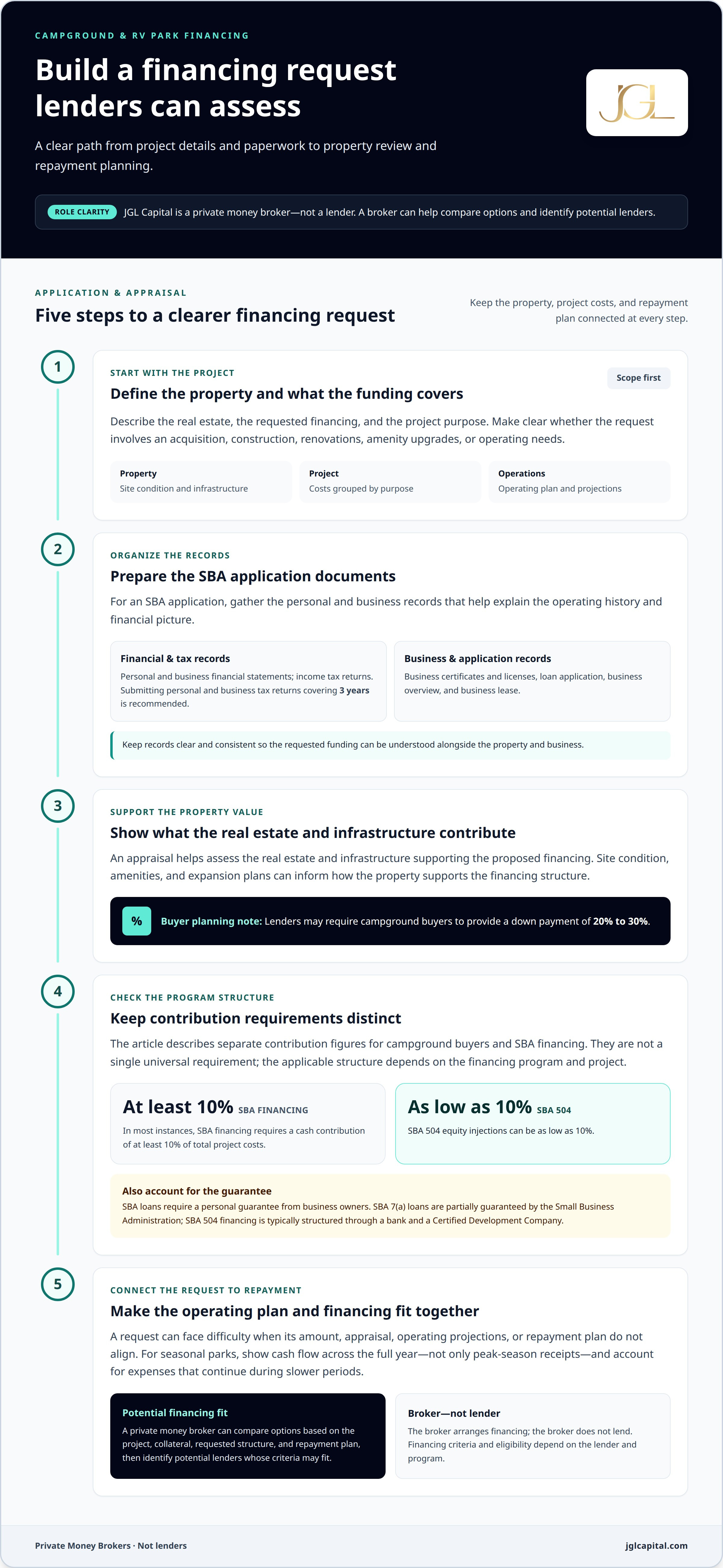
A campground application needs to connect the property’s value, operating plan, and requested financing. Lenders may require a down payment of 20% to 30% from campground buyers. Appraisal review also helps assess the real estate and infrastructure supporting the proposed loan. Site condition, amenities, and plans to expand can inform how the property supports the financing structure.
For SBA applications, prepare personal and business financial statements, business certificates and licenses, a loan application, income tax returns, a business overview, and a business lease. Submitting personal and business tax returns covering 3 years is recommended. These records help show operating history and the financial picture behind projected revenue from guests. Clear, consistent documents make it easier to understand how the requested funding relates to the property and business.
What are the SBA 7(a) and 504 loan requirements for RV parks and campgrounds? In most instances, SBA financing requires a cash contribution of at least 10% of total project costs, and SBA loans require a personal guarantee from business owners. SBA 7(a) loans are partially guaranteed by the Small Business Administration; SBA 504 financing is typically structured through a bank and a Certified Development Company. SBA 504 equity injections can be as low as 10%.
A private money broker can help compare financing options based on the project, collateral, requested structure, and repayment plan, then identify potential lenders whose criteria may fit. The broker arranges financing but is not the lender. This can help borrowers weigh private capital against other programs without assuming that the options are interchangeable.
What are the risks and common reasons lenders reject campground loan applications? An application may face difficulty when the requested amount, appraisal, operating projections, or repayment plan do not align. Incomplete records can also make the property and business harder to assess. A private money broker service can help organize the financing request around the project and its real estate.
Eligible financing uses
Eligible uses depend on the financing program and project purpose. Financing for a campground or RV park may support land acquisition, property purchases, renovations, amenity upgrades, and working capital through SBA 7(a) financing. A buyer, for example, could include an acquisition and repairs, while an established operator may seek funds for facility upgrades or operating needs.
Project scope matters. SBA 7(a) financing may also cover debt refinancing, equipment, and technology investments. A request involving reservation systems, site improvements, and existing debt should distinguish each use clearly. That helps show how the funding supports operations, facilities, or longer-term growth, and whether the proposed costs fit the program.
SBA 504 financing is directed toward fixed assets and improvements. Eligible uses include land purchases, acquiring an existing KOA or campground, expansions, utilities, parking lots, and facility modernization. For an RV park, that could mean expanding the grounds or upgrading utility infrastructure. These improvements can strengthen commercial real estate and hospitality facilities, subject to the program’s eligible-use requirements.
For eligible rural properties, USDA Business & Industry loans can support campground development, expansion, infrastructure upgrades, acquisitions, and refinancing. Its scope may suit rural projects where site development and essential infrastructure are central to the investment. The USDA guarantee reduces lender risk and can help businesses access more capital at competitive rates.
Conventional commercial real estate loans may support a property purchase or refinance, including special-use properties. They may suit a defined real estate transaction better than a project combining property costs with broader operating expenses. Seller financing may also form part of an acquisition, with repayment terms negotiated between buyer and seller. The fit depends on the costs being financed, such as land, facilities, acquisition, or operations, and on program requirements.
What types of financing are available to buy or build a campground or RV park?
The right structure depends on whether the project involves an acquisition, construction, or improvements. For eligible working-capital proceeds, terms may extend up to 7 years; equipment proceeds may have terms up to 10 years. SBA guarantees a portion of loans made by participating lenders, rather than lending directly.
SBA 504 financing is designed for fixed-asset projects, including land, expansions, utilities, parking, and modernization. The structure typically involves a bank and a Certified Development Company. It may suit a project centered on property or facilities, rather than seasonal operating expenses.
For eligible rural properties, USDA Business & Industry loans can support development, acquisitions, expansion, infrastructure upgrades, and refinancing. Conventional commercial real estate loans may also support a specific property purchase or refinancing, including special-use real estate. Each structure addresses different costs, so an acquisition with extensive site work may require a different approach than a straightforward purchase.
Seller financing may form part of an acquisition, with repayment terms negotiated as part of the sale. A seller may agree to a customized schedule or lower down payment, while a balloon payment can create a future refinancing need. In-house financing may be another option, and a chattel mortgage uses movable property as collateral. When cabins or cottages are treated as real estate improvements, commercial real estate financing is generally secured by the property.
JGL Capital is a private money broker, not a lender. For a project involving commercial property, discuss campground financing options to consider how the acquisition, construction, or improvement plan may align with an appropriate financing structure.
JGL Capital
JGL Capital is a private money broker, not a lender. It helps real estate investors explore financing options for campground acquisitions, construction, and property improvements. The property, project scope, and intended use help frame the request, which JGL Capital can present to prospective lenders.
Depending on the project, potential options may include Commercial Real Estate Loans, Bridge Loans, New Construction Loans, or Multi-Family Loans. These may be relevant to a campground purchase, development plan, or operating property involving commercial real estate. JGL Capital arranges financing but does not make lending decisions or promise approval. A clear project scope and repayment plan can help organize the financing request.
For a financing conversation about a campground or RV park, contact JGL Capital.
Move Your Project Toward a Clear Financing Plan
The next step is to define what the property needs to accomplish and how financing supports that plan. For an acquisition, development, or expansion, a clear project scope gives the financing conversation a practical starting point. Financing for a campground or RV park should be considered in relation to the asset, intended use, and the business’s ability to manage repayment through changing operating conditions. Clarifying the project timeline, capital priorities, and intended outcome can keep the discussion focused on fit, not simply the amount requested.
JGL Capital is a private money broker, connecting real estate investors with potential financing options rather than lending directly. If you’re assessing a campground purchase or project, contact JGL Capital about financing to discuss your plans. A thoughtful structure can help bring greater clarity to the decisions ahead and support a more deliberate path forward.
Frequently Asked Questions
What down payment and credit score are typically required for an RV park loan?
Down payment and credit requirements vary by program, lender, and transaction; there is no single credit score that applies to every RV park loan. The figures discussed in this article include a 20% to 30% lender-required down payment for campground buyers and, in most instances, an SBA cash contribution of at least 10% of total project costs. Lenders may also weigh experience, liquidity, collateral, and repayment capacity.
What financial documents and business plan do lenders require for campground financing?
Lenders may review personal and business financial statements, tax returns, business records, and a project narrative. An SBA application may also require business certificates or licenses, a business lease, and a formal loan application. The business plan should connect requested proceeds to site work or operations, explain seasonal revenue and expense assumptions, and support the repayment and exit plan. Keep projections consistent with historical performance.
How do lenders value an RV park and calculate debt service coverage?
Lenders may assess property value using an appraisal and relevant market evidence, then compare that assessment with the financing request. Debt service coverage ratio, or DSCR, compares a property’s net operating income with its debt service. For an expansion, separate the park’s existing performance from forecast income tied to new sites or amenities. Property condition, occupancy, leases, and operating expenses may inform these assessments.
What interest rates, terms, and fees are common for campground and RV park financing?
SBA 7(a) working-capital proceeds may have terms up to 7 years, while equipment proceeds may run up to 10 years. SBA loans are described as fully amortizing, with favorable rates and no balloon payment; seller financing may include annual rate increases of one half to one percent and a balloon payoff as soon as 3 years after the agreement begins.