
Chapter 7 can put an investment property with equity at risk. A trustee may take and sell it to pay creditors after liens and mortgages are addressed. Mortgage waiting periods vary by loan type: the general rules include four years after Chapter 7 discharge for conventional loans and two years for FHA loans. But those timelines alone don’t establish eligibility for an investment property loan after bankruptcy.
If you’re planning a property purchase, it’s fair to want a clear answer. The discharge date is only one part of the picture. The bankruptcy’s effect on existing property, the proposed loan, income, and available down payment can all matter.
Here, we’ll look at how Chapter 7 may affect an investment property, what mortgage eligibility timelines do and don’t tell you, and how income and down payment factor into a review. We’ll also explain where private money financing may fit when conventional mortgage criteria don’t match an investor’s circumstances. JGL Capital LLC is a private money broker, not a lender.
Key Takeaways
- Whether an investment property is at risk in Chapter 7 depends in part on its equity and secured debts.
- Mortgage eligibility after bankruptcy varies by loan type, and a waiting period alone does not determine approval.
- Lenders assess income and down payment as part of the broader review of a borrower’s application.
- JGL Capital LLC is a private money broker that can help investors explore options such as bridge, multi-family, and commercial real estate loans.
How Chapter 7 bankruptcy can affect investment property
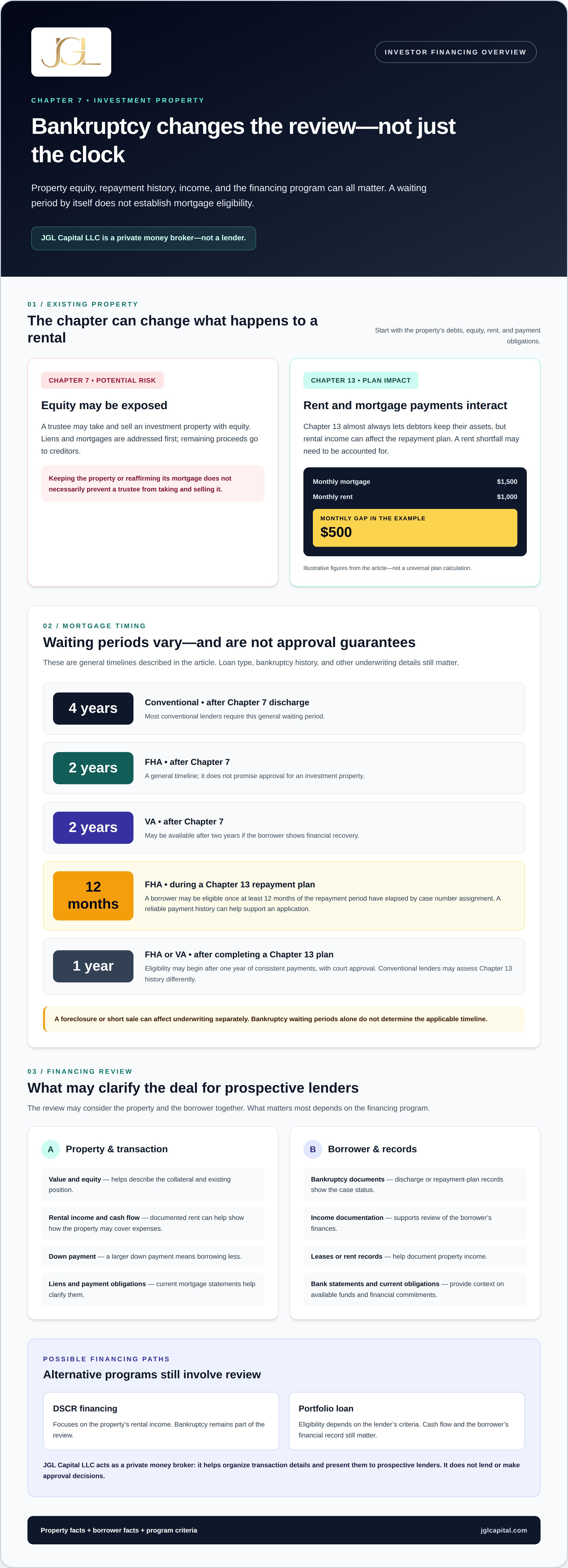
In Chapter 7, a trustee may take and sell an investment property that has equity. After liens and mortgages are paid, the proceeds go to creditors. What matters is the property’s equity, not just its rental potential. Even if the owner chooses to keep the property and reaffirms the mortgage, a Chapter 7 trustee may take possession and sell it short.
Credit-report periods for Chapter 7 and Chapter 13 are a separate issue from whether a trustee can administer a property. A credit-report entry doesn’t show the property’s equity, mortgage balance, or treatment in bankruptcy. Those details matter when looking at the property’s position and possible financing later.
Chapter 13 is a reorganization that almost always lets debtors keep their assets. Rental income can affect the repayment plan. If rent covers 100% of an investment property’s mortgage payment, the property may not affect the plan. But that doesn’t mean every rental property is left out of plan calculations.
For example, a property with $1,500 in monthly mortgage payments and $1,000 in monthly rent has a $500 monthly shortfall. The plan may need to account for the gap between rent and mortgage payments. In Chapter 13, a debtor may have to pay the mortgage portion not covered by rent to unsecured creditors. These figures show how rent and debt payments interact, but they aren’t a universal calculation for every case.
For investors, the distinction is important: Chapter 7 can put property equity at risk, while Chapter 13 plan payments may determine whether an existing rental remains manageable. The bankruptcy chapter, liens, mortgage balance, equity, rental income, and payment obligations all affect the property’s position.
How bankruptcy affects mortgage eligibility
Bankruptcy affects when a borrower may qualify and what documentation may be reviewed. Discharge alone does not mean a borrower is eligible for a mortgage. Most conventional lenders require four years after Chapter 7 discharge. FHA loans may be available two years after Chapter 7, while VA loans may be available after two years if the borrower shows financial recovery. These are general timelines, not a promise of approval for an investment property.
Chapter 13 follows a different timeline. For an FHA-insured mortgage, a borrower may be eligible once at least 12 months of the repayment period have elapsed by case number assignment. A reliable payment history can help support an application. After completing a Chapter 13 plan, FHA or VA eligibility may begin after one year of consistent payments, with court approval. Conventional lenders may look at Chapter 13 history differently, so their criteria matter.
A foreclosure or short sale can affect underwriting separately. If either is part of the borrower’s history, bankruptcy waiting periods alone won’t determine the applicable timeline.
A DSCR loan or portfolio loan may be an option for an investment property after bankruptcy, but neither takes bankruptcy out of the review. DSCR financing focuses on the property’s rental income; portfolio eligibility depends on the lender’s criteria. Cash flow and the borrower’s financial record still matter.
If you’re weighing a rental purchase, the key question is whether your situation and the property fit the financing being considered, not just whether you’ve passed a general waiting period. A private money broker can assess DSCR financing options based on the property and your circumstances.
For example, one scenario pairs $2,000.00 in monthly mortgage payments with $1,000 in monthly rental income. Another cites a $1,500.00 payment and a $500.00 monthly owner contribution through a Chapter 13 plan to keep the property.
Lender considerations, including income and down payment
For an investment property, a prospective lender may look at your finances as well as the property’s value and income potential. A larger down payment means borrowing less, and documented rental income can help show how the property may cover its expenses. After bankruptcy, the lender may also review your credit history and current obligations. What matters most depends on the financing program.
Requirements vary by lender and state, including how they assess the collateral, income, and transaction. A lender may weigh payment history, outstanding debts, property cash flow, and available equity together rather than rely on one threshold.
As private money brokers, we don’t lend or make approval decisions. We help organize the transaction for prospective lenders to review. Useful records may include bankruptcy discharge or repayment-plan documents, current mortgage statements, leases or rent records, income documentation, bank statements, and property or purchase details. What’s needed depends on the property and financing request.
For example, a lease and rent history can help document property income, while mortgage statements clarify existing liens and payment obligations. Records showing the bankruptcy outcome help distinguish a completed discharge from an active repayment plan. Together, these details give a prospective lender a clearer picture of you and the property.
We can bring together the property’s value, rental income, equity, requested amount, and bankruptcy status in a clear deal package, then present it to prospective lenders. We can’t change your credit history or make the lender’s decision. Our role is to help match the facts of the transaction with potentially relevant financing criteria.
How long after Chapter 13 bankruptcy can you qualify for an investment property mortgage?
Chapter 13 does not create one universal waiting period for an investment property mortgage. FHA timing may begin during the repayment plan, while conventional timing is measured after discharge. The dates differ: one rule looks to case number assignment, another to discharge. That distinction helps prevent treating plan completion as the only milestone. Eligibility timing depends on the loan type, and the applicable program’s timeline is only one part of the financing review.
For an FHA-insured mortgage, a borrower may be eligible once at least 12 months of the bankruptcy payout period have elapsed by case number assignment. Reliable repayment patterns after the waiting period can improve the chance of approval. This timing can matter before the Chapter 13 plan ends. It does not mean that every borrower qualifies at the 12-month mark, because the application still requires review under the mortgage program’s criteria.
After completing a Chapter 13 repayment plan, a borrower may be eligible for an FHA or VA loan after one year of consistent payments, with court approval. This is a separate route from FHA eligibility during the plan. The milestone is completion followed by a year of consistent payments, not simply the passage of time since filing. Court approval is also part of this pathway.
Conventional loans usually require a two-to-four-year waiting period after Chapter 13 bankruptcy discharge. The period is tied to discharge, so filing or plan start dates are not interchangeable with that milestone. For an investment property purchase, reaching a program’s waiting-period threshold does not itself establish eligibility. The borrower’s repayment record, the financing program, and the property transaction remain relevant to the overall review. Comparing the timeline to the correct event, such as case number assignment or discharge, gives a more accurate starting point for assessing when an application may proceed.
JGL Capital LLC
JGL Capital LLC is a private money broker and capital advisor, not a lender. For investors exploring financing after bankruptcy, JGL Capital helps organize property and transaction details and identify potential financing sources. A review may consider the asset, its income potential, available equity, and the borrower’s financing objectives.
JGL Capital helps investors explore business-purpose financing for rental, commercial, and multifamily properties, as well as bridge and construction projects. These options may fit investment transactions, subject to the selected lender’s requirements and approval.
If you’re evaluating a property purchase or refinance after bankruptcy, contact JGL Capital LLC to discuss the transaction.
Shape the Next Financing Conversation
Before you start sorting through financing, get clear on what you want to do with the property. Are you buying, improving, or developing it? The property and your plan give us a better place to start than focusing only on your bankruptcy history when discussing an investment property loan.
JGL Capital LLC is a private money broker and capital advisor, not a lender. We help investors organize property and financing details and explore potential lender programs. Our financing categories include New Construction Loans, Multi-Family Loans, and Bridge Loans, which may fit different investment strategies and project structures.
You don’t need to have every detail figured out before reaching out. A clear summary of the property, your plan, and what you’re looking to finance is enough to get the conversation started.
Contact JGL Capital LLC about loan options and tell us what you’re working on. We’ll take a look at the details together and talk through possible next steps.
Frequently Asked Questions
How long after Chapter 7 bankruptcy can you get an investment property loan?
With conventional financing, the usual wait is four years after a Chapter 7 discharge. FHA loans may be available after two years. Be sure to count from the discharge date, not the filing date. We’re private money brokers, not lenders, and a waiting period alone doesn’t determine whether a borrower or property will qualify.
Do Fannie Mae or Freddie Mac loans allow financing for investment properties after bankruptcy?
They may be an option through conventional financing. The usual benchmark is a four-year wait after Chapter 7 discharge, but that doesn’t guarantee a particular application will meet Fannie Mae or Freddie Mac requirements. The borrower’s file and property still need to meet the applicable criteria.
How much down payment is required for a rental property mortgage after bankruptcy?
There isn’t one set down payment for every rental property purchase after bankruptcy. It depends on the lender, program, property, and transaction. The amount of equity and available liquidity can also matter. A borrower putting more money down may have a different financing profile than one bringing limited equity; bankruptcy history is just one part of the picture.
How does a foreclosure or short sale affect the waiting period after bankruptcy?
A foreclosure or short sale can affect underwriting on its own, separate from bankruptcy. If either is part of the borrower’s history, the bankruptcy waiting period alone won’t tell you how long to wait.