

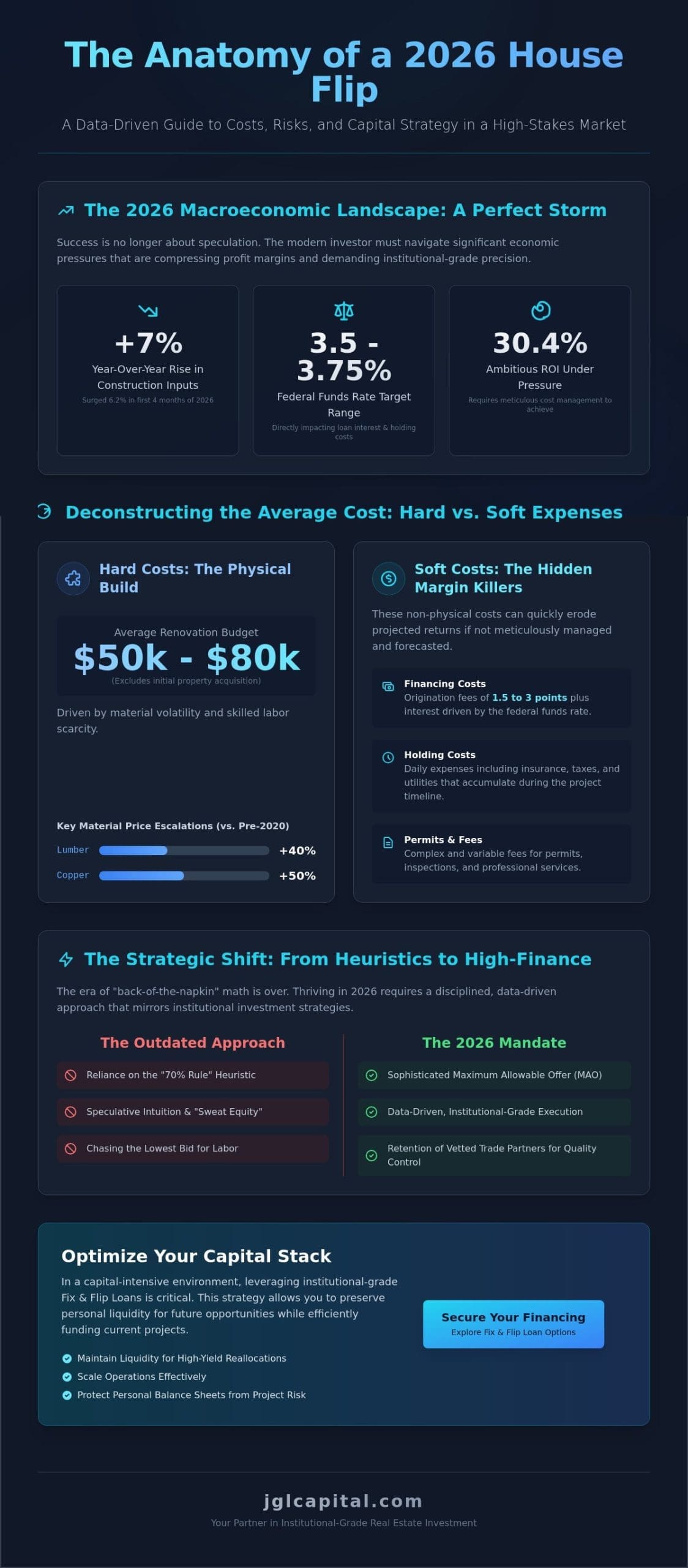
Does the pursuit of a 30.4% return on investment remain a viable objective when the average cost to flip a house 2026 is increasingly dictated by volatile material escalations and a 7% year-over-year rise in construction inputs? For the sophisticated practitioner, the challenge lies not merely in the acquisition of distressed assets but in the meticulous management of a capital stack that’s been pressured by a federal funds rate holding steady at 3.5% to 3.75%. As construction input prices have surged by 6.2% in the first four months of the year alone, the margin for error in capital allocation has effectively vanished.
You’ve likely observed that margin compression is no longer a peripheral risk but a central reality of the current redevelopment landscape. This strategic analysis delivers a disciplined breakdown of the capital requirements and financial frameworks essential for managing the complexities of the 2026 market. We’ll evaluate the critical balance between hard costs, which now average between $50,000 and $80,000 per project, and the sophisticated utilization of Fix and Flip Loans to establish a robust framework for deal viability and long-term value preservation.
Key Takeaways
- Gain a rigorous understanding of how macroeconomic shifts and inventory levels dictate the baseline for acquisition and capital allocation in the current market.
- Navigate the multi-variable equation determining the average cost to flip a house 2026, with a focus on mitigating volatile material and skilled labor expenses.
- Isolate and manage soft costs such as daily holding durations and complex permit fees to prevent the erosion of projected investment margins.
- Replace traditional heuristics with a sophisticated Maximum Allowable Offer (MAO) framework that accounts for the specific financial variables of a high-interest environment.
- Leverage institutional-grade Fix and Flip Loans to optimize your capital stack and preserve liquidity for high-yield reallocations.
Navigating the Macroeconomic Landscape of Residential Redevelopment in 2026
Success in the contemporary residential redevelopment sector requires a departure from the speculative fervor of previous cycles. The practice of Flipping assets has transitioned from a high-velocity retail trend into a sophisticated exercise in institutional capital management. In the current environment, the average cost to flip a house 2026 is no longer a static figure but a multi-variable equation. This calculation must account for elevated holding costs, rising labor rates, and the persistent scarcity of distressed inventory that characterizes the 2026 market. Investors who fail to recognize these macroeconomic shifts risk significant margin erosion before the first physical improvement is even initiated.
Market inventory levels remain a primary driver of acquisition costs, as a consistent lack of supply maintains a high floor for entry prices. This scarcity necessitates a disciplined approach to procurement, where the distinction between gross and net margins becomes the defining metric of success. While gross profits may appear robust on a ledger, the true net return is often pressured by the 1.5 to 3 point origination fees and interest rates that reflect the Federal Open Market Committee’s steady target range of 3.5% to 3.75%. Consequently, the transition from “sweat equity” to a professionalized, asset-backed investment strategy is not merely a preference but a requirement for those seeking to preserve value in a tightening market.
Defining the 2026 Market Context
The current fiscal year has seen a stabilization of material supply chains, yet this equilibrium is offset by a notable rise in skilled labor costs. Even as inflation moderates across the broader economy, the total capital outlay for redevelopment has increased due to the specialized nature of modern residential upgrades. This divergence creates a unique pressure point for developers. For the purpose of strategic planning, the 2026 “Average Cost” is defined as a range of $45,000 to $75,000 for standard renovations, excluding the initial property acquisition.
The Shift Toward Institutional-Grade Investing
Casual participants are increasingly being replaced by disciplined strategic partners who prioritize analytical rigor over speculative intuition. Property selection is now a data-driven process that demands a deep understanding of local micro-markets and long-term demographic shifts. Within this framework, real estate investing serves as a vital tool for wealth preservation rather than a short-term gamble. To maintain liquidity and scale operations effectively, successful redevelopers rely on tailored Fix and Flip Loans, which allow for the efficient allocation of capital while protecting personal balance sheets from the inherent risks of property redevelopment.
A Comprehensive Breakdown of Hard Costs: Renovation and Material Realities
Precise capital allocation in 2026 requires a granular understanding of hard costs, which have been significantly influenced by a 7% year-over-year increase in construction input prices. When calculating the average cost to flip a house 2026, investors must distinguish between structural remediation, mechanical modernization, and aesthetic upgrades. It’s no longer sufficient to rely on broad estimates; the current fiscal environment demands a rigorous line-item analysis. Data indicates that construction input prices surged by 6.2% in the first four months of 2026 alone, with specific materials like lumber and copper remaining 40% and 50% above pre-2020 levels, respectively. These escalations have pushed the average renovation budget to a range of $50,000 to $80,000 for standard residential projects.
The scarcity of skilled labor remains a persistent bottleneck that further pressures project timelines and budgets. Professionalized redevelopment firms now prioritize the retention of vetted trade partners over the pursuit of the lowest bid. This shift reflects a broader trend toward institutional-grade execution where quality control is paramount. To navigate these complexities, sophisticated investors often utilize specialized Fix and Flip Loans to ensure consistent liquidity throughout the project lifecycle. Furthermore, the 2026 market has seen the introduction of stringent energy-efficiency mandates and smart home integration requirements. These are no longer optional “value-adds” but are frequently dictated by updated building codes, necessitating a 15-20% contingency fund to absorb unforeseen structural or regulatory challenges.
Structural and Mechanical Capital Requirements
Remediating a property’s core systems represents the highest risk to an investor’s capital. Mechanical systems, specifically HVAC and foundation integrity, must be evaluated against the latest housing market research and statistics regarding buyer expectations and local code compliance. Modern building codes in 2026 have shifted the “minimum” renovation spend by requiring higher-rated insulation and high-efficiency heat pumps. During due diligence, your mechanical checklist should prioritize:
- Foundation stability and moisture barrier integrity.
- Electrical panel capacity for smart home and EV charging loads.
- Roofing lifespan and compliance with regional weather-resiliency standards.
- HVAC efficiency ratings that meet 2026 federal guidelines.
Aesthetic and Finish Material Projections
The strategic selection of finish materials is the primary lever for maximizing After-Repair Value (ARV). In 2026, the cost-to-value ratio favors mid-range finishes that emphasize durability and environmental sustainability over pure luxury. Design trends have pivoted toward “performance aesthetics,” where materials like recycled composite surfaces and low-VOC finishes yield the highest return on investment. It’s vital to align finish levels with the specific demographic profile of the micro-market to avoid over-capitalization while still ensuring the property stands out in a competitive inventory landscape.
Evaluating Soft Costs and the Impact of Transitional Capital
While the physical renovation budget represents a substantial portion of the capital outlay, the average cost to flip a house 2026 is heavily influenced by intangible soft costs that often escape preliminary scrutiny. These expenses, which include financing fees, municipal permits ranging from $500 to $3,000, and comprehensive insurance, form the foundational framework of a project’s fiscal health. In a market where the Federal Open Market Committee maintains a target range of 3.5% to 3.75%, the cost of capital is a primary variable that requires precise management. Sophisticated investors utilize fix and flip loans to maintain liquidity, ensuring that operational capital isn’t unnecessarily restricted by the slow pace of traditional institutional lending.
Holding costs, often characterized as the “silent profit killers,” include property taxes, utility maintenance, and the ongoing service of debt. Data indicates that monthly holding costs for a residential redevelopment project in 2026 typically range from $1,500 to $3,000. When these figures are compounded over the average project duration of 166 days, they represent a significant percentage of the total capital requirement. Strategic bridge financing serves as a vital mechanism for accelerating project timelines, allowing developers to transition quickly from acquisition to the stabilization phase while preserving the internal rate of return (IRR).
The Financial Nuances of Private Capital
The structure of asset-backed loans in 2026 reflects a disciplined approach to risk, with origination fees established at the industry standard of 1.5 to 3 points. Interest rates for these instruments generally fluctuate between 9.5% and 12.5%, depending on the borrower’s experience and the loan-to-value ratio. While some capital sources might offer lower nominal rates, they often introduce rigid terms and bureaucratic delays that can stall a project for weeks. The strategic advantage of partnering with seasoned hard money lenders lies in their ability to provide rapid deployment of capital, which is essential for securing distressed assets in a competitive inventory landscape. Speed of execution is frequently more valuable than a marginal reduction in interest, as it minimizes the duration of the holding period.
Holding Costs and Administrative Overheads
A 30-day delay in project completion doesn’t merely result in an extra month of interest; it can fundamentally alter the net IRR of a redevelopment venture. Beyond the direct carry costs of the property, investors must account for the professional fees associated with legal reviews, accounting services, and architectural oversight. Comprehensive insurance policies for vacant properties under renovation are also a mandatory requirement, protecting the stakeholder’s interest against unforeseen liabilities. These administrative overheads, when combined with purchase closing costs of 2-3% and selling costs of 5-6%, necessitate a rigorous and cumulative approach to capital planning that extends far beyond the initial renovation estimate.
Strategic Risk Mitigation: Beyond the Traditional 70% Rule
While the 70% rule has historically served as a foundational heuristic for residential redevelopment, the fiscal realities of the 2026 market demand a more nuanced approach to risk mitigation. In an environment where the average cost to flip a house 2026 is pressured by a 6.2% increase in construction inputs and sustained holding costs of up to $3,000 per month, a static percentage often fails to account for the velocity of capital erosion. Relying on outdated models can lead to over-leveraging, particularly when the Federal Funds Rate remains elevated between 3.5% and 3.75%. Sophisticated practitioners have transitioned to a dynamic Maximum Allowable Offer (MAO) formula, which incorporates real-time sensitivity analysis for both material volatility and financing durations.
A disciplined investment strategy must prioritize the preservation of capital through the establishment of secondary exit pathways. If the rate of home price growth slows or buyer demand softens, the ability to pivot from a short-term divestment to a long-term hold becomes essential. This “Exit Strategy B” requires a pre-calculated transition into Rental Property Loans, ensuring that the asset generates yield while awaiting a more favorable market cycle. Utilizing bridge loans provides the necessary transitional capital to navigate these extended timelines without jeopardizing the project’s underlying solvency. If you’re currently evaluating a complex acquisition, you can apply for bridge financing to secure the flexible capital required for a multi-faceted exit strategy.
Advanced Financial Modeling for Investors
Protecting a project’s net internal rate of return requires the calculation of a “Break-Even” After-Repair Value (ARV). This metric serves as a critical threshold, identifying the point at which market corrections would eliminate projected profits. A rigorous model should also include a sensitivity analysis of interest rate fluctuations, as even a minor upward shift by the FOMC can impact the cost of debt service over a 166-day project lifecycle. Adopting a data-driven approach ensures that every acquisition is grounded in analytical certainty rather than speculative optimism, allowing for more resilient capital allocation.
The Exit Strategy Matrix
The 2026 market necessitates a strategic evaluation of “wholetailing”—performing minimal aesthetic improvements for a rapid sale—versus the traditional comprehensive renovation. While full flips target a higher ARV, they also expose the investor to greater labor and material risks. Additionally, marketing and staging in a digital-first environment require a dedicated budget, especially as real estate commissions remain steady between 5.4% and 5.7%. If the primary sale market shows signs of stagnation, the ability to restructure the capital stack through long-term financing ensures that the investor maintains control of the asset’s legacy and value.
Optimizing the Capital Stack with Institutional-Grade Financing
As the average cost to flip a house 2026 remains elevated due to the structural shifts in labor and material pricing discussed previously, the selection of a capital partner becomes as critical as the selection of the asset itself. A sophisticated lender functions as a strategic ally, providing the analytical oversight and fiscal stability necessary to navigate high-stakes redevelopment. By utilizing asset-based lending, developers can effectively preserve their personal capital for other high-yield opportunities, shifting the risk profile from the individual to the asset’s intrinsic value. It’s an approach that’s particularly advantageous for experienced operators who require a streamlined underwriting process that prioritizes project feasibility over traditional personal credit metrics.
For those seeking to scale beyond individual flips, the transition into ground-up development offers a path toward larger-scale value creation. Utilizing new construction loans allows developers to capitalize on the inventory shortage identified earlier in this analysis, moving from the remediation of existing structures to the generation of entirely new residential supply. This strategic pivot requires a deep alignment of objectives between the developer and a lender capable of supporting more complex, multi-phase capital requirements. It doesn’t just provide funding; it provides a framework for scaling a professionalized investment operation within a competitive marketplace.
The JGL Capital LLC Advantage
With thirty years of industry expertise, JGL Capital LLC has navigated multiple real estate cycles, providing a sense of stability that transactional lenders cannot match. Our institutional philosophy focuses on the fundamental worth of the property and the strategic vision of the developer rather than relying solely on individual credit scores. This bespoke approach ensures that both commercial and residential investment financing are tailored to the unique requirements of each project, fostering a collaborative relationship grounded in the generation of worth and the preservation of value. We act as disciplined stewards for our partners, valuing integrity and long-term growth above all else.
Securing Your 2026 Investment Capital
Initiating a private money loan application begins with a rigorous presentation of the project’s scope, including detailed renovation budgets and a clear exit strategy. Transparency and speed are the hallmarks of a successful partnership, especially when closing high-stakes deals in a competitive inventory landscape. We invite sophisticated partners and high-net-worth stakeholders to explore how customized capital solutions can serve as the foundation for their 2026 portfolios. By framing our activities as a form of high-level strategic alliance, JGL Capital LLC helps our partners build lasting legacies through careful, deliberate action.
Mastering Capital Deployment in the 2026 Redevelopment Market
Navigating the residential redevelopment landscape in 2026 requires a transition from traditional heuristics to a model of disciplined fiscal stewardship. We’ve established that the average cost to flip a house 2026 is a multi-variable equation, influenced by a 7% year-over-year increase in construction inputs and the persistent pressure of daily holding costs. Success in this environment is defined by the ability to calculate a precise Maximum Allowable Offer while maintaining a robust 15-20% contingency for structural and regulatory volatility. It’s a commitment to analytical rigor that separates seasoned investors from casual market participants.
As you refine your portfolio strategy, the selection of a capital partner who understands the gravity of high-stakes management becomes your most significant competitive advantage. JGL Capital LLC provides over 30 years of strategic real estate expertise, offering asset-based lending that prioritizes deal viability and the generation of long-term worth. Our national reach and institutional approach provide the stability required to navigate complex market cycles with analytical certainty. Secure your institutional-grade fix and flip financing with JGL Capital LLC today. We’re prepared to align our objectives with yours to build a lasting legacy of value.
Frequently Asked Questions
What is the most significant cost increase for flippers in 2026?
The most substantial fiscal pressure in the current market stems from construction input prices, which rose by 7% compared to the previous year. Specifically, the first four months of 2026 saw a 6.2% surge in material costs. These increases, particularly in essential commodities like copper and lumber, require a more rigorous approach to budgeting than in previous cycles to maintain projected margins.
How much cash reserves should an investor maintain for a standard flip?
Investors should maintain a contingency fund representing 15% to 20% of the total renovation budget to account for material cost volatility alone. This elevated reserve is notably higher than the historical 5% to 10% standard, reflecting the unpredictable nature of supply chains in 2026. Maintaining these liquid reserves ensures that a project remains solvent even when faced with unforeseen structural remediation or regulatory delays.
Can I flip a house with no money down in the current market?
Securing a property with zero capital contribution is exceedingly rare in the 2026 institutional lending environment. Most asset-based lenders require the borrower to maintain a meaningful equity position, typically evidenced by a down payment or existing property value. While creative financing exists, professionalized redevelopment strategies prioritize a stable capital stack where the investor’s interests are clearly aligned with the lender’s risk profile.
How do holding costs differ between residential and commercial flips?
Holding costs for residential flips generally range from $1,500 to $3,000 per month, whereas commercial projects often incur significantly higher expenses due to complex tax structures and utility requirements. Commercial redevelopments also carry larger debt service obligations, which can rapidly erode margins if the project duration exceeds the initial projections. Both sectors require a disciplined accounting of daily carrying costs to protect the net internal rate of return.
What is the average duration of a successful house flip in 2026?
The average duration for a successful residential redevelopment project in 2026 is approximately 166 days. This timeframe encompasses the entire lifecycle from acquisition through renovation to the final divestment. Efficient management of trade partners and the use of transitional capital are essential for adhering to this schedule, as delays directly impact the average cost to flip a house 2026 through increased interest and tax obligations.
Is the 70% rule still applicable for high-value luxury property flips?
The traditional 70% rule often proves insufficient for high-value luxury flips, as the higher entry prices and specialized finishes require a more bespoke financial model. In these instances, a Maximum Allowable Offer (MAO) formula is more effective, allowing for a precise calculation of margins that accounts for the unique risks of the luxury tier. Strategic practitioners prioritize a granular sensitivity analysis over generic percentages to ensure deal viability.
What professional services are essential to include in a flipping budget?
A comprehensive flipping budget must include provisions for legal counsel, accounting services, and architectural reviews to ensure full regulatory compliance. Beyond these, real estate commissions, which currently average between 5.4% and 5.7%, represent a major soft cost that must be factored into the final exit strategy. Neglecting these professional fees can result in an inaccurate projection of the project’s net profitability and lead to unforeseen liabilities.
How does asset-based lending protect an investor’s personal liquidity?
Asset-based lending protects personal liquidity by securing the loan against the property’s intrinsic value rather than the borrower’s personal liquid balance sheet. By utilizing Fix and Flip Loans, investors can deploy institutional capital for the acquisition and renovation phases, preserving their own cash for other strategic opportunities. This approach allows for greater operational scale while insulating personal assets from the direct risks associated with property redevelopment.