

The true measure of a successful real estate investment lies not in the gross margin of the exit, but in the disciplined management of capital friction throughout the project’s lifecycle. Sophisticated investors understand that a standard hard money fix and flip calculator often fails to account for the nuanced interplay between leverage and exit liquidity. This analytical oversight can lead to a significant erosion of net returns, particularly when hidden costs and inaccurately modeled rehab contingencies manifest during the construction phase. Such gaps in underwriting transform a strategic asset into a liability, undermining the preservation of value that institutional-grade partners expect.
It’s a common experience for investors to discover that their realized ROI deviates sharply from initial projections due to the complex fee structures and interest-only carry costs inherent in private lending. This article provides a professional-grade framework for mastering the complexities of fix-and-flip underwriting, ensuring you maintain clear visibility into your total cost of capital. We’ll examine a precise analytical model designed to evaluate risk-adjusted returns and establish confidence in project feasibility before you commit a single dollar of equity. By adopting this rigorous approach, you’ll align your capital allocation strategies with long-term growth and operational integrity.
Key Takeaways
- Master the transition from conventional credit-based lending to asset-backed capital allocation, prioritizing the intrinsic value of the transitional real estate asset.
- Employing a professional-grade hard money fix and flip calculator facilitates the precise articulation of acquisition metrics and multi-phase renovation budgets.
- Evaluate the critical distinction between Loan-to-Cost and Loan-to-Value ratios to understand how specific funding constraints impact your projected exit liquidity.
- Perform rigorous sensitivity analysis and break-even calculations to establish a safety margin that protects your equity against unforeseen project delays or market shifts.
- Leverage thirty years of institutional expertise by aligning your project’s quantitative underwriting with the disciplined standards of a strategic capital partner.
The Role of Quantitative Analysis in Fix-and-Flip Strategy
A hard money fix and flip calculator is not merely a utility for basic arithmetic; it’s a strategic underwriting tool designed to model the entire financial lifecycle of transitional real estate assets. In the context of high-stakes development, the transition from traditional credit-based lending to asset-backed capital allocation represents a fundamental shift in risk management. This approach moves away from subjective borrower metrics to focus on the objective viability of the project itself. Integrating a hard money fix and flip calculator into the initial due diligence phase ensures that capital is deployed only when a project meets stringent risk-adjusted return benchmarks in the volatile 2026 market.
Success in this environment requires a disciplined rejection of marketing hyperbole in favor of analytical rigor. The decision to utilize private capital is often a calculated choice to prioritize certainty of execution and speed over the nominal cost of debt. When a project’s profitability hinges on market timing and rapid renovation cycles, the capital friction of a slower loan becomes a primary risk factor. A professional developer views the interest rate as just one variable in a broader equation of exit liquidity and total return on equity.
Defining the Asset-Backed Lending Paradigm
The fundamental shift toward an asset-backed model is best exemplified by the structure of a Hard money loan, which prioritizes the collateral’s intrinsic value over the borrower’s personal credit history. This paradigm requires an uncompromising level of precision when estimating the After Repair Value (ARV). If the ARV projection is flawed, the entire capital stack is compromised. Seasoned developers frequently engage hard money lenders to facilitate rapid portfolio expansion, relying on the lender’s specialized expertise to validate their own internal underwriting. This collaborative relationship serves as a secondary layer of risk mitigation, ensuring that the project’s feasibility is vetted by professionals who value long-term stability.
Strategic Advantages of Hard Money for Flippers
The primary benefit of private capital is the optimization of internal liquidity. By utilizing leverage effectively, developers can preserve their own equity to fund multiple simultaneous projects rather than concentrating all resources into a single asset. This diversification is essential for building a lasting legacy in real estate. Consider the following strategic advantages:
- Velocity of Capital: 72-hour funding cycles allow investors to secure distressed assets in high-demand markets before traditional competitors can even complete an appraisal.
- Execution Certainty: Eliminating the bureaucratic delays of traditional banks removes the opportunity cost of stalled projects.
- Customized Solutions: Private capital allows for flexible structures that align with the specific operational needs of a complex renovation.
Ultimately, the perceived premium paid for hard money is an investment in agility. It’s the price of entry for a level of responsiveness that traditional financial institutions simply can’t match.
Anatomy of a Professional Hard Money Fix and Flip Calculator
A professional hard money fix and flip calculator must transcend basic arithmetic to capture the multi-dimensional nature of capital deployment. The underwriting process begins with Input Phase 1, where the purchase price and any associated wholesale fees are recorded to establish the acquisition baseline. However, a truly robust model extends into Input Phase 2, requiring a granular breakdown of the rehab budget that includes labor, materials, and soft costs such as architectural permits and engineering reports. By meticulously documenting these initial outlays, an investor ensures that the project’s foundation is grounded in fiscal reality rather than optimistic projection. For those seeking to scale their operations, aligning these metrics with specialized fix and flip loans provides the necessary leverage to execute high-value transitions.
Beyond the physical asset, the model must account for the temporal and financial costs of the capital itself. Input Phase 3 focuses on financing friction, incorporating origination points, interest rates, and servicing fees that define the total cost of debt. Finally, Input Phase 4 addresses the often-overlooked holding and exit costs, such as property taxes, insurance, utilities, and brokerage commissions. This comprehensive data entry ensures that the net profit figure remains resilient against the various forms of capital erosion that occur throughout the project’s duration. It’s this level of detail that separates institutional-grade developers from those who rely on back-of-the-napkin calculations.
Accounting for Financing Friction
The true cost of capital is rarely reflected in the nominal interest rate alone. When utilizing Fix and flip loans, the impact of origination points on the effective annual percentage rate (APR) can be substantial, particularly on short-duration projects. A sophisticated hard money fix and flip calculator must model interest-only payment structures and account for the eventual balloon payment at maturity. Additionally, investors should factor in draw fees and inspection costs associated with rehab disbursements. These recurring expenses, while seemingly minor, can aggregate into a significant drag on liquidity if they aren’t properly anticipated during the underwriting phase.
The Criticality of Rehab Contingency Planning
A disciplined approach to risk management necessitates a non-negotiable contingency buffer, typically ranging from 10% to 15% of the total rehab budget. This reserve isn’t merely a safety net; it’s a strategic recognition of the inherent uncertainties in property redevelopment. Professional underwriting distinguishes between structural improvements, which carry higher risk and potential for discovery, and aesthetic enhancements that are more predictable. Modeling the impact of supply chain volatility on project timelines is also essential. A three-month delay in material delivery doesn’t just stall progress; it increases the total interest carry, fundamentally altering the project’s risk-adjusted return profile.
LTC vs. LTV: Navigating Leverage and Risk
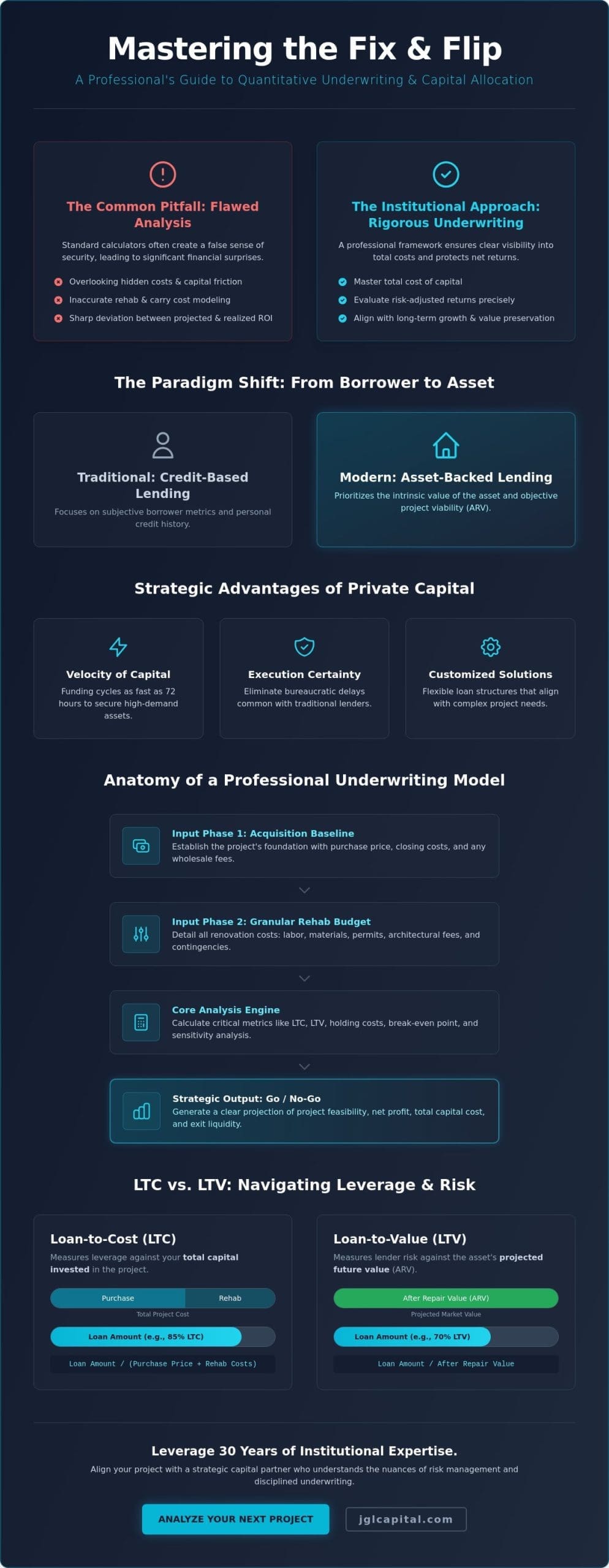
The distinction between Loan-to-Cost (LTC) and Loan-to-Value (LTV) represents a critical juncture in the underwriting process, yet many investors conflate these two metrics to their own detriment. While LTV provides a snapshot of the loan amount relative to the property’s terminal value, LTC serves as the primary constraint on total project funding, dictating the actual cash-to-close requirements. An advanced hard money fix and flip calculator must delineate these variables to provide a clear picture of both initial capital requirements and terminal risk. By understanding how leverage ratios dictate the investor’s equity stake, a developer can better manage risk exposure throughout the asset’s transitional phase.
Experienced developers often employ strategic cross-collateralization to optimize their leverage, utilizing equity in existing holdings to secure more favorable terms on new acquisitions. This approach requires a sophisticated understanding of how different lenders weight LTC versus LTV. When the hard money fix and flip calculator indicates a high LTC, it signals a significant reliance on debt for the project’s execution, which necessitates a more rigorous sensitivity analysis. Maintaining a disciplined balance between high leverage and project liquidity is essential for preserving the integrity of the investment through unforeseen market shifts.
The Strategic Importance of LTC
Institutional-grade fix and flip loans utilize LTC as a benchmark to ensure a proper alignment of interests between the lender and the developer. This metric determines the specific equity commitment required from the borrower, often referred to as having sufficient capital at risk. By funding a percentage of both the purchase price and the subsequent renovation costs, LTC-based lending provides a comprehensive capital solution. However, developers must ensure they maintain enough internal liquidity to manage the “soft costs” that may not be fully covered by the loan’s draw schedule.
Projecting Exit Liquidity with ARV
The terminal success of a flip is predicated on the accuracy of the After Repair Value (ARV) projection. Utilizing a rigorous comparable sales analysis is the only reliable method to establish a realistic exit price; failing to do so risks “over-improving” an asset beyond the natural ceiling of its immediate neighborhood. This projected LTV at the point of exit is what ultimately determines the viability of a refinance into a long-term rental property loan. If the finished asset’s value doesn’t support the required LTV for a permanent mortgage, the investor may be forced into an unplanned sale, compromising the long-term wealth generation potential of the project.
Optimizing Profitability: Sensitivity Analysis and Contingency
A disciplined developer recognizes that a static financial projection is merely a hypothesis. True underwriting excellence requires a dynamic hard money fix and flip calculator capable of simulating various adverse conditions through sensitivity analysis. Stress-testing the model is a non-negotiable requirement for sophisticated capital allocation. If a project’s timeline extends by three months beyond the initial forecast, the cumulative interest carry can significantly erode the anticipated net profit. Calculating the “Break-Even ARV” is equally essential. This figure represents the minimum sale price required to satisfy all debt obligations and recover initial equity, providing a clear safety margin that defines the project’s risk floor.
The daily cost of capital, often referred to as the project’s “burn rate,” must be quantified with precision to maintain operational control. In the private lending space, time is a literal financial variable that directly impacts the bottom line. For example, a sample calculation for a $595,000 loan at a 10.5% interest rate results in a monthly interest-only payment of $5,443. A three-month delay doesn’t just postpone the exit; it costs the project an additional $16,329 in carry alone. These figures demonstrate why professional developers prioritize speed and execution certainty over minor fluctuations in nominal interest rates.
Modeling Time as a Financial Variable
Quantifying the daily burn rate allows for a more nuanced understanding of how delays in permitting or labor availability can degrade a project’s viability. Every day an asset remains in the renovation phase, it consumes the equity buffer intended for profit. Strategies for accelerating the project lifecycle, such as pre-ordering materials or utilizing expedited permitting services, are essential for preserving exit liquidity. By maintaining a measured and steady pace toward the exit, you ensure that the capital remains productive rather than stagnant.
Advanced Metrics: Cash-on-Cash and IRR
While total ROI is a common metric, high-velocity flippers prioritize Cash-on-Cash return as the ultimate measure of performance. This metric isolates the return on the specific equity deployed, providing clarity on how effectively capital is being recycled to build a lasting legacy. For those involved in multi-investor syndications, the Internal Rate of Return (IRR) becomes the standard, as it accounts for the time-weighted value of money. When comparing these transitional returns to passive commercial real estate benchmarks, the active management of fix-and-flip assets offers superior yield potential, provided the underwriting remains rooted in analytical rigor.
To ensure your next project is backed by institutional-grade analysis and a serious approach to value preservation, partner with an expert steward of capital who understands the complexities of transitional asset management.
JGL Capital: Institutional-Grade Capital for Professional Developers
While a hard money fix and flip calculator provides the quantitative foundation for a project, the qualitative strength of the lending partner determines the ultimate success of the capital allocation strategy. JGL Capital serves as a disciplined steward of transitional capital, offering thirty years of institutional expertise to professional developers. We align our expert underwriting standards with your quantitative models; this ensures that every deployment of capital is grounded in analytical rigor rather than speculative momentum. Streamlining the path from your initial calculation to project funding requires a partner who understands the gravity of high-stakes management and the necessity of precision.
Our firm provides bespoke financing solutions that are meticulously tailored to the unique requirements of each individual asset. This customized approach distinguishes JGL Capital from transactional competitors who rely on rigid, one-size-fits-all lending criteria. By framing our activities as a form of high-level strategic alliance, we ensure that the objectives of the developer and the capital provider remain perfectly aligned. This synergy is essential for maintaining exit liquidity and achieving the risk-adjusted returns modeled during the initial underwriting phase.
A Disciplined Approach to Asset-Backed Lending
JGL Capital prioritizes the creation and preservation of value through a serious approach to asset-backed lending. Our analytical rigor provides a sense of security for sophisticated partners, as we meticulously define every strategy and qualify every claim within the loan structure. We offer customized solutions for fix and flip loans, bridge loans, and multi-family assets, ensuring that the financing aligns with the operational realities of the project. This discreet and strategic partnership allows developers to focus on execution while we provide the stability of reliable, institutional-grade capital.
Moving Beyond the Calculator
True expertise involves leveraging intellectual capital to refine the financial assumptions within your hard money fix and flip calculator. We move beyond simple service provision to act as a collaborative ally, helping you transition from a series of individual projects to a disciplined real estate legacy. Our steady and measured communication rhythm reflects a commitment to long-term objectives and the generation of worth. We value integrity and deliberate action above all else, ensuring that every partnership is built on a foundation of mutual trust and professional excellence. When you’re ready to secure institutional-grade funding for your next acquisition, consult with JGL Capital to secure your next project’s funding.
Advancing Strategic Capital Allocation in Transitional Real Estate
The successful management of transitional real estate assets depends on a fundamental transition from speculative estimations to the implementation of a rigorous analytical framework. Utilizing a professional-grade hard money fix and flip calculator serves as the primary mechanism for identifying the true cost of capital and ensuring the resilience of a project’s exit liquidity. By prioritizing sensitivity analysis and a disciplined understanding of Loan-to-Cost metrics, investors can effectively mitigate the risks associated with market volatility and unforeseen operational delays. This approach ensures that every project contributes to the creation of a lasting legacy rather than a mere transactional gain.
JGL Capital stands as a seasoned partner for developers seeking to align their quantitative models with institutional standards. With over 30 years of industry expertise and a commitment to specialized asset-backed underwriting, we provide customized capital solutions across a national reach. Our focus on long-term growth and integrity ensures that your strategic objectives are supported by a steward of capital who values precision as much as performance. We invite you to Secure Institutional-Grade Funding for Your Next Fix and Flip Project. Your commitment to disciplined underwriting deserves a partner capable of delivering excellence at every phase of the project lifecycle.
Frequently Asked Questions
What is the difference between a hard money calculator and a traditional mortgage calculator?
A hard money fix and flip calculator prioritizes the financial lifecycle of transitional assets rather than the long-term amortization schedules found in traditional models. While conventional calculators focus on principal and interest over decades, the hard money variant emphasizes asset-backed metrics such as rehab disbursements, origination points, and short-term carry costs. This specialized tool is designed to model capital friction in a high-velocity environment where speed and leverage are the primary strategic objectives.
How do I estimate the After Repair Value (ARV) accurately for the calculator?
Accuracy in ARV estimation requires a disciplined comparable sales analysis of properties with similar utility and finishes that have transacted within a localized radius. You must adjust for specific variables such as finished square footage and architectural upgrades while strictly adhering to the price ceilings established by recent market data. This analytical rigor ensures that your terminal value remains a realistic reflection of current demand rather than a speculative projection that could compromise your exit liquidity.
Are the interest rates in a hard money calculator fixed or variable?
Interest rates within the private lending sector are typically fixed for the duration of the loan term to provide the certainty of execution required for precise underwriting. Since most fix-and-flip projects have a duration of 6 to 18 months, a fixed rate protects the investor’s equity buffer from the volatility of shifting market conditions. This stability allows for a more accurate calculation of the total interest carry, which is a critical component of the project’s risk-adjusted return profile.
Can a fix and flip calculator account for tiered draw schedules?
Professional-grade underwriting tools are designed to model interest accrual based on disbursed funds rather than the total loan commitment. This functionality is essential for developers who receive capital in tiers following successful site inspections and project milestones. By accounting for the timing of these draws, the hard money fix and flip calculator provides a more nuanced view of the project’s burn rate and prevents the overestimation of financing costs during the early stages of renovation.
How does the loan-to-cost (LTC) ratio affect my initial cash investment?
The Loan-to-Cost ratio serves as the primary constraint on total project funding and directly dictates the amount of internal liquidity a developer must commit. A lower LTC percentage necessitates a higher initial equity contribution, which can impact the project’s cash-on-cash return and limit the investor’s ability to diversify across multiple assets. Understanding this ratio is fundamental to determining the “skin in the game” required to align your objectives with those of an institutional-grade capital partner.
What are the most common hidden fees to include in a hard money calculation?
Beyond the nominal interest rate and origination points, investors should account for document preparation fees, draw inspection costs, and title insurance premiums. These soft costs can aggregate into a significant drag on net profit if they aren’t meticulously documented during the initial underwriting phase. Integrating these recurring expenses into your financial model ensures that your net profit figure remains resilient against the various forms of capital erosion that occur throughout the project’s lifecycle.
Why is a contingency fund essential in my fix and flip underwriting?
A contingency reserve, typically ranging from 10% to 15% of the renovation budget, is a strategic necessity for managing the inherent uncertainties of property redevelopment. This fund provides a safety margin against structural discoveries or supply chain volatility that could otherwise stall progress. Maintaining this disciplined buffer ensures that the project remains solvent and that the developer isn’t forced to seek unplanned equity infusions during critical phases of the construction process.
How do I calculate the net profit if I decide to refinance into a rental loan instead of selling?
In a refinance scenario, net profit is defined by the “forced equity” created through the renovation minus the total cost of the transitional debt and new closing fees. The success of this strategy depends on the asset’s ability to support a long-term rental property loan based on its appraised value and debt service coverage ratio. You must ensure that the new loan amount is sufficient to retire the original bridge financing while leaving enough residual equity to meet your long-term wealth preservation goals.