

The persistent reliance on personal debt-to-income ratios has emerged as a significant structural impediment to the expansion of institutional-grade real estate portfolios in the current fiscal environment. While traditional banking institutions continue to demand exhaustive personal documentation, the evolution of rental property loans toward an asset-centric model offers a more disciplined path for the preservation and generation of long-term wealth. You’ve likely encountered the limitations of conventional underwriting, where slow closing times and rigid credit metrics often result in missed opportunities for strategic acquisition.
This analysis demonstrates how decoupling financing from personal credit and anchoring it to property performance metrics allows for a more efficient allocation of capital. We’ll explore the sophisticated application of Debt Service Coverage Ratio (DSCR) lending, the regulatory shifts following the July 2026 enactment of the “21st Century ROAD to Housing Act,” and the methodologies required to secure financing that scales with the intrinsic value of your assets. By prioritizing the income potential of the property over the personal financial history of the borrower, sophisticated investors can establish a more resilient and scalable foundation for their holdings.
Key Takeaways
- Analyze the fundamental shift toward asset-based underwriting, where the intrinsic performance of the investment property supersedes traditional personal credit metrics.
- Master the mechanics of the Debt Service Coverage Ratio (DSCR) to secure financing that aligns with property cash flow rather than being constrained by personal debt-to-income ratios.
- Evaluate the strategic advantages of rental property loans sourced through private capital to mitigate the opportunity costs associated with the protracted closing cycles of traditional banks.
- Identify the critical documentation requirements and asset performance thresholds necessary to optimize interest rate pricing and enhance portfolio scalability.
- Leverage the expertise of a disciplined lending partner to access national capital markets and implement highly customized financing solutions for high-stakes real estate management.
Understanding Rental Property Loans in the 2026 Investment Landscape
Rental property loans represent a specialized class of financial instruments, meticulously structured to facilitate the acquisition and management of non-owner-occupied residential and multi-family assets. Unlike consumer-facing debt, these vehicles are engineered to prioritize the economic viability of the asset itself. In the fiscal climate of 2026, characterized by fluctuating interest rates and heightened market scrutiny, the shift toward asset-based lending has become a prerequisite for institutional-grade success. The global asset-based lending market, which surpassed $1 trillion in 2026, underscores this transition from personal creditworthiness to property-specific performance metrics.
Professional portfolio expansion often finds traditional 30-year fixed-rate mortgages insufficient. These retail products are frequently encumbered by personal debt-to-income limitations and onerous documentation requirements that fail to account for the sophisticated structures of high-net-worth investors. Strategic capital allocation requires a higher degree of capital velocity. The ability to deploy funds rapidly to secure high-yield units is a hallmark of the disciplined steward, whereas traditional banks often lack the agility to navigate competitive national markets where timing is as critical as the capital itself.
Rental vs. Residential: The Strategic Distinction
The risk assessment methodologies applied to real estate investing differ fundamentally from those used for primary residences. While residential mortgages focus on personal utility and borrower stability, rental property loans prioritize the generation of worth through disciplined cash flow analysis. By utilizing commercial-grade terms for residential rental acquisitions, partners ensure that their financing structures align with the long-term strategic objectives of value preservation. This distinction is critical; it moves the focus from personal liability to the intrinsic performance of the real estate asset.
The Evolution of Private Capital in 2026
The current market trajectory has seen a decisive movement toward private money brokers, as traditional retail banks maintain rigid, antiquated underwriting standards. Sophisticated stakeholders require highly customized, individual solutions that address the complexities of large-scale asset management, especially following the regulatory shifts introduced by the July 2026 enactment of the “21st Century ROAD to Housing Act.” This legislation has altered the acquisition strategies of institutional entities, making the expertise of a seasoned, discreet lending partner even more vital. The 2026 rental loan market is defined by a strategic pivot toward institutional-grade private capital. By fostering collaborative relationships rather than simple service provision, private capital allies allow for the creation of lasting legacies through careful, deliberate action.
The Mechanics of DSCR and Asset-Based Financing
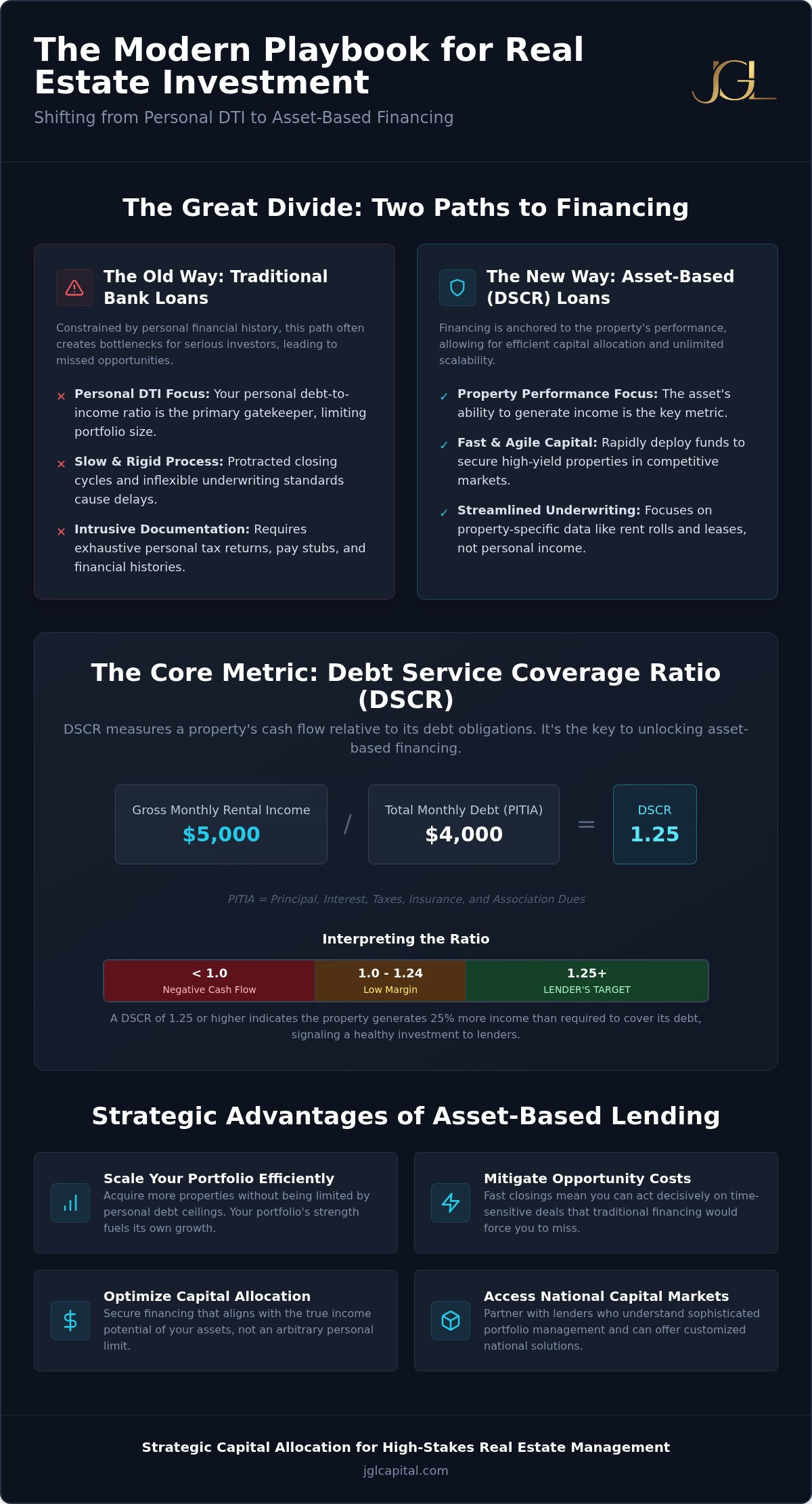
The structural integrity of contemporary rental property loans is predicated on the Debt Service Coverage Ratio (DSCR). This metric serves as the primary arbiter of loan approval, effectively reorienting the underwriting process from the borrower’s personal financial history to the asset’s intrinsic cash-flow performance. By prioritizing the property’s capacity to service its own debt, asset-based underwriting bypasses the traditional limitations imposed by personal tax returns and debt-to-income (DTI) ratios. This decoupling of personal liability from investment performance is a critical strategy for the creation and preservation of portfolio-wide value.
Calculating the Debt Service Coverage Ratio
The formula for determining the DSCR is a precise articulation of a property’s fiscal health. It’s calculated by dividing the Gross Monthly Rental Income by the total monthly debt obligations, commonly referred to as PITIA, which encompasses Principal, Interest, Taxes, Insurance, and Association dues. Within the 2026 economic climate, most institutional lenders favor a ratio of 1.25 or higher, as this indicates the property generates 25% more income than its debt service requirements. Optimizing property performance through professional rent schedules and disciplined expense management is essential to qualify for the most favorable terms. For partners seeking to navigate these complex metrics, engaging a disciplined lending ally ensures that property valuations are accurately aligned with current market standards.
The Asset-Backed Advantage
In an asset-backed model, the property’s market value and rental potential serve as the ultimate security for the capital. This philosophy allows for a streamlined alternative to the bureaucratic delays inherent in traditional retail banking when securing rental property loans for national portfolio expansion. When the asset is the primary focus, the underwriting process gains significant agility, facilitating faster access to capital for high-stakes acquisitions. Professional management plays a pivotal role here; lenders often view seasoned management as a mitigating factor in risk assessment, which can enhance the overall valuation during the underwriting phase.
The relationship between cash flow and loan-to-value (LTV) ratios remains a cornerstone of this disciplined approach. Higher cash-flow margins often allow for more flexible LTV structures, providing the capital velocity necessary for sophisticated stakeholders to pursue high-yield opportunities. This methodology ensures that every claim is qualified by analytical rigor, reinforcing the position of the asset as the central pillar of the investment strategy. By focusing on property-level worth, investors can scale their holdings without being tethered to the constraints of their personal balance sheets.
Traditional Banks vs. Private Capital Solutions
The divergence between traditional institutional lending and private capital solutions has never been more pronounced than in the current fiscal year. While retail banks offer a perceived sense of stability, their rigid operational frameworks often result in significant opportunity costs for the sophisticated investor. Professional partners recognize that the true cost of rental property loans is not merely the interest rate, but the speed and certainty of execution. In competitive national markets, the ability to deploy capital with agility is often the deciding factor in securing high-yield assets before they’re absorbed by more nimble competitors.
Sophisticated stakeholders favor the discreet and expert nature of private money brokers who act as disciplined stewards of their interests. Unlike the transactional approach of traditional banks, private capital allies provide highly customized solutions that reflect the unique complexities of high-stakes management. There’s a calculated trade-off here; while private capital may involve slightly higher points, the ability to close complex deals that traditional institutions would reject provides a measurable strategic advantage. This approach prioritizes the preservation and creation of value over the pursuit of the lowest possible nominal rate.
The Speed of Execution
The traditional bank cycle, which often spans 45 to 60 days, is frequently incompatible with the pace of institutional-grade acquisitions. Accelerated private funding timelines allow for the capture of distressed or off-market opportunities where sellers prioritize certainty of closing. Fast-track funding mechanisms enable investors to negotiate significant discounts, effectively offsetting the cost of capital through immediate equity gains. In many instances, bridge loans serve as the critical tactical instrument, providing the necessary liquidity to secure an asset while transitioning toward a more permanent long-term rental financing structure.
Flexibility in Underwriting
Traditional banks rely on standardized ‘credit boxes’ that often exclude non-warrantable condos, complex multi-family units, and other unique assets that don’t fit a generic profile. Private capital solutions, by contrast, utilize analytical rigor to assess the intrinsic worth of the property and its income potential. JGL Capital leverages over 30 years of industry expertise to identify viable financing pathways where traditional banks see only insurmountable obstacles. This commitment to collaborative relationships ensures that even the most intricate portfolios can scale without being hindered by the administrative inertia of retail banking. By focusing on property performance and asset-backed security, private money brokers provide the flexibility required for the generation of substantial long-term worth. Every rental property loans strategy must be qualified by a deep understanding of these market dynamics to ensure the successful creation of a lasting legacy.
Qualification Criteria for Sophisticated Portfolio Growth
Securing institutional-grade rental property loans necessitates a shift from personal financial narratives to a disciplined presentation of asset performance. While traditional lenders remain preoccupied with personal income tax returns, asset-based financing requires a precise documentation package that validates the property’s standalone viability. This rigorous approach ensures that every capital deployment is grounded in analytical certainty, prioritizing the preservation of wealth over speculative acquisition. By focusing on the intrinsic worth of the asset, partners can navigate the complexities of portfolio expansion with greater precision.
The Appraisal and Rent Schedule
The 1007 Rent Schedule stands as the most critical component of the appraisal report, acting as the definitive source for the property’s projected income. Underwriters utilize this document to reconcile actual lease rates with current market rents, ensuring the DSCR calculation reflects realistic performance. The 2026 appraisal process utilizes AI-driven market data to synthesize real-time historical rental trends with predictive neighborhood appreciation metrics, ensuring a more granular valuation of the property’s income potential. Discrepancies between current lease agreements and these market benchmarks can significantly influence loan terms, as lenders seek to mitigate the risk of underperforming assets. A strong DSCR, typically 1.25 or higher, remains the benchmark for securing the most competitive interest rate pricing.
Lenders evaluate the borrower’s liquidity as a measure of stability and commitment to the asset’s success. Maintaining ‘skin in the game’ through a substantial down payment, which often ranges between 20% and 30% depending on the asset’s risk profile, aligns the interests of the partner and the lender. Most asset-based programs also require a minimum of 3 to 6 months of PITIA reserves to ensure the property can withstand temporary vacancies or unexpected capital expenditures. This requirement reinforces the necessity of a disciplined steward who values long-term integrity and the steady generation of worth through rental property loans.
Corporate Structure and Liability
Sophisticated partners frequently execute their real estate investing strategies through corporate entities rather than personal names. Utilizing a Limited Liability Company (LLC) or a corporate structure provides a necessary layer of protection, insulating personal assets from property-specific liabilities. This structural choice also facilitates portfolio scalability, as entity-based borrowing allows for the seamless transfer of assets and the inclusion of multiple stakeholders. A complete loan package must include the Articles of Organization and a comprehensive Operating Agreement to define the governance and responsibility of the borrowing entity. For those prepared to scale their holdings with a disciplined partner, submitting your entity documentation for review is the next logical step in the acquisition process.
Strategic Capital Allocation with JGL Capital
JGL Capital functions as a disciplined steward for sophisticated partners who require more than just a transactional relationship in their pursuit of institutional-grade growth. As a national private money broker, we provide access to diverse capital stacks, enabling the execution of complex acquisitions that require a high degree of intellectual capital and strategic foresight. Our expertise extends beyond standard rental property loans to include the facilitation of commercial real estate loans and large-scale multi-family projects. This comprehensive approach ensures that every strategic objective is met with analytical rigor and a commitment to stability, projecting a confidence that is grounded in decades of successful resource management. We view every engagement as a strategic alliance, where the preservation of value is as critical as its creation.
A Partnership Grounded in Expertise
Leveraging over thirty years of industry history allows our firm to navigate complex market cycles with a patient and measured perspective that’s often missing in more aggressive sectors of the lending market. We’ve established ourselves as a quiet expert, an organization that prioritizes the preservation of value over the fleeting trends of speculative marketing or industry buzzwords. This seasoned approach is designed to instill a sense of security in our high-net-worth partners, as we focus on the generation of worth through careful, deliberate action and meticulous risk assessment. By framing our activities as a form of high-level strategic alliance, we distinguish ourselves from transactional competitors who lack the depth of our established intellectual capital and the discipline required for high-stakes management. Our firm’s personality is defined by exclusivity and a focus on building lasting legacies through the alignment of our partners’ long-term objectives.
The same commitment to excellence that defines a successful real estate portfolio is often mirrored in the personal pursuits of our partners; for those who value expert, one-on-one mentorship in their creative endeavors, Jay Moore Guitar provides the high-level instruction necessary to master the instrument with precision.
Next Steps for Your Next Acquisition
The transition from analysis to execution requires a streamlined process that respects the gravity of high-stakes management and the necessity of capital velocity. Our methodology for reviewing new acquisitions is cumulative and logical, moving from a high-level mission alignment to specific operational strengths without the administrative friction common in traditional banking. We ensure that our objectives are perfectly aligned with yours, fostering a collaborative relationship that serves as the foundation for long-term strategic success and portfolio scalability. For those seeking to secure rental property loans that reflect the true performance and income potential of their assets, the preliminary review process begins with a thorough examination of the property’s intrinsic value. We invite you to contact our seasoned professionals to initiate a bespoke financing consultation that prioritizes your individual solutions and the careful stewardship of your real estate holdings.
Strategic Portfolio Expansion Through Disciplined Financing
Navigating the complexities of the 2026 real estate market requires a transition from traditional, documentation-heavy borrowing to a more sophisticated model of asset-based underwriting. By prioritizing the Debt Service Coverage Ratio and property-level performance, professional partners can effectively decouple their growth from personal credit constraints. This structural shift, supported by the agility of private capital, ensures that high-stakes acquisitions are executed with the precision and speed necessary to preserve long-term value. Every successful legacy is built upon these principles of analytical rigor and strategic stewardship.
JGL Capital remains committed to the creation and preservation of worth through highly customized solutions tailored to your specific objectives. With over 30 years of strategic lending expertise and a specialization in high-stakes 10 MIL+ financing, we serve as the quiet expert for partners seeking a nationwide reach. It’s time to align your acquisition strategy with a disciplined lending ally that values integrity and intellectual capital. We invite you to Secure Your Investment Capital with JGL Capital and begin the process of scaling your rental property loans portfolio with confidence and institutional-grade stability. Your vision for long-term growth deserves a partner who understands the gravity of your management objectives.
Frequently Asked Questions
What is the minimum credit score required for a DSCR rental property loan?
Minimum credit requirements typically begin at 620, though a score of 680 or higher is generally required to access more favorable interest rate pricing. Asset-based lenders prioritize the property’s performance, yet the borrower’s credit history serves as a secondary indicator of financial responsibility. Maintaining a superior credit profile ensures the alignment of property performance with optimal financing terms and lower down payment requirements.
Can I get a rental property loan without personal income verification?
Yes, asset-based financing models allow for the acquisition of investment properties without traditional personal income verification or debt-to-income (DTI) analysis. These rental property loans are structured to evaluate the property’s gross rental income against its debt obligations; to explore how these programs function in practice, check out Simplified Commercial Lending, which offers diverse loan products without requiring tax returns. This approach provides a streamlined path for sophisticated investors whose personal tax returns don’t fully reflect their institutional-grade liquidity or portfolio strength.
How do rental property loan rates compare to primary residence mortgages in 2026?
Interest rates for investment assets in 2026 typically command a premium of 0.5% to 1.0% over primary residence mortgages. While conventional investment rates average between 7.309% and 7.809%, DSCR-specific options may offer different structures, such as 30-year fixed options starting at 6.375%. This pricing reflects the increased risk profile inherent in non-owner-occupied real estate and the specialized nature of institutional capital.
What is the typical down payment required for an asset-backed investment loan?
A standard down payment of 20% is generally required for borrowers possessing strong credit profiles, while those with lower scores or more complex asset types may need to provide 25% to 30%. This ‘skin in the game’ ensures a disciplined alignment between the investor and the lending institution. It also serves as a critical buffer against market volatility, preserving the long-term integrity of the capital stack.
Is it possible to finance a multi-family rental property with private money?
Private capital is an ideal vehicle for financing multi-family rental properties, particularly those requiring the agility that traditional banks can’t provide. Private money brokers offer specialized multi-family loans designed for both stabilized assets and value-add opportunities. This flexibility allows for the creation of customized individual solutions that account for complex unit counts and the diverse income streams characteristic of institutional-grade residential portfolios.
How long does the approval and funding process take for a rental property loan?
The funding timeline for private asset-based loans is significantly shorter than the 45 to 60-day cycle typical of traditional institutional lenders. Most private money transactions can reach completion within 14 to 21 days, provided all property-level documentation and appraisals are finalized. This accelerated pace is a strategic necessity for partners operating in competitive national markets where the speed of execution directly impacts acquisition success.
What are the advantages of borrowing through an LLC for rental properties?
Borrowing through an LLC provides a robust layer of liability protection by insulating personal assets from property-specific legal or financial claims. This corporate structure also facilitates portfolio scalability, allowing sophisticated stakeholders to manage multiple rental property loans without impacting their personal credit capacity. Utilizing an entity signals a disciplined, professional approach to asset management, which is highly valued by institutional-grade lending partners.
Does JGL Capital offer financing for new construction rental projects?
JGL Capital provides specialized new construction loans designed specifically for the development of high-yield rental assets. Our expertise in sourcing diverse capital stacks ensures that builders and developers receive the necessary liquidity to execute projects from ground-break to stabilization. This offering reflects our commitment to the generation of worth through collaborative relationships and a deep understanding of the evolving 2026 housing landscape.