

In high-stakes real estate markets, the perceived security of traditional bank financing often functions as a strategic anchor rather than a catalyst for growth. You’ve likely recognized that capital locked in existing assets represents a significant opportunity cost when time-sensitive acquisitions emerge. Utilizing a bridge loan for home purchase allows sophisticated investors to bypass the standard 45-day underwriting cycles of depository institutions, providing the liquidity needed to compete with institutional-grade speed. This strategic shift ensures your investment trajectory isn’t dictated by the administrative pace of a retail lender but by your own analytical rigor and market timing.
This guide will equip you with the framework to master transitional capital as a tool for portfolio optimization. We’ll explore the mechanics of rapid capital deployment and the precise methodologies for creating a seamless transition between acquisition and permanent financing. By the conclusion of this analysis, you’ll understand how to minimize contingency requirements and execute residential investments with the confidence expected of a seasoned steward of capital. Our objective is to ensure your capital remains as mobile and disciplined as your investment philosophy.
Key Takeaways
- Recognize the strategic utility of asset-backed financing to facilitate immediate residential acquisitions without the traditional delays of liquidity-based constraints.
- Master the operational mechanics of a bridge loan for home purchase, utilizing interest-only structures to maintain capital agility during transitional investment phases.
- Evaluate the critical distinctions between institutional bridge financing and conventional mortgages, prioritizing property equity and speed over personal credit metrics.
- Discern the essential underwriting requirements and the pivotal role of a robust exit strategy in securing favorable terms from sophisticated capital partners.
- Learn how JGL Capital LLC leverages three decades of financial stewardship to provide bespoke transitional funding for complex real estate portfolios.
Table of Contents
- The Strategic Role of a Bridge Loan for Home Purchase in Real Estate Portfolios
- Operational Mechanics: How Bridge Loans Facilitate Transitional Property Acquisition
- Comparative Analysis: Bridge Loans vs. Conventional Mortgage Instruments
- Underwriting Criteria and Strategic Implementation for Investors
- JGL Capital: Bespoke Transitional Capital Solutions for the Modern Investor
The Strategic Role of a Bridge Loan for Home Purchase in Real Estate Portfolios
Within the architecture of modern real estate investment, the utilization of a bridge loan for home purchase serves as a critical facilitator for the acquisition of residential assets. This short-term, asset-backed instrument is engineered specifically for transitional periods, providing the necessary leverage to secure property when immediate liquidity is otherwise committed. While some might ask What is a bridge loan? in a general sense, the institutional perspective views it as a specialized form of transitional capital that bridges the gap between the identification of an undervalued asset and the eventual procurement of long-term financing or a liquidity event.
In today’s competitive real estate markets, where properties often move quickly, the velocity of capital is a primary determinant of portfolio growth. Institutional-grade transitional capital differs fundamentally from consumer-grade “swing loans” by focusing on the underlying collateral value and the investor’s strategic exit rather than personal debt-to-income ratios. This distinction allows sophisticated investors to bypass the rigid constraints of traditional retail banking, ensuring that capital is deployed where it generates the highest risk-adjusted returns.
Decoupling Acquisition from Liquidity Events
Investors often encounter scenarios where a prime asset becomes available while their existing capital remains locked in properties pending sale or renovation. By leveraging a bridge loan for home purchase, an organization can execute on new opportunities without the necessity of waiting for a prior disposition to settle. This approach effectively eliminates the “sale-of-home” contingency, which often renders an offer uncompetitive in a landscape where cash or non-contingent bids are the standard. Transitional capital represents a sophisticated mechanism for the strategic expansion of a real estate portfolio, allowing for the deliberate acquisition of assets during periods of capital reorganization.
The Investor Advantage: Speed as a Competitive Moat
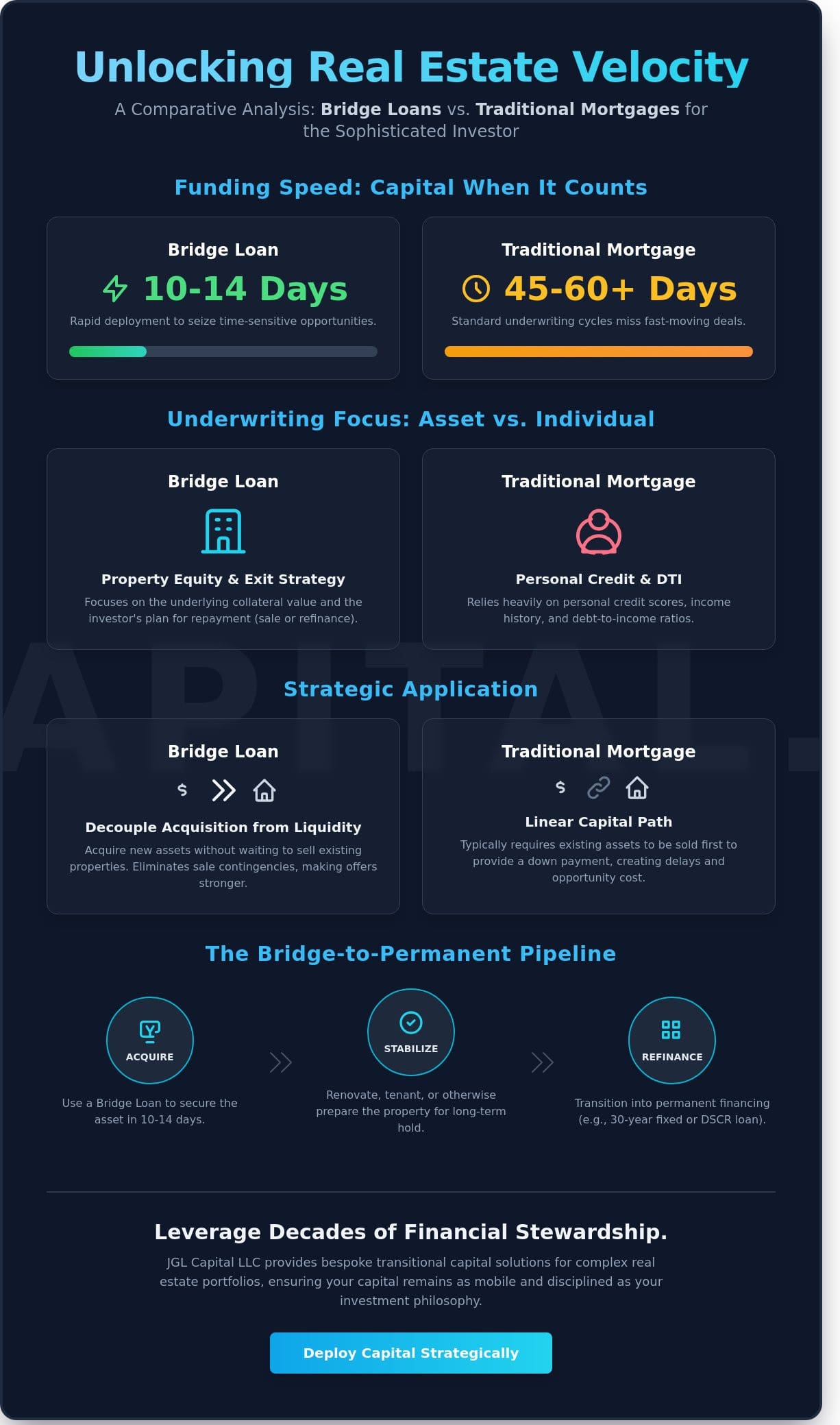
The efficacy of private capital is most visible in its funding cycles, which typically range from 10 to 14 days, whereas traditional bank timelines often extend to 45 or 60 days. Rapid deployment of capital reduces the risk of deal attrition, ensuring that attractive investment opportunities aren’t lost to more agile competitors. It’s this speed that creates a tangible moat around an investor’s pipeline. Managing these short-term debt obligations requires a disciplined approach to stewardship, ensuring that the cost of capital is balanced against the long-term value creation of the asset. By securing a property quickly, an investor establishes a position of strength that protects their interests from the delays inherent in conventional mortgage underwriting.
Operational Mechanics: How Bridge Loans Facilitate Transitional Property Acquisition
Investors targeting the Orlando real estate market often encounter compressed acquisition timelines that traditional mortgage products cannot accommodate. A bridge loan for home purchase serves as the primary mechanism for securing assets while long-term financing remains underwritten. These instruments prioritize speed and agility, allowing sophisticated buyers to bypass the exhaustive 45-day documentation cycles typical of retail banks. By utilizing short-term capital, investors can execute on distressed opportunities or time-sensitive auctions that require closing within 10 to 14 days.
The bridge-to-permanent pipeline is a cornerstone of professional portfolio growth. This strategy involves using high-leverage, short-term debt to acquire and stabilize an asset, followed by a transition into a conventional 30-year fixed or a DSCR loan once the property is tenanted. This methodology ensures that capital remains fluid, permitting the investor to move from one acquisition to the next without waiting for the slow machinery of traditional capital markets.
Collateralization and Loan-to-Value Frameworks
Lenders primarily evaluate the underlying asset rather than the borrower’s personal credit history. Understanding what is a bridge loan involves recognizing its nature as an asset-based solution where existing equity in a portfolio is leveraged to fund new acquisitions. For non-owner-occupied residential properties, loan-to-value (LTV) ratios typically range between 65% and 80%. These thresholds dictate capital allocation, as the lender requires a sufficient equity cushion to mitigate risk during the transitional phase. High-net-worth individuals often cross-collateralize multiple properties to achieve 100% financing on a new purchase, effectively using their current holdings as the engine for expansion.
Interest Structures and Repayment Strategies
The financial architecture of these loans favors cash flow preservation through interest-only payments. Most structures utilize this model for terms spanning 6 to 24 months, which reduces the monthly debt service burden during the renovation or stabilization period. Analyzing bridge loan rates reveals a premium over conventional debt; this cost reflects the expedited delivery and the lender’s increased risk exposure.
A defined exit strategy is a mandatory component of the underwriting process. Most bridge loans conclude with a balloon payment, necessitating a clear path to liquidity through either the sale of the asset or a long-term refinance. Investors who maintain a disciplined approach to these timelines can successfully navigate the cost of capital while maximizing their risk-adjusted returns. To ensure your acquisition strategy aligns with institutional standards, consider a consultation regarding bespoke capital solutions
Comparative Analysis: Bridge Loans vs. Conventional Mortgage Instruments
Underwriting for conventional mortgages remains anchored in the personal financial history of the borrower, requiring exhaustive documentation of tax returns and liquid assets. This methodology often fails to account for the strategic value of a specific real estate asset or the nuances of a rapid acquisition. A bridge loan for home purchase operates on a different logic, emphasizing the collateral’s equity and the viability of the investor’s exit strategy rather than personal debt-to-income ratios. While retail interest rates might appear more attractive on a balance sheet, they often carry a hidden cost: the inability to close within the tight windows required by Orlando’s 2024 competitive landscape, where inventory levels have remained 20% below historical averages.
The total cost of capital is a multifaceted metric that must be weighed against the opportunity cost of missed acquisitions. Investors who rely solely on institutional financing frequently lose high-yield opportunities to cash-ready competitors. Private money brokerage provides the flexibility to structure bespoke solutions, such as cross-collateralization or interest reserves, which are unavailable through standard banking channels. This professional approach ensures that the capital structure is an enabler of growth, rather than a bureaucratic hurdle. High-net-worth individuals recognize that higher nominal rates don’t always equate to lower profitability; instead, they represent a premium paid for the speed and certainty of execution.
Institutional Flexibility vs. Regulatory Rigidity
Traditional banks are bound by the Basel III capital adequacy standards and the restrictive framework of the Dodd-Frank Act. These regulations limit their exposure to transitional real estate and assets requiring significant renovation. Consequently, depository institutions often struggle with investment scenarios that don’t fit a standardized profile. Sophisticated investors utilize bridge loan mortgage products to bypass these constraints, benefiting from an alignment of interests with private lenders who prioritize asset performance. This partnership allows for a disciplined approach to wealth creation that traditional retail banks cannot replicate.
Calculating the Risk-Adjusted Return on Capital
Assessing the efficacy of short-term capital requires a transition from viewing interest as a mere expense to viewing it as a tool for strategic leverage. A framework for this analysis includes several key variables:
- Appreciation Capture: Comparing the 8% to 12% cost of bridge capital against the projected 15% annual appreciation in high-demand Orlando corridors.
- Capital Velocity: Evaluating how a 30-day closing period increases the number of annual acquisitions compared to a 60-day institutional cycle. Investors seeking to master the mechanics behind this speed advantage should understand how does a bridge loan work as a mechanism for rapid capital deployment and strategic repositioning.
- Tax Efficiency: Analyzing the deductibility of short-term interest expenses under current IRS guidelines, which can mitigate the net cost of the bridge loan for home purchase.
- Equity Preservation: Using property value to secure funding rather than liquidating existing portfolios at inopportune market moments.
Asset-based lending is the preferred choice for time-sensitive deals because it prioritizes the collateral’s liquidation value over the borrower’s liquidity profile. This disciplined focus on the asset ensures that capital allocation remains efficient and that strategic objectives are met without the delays inherent in traditional financial oversight.
Underwriting Criteria and Strategic Implementation for Investors
Securing a bridge loan for home purchase within the Orlando market requires a shift from traditional credit-based underwriting toward a more rigorous, asset-centric evaluation that prioritizes the intrinsic value of the collateral. Institutional lenders necessitate a robust documentation package, which typically includes the purchasing entity’s organizational documents, a detailed schedule of real estate owned (SREO), and a comprehensive scope of work for any planned capital improvements. The appraisal process serves as the cornerstone of this evaluation; it provides a bifurcated valuation that accounts for both the “as-is” condition and the “as-stabilized” projected value. This analytical precision ensures that the capital allocation remains within prudent risk-adjusted parameters, often targeting a loan-to-value ratio that safeguards the interests of all stakeholders involved in the transaction.
Investors frequently utilize these structures for high-velocity projects where timing is the primary constraint. For example, fix and flip loans Florida are structured as bridge facilities that provide the liquidity necessary to acquire distressed assets and fund subsequent renovations. By focusing on the property’s future potential rather than its current deficiencies, these loans enable the acquisition of residences that wouldn’t qualify for conventional financing due to condition or occupancy status. It’s a method that rewards investors who maintain a disciplined approach to property selection and project management.
Defining the Exit Strategy: The Path to Permanent Financing
A sophisticated strategic partner views the exit strategy as the most critical component of the underwriting narrative. Investors must articulate a clear transition to permanent financing, such as a Debt Service Coverage Ratio (DSCR) loan. Data from 2023 investor sentiment reports indicates that successful transitions often rely on achieving a 1.20x coverage ratio. Refinancing or strategic asset sales retire the bridge obligation, requiring analytical rigor to project accurate timelines. This foresight prevents liquidity traps and ensures the preservation of capital across the investment lifecycle.
Portfolio Optimization Through Strategic Oversight
Bridge capital functions as a catalyst for portfolio rebalancing, allowing investors to capture value-add opportunities without the constraints of traditional banking timelines. By utilizing short-term liquidity for residential acquisitions, a steward of capital can improve the overall quality of their holdings. This disciplined approach to wealth preservation focuses on long-term legacy building through deliberate action. Partnering with a firm that offers strategic oversight ensures that every acquisition aligns with broader investment objectives and the delivery of bespoke solutions tailored to specific portfolio needs.
JGL Capital: Bespoke Transitional Capital Solutions for the Modern Investor
JGL Capital operates as a disciplined steward of capital, leveraging three decades of institutional expertise to facilitate the acquisition of high-value assets through a bridge loan for home purchase. The firm’s methodology prioritizes analytical rigor over speculative trends, ensuring that every allocation of capital aligns with the long-term strategic objectives of its partners. By maintaining a focus on risk-adjusted returns, JGL Capital provides the stability required for high-net-worth individuals and institutional investors to execute complex transactions with absolute confidence.
The firm’s ability to engineer tailored solutions for intricate investment scenarios distinguishes it from conventional lending institutions. Whether an investor is targeting a multi-family redevelopment or a luxury residential acquisition, JGL Capital delivers a level of strategic oversight that transforms simple financing into a collaborative engine for value creation. This commitment to integrity and transparency serves as the foundation for building lasting legacies in the real estate sector through careful, deliberate action.
The JGL Advantage: Precision in Capital Allocation
Efficiency in capital deployment is paramount when securing a bridge loan for home purchase in competitive markets like Orlando. JGL Capital utilizes a streamlined underwriting process that bypasses the protracted delays often associated with traditional banking hierarchies. This agility allows investors to capitalize on time-sensitive opportunities without compromising on due diligence or structural precision. It’s a method that values the investor’s time as much as their capital.
Transparency remains a core tenet of the firm’s operational philosophy. By ensuring a complete alignment of interests between the lender and the borrower, JGL Capital fosters a partnership environment where strategic growth is the primary objective. Investors seeking specialized guidance to expand their footprint should schedule a consultation regarding new construction loans and bridge financing to optimize their portfolio’s performance.
Facilitating Seamless Transactions Nationwide
Operating as a national private money broker, JGL Capital possesses the reach and experience necessary to manage cross-market deals across diverse residential landscapes. The firm functions as a discreet, strategic ally for high-stakes finance, providing the intellectual capital required to navigate varying regulatory environments and market dynamics. This national perspective ensures that partners aren’t limited by geography but are instead empowered by a global standard of financial excellence that applies to every zip code.
Success in modern real estate investment demands a partner who understands the nuance of transitional capital and the importance of portfolio optimization. JGL Capital remains dedicated to providing the sophisticated structures required for significant asset acquisition and wealth preservation. To begin a partnership focused on meticulous execution and strategic value, Inquire about bespoke bridge financing solutions from JGL Capital today.
Securing Your Competitive Advantage in Transitional Real Estate
Navigating the complexities of high-stakes real estate requires more than just liquid capital; it demands a disciplined approach to transitional financing that aligns with long-term wealth preservation. A bridge loan for home purchase serves as a sophisticated instrument for investors who prioritize speed and agility in competitive markets, allowing for the seamless acquisition of assets before traditional long-term financing is secured. By focusing on the intrinsic value of the property rather than traditional credit metrics, these bespoke solutions empower investors to capitalize on immediate opportunities without the constraints of institutional inertia.
With over 30 years of strategic expertise in private money lending, JGL Capital provides the analytical rigor and national reach necessary for successful portfolio optimization. Our asset-backed solutions are meticulously engineered to support high-stakes investors through streamlined institutional underwriting that values property equity above all else. This commitment to stewardship ensures that every transaction is handled with the precision and discretion that modern capital allocation demands. It’s a level of service that transforms simple lending into a true strategic partnership.
Partner with JGL Capital for Bespoke Bridge Financing Solutions to secure your next strategic investment with confidence. We’re ready to help you build a lasting legacy through expert capital management.
Frequently Asked Questions
Can a bridge loan be used for an investment home purchase instead of a primary residence?
Bridge loans are fundamentally designed to accommodate investment property acquisitions, providing the necessary liquidity to secure assets before permanent financing is established. While traditional lenders often prioritize primary residences, institutional capital providers focus on the underlying value of the investment asset and the borrower’s portfolio optimization strategy. Investors in the Orlando market frequently utilize a bridge loan for home purchase to execute time-sensitive acquisitions without the constraints of conventional mortgage timelines.
How much equity is typically required to secure a bridge loan for a new property?
Lenders generally require a minimum equity position of 20% to 30% of the property’s appraised value to mitigate risk and ensure alignment of interests. This equity threshold serves as a protective buffer against market volatility, particularly in high-growth regions like Central Florida. By maintaining a loan-to-value ratio below 80%, investors demonstrate a commitment to the asset’s long-term performance and facilitate a more seamless transition to permanent capital structures.
What is the typical duration for a real estate bridge loan in 2026?
The standard duration for a real estate bridge loan in 2026 typically spans from 6 to 18 months, reflecting the time required to complete renovations or secure stabilized occupancy. This timeframe allows for the execution of strategic value-add initiatives that enhance the property’s risk-adjusted returns. Most institutional agreements include options for short-term extensions, provided the borrower maintains adherence to the established project milestones and capital allocation plan.
How do bridge loan interest rates compare to traditional investment property mortgages?
Interest rates for bridge financing are consistently higher than those of traditional investment mortgages, reflecting the increased risk and expedited delivery of capital. According to 2024 industry benchmarks from the National Real Estate Investor, bridge rates often carry a premium of 200 to 500 basis points over conventional 30-year fixed rates. This cost is viewed as a strategic expense for the sake of agility, allowing investors to capture opportunities that’d otherwise be lost to slower funding sources.
Is it possible to secure a bridge loan if my current property is not yet listed for sale?
You can secure a bridge loan even if your current property isn’t listed for sale, provided you demonstrate a robust exit strategy and sufficient collateral. Institutional lenders evaluate the total net worth and liquidity of the borrower rather than focusing solely on the immediate disposition of existing assets. This flexibility’s essential for sophisticated investors who wish to maintain strategic oversight of their portfolio while simultaneously expanding their footprint in the Orlando residential sector.
What are the most common exit strategies for investors using bridge financing?
The most prevalent exit strategies for bridge financing include refinancing into a long-term debt instrument or the outright sale of the improved asset. A 2025 report on private lending indicates that 65% of bridge borrowers transition to permanent agency debt once the property reaches stabilization. Alternatively, many investors choose to liquidate the asset after completing capital improvements, thereby realizing a capital gain and recycling the equity into new institutional-grade opportunities.
Does JGL Capital offer bridge loans for multi-family residential acquisitions?
JGL Capital provides bespoke bridge financing solutions specifically tailored for multi-family residential acquisitions and portfolio expansions. Our firm’s approach emphasizes stewardship and the creation of lasting value through disciplined capital allocation. By leveraging our deep-seated expertise in multi-family assets, we offer institutional partners the strategic support needed to optimize their holdings and achieve superior risk-adjusted returns within the competitive Florida real estate market.