

What if a rental property’s DSCR looks strong, but the financing review still raises questions? Understanding debt service coverage ratio (DSCR) means more than dividing income by a payment and treating the result as a verdict. The income and expenses included, along with the calculation method, can change what the ratio shows.
This article explains how to calculate a basic property-level DSCR, which income and expenses to consider, and what a result above or below 1.0 can indicate about cash flow. It also explains the ratio’s limits: DSCR is one part of a financing review, not a stand-alone decision.
JGL Capital LLC is a private-money broker and capital advisor, not a lender. The firm helps borrowers organize business-purpose financing requests and compare prospective lender programs. The sections ahead show how to use DSCR as a starting point, make assumptions clear, and present a rental-property request with the broader transaction in view.
Key Takeaways
- For rental-property DSCR, separate operating expenses from debt payments so net operating income reflects the property’s performance before debt service.
- Understanding debt service coverage ratio (DSCR) starts with consistent inputs: define the period, identify qualifying income, and state the assumptions behind your calculation.
- Use the ratio to assess cash flow, not as a complete picture of financing readiness; borrower and property details can also matter.
- Prepare leases, income and expense records, existing debt, and property details, then label any alternative assumptions clearly.
What Does DSCR Mean for an Income-Producing Property?
For an income-producing property, the debt service coverage ratio (DSCR) compares qualifying cash flow with debt service over a stated period. This article focuses on rental real estate, not the broader corporate-finance use of DSCR, where a company’s cash flow is compared with its debt obligations. Understanding debt service coverage ratio (DSCR) starts with keeping that property-level context clear.
DSCR describes cash-flow coverage; it is not a lender’s final financing decision. A 1.0 ratio means the measured income equals the measured debt service. The ratio alone doesn’t establish whether financing will be approved.
The Basic DSCR Formula
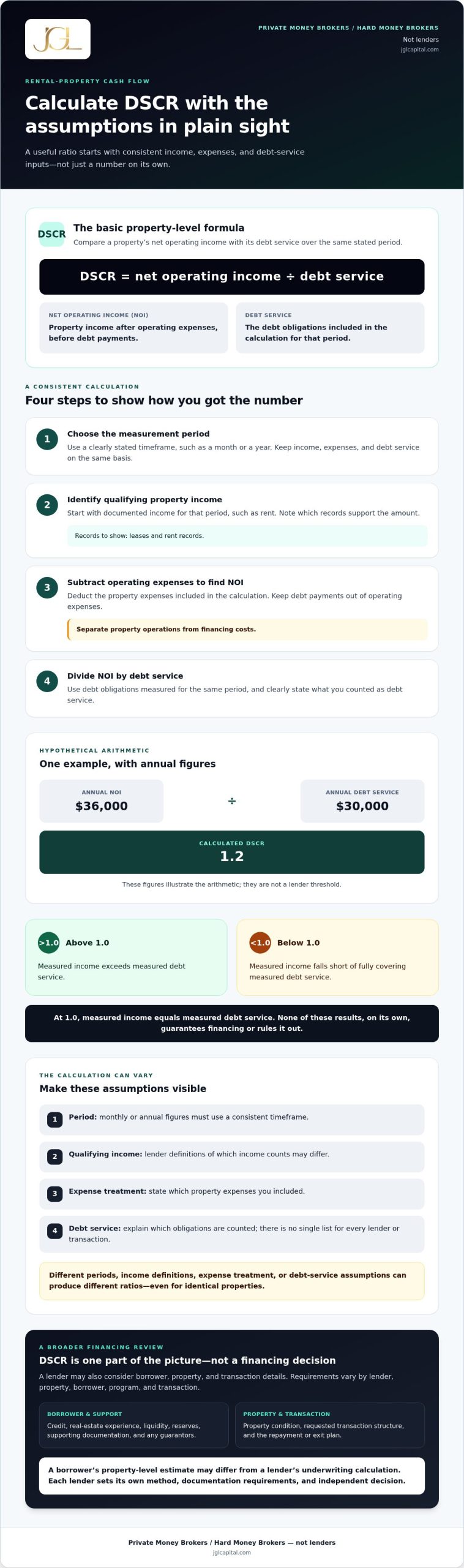
Net operating income (NOI) is the property’s income after operating expenses and before debt payments. Annual debt service is the debt obligation measured over a year. Divide NOI by annual debt service:
DSCR = net operating income ÷ annual debt service
Hypothetical example: If a rental property has annual net operating income of $36,000 and annual debt service of $30,000, its DSCR is 1.2 ($36,000 ÷ $30,000). These figures illustrate the arithmetic, not a lender threshold. The Debt Service Coverage Ratio on Wikipedia also outlines how the measure is used across financial contexts.
What a Result Above or Below 1.0 Indicates
Above 1.0, the measured income exceeds the measured debt service. Below 1.0, it falls short of fully covering that debt service. Neither result, on its own, guarantees financing or rules it out. The inputs and calculation method matter, and lender requirements vary.
JGL CAPITAL is a private-money broker, not a lender. It helps organize business-purpose real-estate financing requests and compare prospective lender programs; each lender makes its own independent decision.
How to Calculate Rental-Property DSCR Without Hiding Assumptions
A useful property-level calculation depends on clear, consistent inputs. Before doing the arithmetic, state the measurement period and record how you treat rental income, operating expenses, and debt service. Understanding debt service coverage ratio (DSCR) means making those choices visible rather than presenting a ratio without context. The BDC’s guide to Debt Service Coverage Ratio provides a broader explanation of the measure, while rental-property calculations require attention to property-specific inputs.
- Choose the period. Use a clearly stated timeframe, such as a month or a year, and keep income, expenses, and debt service on the same basis.
- Determine qualifying property income. Start with documented income for that period, such as rent, and note which records support the figure.
- Subtract operating expenses. Deduct the property expenses included in your calculation to arrive at net operating income (NOI). Keep debt payments out of this step.
- Divide by debt service. Divide NOI by the debt obligations measured for the same period, and state how you defined those obligations.
Build Net Operating Income From Property Records
Use leases, rent records, and expense documentation to show how you arrived at each amount. Apply expense categories consistently, and distinguish property operations from financing costs: debt service is not an operating expense in the NOI calculation. Because lender treatment of income and expenses can vary, label your assumptions rather than presenting them as universal.
Confirm What Counts as Debt Service
Debt service means the obligations included in a particular calculation; there is no single list that applies to every lender or transaction. State what you counted and whether the figures are monthly or annual. A lender sets its own calculation method and documentation requirements, so a borrower’s property-level estimate may differ from the lender’s underwriting calculation. Identical properties can show different DSCRs when the period, qualifying income, expense treatment, or debt-service assumptions differ.
For a business-purpose rental-property request, JGL CAPITAL’s private-money broker services can help organize the transaction details for review. JGL CAPITAL is a broker, not a lender; financing decisions remain with prospective lenders.
Does a Strong DSCR Guarantee Financing? What the Ratio Cannot Tell You
No. A strong DSCR is not an approval or funding guarantee. It describes how measured property cash flow compares with measured debt service; it doesn’t establish whether a lender will proceed. Understanding debt service coverage ratio (DSCR) also means recognizing what the number leaves out: the borrower, the property’s condition, and the transaction as a whole.
A lender may consider credit, real-estate experience, liquidity, reserves, supporting documentation, and any guarantors, alongside the property’s income. Property condition, requested transaction structure, and the repayment or exit plan may also matter. Requirements vary by lender, property, borrower, program, and transaction. Asset-backed financing does not, by itself, eliminate borrower or financial review.
Why Lenders May Calculate DSCR Differently
Calculations can differ because lenders may define qualifying income differently, treat expenses differently, or include different components in debt service. A comparison is meaningful only when the measurement periods and assumptions align. If one figure uses a different income basis or debt-service definition, the ratios aren’t directly equivalent. No single minimum should be treated as a universal lender standard.
Why the Ratio Is Only One Part of the Review
Property cash flow offers one view of a deal. Borrower qualifications and documentation provide other information a lender may assess. Clear records can help explain the income, expenses, property condition, requested structure, and proposed exit, but they don’t predetermine the outcome. Each prospective lender independently sets its underwriting requirements and makes its own decision.
JGL CAPITAL is a private-money broker, not a lender or loan approver. The firm helps business-purpose real-estate borrowers organize financing requests and compare prospective lender programs. To prepare a clearer rental-property financing request, discuss your financing request with JGL CAPITAL.
How to Use DSCR When Preparing a Rental-Property Financing Request
A clear DSCR calculation is most useful as part of an organized picture of the property and proposed transaction. Understanding debt service coverage ratio (DSCR) can help frame the cash-flow discussion, but the financing request should also explain how the property operates, what structure is requested, and how repayment or a future refinance fits the business plan.
Prepare a Clear Cash-Flow Summary
Bring the underlying records together so each figure can be traced to a source. A concise summary might include:
- Leases and income records, with the period each figure covers.
- Operating expense details and supporting records, separated from debt payments.
- Existing property debt and the obligations included in your calculation.
- Property information, including its condition and current income status.
- A base DSCR calculation, plus clearly labelled sensitivity assumptions.
For every input, identify its source, timeframe, and treatment. Keep documented results distinct from projections. If projected rent or another assumption changes the ratio, label it as an estimate rather than established income. Sensitivity scenarios can show how the calculation responds to changed assumptions, but they don’t establish that a lender will accept those inputs.
Understand the Broker’s Role in Exploring Lender Programs
Connect the cash-flow summary to the transaction’s purpose and a credible repayment or refinance exit. JGL CAPITAL helps business-purpose real-estate borrowers organize financing requests and identify prospective private and institutional capital sources. As a private-money broker, JGL CAPITAL does not lend or approve loans; each lender independently sets its requirements and makes its underwriting decisions.
JGL CAPITAL works with DSCR and rental-property financing requests, helping bring the property, income, requested structure, and exit into one clear presentation. If you’re preparing a business-purpose rental-property transaction, discuss the deal or share a summary for an initial financing-fit review.
Put Your Rental-Property Financing Request in Motion
A well-prepared financing request gives the property and its business plan a clear place in the discussion. As you continue understanding debt service coverage ratio (DSCR), use the calculation to frame the cash-flow picture, then connect it to the requested structure and intended exit. That context can support a more focused initial review without treating any single ratio as a financing outcome.
JGL CAPITAL is a private-money broker and capital advisor, not a direct lender. The firm helps organize financing requests and compare prospective lender programs, while each lender independently evaluates the transaction. JGL CAPITAL describes its service standard as “5 Star Service.”
If you’re considering financing for a business-purpose rental property, take the next step by sharing your rental-property financing request with JGL CAPITAL. A clear account of the property, income, proposed structure, and exit gives the conversation a practical starting point. Submit a concise deal summary to request an initial financing-fit review and explore possible capital sources.
Frequently Asked Questions
Is DSCR the same as debt-to-income ratio?
No. DSCR compares a property’s qualifying cash flow with its debt service, while debt-to-income ratio compares a borrower’s income with personal debt obligations. They answer different questions and use different inputs. For a rental-property review, understanding debt service coverage ratio (DSCR) means focusing on property-level income and expenses, rather than assuming a personal income measure tells the same story.
Can a property have a negative DSCR?
Yes. If the calculation uses positive debt service and the property’s net operating income is negative, the resulting DSCR is negative. For example, this could occur when recognized operating expenses exceed the income counted for the same period. A negative figure signals a shortfall under those assumptions, but it doesn’t by itself establish what financing options a lender may consider.
Does DSCR include property taxes and insurance?
It depends on the calculation method. Property taxes and insurance are generally treated as operating expenses when calculating net operating income, while some lender calculations may also account for them within the debt-service payment measure. To avoid counting the same expense twice, show where each item appears in your calculation and use the selected lender’s definitions for its review.
Can a lender use projected rent to calculate DSCR?
A lender may consider projected rent in some circumstances, but whether and how it is used depends on the program, property, and supporting evidence. A proposed lease-up, recently renovated unit, or rent increase shouldn’t be presented as collected income. Separate actual rent from projections and identify the records or assumptions behind each figure so the distinction remains clear.
Does a higher DSCR always mean a lower-risk loan?
No. A higher DSCR can indicate more measured cash flow relative to debt service, but it doesn’t capture every source of risk. The ratio may not reflect property condition, tenant concentration, borrower liquidity, documentation quality, or the strength of a repayment plan. Lenders assess the full transaction, and a favorable ratio alone doesn’t establish overall risk or determine a financing decision.