

Cross-collateralization in real estate loans means using multiple properties to secure one loan, or pledging property securing one loan as collateral for another. It may help an investor access financing by drawing on equity across properties, but it also links those assets: a default or planned sale can affect more than one property. Whether this structure makes sense depends on how its financing flexibility compares with the restrictions it may place on the portfolio.
The trade-off matters when an investor is financing several properties, consolidating debt, or planning to sell or refinance an asset. This article explains how cross-collateralized loans work, how they differ from blanket loans and refinancing, and what to review before proceeding. It also covers potential benefits and risks, including the effects on property sales, refinancing, and default, so you can judge whether the structure fits your investment plans.
Key Takeaways
- Compare the added borrowing capacity with the risk of tying several properties to the same debt before choosing this structure.
- Distinguish a cross-collateralized loan from a blanket loan or a refinance so you understand which assets secure which obligations.
- Review property values, existing debt, equity, rental income, and cash flow together when assessing the financing structure.
- Before committing, understand how the loan documents address default, property sales, refinancing, and the release of individual assets.
Exploring Cross-Collateralisation: Is It a Risky or Beneficial Financial Strategy?
Cross-collateralization can expand financing options by linking properties and debts through shared collateral. That flexibility comes with a trade-off: a default or planned sale may affect multiple assets.
Properties Pledged Across Multiple Loans
In a cross-collateralized arrangement, several properties may secure one loan, or a property pledged for one loan may also secure another. For an investor with multiple rental buildings, this can allow a lender to assess the assets together rather than one at a time. The loan agreement specifies which properties secure each obligation, so map those connections before accepting the terms.
Shared Assets and Loan Security
A property can secure more than one loan. For example, a property pledged for a primary mortgage might also secure a second loan. That second lender’s security interest links the property to another debt, rather than leaving it tied only to the original mortgage. If you plan to refinance, sell, or borrow more, the shared collateral may make those decisions dependent on multiple loan agreements.
Default Exposure Across Properties
When loan documents pledge multiple properties as security for shared debt, a default may expose all of them to risk. If the borrower defaults on a loan secured by several assets, the lender may pursue the collateral specified in the agreement, potentially putting multiple properties at risk of loss. A property that continues to generate rental income may still be exposed if another asset or loan in the arrangement underperforms.
Comparing Loan Structures
Separate property loans generally tie each debt to its own collateral. Cross-collateralization links assets across loans or pledges several properties for one loan. A portfolio loan finances a group of properties, while a blanket loan typically lists multiple properties as collateral for a single loan. These distinctions matter: separate debts can keep obligations more distinct, while shared collateral may link sale, refinancing, and default consequences across the portfolio.
Definition of cross-collateralization
In real estate lending, cross-collateralization means using two or more properties as collateral for a loan. It can also link property pledged for one debt to another loan.
Core Meaning of Cross-Collateralization
Consider an investor who owns Rental Property A and Rental Property B. A lender might take both as security for one loan, or use Property A to secure multiple loans. In either case, the collateral arrangement links the borrower’s assets. A property’s role may therefore extend beyond the loan that originally financed its purchase.
Cross-collateralization describes the relationship between assets and debt, not a particular loan amount, interest rate, or credit decision. A borrower’s credit may be assessed separately from the value of the pledged properties. The loan agreement specifies which property secures each obligation and whether an asset supports multiple loans. Understanding that distinction helps investors identify exactly what they are pledging.
Loan Structure and Mechanics
A cross-collateralized structure can link multiple properties to one loan, or one property to multiple loans. A lender may also use collateral pledged for one loan to secure another loan from the same lender. The arrangement can include different loan types, so every debt in a portfolio need not have identical terms.
Suppose an investor has a mortgage on Property A and a separate loan for Property B. If the agreement also pledges Property A as security for the second loan, that property now supports both obligations. The documents specify which debts each property secures and how repayment relates to the collateral. Reviewing the agreements together gives a clearer picture than considering each loan in isolation.
Start by listing every property and loan named in the agreements. A property might secure its primary mortgage and additional debt, while several properties might secure one loan. Mapping these connections shows how the portfolio is tied together and which assets could be affected if repayment changes.
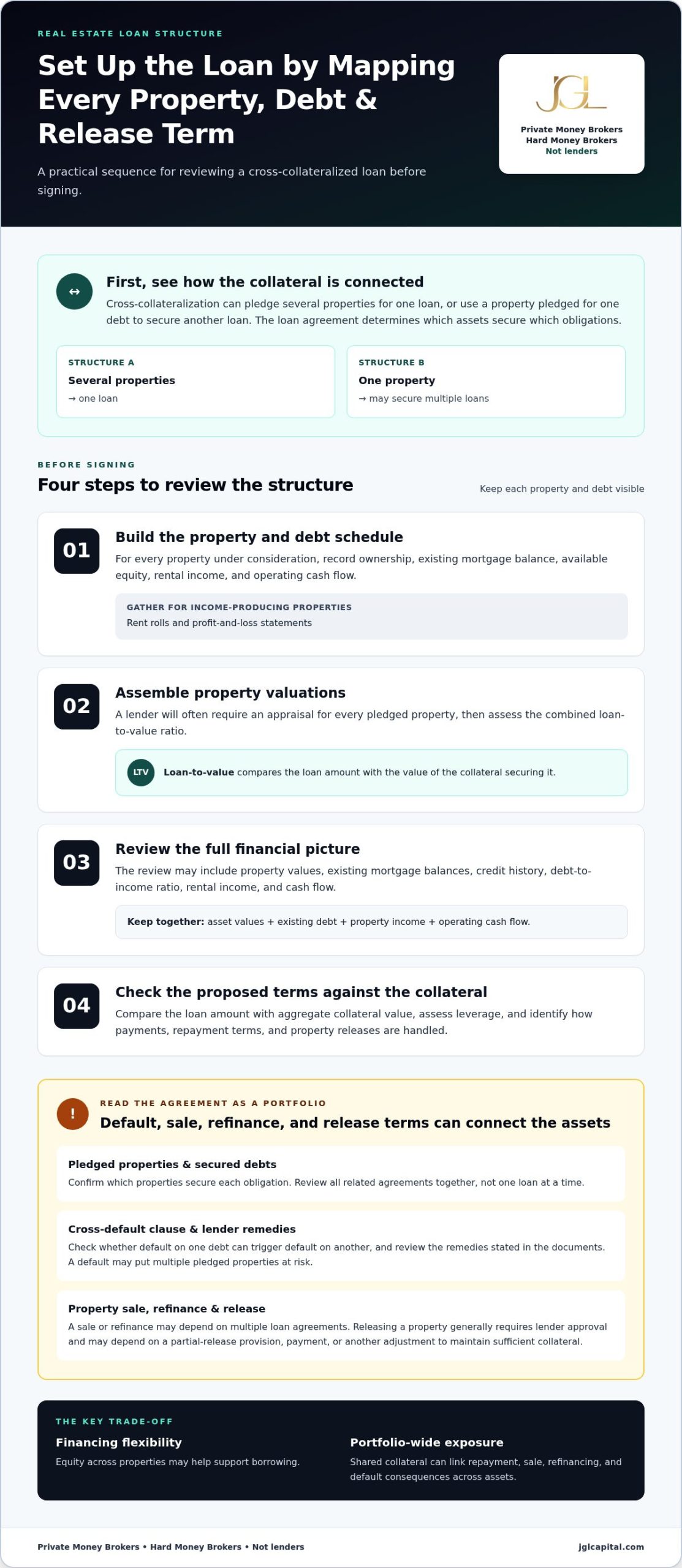
Steps to set up a cross-collateralized loan
Begin by defining the borrowing purpose and compiling a complete schedule of properties and existing debt. A lender may assess the assets together, but the agreement determines how each property secures the loan.
- List every property under consideration, its ownership, existing mortgage balance, available equity, rental income, and operating cash flow. Gather rent rolls and profit-and-loss statements for each income-producing property.
- Assemble property valuations. A lender will often require an appraisal for every property pledged, then assess the combined loan-to-value ratio. LTV compares the loan amount with the value of the collateral securing it.
- Submit the application and financial records for review. Evaluation may include property values, existing mortgage balances, credit history, debt-to-income ratio, rental income, and cash flow. Strong equity and complete financials help clarify the portfolio’s capacity to support the requested debt.
- Review the proposed structure before signing. Compare the loan amount with aggregate collateral value, assess leverage, and identify how payments, repayment terms, and property releases are handled.
The loan agreement governs cross-collateralization and any cross-default clause. It identifies the pledged properties, the debts they secure, and whether default on one debt can trigger default on another. Read these provisions alongside the lender’s stated remedies.
Releasing a property generally requires lender approval and may depend on a partial-release provision. The agreement may require a payment or another adjustment to maintain sufficient collateral for the remaining debt.
Flexibility depends on the structure, not just the combined property value. If you expect to sell a rental property, address release conditions before closing, since a sale or refinance may require lender approval. Comparing the overall loan-to-value ratio with each property’s equity can also show how the arrangement might limit future borrowing. Review every collateral schedule carefully, including any clause covering additional obligations to the same lender.
How cross-collateralized real estate loans work
With cross-collateralization in real estate loans, property equity supports financing across connected assets or debts. A lender may secure one loan with several properties or use one property to secure multiple loans. Depending on the lender and loan type, the borrower may make a single monthly payment instead of several. The loan documents specify how the structure works.
Consider a rental property valued at $400,000, with a $150,000 mortgage balance and $250,000 in equity. That equity may contribute to the collateral supporting additional financing, subject to the lender’s valuation and loan terms. For an investor seeking to purchase another property, the combined assets may affect whether they qualify and how the transaction is structured.
This financing may consolidate several commercial property debts under one mortgage, simplifying payment administration. However, consolidation also links the properties: refinancing or removing one asset may require lender approval. The lender’s assessment may consider the combined collateral and obligations, as well as the borrower’s circumstances, property values, rental income, and cash flow.
In the United States, review the collateral schedule, default provisions, and any dragnet clause, which may extend collateral to other obligations owed to the same lender. Foreclosure rights under a cross-collateralization clause are limited to properties specifically stated in the loan document. For tax planning, track interest expense by debt and property, and assess how a sale or refinance affects reporting and ownership records.
Before signing, match each property to every debt it secures, then consider how a sale, refinance, or missed payment could affect the portfolio. For investment-property financing, a private money broker can help assess available structures but is not the lender; explore private money financing options for your project.
JGL Capital: New Construction Loans
JGL Capital LLC is a private money broker, not a direct lender, and helps real estate investors explore financing options for business-purpose projects, including new construction. New Construction Loans and Multifamily Loans may be relevant to development or multi-unit projects. Rental Property Loans or Bridge Loans may suit an existing investment property or a time-sensitive transaction. Financing depends on the property, transaction, and selected lender’s requirements.
When considering cross-collateralization in real estate loans, prepare a property schedule, current mortgage balances, and a clear description of how you plan to use the funds. These details help frame the project and its collateral needs when exploring potential financing structures. JGL Capital LLC connects borrowers with private and institutional capital sources; it does not lend its own funds.
Contact JGL Capital LLC to discuss financing for your real estate project.
Make the Next Financing Decision Deliberately
Assess how a financing structure fits your investment plan beyond closing. Before pursuing cross-collateralization in real estate loans, consider how your portfolio may change: a planned acquisition, sale, or refinance can affect which assets you need available and when. A structure that supports a purchase today should also account for the decisions you expect to make later.
JGL Capital is a private money broker, not a direct lender. For investors weighing financing options against their property strategy, a conversation can help clarify the project and the structures under consideration. The goal is to understand both the opportunity and the obligations attached to the collateral.
Contact JGL Capital to discuss financing for your real estate project. A considered next step can help you move forward with greater clarity.
Frequently Asked Questions
How Do Borrowers Qualify for Cross-Collateralisation?
A lender’s assessment may consider the borrower, properties, and repayment plan together. Factors can include property values, existing mortgage balances, available equity, credit history, debt-to-income ratio, rental income, and cash flow. For an investor with several rentals, income information and clear ownership records can help explain how the portfolio relates to the financing request.
How Does Collateral Work for a Loan?
Collateral is an asset pledged to secure repayment, giving the lender a claim described in the loan documents. In a real estate transaction, the agreement identifies the property securing the debt and the obligations connected to it. Compare that list with existing mortgages and planned transactions: an asset already pledged may have less flexibility for a sale or refinance.
Who Offers Cross Collateralized Loans?
Some banks, credit unions, and private lenders offer cross-collateralized financing, particularly for investment properties. JGL Capital is a private money broker, not a direct lender; it helps borrowers identify private and institutional capital sources for business-purpose real estate transactions. A broker can organize project details and compare potential lender programs, while each lender sets its own requirements and makes its own decisions.
What is cross-collateralization in real estate loans?
Cross-collateralization is a financing structure that links real estate assets to loan obligations as collateral. For instance, a borrower might pledge several investment properties to support financing for one transaction. The loan documents define which assets are involved and which debts they secure, clarifying how each property relates to the borrower’s obligations.
How does cross-collateralization work with multiple properties and loans?
A lender may use multiple properties to secure one debt, or use an asset pledged for one loan to secure another. Investors with rental and commercial properties should keep a property-by-property record of each secured obligation. This makes it easier to see which assets could be affected when seeking another loan, changing ownership, or planning a transaction involving a particular property.
What are the benefits of cross-collateralized real estate loans for borrowers and lenders?
Borrowers may use equity across properties, consolidate commercial property debt, or simplify the administration of separate payments. Lenders receive security interests in the assets identified in the agreement, which may support their assessment of the transaction. The structure makes sense only when its financing and administrative benefits align with the borrower’s plans for each property and the portfolio.