

A familiar financing contact is useful only when the capital fits the transaction. That is the practical question behind the benefits of a dedicated real estate lender: can an established relationship bring better coordination, clearer expectations, and financing aligned with the property’s business plan and exit? A headline rate alone cannot answer it. Structure, documentation, execution requirements, and repayment strategy all matter.
Investors are right to consider whether a specialist relationship will simplify a deal or add another layer to manage. The key is understanding who makes the financing decision and what each party is responsible for. JGL Capital LLC is a private-money broker and capital advisor, not a lender. It helps investors organize financing requests, identify prospective capital sources, compare lender programs, and coordinate communication. Each lender makes its own decisions. This article explains what a focused financing relationship may offer, which trade-offs to assess, and how to prepare a clear transaction summary before taking the next step.
Key Takeaways
- The benefits of a dedicated real estate lender depend on how well the financing relationship aligns with the property, transaction structure, and planned exit.
- Assess a financing option in stages: define the transaction, evaluate fit, compare the full structure, and test the exit strategy.
- A lender makes financing decisions. A broker helps identify prospective capital sources, organize the request, compare programs, and coordinate communication.
- JGL Capital LLC is a private-money broker and capital advisor that helps investors prepare business-purpose financing requests and compare potential lender programs.
Benefits of a Dedicated Real Estate Lender: What Investors Should Expect
A dedicated real estate financing relationship keeps attention on the asset, the proposed transaction, and the plan for repayment or sale. The potential benefits of a dedicated real estate lender include a more relevant discussion of how financing could fit a project, rather than treating it as a generic borrowing request. Specialization does not guarantee approval, a faster process, or particular terms. Its value depends on the quality of the discussion and how well the proposed financing fits the transaction.
What does dedicated real estate financing mean?
In a direct financing relationship, the lender reviews the request, applies its own criteria, and makes the financing decision. A private-money broker or capital advisor does not make that decision or provide loan proceeds. The broker helps organize the request, identify prospective lender sources, compare programs, and coordinate communication. Real estate finance covers the broader ways property transactions are funded. Business-purpose financing is tied to an investment or commercial activity, such as acquiring a rental property, renovating an asset for resale, or developing a commercial project. It is distinct from financing a home for the borrower to occupy as a residence.
Which investors may value a specialist relationship?
The value depends on the transaction. A landlord evaluating a rental acquisition may need to explain the property’s income, operating assumptions, and intended repayment plan. A developer planning new construction may need to present the project scope, budget, schedule, requested proceeds, and exit. An investor pursuing a renovation or a commercial sponsor working on an acquisition will have different property details, documentation, and financing questions to address.
For each transaction, suitability depends on the property, borrower, project plan, and prospective lender criteria. A specialist relationship can help keep those elements in view, but it cannot remove lender requirements or fix a weak business plan. Investors should expect organized communication and a clear discussion of trade-offs, not a promise of a particular outcome.
How a Dedicated Real Estate Financing Relationship Can Add Value
A specialist can keep the financing discussion anchored to the transaction: what the property is, how proceeds will be used, what the project requires, and how the borrower expects to repay or exit. A rental acquisition, renovation, and construction project may each call for different structures and documentation. One potential benefit of a dedicated real estate lender relationship is a more organized comparison of those factors, not a promise that every proposed structure will be available.
Why transaction fit matters beyond a headline rate
A quoted rate is only one part of the decision. Where available, compare the proposed structure, expected proceeds, costs, recourse, reserve requirements, and execution obligations against the project’s cash needs and planned exit. A lower rate may still come with other terms that do not fit the business plan. The selected lender determines actual terms after reviewing the request, conducting due diligence, and applying its own criteria. Requirements and final approval remain lender-specific.
For example, an investor planning to renovate and resell a property should consider whether the financing structure accounts for the work, carrying costs, and expected sale. A landlord evaluating a rental property should compare the proposed financing with the property’s income and operating assumptions. In either case, focus on the complete structure and the repayment plan, not a single headline term.
How coordination can make a complex request clearer
A concise deal narrative connects the property, requested proceeds, business plan, timeline, and intended exit in one coherent account. Supporting documents should reinforce that account, not leave key details scattered across inconsistent versions. A broker can help organize the financing request, identify prospective private or institutional sources, compare available programs, and coordinate communication. That work can make a request easier to follow, but it does not replace lender review or guarantee a faster decision.
JGL Capital LLC is a private-money broker and capital advisor, not a direct lender. It helps investors coordinate business-purpose financing requests while lenders retain responsibility for financing decisions. To discuss a transaction, start with your business-purpose project.
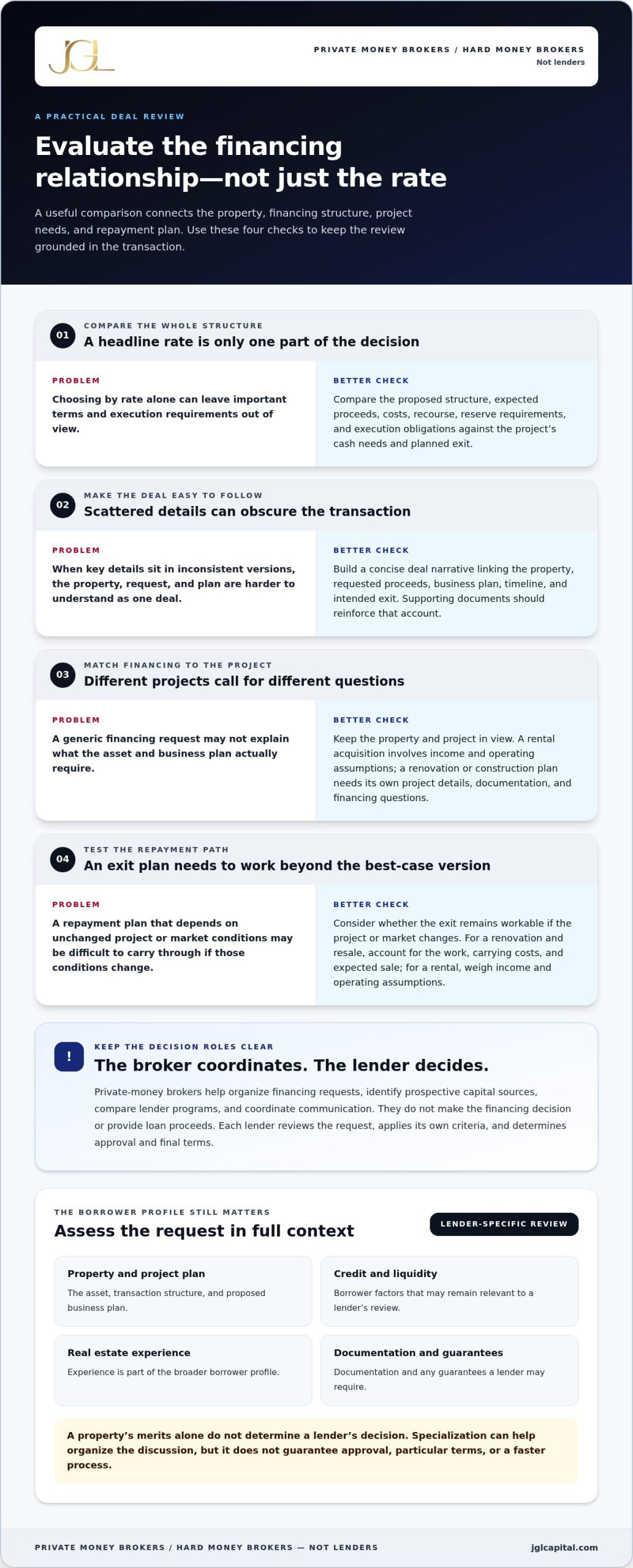
How to Evaluate a Dedicated Real Estate Lender or Broker
A sound comparison starts with the transaction, not a promise about rate or speed. Use these four steps to assess whether a financing relationship fits the project and your capacity to carry it through:
- Define the transaction. Summarize the property, business plan, requested proceeds, timeline, and intended repayment path.
- Assess fit. Consider how the proposed financing aligns with the asset and project, while accounting for lender criteria and your own qualifications.
- Compare full structures. Review the complete terms and execution requirements, not just the rate.
- Test the exit. Examine whether the repayment plan remains workable if the project or market conditions change.
Keep the review grounded in the full borrower profile. Credit, liquidity, real estate experience, documentation, and any guarantees a lender may require can all remain relevant. A property’s merits alone do not determine a lender’s decision. Also consider how clearly the lender or broker communicates, what information is expected, and whether their experience is relevant to the transaction type.
What should you compare besides rates?
Where offered, compare proceeds, costs, recourse, reserves, covenants, extension terms, and conditions for execution. These features affect how financing interacts with the project’s cash needs and obligations. Terms vary by lender and transaction, and the lender establishes the actual structure after its review. A broker can help organize the comparison but does not set lender terms.
How to assess a credible exit strategy
Identify whether repayment depends on a sale, refinance, stabilization, or another defined path. Then test the assumptions. What if construction or renovation takes longer? What if leasing differs from expectations, or the planned sale or refinance is unavailable when needed? Consider whether there is a workable alternative and how extension provisions or reserves affect the plan. This exercise helps clarify the transaction’s risks. It does not guarantee performance or a particular outcome.
JGL Capital LLC is a private-money broker and capital advisor, not a lender. Discuss your business-purpose transaction and organize the details needed for an initial financing-fit review.
How JGL CAPITAL Supports a Dedicated Financing Process
A focused financing process starts by understanding the transaction before identifying potential lender fits. JGL CAPITAL LLC is a private-money broker and capital advisor, not a direct lender. It does not provide loan proceeds or make lender decisions. Its role is to review a business-purpose request, organize the transaction details, identify prospective private or institutional capital sources, compare potential programs, and coordinate communication. For investors weighing the benefits of a dedicated real estate lender, this broker-led approach provides a structured way to explore potential lender programs without confusing coordination with underwriting authority.
JGL CAPITAL’s stated 5 Star Service reflects responsive communication and efficient handling of questions. It describes the service experience, not a promise of approval, terms, funding, or timing.
What to prepare for an initial financing-fit review
A clear summary makes the initial discussion more useful. Include the property type, transaction purpose, requested financing structure, anticipated timeline, and planned exit. Add relevant borrower experience, available capital, and a concise project plan. Supporting documents should substantiate the request and clarify the asset, costs, and proposed use of proceeds. For a construction project, make sure the scope and budget are easy to understand. The information needed varies with the transaction and lender requirements.
What happens after a potential lender fit is identified?
When a potential source appears aligned with the request, JGL CAPITAL can help present the organized financing package and coordinate communication as the lender reviews it. This keeps questions and project information connected while leaving the lender responsible for its own process. Each lender determines its requirements, underwriting, terms, proceeds, and closing timeline. Identifying a potential fit is not an approval or an assurance of financing.
If you have a business-purpose real estate project to discuss, submit it for an initial financing-fit review.
Make the Next Financing Decision With Clarity
The benefits of a dedicated real estate lender matter most when the financing approach supports the project from acquisition through repayment. Before moving forward, put the key facts in one place: the asset, intended use of proceeds, project assumptions, borrower capacity, and exit plan. This preparation gives the financing discussion a clear starting point and keeps attention on fit rather than a single headline term.
It helps organize business-purpose financing requests, identify potential lender options, and coordinate communication. Each lender remains responsible for its own review and decisions. A thoughtful review can clarify possible next steps, but it cannot guarantee approval, terms, or funding.
If you’re preparing a real estate transaction and want to discuss its financing fit, submit your business-purpose project for an initial financing-fit review. A well-framed request is a practical first step toward evaluating possible capital sources with care and confidence.
Frequently Asked Questions
Is a term sheet a guarantee of real estate financing?
No. A term sheet generally outlines proposed terms, but the lender may still need to complete underwriting, due diligence, document review, approvals, and closing conditions. Before relying on it, identify what remains outstanding, what could change, and whether the proposed structure supports the project’s business plan and exit. A dedicated real estate financing relationship does not remove these steps or guarantee funding.
Can a dedicated real estate financing source help with an owner-occupied home?
No. JGL CAPITAL arranges business-purpose real estate financing and does not arrange owner-occupied residential financing. A property’s intended use is central to determining whether a request fits that scope. For an investment or commercial property, available options still depend on the property, borrower qualifications, transaction purpose, lender programs, and current requirements. JGL CAPITAL is a private-money broker and capital advisor, not a direct lender.
How much does it cost to use a private money broker?
Costs vary by transaction, so do not assume a fee or rate without transaction-specific disclosure. Review the broker’s compensation and other proposed costs in writing, including what each charge covers and who receives it. Consider those costs alongside the financing structure being discussed. Using a broker does not guarantee savings, approval, improved terms, or a faster closing.
Does a private real estate lender consider more than property value?
Yes. Collateral is one part of a lender’s review. The lender may also consider borrower credit, experience, liquidity, reserves, documentation, project feasibility, and the proposed exit. For example, an estimated property value may not resolve questions about condition, title, construction costs, or the borrower’s capacity to carry the project. Criteria and the weight given to each factor vary by lender and program.
What happens if a real estate investment’s planned exit takes longer than expected?
A delay can affect repayment, so understand the written agreement’s extension options, conditions, costs, and default provisions before closing. Consider a backup repayment path if a sale, refinance, or stabilization takes longer than planned. For example, assess whether available reserves could support additional carrying time. The selected lender sets applicable terms, and an extension or alternative financing is not guaranteed.