

The relentless pursuit of the next fix-and-flip project often creates a deceptive illusion of prosperity while tethering the investor to an active income treadmill that offers no respite from market volatility. For the professional seeking a more sustainable trajectory, understanding how to transition from flipping to rentals is the essential next step in capital preservation. Many sophisticated developers recognize that while short-term redevelopment provides immediate liquidity, it simultaneously exposes their capital to significant tax liabilities and the inherent risks of fluctuating exit prices. You likely understand that true financial stability isn’t found in the next transaction, but in the deliberate accumulation of durable assets.
This article provides a rigorous framework for this strategic pivot, enabling you to convert high-velocity gains into a legacy of predictable cash flow and long-term equity growth. We’ll examine the strategic reallocation of capital, the utilization of tax-efficient instruments like the 1031 exchange, and the current 2026 market dynamics where stabilizing mortgage rates near 6.5% and increased inventory offer unique entry points for the disciplined steward. By moving beyond the transactional, you can secure a position of stability that persists regardless of short-term economic shifts.
Key Takeaways
- Analyze why shifting from high-velocity active income to passive rental portfolios is essential for mitigating cyclical market volatility and ensuring long-term wealth preservation.
- Discover how to transition from flipping to rentals by implementing a disciplined financial architecture that prioritizes Debt Service Coverage Ratio (DSCR) and liquidity management.
- Evaluate the strategic execution paths between the high-velocity BRRRR framework and more conservative, turnkey acquisition models to determine the optimal fit for your capital requirements.
- Leverage advanced tax-efficiency strategies, including 1031 exchanges and depreciation schedules, to protect your principal from short-term capital gains exposure.
- Understand the role of institutional-grade financing in facilitating a seamless pivot from active redevelopment to a diversified, income-generating real estate portfolio.
The Strategic Imperative: Why Investors Move from Active Flipping to Passive Rentals
The decision to reorient a real estate enterprise from active redevelopment to long-term asset management represents a significant evolution in an investor’s professional lifecycle. While the fix-and-flip model offers the allure of rapid capital turnover, it often functions as a high-stakes vocation rather than a sustainable investment strategy. Sophisticated practitioners increasingly recognize that the treadmill of constant acquisition and disposition provides little protection against systemic economic shifts. Learning how to transition from flipping to rentals isn’t merely a tactical adjustment. It’s a fundamental shift toward a stewardship-focused philosophy that prioritizes the preservation of value over the velocity of transactions.
The Limitations of High-Velocity Flipping
Active redevelopment carries a substantial tax burden that often goes unexamined in the pursuit of the next project. Short-term capital gains, which apply to properties held for less than one year, can significantly erode net profitability. In the current 2026 fiscal environment, where the 20% rate applies to income above $533,400 for single filers, the friction of frequent sales becomes a barrier to true wealth accumulation. Market saturation further complicates this. Increased competition for distressed inventory compresses margins, forcing redevelopers into a cycle of perpetual activity where any pause in operations results in an immediate cessation of income. It’s a model that demands constant motion to remain viable.
Long-Term Equity as a Wealth Preservation Tool
In contrast, a rental portfolio serves as a robust mechanism for long-term equity growth and inflation protection. By retaining assets, investors benefit from the compounding effects of principal pay-down and organic market appreciation. This approach aligns with institutional real estate investing strategies that value stability and risk mitigation. Establishing a portfolio of institutional-grade residential assets creates a reliable hedge against inflationary pressures. Since rental rates typically adjust in tandem with broader economic indices, your purchasing power remains protected over decades. This transition requires a psychological pivot. You must move from celebrating the completion of a renovation to valuing the steady, disciplined performance of a cash-flowing asset. It’s a move from being a project manager to becoming a dedicated steward of capital.
Financial Architecture of the Transition: Reallocating Capital for Longevity
Successful execution of a strategic pivot requires an analytical reassessment of your balance sheet. While flipping relies on short-term liquidity and high velocity, holding rentals necessitates a more patient capital structure. Understanding how to transition from flipping to rentals involves identifying the specific “Pivot Point” where the long-term yield of an asset outweighs the immediate gain of a sale. This determination is often based on the property’s projected yield versus the opportunity cost of tied-up capital. Moving away from a purely transactional model demands a disciplined approach to capital allocation that supports both active renovation costs and long-term debt service obligations.
Understanding Asset-Based Lending in the Rental Context
Institutional rental property loans operate on a fundamentally different underwriting logic than residential mortgages or short-term bridge financing. These instruments prioritize the performance of the asset itself over the personal credit profile of the borrower. The primary metric for evaluating this performance is the Debt Service Coverage Ratio (DSCR). Debt Service Coverage Ratio is the primary metric for rental loan underwriting, defined as the ratio of a property’s net operating income to its total debt service obligations. A ratio above 1.20 is typically considered the baseline for institutional stability, ensuring the asset generates sufficient revenue to cover its own liabilities while providing a margin for operational contingencies.
Balancing the Portfolio: The 70/30 Rule of Transition
Maintaining a hybrid model requires a disciplined 70/30 allocation strategy to ensure operational continuity. Under this framework, 70% of available capital remains dedicated to active redevelopment projects to generate the liquidity needed for operations and new acquisitions. The remaining 30% is systematically reallocated into long-term holds. This balance prevents the capital lockup that occurs when too many funds are committed to passive assets prematurely. As the portfolio matures, investors often leverage commercial real estate loans to scale into multi-family assets, which offer superior economies of scale and more stable cash flow profiles.
The tax implications of the pivot are profound, as the IRS distinguishes clearly between the intent of a dealer and that of an investor. Managing cash reserves is vital during this phase. You must account for potential vacancies and maintenance cycles without depleting the reserves required for your active flipping pipeline. For those seeking a strategic partner to navigate these complex capital requirements, JGL Capital provides the institutional expertise necessary to align your financing with your long-term wealth objectives.
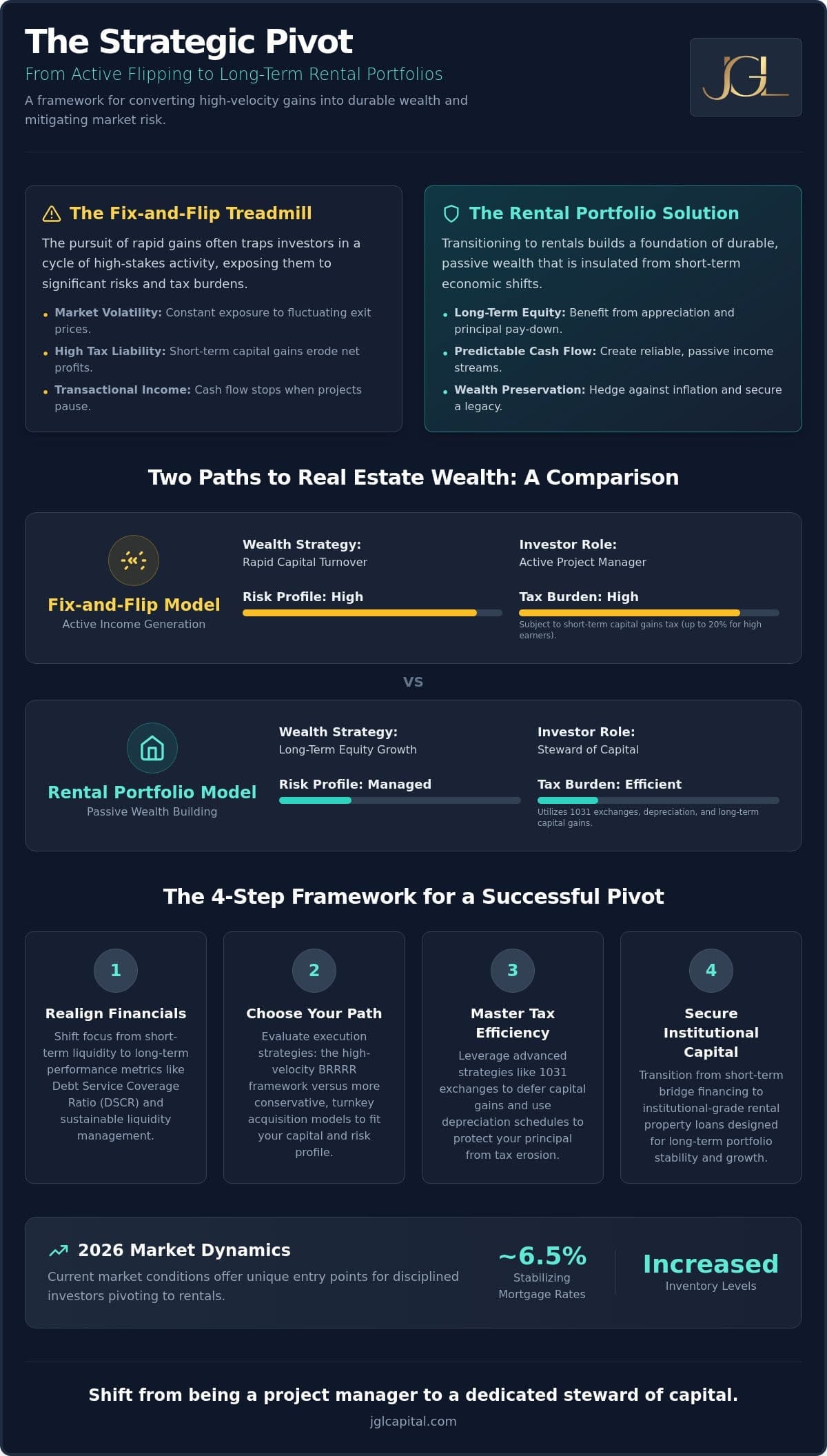
The BRRRR Framework vs. Portfolio Retention: Strategic Execution Paths
The selection of an execution path is the most critical operational decision when determining how to transition from flipping to rentals. While the Buy, Rehab, Rent, Refinance, Repeat (BRRRR) framework remains a popular choice for those seeking to recycle capital rapidly, it carries inherent risks that more conservative models, such as the “Slow-Hold” or “Turnkey” acquisition, do not. The “Slow-Hold” model, which focuses on acquiring properties with existing cash flow and lower renovation requirements, offers a more stable, albeit slower, path to portfolio accumulation. In a market where 30-year fixed mortgage rates average between 6.40% and 6.58%, the margin for error in a cash-out refinance is remarkably slim. High-leverage strategies that were viable in lower-rate environments now require a more disciplined analysis of the debt-to-equity ratio to avoid over-leveraging the portfolio.
Executing the BRRRR Method with Precision
A successful BRRRR strategy begins with the identification of assets that possess significant forced equity potential. Unlike traditional flipping, where the objective is a polished aesthetic for immediate resale, rental renovations must prioritize institutional-grade durability to minimize long-term maintenance liabilities. This includes the selection of resilient materials, such as luxury vinyl plank flooring and quartz surfaces, which withstand the rigors of tenant turnover. Securing stable, long-term tenants is the final operational hurdle before the refinancing phase, as a property’s income-producing status is a prerequisite for favorable underwriting terms.
Refinancing Strategies: Moving from Bridge to Permanent Debt
The transition from active redevelopment to passive holding often requires a sophisticated sequence of financial instruments. Investors frequently utilize bridge loans to secure and renovate the asset, as these products provide the necessary liquidity for the acquisition phase. For those working within specific geographic concentrations, utilizing specialized fix and flip loans can offer the flexibility needed to stabilize the asset before moving into permanent rental financing. The appraisal remains the critical pivot point in the cash-out refinance process. Given that the national average APR for a 30-year fixed cash-out refinance is approximately 6.78%, the valuation must support a loan-to-value ratio that preserves equity while providing sufficient capital for the next acquisition.
Navigating the Tax and Liquidity Implications of the Pivot
The fiscal transition from active redevelopment to long-term asset management necessitates a disciplined analysis of tax efficiency and liquidity management. While flipping generates immediate, high-velocity liquidity, it simultaneously triggers substantial short-term capital gains obligations. Understanding how to transition from flipping to rentals involves reallocating capital into structures that offer tax deferral and long-term depreciation benefits. In the 2026 fiscal landscape, long-term capital gains rates of 0%, 15%, or 20% provide a significantly more favorable environment for wealth preservation than the ordinary income rates often applied to active “dealer” activities. Professional stewards manage the temporary “cash crunch” of moving from lump-sum profits to incremental rents by maintaining robust reserves and utilizing cost segregation studies to front-load depreciation.
The 1031 Exchange as a Growth Accelerator
Utilizing a 1031 exchange serves as a primary mechanism for scaling a portfolio without the immediate erosion of capital through taxation. This regulatory instrument allows an investor to defer capital gains by reinvesting proceeds from a sold asset into a “like-kind” replacement, such as moving from a single-family flip into a stabilized multi-family rental. Success requires strict adherence to IRS timelines, specifically the identification of replacement property within 45 days and the completion of the transaction within 180 days. Aligning these strategies with specialized hard money lenders provides the speed and certainty of execution necessary to meet these rigorous regulatory windows.
Depreciation and Cash Flow Optimization
Depreciation functions as a non-cash phantom expense that offsets rental income on paper, thereby reducing the investor’s immediate tax liability without impacting actual liquidity. Under current IRS regulations, residential rental property is depreciated over a 27.5-year schedule using the straight-line method. This systematic reduction of taxable income enhances the net internal rate of return for the patient investor. However, a sophisticated strategy must also account for depreciation recapture, which is taxed at a maximum rate of 25% upon the eventual sale of the asset. Managing capital expenditure (CapEx) reserves is vital to ensure that the physical integrity of the asset is maintained without compromising the cash flow generated by the portfolio.
To ensure your capital remains protected during this strategic shift, it’s essential to partner with a firm that understands the nuances of institutional-grade debt. If you’re ready to optimize your portfolio’s tax position through strategic financing, consult with JGL Capital to discuss bespoke lending solutions. Mastering how to transition from flipping to rentals requires this level of analytical rigor to ensure that every dollar of equity is deployed with maximum efficiency.
Securing Institutional Capital for Your Rental Portfolio Transition
The final phase of a strategic shift involves establishing a robust relationship with a private capital provider capable of supporting sustained growth. Understanding how to transition from flipping to rentals requires more than operational knowledge; it demands access to a capital partner that values asset performance over traditional credit metrics. For investors managing complex tax returns due to high-velocity redevelopment, asset-based underwriting becomes a critical advantage. Traditional institutions often struggle to interpret the fluctuating income of an active redeveloper, whereas a specialized partner focuses on the Debt Service Coverage Ratio and the intrinsic value of the real property. This alignment ensures that your borrowing capacity isn’t constrained by the very activity that generated your initial capital.
JGL Capital facilitates this evolution by providing diverse financing options, including new construction loans and rental-specific debt instruments. This flexibility allows you to bridge the gap between active construction and stabilized occupancy. By utilizing bridge financing to secure an asset and subsequently transitioning into permanent rental debt, you maintain the liquidity necessary for future acquisitions. This transitional capital acts as a vital link, allowing you to move properties from your active inventory into your long-term portfolio without depleting your operating cash. It’s a disciplined approach to leverage that prioritizes long-term stability over short-term gain.
The JGL Capital Advantage: Expertise in Transitional Capital
The firm brings over three decades of institutional experience to every partnership, offering a level of stability that transactional lenders cannot replicate. We prioritize the alignment of objectives, ensuring that every financial solution serves your broader wealth preservation goals. This asset-focused approach eliminates the bureaucratic delays of conventional banking, providing the speed required to execute 1031 exchanges or time-sensitive acquisitions. Our team functions as a discreet partner, valuing integrity and long-term growth above all else. We don’t just provide capital; we provide a strategic alliance designed to protect your legacy.
Taking the Next Step in Your Investment Evolution
Professionalizing your portfolio requires a disciplined approach to underwriting and capital allocation. As you finalize your roadmap for how to transition from flipping to rentals, engaging with a seasoned ally ensures your strategy is grounded in analytical rigor. Preparing your portfolio for institutional growth involves a thorough review of your current assets and future cash flow projections. This preparation allows for a more seamless transition into professional-grade financing structures. Contact JGL Capital today to discuss your rental portfolio financing strategy. By partnering with a quiet expert, you can move beyond the transactional treadmill and secure a future defined by steady, predictable wealth accumulation.
Establishing a Foundation for Multi-Generational Wealth
The transition from active redevelopment to long-term asset management represents a fundamental maturation of an investment career, shifting the focus from immediate liquidity to the preservation of value. By prioritizing disciplined financial metrics such as the Debt Service Coverage Ratio and utilizing tax-efficient instruments like the 1031 exchange, you can insulate your capital from the volatility of transactional cycles. Mastering how to transition from flipping to rentals allows you to build a foundation of durable assets. These properties generate predictable cash flow while benefiting from long-term equity growth. This evolution ensures that your financial future isn’t defined by the frantic pace of the next closing.
Securing a legacy of this magnitude requires a capital partner with the institutional depth to support complex strategies. JGL Capital provides this stability, offering over 30 years of specialized expertise in private money and commercial real estate across the nation. Our asset-based underwriting focuses on property value rather than personal credit scores, providing the flexibility required for sophisticated residential, multi-family, and new construction projects. Partner with JGL Capital for your strategic transition to rental property financing. Your commitment to disciplined growth deserves a discreet ally that values integrity and long-term worth.
Frequently Asked Questions
Is it better to flip houses or hold them as rentals in 2026?
The optimal strategy depends on your specific liquidity requirements and risk tolerance, though the 2026 market environment increasingly favors the stability of rental assets. While flipping offers immediate capital turnover, the current landscape of high inventory and stabilizing home prices makes long-term holding a superior hedge against market volatility. Professional investors often choose to retain assets to benefit from a predictable yield rather than risking capital on the compressed margins found in today’s competitive redevelopment sector.
How much capital do I need to transition from flipping to rentals?
Transitioning requires sufficient liquidity to cover institutional down payments, which typically range from 20% to 30%, alongside robust cash reserves for operational contingencies. Unlike the fix-and-flip model where capital is recycled every few months, a rental strategy locks up principal for extended periods. You should maintain enough capital to cover at least six months of debt service and maintenance for each stabilized asset to ensure the health of your broader portfolio.
Can I use a fix and flip loan to buy a rental property?
You can utilize a fix and flip loan for the initial acquisition and renovation phase, but these are short-term instruments that aren’t suitable for long-term holding. These bridge products are designed to be retired quickly, often within 12 to 18 months. To successfully execute the pivot, you must have a clear exit strategy to refinance the bridge debt into a permanent, long-term rental property loan once the asset reaches stabilized occupancy.
What is the DSCR requirement for a rental property loan?
Most institutional lenders require a Debt Service Coverage Ratio (DSCR) of at least 1.20 to ensure the property generates enough income to cover its debt obligations. This metric is the cornerstone of how to transition from flipping to rentals with professional-grade financing. A higher ratio often results in more favorable interest rates and terms, as it signals a lower risk of default to the lending partner during periods of economic fluctuation.
How does a 1031 exchange work for a house flipper?
A 1031 exchange is only available for properties held with investment intent, which typically excludes properties bought and sold quickly as “dealer” inventory. To qualify, you must demonstrate that the property was held for productive use in a trade or business or for investment, often necessitating a holding period of at least one to two years. If met, you can defer capital gains by identifying a replacement property within 45 days and closing within 180 days.
What are the main tax benefits of holding rentals over flipping?
The primary tax advantages include the 27.5-year residential depreciation schedule and access to long-term capital gains tax rates. While flipping profits are often taxed as ordinary income at rates up to 37%, rental assets held for over a year qualify for the 0%, 15%, or 20% long-term rates. This distinction significantly enhances your after-tax internal rate of return and allows for more efficient wealth compounding over several decades.
Can I manage rentals while still actively flipping houses?
How do interest rates affect the transition to a rental strategy?
Elevated interest rates, currently averaging between 6.40% and 6.58% for 30-year fixed mortgages, require a more disciplined analysis of cash flow margins. When calculating how to transition from flipping to rentals in this environment, you must account for the narrower spread between your cost of debt and the property’s capitalization rate. This often necessitates larger equity positions at closing to ensure the asset remains cash-flow positive and meets institutional DSCR requirements.