

In the current 2026 fiscal environment, the traditional reliance on exhaustive personal income verification is increasingly viewed as an obsolete metric for sophisticated real estate developers who are seeking to capitalize on high-growth opportunities with agility. You likely recognize that the rigid, bureaucratic underwriting cycles characteristic of conventional banking institutions often jeopardize critical project milestones; additionally, the lack of transparency inherent in many construction draw processes can create unnecessary friction during the execution phase. This strategic guide provides a comprehensive new construction loan requirements checklist and an institutional-grade documentation framework, which is specifically designed to facilitate the acquisition of private construction capital with unparalleled precision and speed.
By shifting the focus from personal financial minutiae to the intrinsic value and feasibility of the asset itself, you can unlock a more streamlined path to the capital required for large-scale development. We will examine the nuances of project-based underwriting and define the specific documentation necessary to satisfy the rigorous standards of private lenders in today’s volatile market. This analysis serves as a roadmap for establishing a reliable funding partnership that prioritizes the alignment of strategic objectives and the preservation of long-term value.
Key Takeaways
- Comprehend the transition from consumer-centric mortgage metrics to institutional asset-backed underwriting, focusing on the critical roles of Loan-to-Cost and Loan-to-Value ratios in 2026.
- Implement a comprehensive new construction loan requirements checklist that encompasses both corporate entity documentation and the technical civil engineering plans necessary for formal approval.
- Gain insights into the rigorous evaluation of general contractors and the strategic management of construction draw schedules to mitigate liquidity risks.
- Analyze the fiscal implications of capital speed, recognizing why the efficiency of private funding often outweighs the administrative delays inherent in traditional banking.
- Explore the framework for initiating a strategic alliance with JGL Capital, ensuring your development objectives are supported by disciplined stewardship and deep industry expertise.
The Architecture of Capital: Understanding Private Construction Loan Underwriting
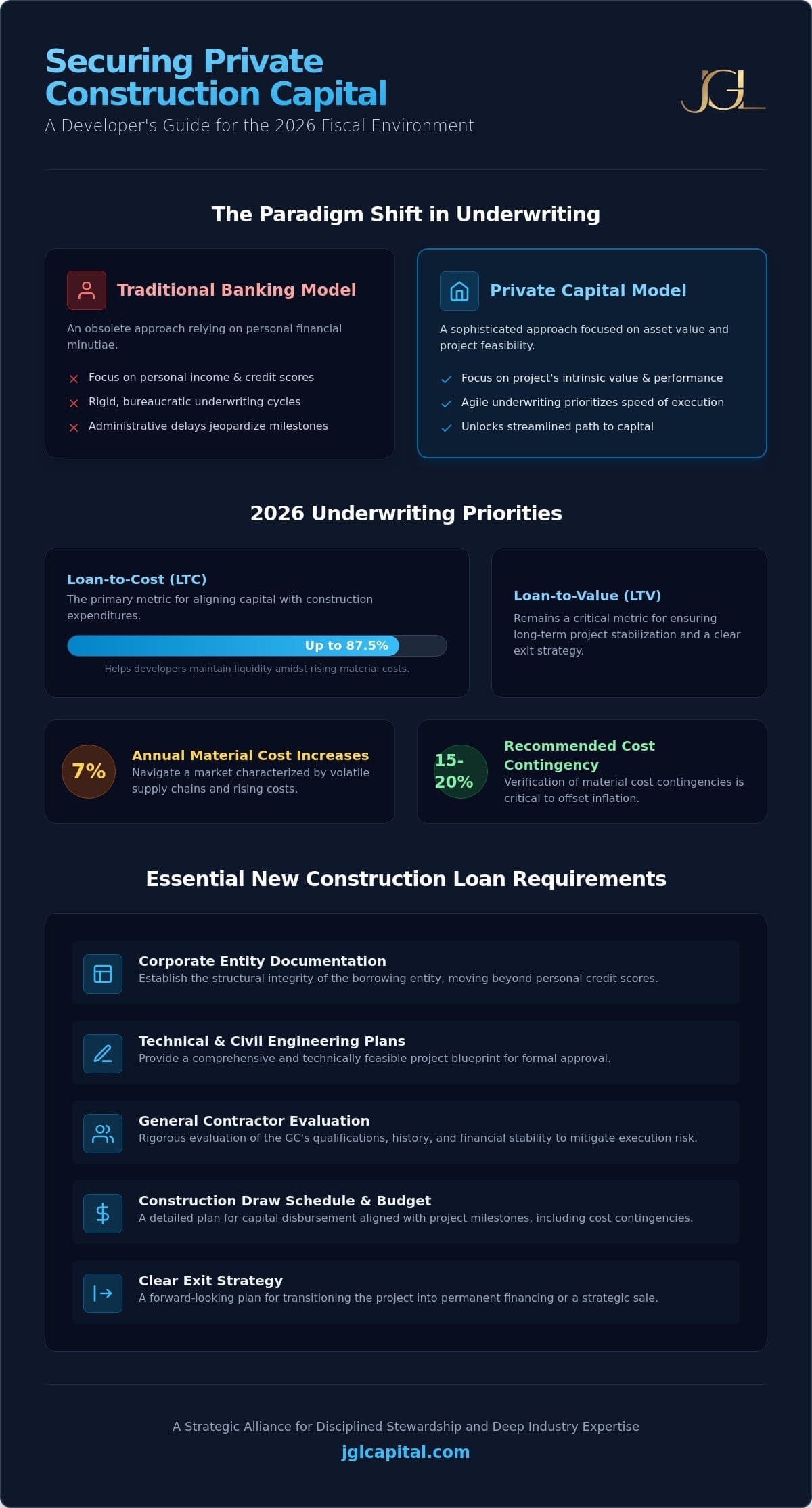
The deployment of capital within the current real estate environment necessitates a sophisticated understanding of the structural shift from traditional, credit-centric models to asset-backed methodologies. This transition informs every element of a developer’s new construction loan requirements checklist, as private lenders prioritize the project’s intrinsic value and projected performance over the borrower’s personal debt-to-income ratios. In 2026, the focus on Loan-to-Cost (LTC) has intensified, with some institutional partners offering up to 87.5% LTC to help developers maintain liquidity amidst rising material costs. While Loan-to-Value (LTV) remains a critical metric for long-term stabilization, the immediate priority is the precise alignment of capital with actual construction expenditures.
For high-net-worth stakeholders, the absolute cost of capital is often secondary to the speed of execution. A delay in the underwriting cycle can result in missed market windows or increased carrying costs that far exceed minor interest rate variances. Underwriting in this context is a forward-looking exercise that begins with a clear exit strategy. This ensures the project can transition into permanent financing or a strategic sale. It involves a nuanced understanding of funding structures, such as a Floor Loan, which establishes the minimum capital commitment available before the project meets specific stabilization or leasing benchmarks. Factors influencing the 2026 underwriting paradigm include:
- The alignment of project milestones with capital disbursement schedules.
- The verification of material cost contingencies, typically recommended at 15-20% to offset inflation.
- The assessment of the developer’s historical performance in similar asset classes.
Asset-Backed vs. Credit-Based Lending
Private capital offers a disciplined approach to risk mitigation by focusing on high-quality collateral rather than the personal financial minutiae of the sponsor. This property-centric valuation allows for the development of complex multi-family and commercial assets without the exhaustive administrative friction required by conventional banks. By evaluating the asset’s potential for value creation, lenders can provide the necessary flexibility to navigate a market characterized by 7% annual increases in material costs and volatile supply chains. It’s a rejection of speculative trends in favor of analytical rigor and stable growth.
The Role of the Private Money Broker
Navigating the complexities of transitional capital for large-scale development requires a strategic alliance rather than a simple service provision. A broker with 30 years of industry expertise acts as a disciplined steward, aligning the developer’s long-term growth objectives with the capital provider’s performance metrics. They ensure that the new construction loan requirements checklist is prepared with institutional-grade precision, facilitating a seamless underwriting process that respects the gravity of high-stakes management. This collaborative relationship serves as a Linguistic signature of a firm committed to the generation of worth through deliberate and careful action.
The Essential New Construction Loan Requirements Checklist for 2026
Precision in documentation is the cornerstone of institutional-grade financing. While government agency definitions provide a baseline understanding of these instruments, sophisticated developers require a more robust framework. A comprehensive new construction loan requirements checklist must transcend simple credit scores to encompass the structural integrity of the borrowing entity and the technical feasibility of the project. This rigorous approach ensures that every strategic objective is clearly defined and every claim is qualified before capital is committed.
Entity and Personal Identification Documents
The underwriting process begins with a meticulous review of the borrowing vehicle’s legal architecture. This includes the provision of Articles of Organization, Operating Agreements, and EIN verification to establish the entity’s standing. While traditional institutions often overemphasize personal income, private capital views the Personal Financial Statement primarily as a metric for liquidity and contingency capacity. A detailed developer resume, articulating a proven track record in similar asset classes, serves as a critical indicator of operational stability and expertise.
Project-Specific Technical Documentation
Technical precision remains non-negotiable for the preservation of asset value. Lenders require finalized blueprints and site plans that have been formally vetted by the relevant municipal authorities. Environmental assessments and soil reports are essential to identify latent site risks that could compromise the project’s execution. Additionally, a “Description of Materials” form provides a granular view of the build quality, ensuring the finished asset aligns with the projected market valuation and performance metrics.
The financial pro forma for the 2026 fiscal year must reflect the reality of current market volatility, including the projected 7.0% increase in aggregate material costs documented in recent industry reports. A comprehensive, line-item construction budget serves as the definitive document for managing the draw process and maintaining cash flow. It’s recommended that this budget includes a 15-20% contingency to offset potential cost overruns in lumber, steel, or copper. For developers who prioritize a disciplined approach to value creation, aligning with a partner experienced in new construction loans ensures that these documentation standards are met with precision and speed.
Project Viability: Evaluating the Builder and the Budget
Evaluating project viability requires a meticulous analysis of the construction budget’s elasticity. Given that aggregate material costs rose by 7.0% through early 2026, with specific volatility in steel and copper prices, a disciplined steward must insist on a robust contingency cushion. We typically require a 15-20% budget contingency to mitigate the risks of cost overruns. This fiscal buffer isn’t a mere suggestion; it’s a fundamental component of the risk mitigation strategy designed to preserve the project’s equity position. When material prices for steel are projected to rise by 15-35% and copper by up to 50%, a thin budget is a liability that sophisticated lenders won’t ignore.
The Builder Track Record and Licensure
The verification of professional credentials represents the first tier of execution risk management. This involves more than a cursory check of state-level licensure; it requires a comprehensive review of General Liability and Workers Compensation insurance to ensure the project is insulated from third-party claims. A clean litigation history and a documented resume of on-time, on-budget completions are essential. We look for builders who demonstrate a history of administrative precision, as their ability to manage subcontractors and material procurement directly impacts the project’s timeline and the lender’s security. This level of vetting ensures that the contracting entity is a collaborative ally rather than a source of project friction.
Mastering the Draw Schedule
A well-structured draw schedule is the mechanism that aligns capital disbursement with physical progress. This schedule defines specific milestones, such as site preparation, vertical construction, and the final certificate of occupancy, which trigger the release of funds. The administrative process for draw requests must be rigorous, incorporating lien waivers from all subcontractors to protect the asset from encumbrances. To maintain transparency, a third-party inspector typically conducts on-site evaluations before each disbursement, ensuring that the work performed matches the capital requested. This disciplined approach ensures that liquidity is managed with precision, preventing the cash flow disruptions that often plague less organized developments. By following a strict new construction loan requirements checklist for every draw, developers can maintain the momentum necessary to reach stabilization on schedule.
Institutional vs. Private Capital: Navigating the Underwriting Disparity
The decision to secure funding through institutional or private channels is often simplified into a comparison of interest rates; however, this perspective neglects the profound impact of the opportunity cost of delay. Traditional banking institutions, governed by increasingly rigid regulatory frameworks, typically operate on closing cycles that span 60 to 90 days. In the 2026 market, where material inputs for steel and copper are projected to rise by double digits, a multi-month delay in capital deployment can erode project margins more substantially than a slightly higher cost of funds. Private capital addresses this friction by prioritizing asset-backed viability, allowing for a new construction loan requirements checklist that focuses on the project’s intrinsic value rather than the sponsor’s consumer credit metrics.
Sophisticated developers recognize that the underwriting disparity is rooted in the lender’s philosophy regarding risk. While banks seek to mitigate risk through exhaustive personal income verification and high credit scores, private capital providers act as disciplined stewards of project feasibility. This asset-centric approach enables the financing of non-traditional property types that traditional institutions often reject due to a lack of historical comparable data. By leveraging new construction loans from private sources, developers can navigate the 2026 fiscal environment with a level of agility that institutional counterparts cannot replicate.
Speed as a Competitive Advantage
Closing cycles of 10 to 14 days represent a transformative shift in the competitive landscape for large-scale development. This accelerated timeline allows developers to execute on land acquisitions or secure material contracts before further inflationary pressures materialize. The persona of the “quiet expert” is central to this process, as it provides a discreet funding mechanism for high-stakes transactions where certainty of execution is the primary objective. By removing the credit score bottleneck, asset-backed underwriting ensures that capital is allocated based on the generation of worth and the technical merits of the project. It’s a rejection of bureaucratic red tape in favor of analytical rigor and strategic speed.
Flexibility in Loan Structure
Institutional debt often lacks the nuance required for complex project lifecycles. In contrast, private capital allows for the customization of interest-only periods and balloon payments that align perfectly with a project’s construction milestones and stabilization targets. Within a larger development portfolio, commercial real estate loans can be structured to provide bridge financing during the critical transition from vertical construction to permanent debt. This strategic use of transitional capital ensures that the new construction loan requirements checklist serves as a tool for growth rather than a barrier to entry. For those seeking to optimize their capital stack with precision, we invite you to explore our customized funding solutions today.
Strategic Alliance: Securing Your Construction Capital with JGL Capital
At JGL Capital, we view the provision of liquidity not as a mere transaction, but as a disciplined form of stewardship over our partners’ strategic objectives. Our national reach ensures that institutional-grade capital is available for high-stakes development projects across the United States; this reach is supported by a history of analytical rigor and a commitment to the preservation of value. By moving beyond the static nature of a new construction loan requirements checklist, we foster a collaborative environment where intellectual capital and financial resources converge to create lasting legacies. Our philosophy is rooted in a rejection of speculative trends, favoring instead a serious and disciplined approach to capital allocation that respects the gravity of your investment.
The transition from initial documentation to full deployment is a measured process designed to instill a sense of security in our sophisticated stakeholders. We recognize that the complexities of 2026 development require more than a passive lender. They require a seasoned partner who understands the nuances of project-based underwriting. By establishing an alliance with a quiet expert, you ensure that your funding remains stable even as market conditions fluctuate. Our goal is to provide a reliable path to capital that supports your growth through every phase of the construction lifecycle.
The Preliminary Project Review
Initiating an engagement begins with a comprehensive preliminary project review, which is centered on a high-level executive summary. This document should articulate the project’s scope, the developer’s track record, and the anticipated exit strategy with clarity. Our team engages in a collaborative refinement of the project pro forma, ensuring that all assumptions are grounded in current market data and performance metrics. This initial phase isn’t just a hurdle to clear; it’s the foundation of a long-term strategic alliance. We prioritize the alignment of our capital with your individual solutions, ensuring that the structural integrity of the deal is sound before moving toward formal commitment.
Finalizing the Capital Allocation
Once the preliminary review is complete, the underwriting review moves behind the scenes, where our analysts conduct a thorough verification of the new construction loan requirements checklist items. This period of deliberate analysis ensures that every claim is qualified and every strategy is clearly defined. As we prepare for closing, our team manages the complex logistics of document execution and escrow coordination with precision. This steady rhythm continues into the transition to the construction draw phase, where we establish the administrative framework for future disbursements. By framing our activities as a strategic alliance, we ensure that the final steps to funding are executed with the speed and professional gravity your project demands.
Capitalizing on Future Development Opportunities
The 2026 development landscape demands a departure from the administrative inertia of traditional banking. By prioritizing asset-backed underwriting and technical precision, developers can navigate volatile material costs with greater confidence. Utilizing a meticulous new construction loan requirements checklist ensures that your project is positioned for rapid deployment and long-term stabilization. JGL Capital serves as a disciplined steward in this process, leveraging over 30 years of industry-leading expertise in private capital markets to support your vision. Our national funding capabilities for residential and multi-family developments provide the stability required for high-stakes management. It’s this commitment to analytical rigor that distinguishes a strategic alliance from a simple transaction.
We invite you to secure your institutional-grade construction capital through JGL Capital today. Through our disciplined, asset-backed underwriting focused on project viability, we help you transform strategic objectives into lasting value. We look forward to building a collaborative relationship that preserves your legacy and fuels your continued growth as you navigate the complexities of the modern market with a partner you can trust.
Frequently Asked Questions
What is the typical down payment requirement for a private construction loan in 2026?
In the 2026 fiscal environment, down payment requirements for investment-grade projects typically range from 25% to 30% of the total project value. While some programs offer higher leverage, private capital providers prioritize a disciplined equity position to ensure alignment between the developer and the lender. This capital commitment serves as a necessary safeguard against market volatility and ensures the project remains sufficiently capitalized through to completion.
Can I qualify for a new construction loan if I am a first-time developer?
First-time developers can qualify for private funding provided they demonstrate significant administrative rigor and partner with an experienced general contractor. In these instances, the new construction loan requirements checklist places greater emphasis on the competence of the execution team and the project’s technical feasibility. We often view a strong general contractor with a proven track record as a necessary mitigator for a sponsor’s lack of direct development experience.
How do construction draw schedules work with private money lenders?
Construction draw schedules operate through a series of predefined milestones that trigger the release of capital at specific intervals. After a developer submits a request, a third-party inspector verifies the physical progress on-site to ensure the work performed matches the requested disbursement. This process includes the collection of lien waivers from subcontractors to protect the asset’s title. It’s a methodical approach designed to maintain liquidity while protecting the lender’s collateral.
Do I need a building permit in hand before applying for a construction loan?
You can initiate the underwriting process without final permits, but most private lenders require a building permit in hand before the initial funding of construction draws. Securing these approvals is a critical item on the new construction loan requirements checklist because it confirms the project’s legal feasibility. Closing a loan prior to permitting is a strategic move for land acquisition, but vertical construction capital remains contingent upon municipal authorization.
What is the difference between LTC and LTV in the context of construction financing?
Loan-to-Cost (LTC) measures the loan amount against the actual hard and soft costs of construction, whereas Loan-to-Value (LTV) compares the loan to the projected market value of the stabilized asset. In 2026, private lenders focus on LTC to manage the immediate risks of material inflation and labor costs. LTV is utilized to ensure the project remains viable for a future exit through a strategic sale or a transition into permanent debt.
How does JGL Capital evaluate the value of the land in a new build project?
JGL Capital evaluates land value through a combination of current market comparables and the land’s “as-is” state versus its “as-developed” potential. We utilize analytical rigor to assess the site’s entitlement status, environmental condition, and strategic location within high-growth corridors. This disciplined approach ensures the land serves as high-quality collateral, reflecting its true contribution to the project’s overall capitalization and the long-term generation of worth.
Are there personal recourse requirements for private construction loans?
Private construction loans often feature limited recourse or “bad boy” carve-outs, though full personal recourse may be required depending on the project’s risk profile. We prioritize asset-backed underwriting, yet a personal guarantee often serves as a linguistic signature of the developer’s commitment to the project’s success. This structure aligns the interests of both parties, ensuring a serious and disciplined approach to the stewardship of the allocated capital.
What happens if my construction project goes over budget or past the deadline?
If a project exceeds its budget, the developer is typically responsible for funding the shortfall through the 15-20% contingency reserve established at the outset. When these reserves are exhausted, we work collaboratively with our partners to evaluate the project’s remaining feasibility and potential re-capitalization options. Maintaining a steady communication rhythm allows us to address these challenges before they compromise the asset’s long-term value or the developer’s strategic objectives.