

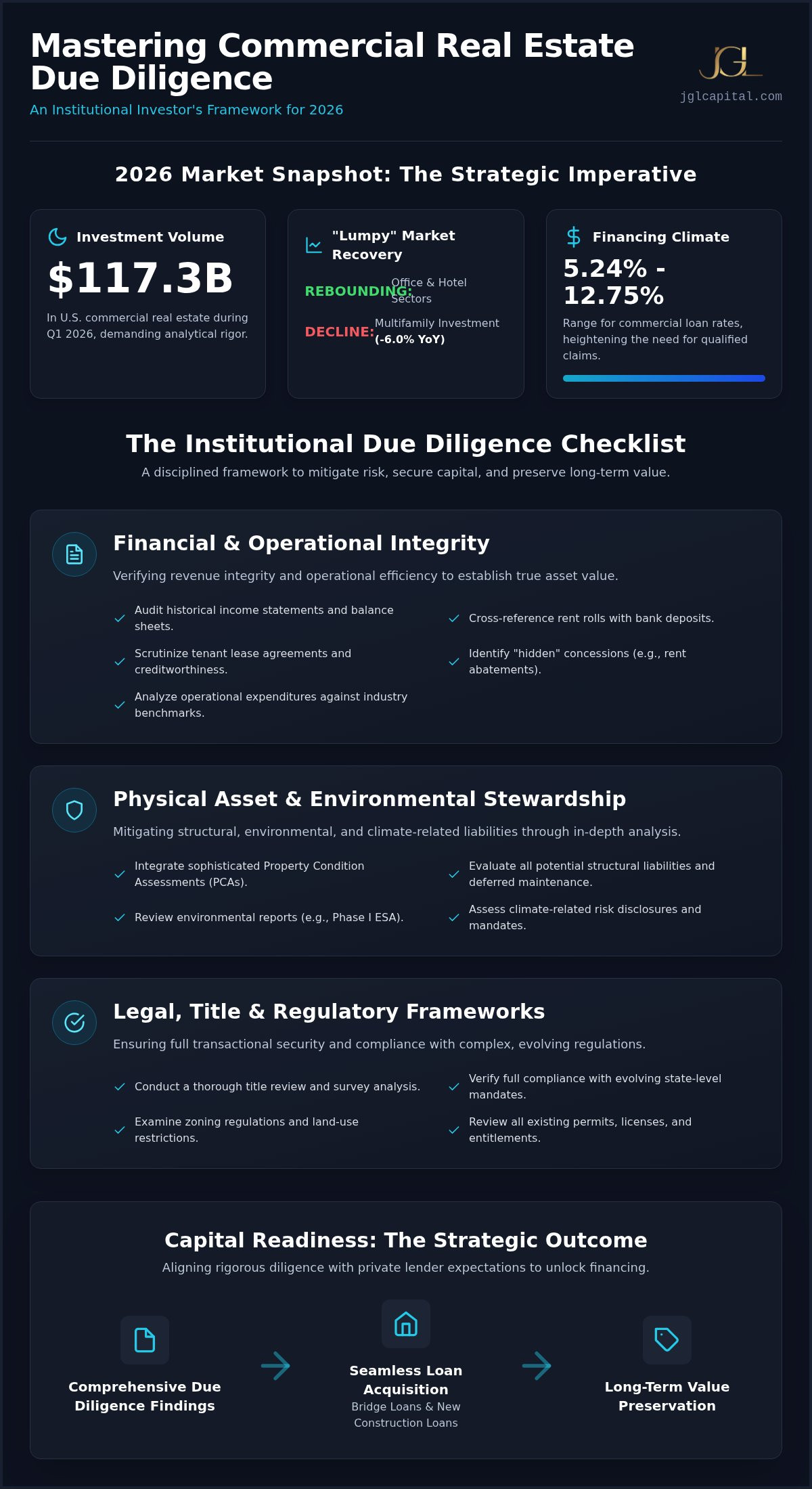
In an investment climate where U.S. commercial real estate volume exceeded $117 billion in the first quarter of 2026, the distinction between a secure legacy and a capital loss rests entirely upon the depth of your analytical rigor. Sophisticated investors recognize that superficial inspections are insufficient to address the complexities of modern regulatory shifts, encompassing diverse environmental mandates and evolving compliance standards across various jurisdictions. Utilizing a comprehensive real estate investment due diligence checklist isn’t merely a procedural step; it’s the strategic foundation for institutional capital readiness and long-term value preservation.
It’s likely you’ve encountered the frustration of inaccurate financial reporting or hidden liabilities that threaten to derail critical deal timelines. This article provides a disciplined framework designed to help you mitigate risk and secure private capital through rigorous asset analysis. We’ll explore how to align asset data with the specific requirements of lenders for Bridge Loans and New Construction Loans, ensuring your process remains repeatable and your capital remains protected through every phase of the acquisition lifecycle.
Key Takeaways
- Establish a disciplined, institutional-grade framework that transcends surface-level inspections to preserve long-term asset value in a complex market.
- Verify revenue integrity through a meticulous audit of historical income statements and tenant lease agreements to ensure accurate financial reporting.
- Mitigate structural and environmental liabilities by integrating sophisticated Property Condition Assessments and climate-related risk disclosures into your analysis.
- Implement a rigorous real estate investment due diligence checklist to ensure full compliance with evolving state-level regulatory frameworks and title requirements.
- Align your findings with private lender expectations to facilitate the seamless acquisition of Bridge Loans and New Construction Loans.
The Strategic Imperative of Rigorous Due Diligence in 2026
In the current fiscal environment, characterized by a total U.S. commercial real estate investment volume of $117.3 billion in the first quarter of 2026, the necessity for analytical rigor has never been more pronounced. For the sophisticated investor, due diligence is far more than a post-contractual obligation; it’s a disciplined approach to value preservation that distinguishes institutional-grade management from speculative participation. As market dynamics fluctuate, the transition from surface-level inspections to deep-seated analytical scrutiny becomes the primary defense against capital erosion. By adhering to a comprehensive real estate investment due diligence checklist, partners ensure that every acquisition is grounded in empirical data rather than market hyperbole.
The 2026 market presents a “lumpy” recovery, where sectors like office and hotel space show robust rebounds while multifamily investment has seen a 6.0% year-over-year decline. This divergence demands a granular understanding of asset-specific risks. Professional investors prioritize stability, seeking assets that offer predictable income-driven returns in a landscape where commercial loan rates range from 5.24% to 12.75%. Success in this climate requires an unwavering commitment to the alignment of objectives, ensuring that every property under consideration supports the overarching strategic vision of the portfolio.
The Role of Stewardship in Real Estate Finance
Adopting the persona of a disciplined steward requires a shift from transactional thinking toward long-term resource management. This perspective is vital when presenting opportunities to high-net-worth stakeholders who value the preservation of worth above all else. Thorough analysis instills a sense of security, demonstrating that the firm has accounted for every structural liability and regulatory nuance. It’s this level of meticulousness that fosters lasting legacies; it ensures that portfolio stability is maintained even when broader economic indicators suggest volatility.
Identifying Strategic Risk in a Volatile Market
Evaluating macro-economic shifts is essential for understanding the localized impact on property values. With 10-year fixed interest rates hovering around 6.21%, the cost of capital necessitates a higher standard for qualified claims in any investment prospectus. Investors must utilize proven real estate investing strategies to frame their due diligence process, ensuring that the analysis accounts for both federal rollbacks and stringent state-level environmental mandates. This methodical presentation of principles allows for the precise articulation of strategic objectives, ultimately securing the private capital required for high-stakes acquisitions.
Financial and Operational Analysis: Verifying Revenue Integrity
The preservation of value begins with a forensic examination of the asset’s financial performance. In a market where total returns are increasingly income-driven, verifying revenue integrity requires a meticulous review of historical income statements and audited balance sheets. A robust real estate investment due diligence checklist must prioritize the authentication of every dollar reported, ensuring that the stated Net Operating Income (NOI) is a true reflection of the property’s earning potential. This disciplined analysis serves as the bedrock for institutional confidence, particularly when securing private capital for high-stakes acquisitions.
Revenue Verification and Lease Auditing
A precise audit extends beyond the summary of a rent roll; it necessitates the cross-referencing of bank deposits with reported rental income to eliminate discrepancies. Investors must scrutinize the legitimacy of tenant lease agreements, assessing not only the expiration schedules but also the underlying creditworthiness of the occupants. It’s essential to identify “hidden” concessions, such as rent abatements or tenant improvement allowances, that may artificially inflate effective gross income. Without this level of scrutiny, the perceived value of the asset remains speculative rather than empirically verified.
Operational Expenditure and Performance Metrics
Operational efficiency is defined by the alignment of expenses with industry benchmarks. A sophisticated analysis involves evaluating property management fees, utility costs, and maintenance reserves with institutional precision. In 2026, particular attention must be paid to insurance premiums, which have seen significant adjustments due to shifting climate-related risks and regulatory requirements. Utilizing precise, industry-specific language in these reports ensures that every strategy is clearly defined, allowing stakeholders to understand the impact of these costs on the asset’s long-term worth. Identifying these inefficiencies early in the process allows for a more accurate projection of future cash flows.
The synthesis of these financial data points culminates in the calculation of the Debt Service Coverage Ratio (DSCR), a metric of paramount importance to private capital underwriters. A healthy DSCR indicates a property’s ability to cover its debt obligations while maintaining a margin for operational stability. For those seeking to optimize their capital structure, aligning these metrics with the requirements for DSCR Loans ensures a more seamless path to funding and long-term portfolio growth. This methodical presentation of financial strength reinforces the brand’s commitment to timeless principles of risk management and disciplined capital stewardship.
Physical Asset and Environmental Stewardship: Mitigating Structural Risk
While financial verification establishes the economic viability of a transaction, the physical substance of the asset determines its long-term resilience. A disciplined steward recognizes that structural liabilities can swiftly erode projected returns if not identified during the initial analysis phase. Incorporating a comprehensive Property Condition Assessment (PCA) into your real estate investment due diligence checklist allows for the identification of deferred maintenance that might otherwise remain obscured. This technical scrutiny ensures that the physical state of the property aligns with the strategic objectives of the portfolio, providing a clear path for value preservation.
In transitional assets, the risk of unforeseen structural failure necessitates a forensic approach to building systems. Investors must move beyond visual inspections, engaging specialists to verify the integrity of foundational elements and building envelopes. This level of detail is particularly vital when evaluating properties for potential redevelopment or expansion, where the existing infrastructure must support intensified use. By quantifying these risks early, partners can negotiate from a position of analytical strength, ensuring that the acquisition price reflects the true cost of ownership.
Structural Integrity and Capital Expenditure Planning
Effective resource management requires a meticulous evaluation of HVAC, roofing, and mechanical systems to determine their remaining useful life. Rather than relying on anecdotal evidence, sophisticated investors develop a 10-year capital expenditure (CapEx) forecast grounded in empirical data. This forecast serves as a roadmap for maintaining the asset’s competitive position within the market. For projects involving significant site improvements or ground-up development, ensuring physical readiness is a prerequisite for securing new construction loans. This alignment between physical condition and financing requirements accelerates deal timelines and minimizes the potential for mid-project capital shortfalls.
Environmental and Sustainability Compliance
The 2026 regulatory landscape introduces new complexities that demand heightened environmental stewardship. The necessity of Phase I and Phase II Environmental Site Assessments is underscored by stringent state-level mandates, such as California’s SB 253 and the Climate-Related Financial Risk Act. These regulations require large entities to provide detailed disclosures regarding greenhouse gas emissions and financial risks associated with climate change. Additionally, amendments to the New York Environmental Quality Review Act (SEQRA) now require agencies to evaluate the impact of proposed actions on disadvantaged communities. Assessing soil stability, hazardous material reports, and flood zone designations with specialized technical terminology ensures that your asset remains compliant and resilient against shifting environmental standards.
Legal, Title, and Regulatory Frameworks: Ensuring Transactional Security
The legal integrity of an asset serves as the definitive defensive perimeter for any sophisticated investment strategy. While financial and physical audits identify operational risks, legal due diligence addresses the fundamental right to own, develop, and leverage the property. A robust real estate investment due diligence checklist must include a forensic examination of title commitments and ALTA surveys to identify any encumbrances that could jeopardize the collateral. This level of scrutiny is essential for securing commercial real estate loans, as institutional underwriters require absolute clarity regarding the priority of their liens and the absence of litigation that could disrupt cash flows. It’s a process that requires patience and precision rather than speed.
Title and Survey: The Foundation of Asset-Backed Security
Meticulous documentation is the only path to preventing transactional delays in high-stakes management. Investors should prioritize identifying easements, encroachments, and restrictive covenants that might limit the property’s future utility or development potential. Clear title doesn’t just protect equity; it facilitates the rapid execution of bridge financing by providing lenders with a clean path to security. By addressing these issues during the due diligence period, partners avoid the friction that often kills deals during the final stages of closing. This disciplined approach ensures that every claim is qualified and every strategy is clearly defined for all stakeholders involved.
Zoning and Regulatory Alignment
Navigating local municipal codes requires more than a passing familiarity with land-use restrictions. It demands an analytical evaluation of the property’s “highest and best use” under current and proposed regulatory frameworks. In 2026, this process is complicated by a diverging regulatory environment where federal rollbacks, such as the EPA’s repeal of the greenhouse gas endangerment finding in February 2026, contrast sharply with stringent state-level disclosures in markets like California and New York. Evaluating the feasibility of a project under these shifting entitlements ensures that the asset supports the long-term strategic vision without falling foul of non-compliance issues. For those ready to move forward with a verified asset, engaging Private Money Broker Services provides the strategic alliance needed to navigate these complex legal requirements while securing optimal terms.
Capital Readiness: Aligning Due Diligence with Private Financing Requirements
The culmination of a rigorous real estate investment due diligence checklist is not merely a collection of reports but the synthesis of these findings into a professional investment memorandum. This document serves as the primary instrument for communicating value and risk to private capital underwriters. When an investor presents a meticulously vetted asset, it signals a level of discipline that instills confidence in stakeholders. This transparency is particularly crucial in 2026, where commercial mortgage rates start at 5.52% and demand a higher threshold for risk mitigation. By articulating a clear narrative supported by empirical data, you transform a transactional proposal into a strategic investment opportunity.
Preparing the Transaction for Asset-Backed Funding
Organizing a comprehensive data room is a prerequisite for the rapid execution of capital allocation. This repository should contain all financial, physical, and legal verifications, allowing for the seamless processing of complex applications. Presenting qualified claims that satisfy the analytical rigor of private lenders significantly accelerates the underwriting of bridge loans. It’s essential to align the property’s true market value with lender Loan-to-Value (LTV) thresholds, ensuring that the capital structure remains stable throughout the holding period. A well-prepared memorandum must also feature a clearly articulated exit strategy, as private capital providers prioritize the preservation of worth and the certainty of repayment.
The Strategic Alliance Between Investor and Broker
Success in high-stakes real estate management often depends on the strength of your professional alliances. JGL Capital acts as a disciplined steward in this process, leveraging over 30 years of pattern-recognition expertise to navigate the nuances of the national market. This history allows for the identification of potential obstacles long before they disrupt a closing timeline. Rather than providing generic services, the firm focuses on delivering highly customized, individual solutions for transitional assets and large-scale projects exceeding $10 million. By framing the relationship as a strategic alliance, investors gain access to intellectual capital that overrides simple personal credit scores, focusing instead on the intrinsic value of the asset itself.
Executing with confidence requires a partner who is as invested in the outcome as the stakeholders themselves. This collaborative approach ensures the alignment of objectives between the borrower and the source of capital. Through a serious and disciplined application of the real estate investment due diligence checklist, you provide the foundation for a lasting legacy. In an environment where market recovery remains uneven across sectors like industrial and multifamily, the ability to present a vetted, asset-backed case is the ultimate competitive advantage. This methodical presentation of operational strengths builds a persuasive argument for competence, securing the flexible terms and fast execution necessary for sustained growth.
Advancing Your Investment Strategy Through Analytical Rigor
Success in the 2026 real estate landscape requires a transition from transactional speed to institutional stewardship. By implementing a rigorous real estate investment due diligence checklist, you ensure that every acquisition is grounded in empirical truth and aligned with the exacting requirements of private capital underwriters. This disciplined approach mitigates structural liabilities and verifies revenue integrity, effectively transforming complex data into a persuasive case for funding. It’s the foundation upon which sophisticated investors build and preserve significant worth across their portfolios.
JGL Capital serves as a collaborative ally in this high-stakes environment, leveraging over 30 years of industry-leading expertise to provide national reach with institutional-grade private capital access. Our disciplined approach to asset-backed lending and strategic guidance ensures that your long-term objectives are supported by flexible terms and precise execution. We remain committed to the generation of worth through responsibility and collaborative relationships. Secure Strategic Financing for Your Next Investment with JGL Capital and move forward with the confidence that only deep-seated analytical rigor can provide.
Frequently Asked Questions
What is the typical timeline for comprehensive real estate due diligence in 2026?
A comprehensive timeline typically spans 30 to 60 days, depending on the complexity of the asset class and the depth of the property condition assessment. Sophisticated partners should allow for this duration to ensure every claim in the investment memorandum is empirically verified. Rushing this process jeopardizes the alignment of objectives and may lead to the discovery of hidden structural liabilities after the close of the transaction.
How does due diligence differ between residential investment and commercial hospitality assets?
Due diligence for residential assets emphasizes lease expiration schedules and tenant creditworthiness, whereas hospitality assets require a forensic audit of operational performance metrics like RevPAR and ADR. Hospitality transactions also necessitate a review of franchise agreements and brand-specific capital expenditure requirements. Each sector requires a tailored real estate investment due diligence checklist to address its unique risk profile and operational intricacies.
Is environmental due diligence necessary for every asset-backed loan transaction?
Environmental due diligence remains a mandatory component for every asset-backed loan transaction to protect the collateral’s long-term worth. In 2026, this includes not only Phase I Environmental Site Assessments but also climate resiliency metrics required by evolving state-level regulations. Failure to conduct these assessments can result in significant structural liabilities and non-compliance with institutional lender requirements, potentially stalling the capital allocation process.
What are the most common ‘red flags’ discovered during the financial audit phase?
The most frequent red flags include discrepancies between bank statements and reported rental income, alongside undisclosed tenant concessions that artificially inflate effective gross income. Auditors often discover that maintenance reserves are insufficient to cover the actual costs of deferred maintenance identified in physical inspections. These inconsistencies signal a lack of operational integrity that must be addressed before proceeding with any commitment of private capital.
Can due diligence findings be used to renegotiate terms with private capital brokers?
Findings from the due diligence process provide the analytical basis for adjusting transaction terms to reflect the asset’s true market value. While professional investors avoid aggressive self-promotion, they utilize qualified data to ensure the acquisition price accounts for identified risks like structural defects or zoning restrictions. This disciplined approach ensures that the eventual capital structure remains stable and the exit strategy remains viable for all involved partners.
How does JGL Capital utilize due diligence reports during the underwriting process?
JGL Capital utilizes these reports to conduct a rigorous analysis of property value, which serves as the primary security for our Bridge Loans and DSCR Loans. Our asset-backed focus overrides personal credit scores; therefore, the integrity of the due diligence data is paramount to our underwriting decisions. We rely on these forensic insights to provide the flexible terms and fast execution that our sophisticated stakeholders expect.
What documents are essential for a 2026 real estate due diligence data room?
An institutional-grade data room must include three years of audited financial statements, a current rent roll, a comprehensive Property Condition Assessment, and a Phase I Environmental Site Assessment. For 2026 transactions, it’s also essential to include ALTA surveys and climate-related financial risk disclosures to satisfy institutional underwriting standards. Meticulous organization of these documents facilitates a steady flow of information and prevents costly transactional delays.
How do zoning laws impact the feasibility of a new construction loan?
Zoning laws serve as the definitive framework for determining the feasibility of a project and its eligibility for New Construction Loans. These regulations dictate density, height, and usage, directly impacting the “highest and best use” analysis of the land. Any misalignment with local municipal codes can lead to significant permitting delays or the total rejection of the project’s strategic objectives during the underwriting phase.