

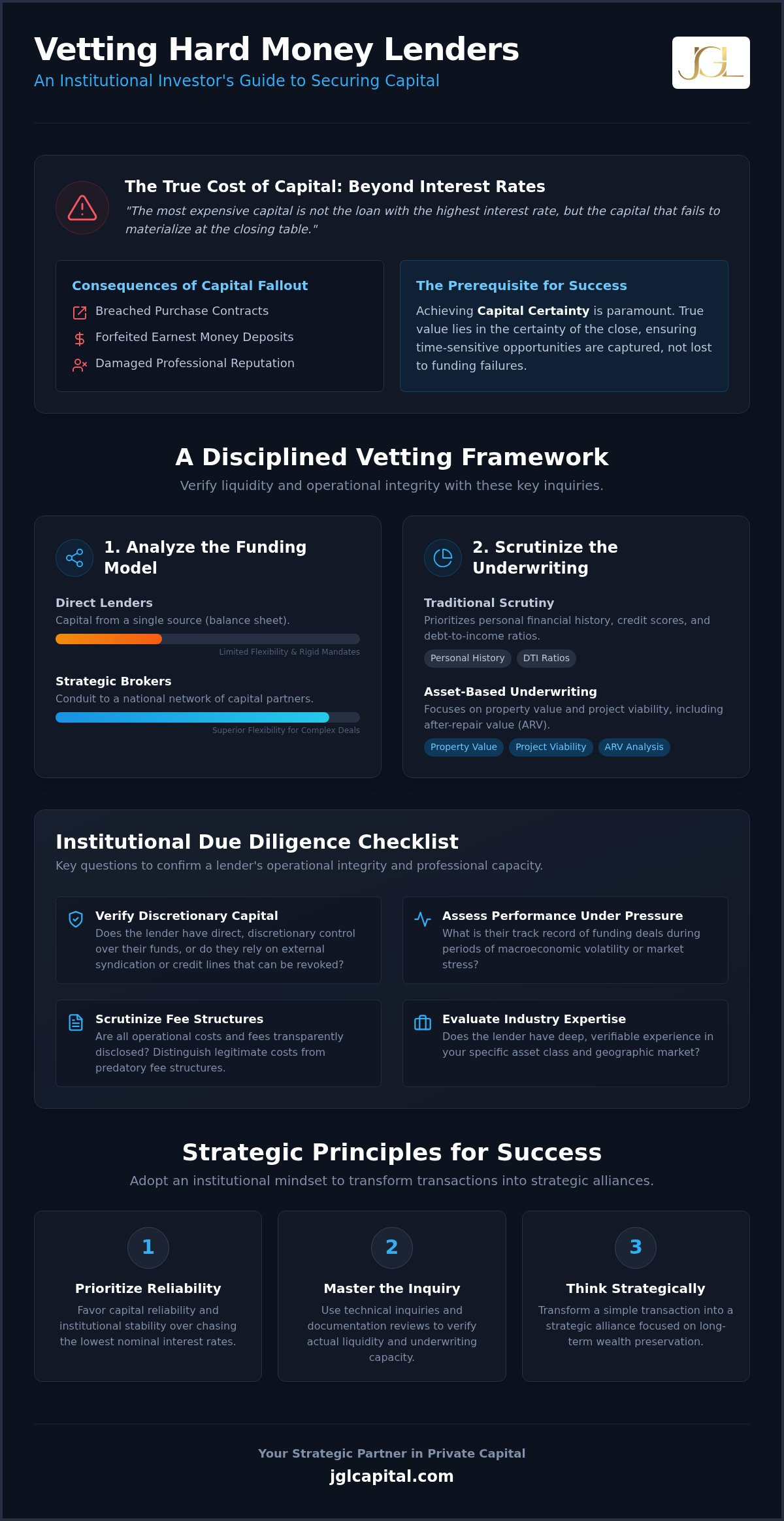
In the high-stakes arena of institutional real estate, the most expensive capital is not the loan with the highest interest rate, but the capital that fails to materialize at the closing table. You likely recognize that in a market defined by 2026’s stabilized yet elevated interest rates, the distinction between a transactional lender and a strategic partner is often obscured by marketing hyperbole and opaque fee structures. Many sophisticated investors have experienced the professional setback of hidden underwriting costs or inconsistent communication that jeopardizes time-sensitive acquisitions.
Mastering how to vet a hard money lender requires more than a cursory review of a term sheet; it demands a disciplined, analytical framework to verify liquidity and operational integrity. This article provides the institutional-grade due diligence necessary to identify reliable capital partners and secure certain funding for your real estate portfolio. We’ll examine the essential metrics of lender stability, the nuances of asset-based underwriting, and the specific inquiries required to ensure your capital partner’s objectives align with your long-term wealth preservation strategies.
Key Takeaways
- Adopt a rigorous risk-assessment framework that prioritizes capital reliability and institutional stability over the pursuit of the lowest nominal interest rates in a volatile market.
- Master the specific technical inquiries and documentation reviews required for how to vet a hard money lender to verify their actual liquidity and professional underwriting capacity.
- Recognize the strategic advantages of a private money brokerage model, which leverages national networks to provide the capital certainty necessary for high-stakes, asset-backed acquisitions.
- Distinguish between legitimate operational costs and predatory fee structures by scrutinizing a lender’s infrastructure and historical performance across specific asset classes.
- Learn how long-term industry expertise and a disciplined approach to value preservation can transform a simple transaction into a sophisticated strategic alliance.
The Imperative of Institutional Due Diligence in Private Lending
Vetting a capital source represents a critical risk-assessment protocol designed to verify capital reliability before a transaction reaches the closing table. In the context of high-stakes real estate, where acquisition timelines are compressed and equity requirements are substantial, a cursory review of interest rates is insufficient. Professional investors recognize that understanding how to vet a hard money lender involves scrutinizing the lender’s internal liquidity and their track record of performance under market pressure. A strategic capital partner doesn’t merely provide funds; they safeguard the investor’s project timeline and personal equity through disciplined execution.
Asset-Based Underwriting vs. Traditional Scrutiny
While conventional institutions prioritize personal financial history and debt-to-income ratios, the private sector has shifted toward a model where property value and project viability take precedence. This asset-based approach requires a sophisticated understanding of valuation methodologies. It’s not enough to know what a property is worth today; a lender must evaluate what it will be worth after the proposed capital improvements. Sophisticated investors often prefer hard money lenders for transitional assets because these partners possess the analytical rigor to underwrite complex deals that traditional banks frequently overlook. This focus on the asset allows for a more streamlined approval process, provided the lender has the expertise to accurately assess the risk profile of the collateral.
The Cost of Capital Fallout
The primary risk in private lending is capital fallout at the closing table. When a lender fails to fund, the consequences extend far beyond a missed opportunity. Purchase contracts are breached, and substantial earnest money deposits are often forfeited. For a $10 million acquisition, a delay of even forty-eight hours can result in the loss of a deal and a significant blow to an investor’s professional reputation. Achieving capital certainty is therefore a prerequisite for competitive acquisitions. Identifying a partner who demonstrates transparency and a verifiable history of funding ensures that time-sensitive opportunities are captured rather than lost to administrative or liquidity failures. True value in private lending is found in the certainty of the close, not just the cost of the credit.
Evaluating Capital Certainty and Funding Capacity
Capital certainty represents the cornerstone of institutional real estate investment, particularly when navigating the compressed timelines of high-value acquisitions. The structural resilience of a capital source becomes most evident during periods of macroeconomic volatility, where non-discretionary lenders may face sudden liquidity constraints that jeopardize pending transactions. A critical component of how to vet a hard money lender involves a granular analysis of their funding capacity and the origin of their capital. Understanding whether a partner operates from a static balance sheet or possesses the agility of a strategic network is essential for maintaining the momentum of a growing portfolio.
Direct Lenders vs. Strategic Brokers
The distinction between a direct lender and a private money brokerage service is often misunderstood by less experienced sponsors. While a direct lender provides capital from a single source, a strategic broker acts as a conduit to an expansive ecosystem of institutional-grade capital. This broker-first model offers superior flexibility for complex deals that may fall outside the rigid mandates of a traditional balance-sheet lender. By leveraging a national network, JGL Capital LLC matches sponsors with capital partners whose specific risk appetites and asset-class preferences align with the project’s objectives. This approach ensures that even the most nuanced transactions receive the necessary funding without the limitations inherent in a single-source model.
Verifying Discretionary Capital
Sophisticated sponsors must look beyond the term sheet to determine who possesses final sign-off on the funding. It is vital to differentiate between entities with discretionary control over their funds and those that rely on external syndication or warehouse lines of credit that may be retracted without notice. When evaluating a partner for new construction loans or large-scale projects, the lender’s history of executing $10 million plus transactions serves as a primary marker of reliability. A partner who can demonstrate a consistent track record of funding significant capital outlays provides a level of security that non-discretionary shadow lenders cannot replicate. Investors who prioritize this level of operational transparency often choose to partner with a seasoned private money broker at JGL Capital LLC to navigate the complexities of the national capital markets. This strategic alliance ensures that capital remains available even when interest rate environments fluctuate, preserving both project timelines and investor equity.
Scrutinizing Operational Infrastructure and Professional Longevity
Vetting a capital partner extends beyond the verification of their balance sheet; it requires a granular assessment of their internal operational infrastructure. A lender’s ability to execute complex transactions, particularly in specialized asset classes like multi-family or industrial properties, is predicated on the sophistication of their underwriting and processing teams. When determining how to vet a hard money lender, an investor must evaluate the depth of the lender’s professional history. Over thirty years of industry experience provides a form of “pattern recognition” that allows a firm to anticipate potential hurdles in the underwriting process before they escalate into structural failures. This level of institutional knowledge ensures that the capital remains stable, even when the underlying project encounters the complexities typical of large-scale development.
Historical Performance in Volatile Markets
A lender’s performance during periods of economic contraction reveals more about their reliability than their activity during a market peak. Sophisticated sponsors investigate how a firm navigated previous cycles; specifically, whether they maintained their funding commitments when liquidity tightened across the broader market. Professional stability is often signaled by a permanent physical headquarters and a verifiable reputation among title companies and real estate attorneys. These stakeholders often possess firsthand knowledge of which lenders consistently deliver on their promises and which entities frequently renegotiate terms at the eleventh hour. Establishing a protocol for how to vet a hard money lender includes observing their communication cadence; a lack of responsiveness during the initial inquiry often foreshadows operational friction during the funding cycle.
Underwriting Rigor and Transparency
The clarity of a lender’s initial Letter of Intent (LOI) serves as a primary indicator of their institutional discipline. A transparent term sheet should articulate all anticipated costs, including origination points, processing fees, and third-party expenses, without ambiguity. Investors should remain skeptical of “too-good-to-be-true” interest rates, which often mask a lack of underwriting rigor or a reliance on predatory fee structures discovered late in the process. This transparency is especially critical in transitional financing, where understanding what is a bridge loan structure entails is necessary for managing short-term liquidity needs. A disciplined lender provides strategic guidance throughout the due diligence phase, ensuring that the loan structure aligns with the sponsor’s exit strategy and long-term objectives. Furthermore, a dedicated processing team is essential for managing the complexities of construction draw schedules, where administrative delays can stall a project’s physical progress.
Identifying Risk Indicators and Transactional Red Flags
Identifying risk indicators requires a vigilant approach to a lender’s financial disclosures and operational transparency. While legitimate processing fees are standard for high-stakes transactions, predatory upfront “commitment” fees often signal a lender that prioritizes immediate revenue over transactional execution. A disciplined investor understands that how to vet a hard money lender involves examining the source of these fees and the conditions under which they are collected. Shadow lenders, characterized by a lack of a verifiable corporate identity or physical headquarters, present a significant risk of capital fallout. These entities often bypass formal third-party valuations for high-LTV deals. This lack of rigor might seem convenient. It usually precedes a failure to fund when the lender’s secondary capital source scrutinizes the deal’s fundamentals.
The ‘Bait-and-Switch’ on Terms
One of the most disruptive red flags is the late-stage modification of terms. This is frequently referred to as a bait-and-switch. This occurs when a lender adjusts the loan-to-value ratio or increases interest rates just days before the scheduled closing. Such actions exploit the sponsor’s lack of alternative options as the contract deadline approaches. Distinguishing between a non-binding Letter of Intent and a binding commitment letter is a hallmark of institutional-grade due diligence. Reliable partners prioritize transparency in fix and flip loans, ensuring that the terms presented initially remain consistent throughout the underwriting cycle. This consistency is essential for maintaining the financial integrity of the pro forma.
Lack of Post-Closing Infrastructure
The risk of a capital partnership doesn’t end at the closing table. Many “one-man-shop” lenders lack the administrative infrastructure to manage post-closing requirements. This includes construction draw schedules or interest reserve accounting. A failure in this area can stall a project’s physical progress. This leads to cost overruns and missed market windows. Sophisticated sponsors require a clear point of contact and a dedicated servicing team to ensure operational continuity. Lenders offering “guaranteed” funding without a thorough underwriting process often lack the capital certainty required for large-scale projects. To avoid these transactional pitfalls and secure funding through a disciplined steward, you should evaluate your capital requirements with JGL Capital.
Establishing a Strategic Alliance with JGL Capital LLC
The finalization of a rigorous vetting protocol marks the transition from risk mitigation to the establishment of a strategic alliance that defines the long-term trajectory of a real estate portfolio. JGL Capital LLC operates as a disciplined steward of institutional-grade capital, offering a level of stability that transactional entities cannot replicate. When determining how to vet a hard money lender, an investor should prioritize firms that leverage deep-seated expertise to navigate the complexities of $10 million plus transactions. Our thirty-year legacy in the private sector serves as a marker of reliability, providing the pattern recognition necessary to ensure capital certainty in fluctuating markets. This history allows us to anticipate challenges that less experienced entities often overlook.
Our broker-first model functions as a strategic advantage, granting sponsors access to a broad and diverse national capital network. This structure allows for the precise alignment of project objectives with the most competitive funding sources available. Rather than being confined to a single balance sheet, clients benefit from a customized approach that prioritizes long-term growth and the preservation of value. It’s a model built for the sophisticated sponsor who values intellectual capital over marketing hyperbole. In the final analysis, the process of how to vet a hard money lender concludes when an investor identifies a partner that values integrity above aggressive self-promotion.
The JGL Capital LLC Methodology
Our commitment extends beyond simple service provision to the delivery of highly individual solutions. JGL Capital LLC manages a comprehensive suite of programs, ranging from DSCR rental loans to ground-up new construction projects. This breadth ensures that every strategic objective is clearly defined and supported by analytical rigor. A partner who understands the intricate nuances of real estate investing is essential for sponsors who seek to build lasting legacies through deliberate action. We take the time to conduct thorough analysis, valuing precision over speed to ensure the long-term health of your acquisitions.
Next Steps for Serious Investors
We invite developers and commercial sponsors to initiate a professional consultation for their next high-stakes project. The process begins with a preliminary review of the asset’s fundamentals, leveraging our asset-backed underwriting focus to provide rapid feedback. This methodical presentation of operational strengths ensures that time-sensitive acquisitions are secured with precision. Engaging with JGL Capital LLC provides a clear path to capital certainty, allowing you to focus on the creation of worth while we manage the complexities of the capital stack. It’s time to move beyond transactional relationships and establish a collaborative alliance that prioritizes your project’s success.
Securing Capital Certainty for Institutional Growth
Achieving operational excellence in real estate requires more than identifying high-yield assets; it demands the identification of capital partners who possess the institutional discipline to fund them. You’ve now seen that mastering how to vet a hard money lender involves a deep analysis of discretionary capital and historical performance across diverse economic cycles. By prioritizing capital certainty over nominal interest rates, you protect your earnest money and your professional reputation. This framework ensures that your acquisitions are supported by a foundation of analytical rigor rather than speculative trends.
JGL Capital LLC leverages over 30 years of industry expertise to provide the stability required for sophisticated $10M+ commercial transactions. Our extensive national network of institutional capital ensures that your portfolio remains resilient, regardless of broader market volatility. We invite you to secure your next project with JGL Capital LLC’s strategic financing solutions. By aligning your objectives with a disciplined steward of capital, you can focus on the creation and preservation of value. We look forward to supporting your long-term vision with precision and integrity.
Frequently Asked Questions
What is the most important question to ask a hard money lender before applying?
The most critical inquiry involves identifying the individual or committee with final discretionary authority over the funding decision. You must determine if the lender operates with internal discretionary capital or if they’re subject to the mandates of an external warehouse provider. Understanding this hierarchy is essential when learning how to vet a hard money lender, as it directly impacts capital certainty. A lender who lacks final sign-off cannot guarantee a project’s funding timeline.
How can I verify if a private money lender actually has the funds to close?
Verification of funding capacity requires a review of the lender’s historical performance and their reputation within the institutional ecosystem. You should request a list of recently closed $10 million plus transactions and seek references from established title companies or real estate attorneys. These stakeholders possess firsthand knowledge of a lender’s liquidity. A credible partner will demonstrate a consistent track record of executing significant capital outlays without the administrative delays typical of non-discretionary entities.
Are upfront fees ever legitimate in hard money lending?
Legitimate upfront fees are exclusively restricted to third-party expenses, such as professional appraisals, site inspections, or environmental assessments. Any requirement for a “commitment fee” or “due diligence fee” paid directly to the lender before a formal underwriting process is completed serves as a primary red flag. Sophisticated sponsors recognize that reputable firms earn their compensation through origination points at the closing table rather than through predatory upfront charges that lack transactional transparency.
What is the difference between a direct hard money lender and a broker?
A direct lender utilizes a single balance sheet to fund transactions, whereas a private money broker provides a strategic conduit to a national network of institutional capital. While direct lending offers perceived simplicity, a broker-first model provides superior flexibility for complex assets. This approach ensures that your project is matched with a capital partner whose specific risk appetite and asset-class experience align with your long-term objectives and wealth preservation strategies.
How do I vet a lender specifically for a new construction project?
Vetting for new construction requires a granular assessment of the lender’s post-closing infrastructure, specifically their draw schedule and inspection protocols. You must verify that the lender has a dedicated processing team capable of managing the complexities of ground-up development. In the context of how to vet a hard money lender for construction, a firm’s ability to release funds promptly following a site inspection is critical for maintaining project momentum and avoiding costly contractor delays.
Can a hard money lender change the terms of the loan at the closing table?
While a non-binding Letter of Intent allows for term modifications, a professional lender maintains the integrity of their initial proposal unless a material change in the asset’s fundamentals occurs. Changing loan-to-value ratios or interest rates just days before closing is a “bait-and-switch” tactic used by less reputable entities. Establishing a strategic alliance with a partner who prioritizes transparency ensures that the terms presented during initial due diligence remain consistent through the close.
What documents should I ask to see from a lender to verify their credibility?
You should request a comprehensive Letter of Intent that clearly articulates all anticipated costs and a sample of their binding commitment letter. Additionally, verify the lender’s professional longevity by reviewing their track record in specific asset classes like multi-family or industrial properties. A credible firm will provide evidence of a permanent physical headquarters and a verifiable history of funding large-scale projects, reflecting a disciplined approach to the creation and preservation of value.
Why should I work with a private money broker instead of going directly to a fund?
Working with a private money broker grants you access to a broader ecosystem of capital, ensuring that you aren’t limited by the rigid mandates of a single fund. This model allows for highly customized solutions that a transactional fund cannot provide. A seasoned broker acts as a strategic ally, leveraging decades of industry pattern recognition to navigate complex financing hurdles and secure the most competitive terms available in the national capital markets.