

The institutional shift toward asset-centric lending represents a fundamental evolution in how sophisticated sponsors approach project capitalization. Mastering the specific fix and flip loan requirements is no longer a mere administrative hurdle; it’s a strategic necessity for investors seeking to bypass the opaque, slow-moving underwriting processes that characterize traditional financial institutions. You likely recognize that while speed of execution remains a critical competitive advantage, the rigid lending boxes of conventional banks frequently ignore the inherent potential within a distressed property’s renovation scope.
This guide serves as a comprehensive framework, designed to help you master the rigorous underwriting criteria and documentation standards required to secure sophisticated private capital for your next renovation project. By aligning with a disciplined financing partner, you’ll gain clarity on LTARV caps, experience-tiered leverage, and the repeatable capital structures that define the modern investment landscape. We will examine the precise metrics that lenders utilize to evaluate project viability, ensuring your next acquisition is backed by a strategic alliance rather than a simple transaction.
Key Takeaways
- Understand the fundamental shift from traditional credit-based mortgages to asset-centric underwriting, where property value and project potential dictate the terms of capital allocation.
- Navigate the essential fix and flip loan requirements, including the mandatory verification of non-owner-occupied status and the maintenance of adequate liquidity for project completion.
- Master the critical metrics of After-Repair Value (ARV) and Loan-to-Cost (LTC) to establish a clear framework for project evaluation and leverage optimization.
- Develop a professional project dossier featuring a comprehensive scope of work and detailed budget to ensure accelerated underwriting and execution speed.
- Leverage the expertise of a strategic financing partner to access flexible, repeatable capital through a broad network of sophisticated private lenders.
Beyond Traditional Mortgages: The Shift to Asset-Based Underwriting
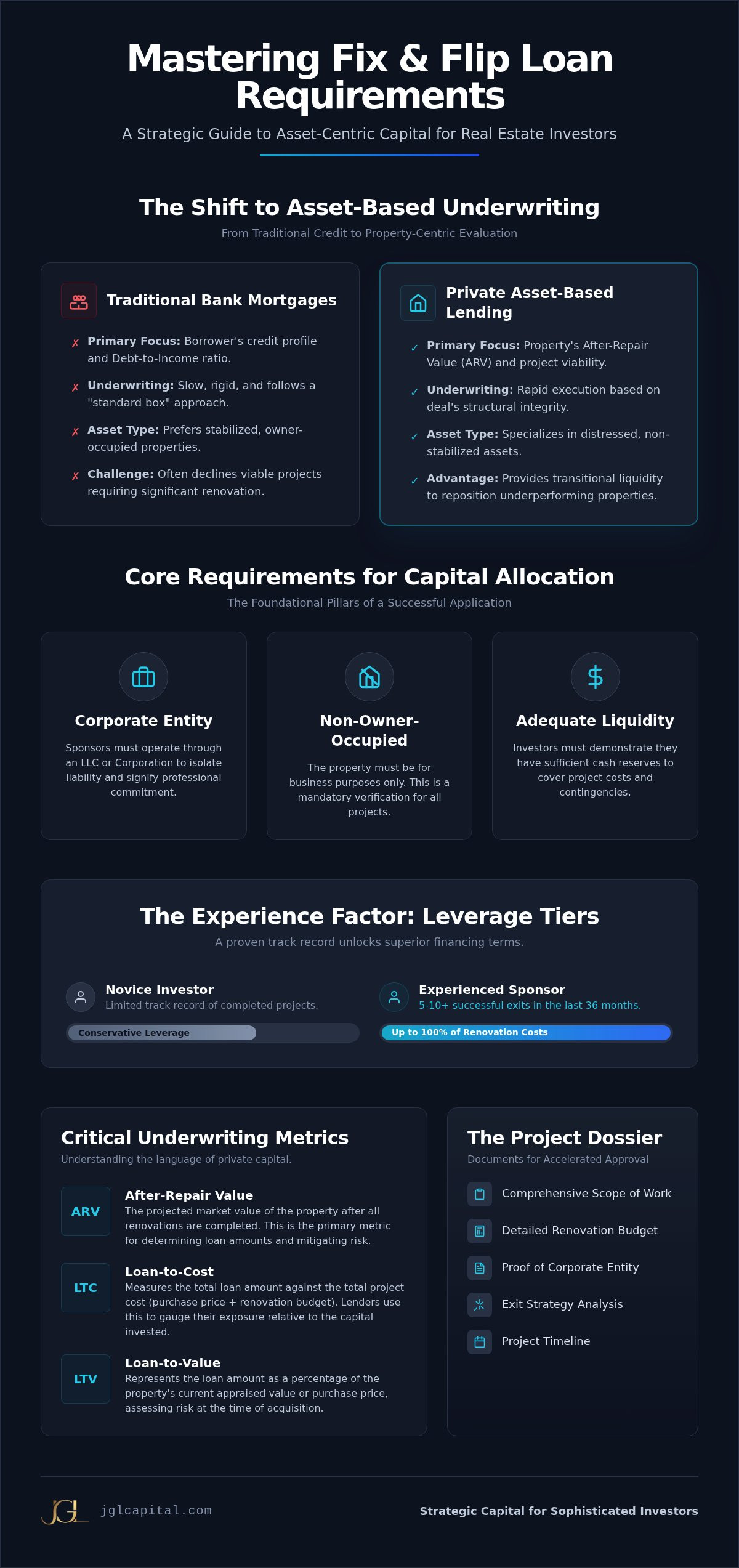
Real estate finance in 2026 distinguishes sharply between residential consumer lending and the strategic allocation of business-purpose capital. While traditional mortgages focus on the borrower’s debt-to-income ratio, the modern fix and flip loan requirements emphasize the intrinsic value of the collateral and the feasibility of the renovation plan. This shift reflects a move toward analytical rigor where the property’s After-Repair Value (ARV) serves as the primary metric for risk mitigation. In this environment, the viability of the project takes precedence over personal income verification, allowing for a more disciplined approach to the creation of value through distressed asset repositioning.
The Philosophical Difference in Private Lending
Private lending operates on the principle that a well-vetted project provides its own security. Unlike traditional lenders who primarily underwrite the individual’s credit profile, sophisticated private capital providers focus on the deal’s structural integrity. This asset-backed focus allows for rapid execution, which is vital when competing against cash buyers in a high-velocity market. By prioritizing property potential over personal income history, these lenders provide the liquidity necessary for transforming underperforming assets into high-value inventory. It’s a rejection of speculative trends in favor of deep-seated expertise, ensuring that every capital allocation is grounded in a serious and disciplined analysis of the property’s future worth.
Why Banks Decline Viable Flip Projects
Traditional banks are bound by institutional constraints that favor stabilized, owner-occupied assets. Their “standard box” often excludes properties requiring significant structural intervention or those that don’t meet strict occupancy standards. This creates a significant hurdle for investors who identify value in non-stabilized assets. Private capital sources offer the transitional liquidity required to bridge the period between acquisition and stabilization. Meeting the fix and flip loan requirements of a private lender ensures a strategic alignment between the borrower’s objectives and the steward of capital. This partnership facilitates the preservation of value through careful, deliberate action rather than the rigid, often ambiguous criteria of traditional banking institutions.
In the 2026 landscape, the primacy of collateral value has become the cornerstone of real estate finance. The role of private capital isn’t merely to provide funds, but to act as a strategic partner in the repositioning of distressed assets. This model values the generation of worth through a collaborative relationship, distinguishing it from the transactional nature of conventional mortgage providers. By focusing on the alignment of objectives, investors can secure the capital necessary to execute complex renovation projects that traditional institutions simply aren’t equipped to evaluate.
Primary Requirements for Fix and Flip Capital Allocation
The transition from theoretical project viability to actual capital deployment requires a rigorous adherence to established fix and flip loan requirements. Sophisticated sponsors operate exclusively through corporate entities, such as an LLC or a Corporation, to ensure a clear distinction between personal assets and business-purpose activities. This structure is not merely a preference for liability isolation; it signifies a professional commitment to the project as a standalone enterprise. The mandatory verification of non-owner-occupied status serves as both a regulatory boundary and a strategic filter, ensuring that capital is directed toward value-generating investments rather than consumer residential needs. This separation of personal and professional interests is a linguistic signature of the seasoned developer.
The Experience Factor in Loan Structuring
Lenders in 2026 categorize sponsors based on a documented history of successful project completions. A proven track record of five to ten successful exits within the previous 36 months typically unlocks significantly higher leverage, sometimes reaching up to 100% of renovation costs. Novice investors, while not excluded, often face more conservative leverage caps until they can demonstrate mastery over the renovation lifecycle. Documentation requirements for these past exits must be meticulous, including settlement statements and detailed project timelines that reflect a disciplined approach to execution. By engaging with a private money broker like JGL Capital LLC, investors can better position their portfolios to meet these institutional expectations and secure customized financing solutions.
Financial Readiness and Liquidity Ratios
Financial discipline is measured through liquidity thresholds that extend beyond the initial capital contribution. While a minimum FICO score between 620 and 660 is often cited as a market baseline, the true measure of a sponsor’s readiness lies in their liquid reserves. These reserves must be sufficient to cover 6 to 12 months of interest carry and provide a buffer for unforeseen cost overruns that frequently occur during complex renovations. Lenders evaluate “skin in the game” as a primary indicator of alignment, ensuring that the investor is as committed to the preservation of value as the steward of capital. This analytical rigor protects the project from the volatility of non-stabilized assets and ensures that the fix and flip loan requirements are met with a sense of security and foresight. The generation of worth is a cumulative process that begins with a steady and logical presentation of financial strength.
Navigating the Underwriting Framework: ARV, LTC, and LTV
The technical underwriting phase represents the transition from conceptual project potential to a structured capital commitment. While earlier discussions centered on sponsor eligibility, this framework focuses on the property’s projected worth and the efficiency of the capital stack. Adhering to fix and flip loan requirements ensures that every investment is shielded from market volatility through a rigorous and methodical valuation process. This analytical rigor isn’t merely a hurdle; it’s a protective measure that secures the sponsor’s equity and the lender’s capital alike.
Defining the After-Repair Value (ARV)
The After-Repair Value (ARV) is the estimated market value of a property after all planned improvements are completed. This metric serves as the primary cornerstone of the underwriting process, dictating the ultimate ceiling for capital allocation. In 2026, professional property valuation requires a disciplined analysis of comparable sales within a narrow geographic radius, typically focusing on properties sold within the last 90 to 180 days. This methodology filters out speculative trends, focusing instead on realized market performance. Sophisticated lenders require a full appraisal to validate these projections, ensuring the exit strategy is rooted in empirical data rather than marketing hyperbole.
Leverage Limits and Capital Preservation
Lenders typically size loans using two primary constraints: Loan-to-Cost (LTC) and Loan-to-After-Repair Value (LTARV). For experienced sponsors, financing can cover up to 95% of the purchase price and 100% of renovation costs, provided the total loan amount doesn’t exceed 75% of the ARV. It’s important to understand that 100% financing of the entire project is viewed as an anti-pattern in institutional-grade lending. Such structures often signal a lack of alignment or “skin in the game,” which increases risk for all parties involved. Balancing leverage with project safety ensures that the sponsor retains sufficient equity to manage the project effectively. This foresight is particularly valuable for sponsors planning to transition the stabilized asset into a long-term DSCR loan, where the initial ARV calculation dictates the eventual take-out financing.
Renovation funds are integrated into the total loan commitment through a disciplined draw schedule. These funds are held in reserve and released in arrears following the successful completion of specific project milestones. This steady flow of information and capital reflects a patient approach to long-term objectives, moving logically from acquisition to stabilization. It’s a persuasive rhythm that builds a case for the sponsor’s competence through the methodical presentation of physical progress. By following these fix and flip loan requirements, investors maintain the transparency necessary to foster a lasting strategic alliance with their capital provider.
Developing a Robust Project Dossier for Accelerated Approval
The efficacy of project capitalization is fundamentally linked to the institutional quality of the documentation provided during the intake phase. While previous discussions emphasized the structural metrics of leverage and property valuation, the dossier functions as the evidentiary basis for a sponsor’s operational competence. Providing a meticulously organized submission minimizes underwriting friction, facilitating a more rapid path to funding by preemptively addressing the inquiries of the capital steward. Adhering to contemporary fix and flip loan requirements demands a level of transparency that mirrors corporate standards, ensuring that every strategic objective is supported by verifiable, empirical data.
The Detailed Renovation Budget
A comprehensive Scope of Work (SOW) serves as the definitive roadmap for the physical generation of worth within the asset. Lenders require granular, line-item budgets that are qualified by formal contractor bids and verified material cost estimates rather than generalized projections. This dossier must account for municipal permit timelines, various soft costs, and a disciplined contingency fund to manage the inherent volatility of distressed property repositioning. Sponsors managing complex structural interventions often find success by integrating the rigorous analytical logic found in new construction loans into their renovation dossiers. This level of meticulous detail instills a sense of security, confirming that the project is grounded in technical reality rather than marketing speculation.
The Exit Strategy and Stabilization Plan
Every disciplined investment strategy requires a clearly defined path toward either liquidation or long-term stabilization. Sponsors must articulate a primary exit strategy, typically a retail resale, while simultaneously presenting a viable secondary plan for asset retention. Aligning the project with DSCR and rental property loans from the inception of the project provides a strategic fallback should market conditions favor yield over immediate capital gains. This forward-thinking approach reduces reliance on transitional capital and demonstrates a sophisticated understanding of the asset lifecycle. It is the hallmark of a seasoned developer to anticipate market fluctuations by securing a repeatable capital source that supports long-term growth.
Standard documentation such as clear title reports, comprehensive insurance binders, and executed purchase contracts must be included to ensure a cumulative and logical flow of information. By presenting an exhaustive project dossier, you distinguish yourself as a sophisticated sponsor ready for a high-level strategic alliance. To begin this collaborative process with a disciplined partner, you may submit your project for a fix and flip loan through JGL Capital LLC to secure the specialized capital your portfolio requires.
Strategic Execution: The JGL Capital LLC Brokerage Advantage
Navigating the multifaceted fix and flip loan requirements of the 2026 market demands more than a mere transactional lender; it requires a strategic partner capable of synthesizing complex underwriting data into executable capital solutions. JGL Capital LLC leverages over 30 years of combined industry experience to provide a broker-first model that transcends the inherent limitations of single-source funding. By maintaining an expansive network of alternative capital providers, the firm ensures that sophisticated sponsors gain access to highly customized solutions that are specifically tailored to the unique demands of high-balance transactions. This specialized focus is particularly relevant for sponsors managing projects that exceed the 10 million dollar threshold, where the complexity of the capital stack requires a more nuanced approach than standard retail lending can provide. The firm’s ability to align diverse capital sources with specific project needs serves as a linguistic signature of its commitment to individual solutions.
Intellectual Capital in Private Finance
The firm’s approach is defined by a deep-seated intellectual capital that allows for advanced pattern recognition across diverse asset classes and market cycles. This expertise ensures that every project is vetted with a level of analytical rigor that protects the interests of both the sponsor and the steward of capital. Rather than viewing financing as a simple service provision, JGL Capital LLC frames its activities as a form of high-level strategic alliance, valuing long-term growth and integrity above all else. This disciplined approach proves essential when navigating the intricacies of non-stabilized assets, providing a steady hand in the creation and preservation of worth through careful, deliberate action. By moving beyond the transactional, the firm serves as a quiet expert, relying on established history and intellectual capital rather than aggressive self-promotion.
Securing Your Next Real Estate Opportunity
The brokerage model excels in its ability to facilitate a seamless transition from initial acquisition to permanent capital through a single, deeply invested ally. By vetting non-owner-occupied investments with speed and precision, JGL Capital LLC serves investors on a national scale, ensuring that geographical boundaries don’t impede the execution of a sound investment strategy. This steady flow of capital allows sponsors to maintain their focus on operational excellence while the firm manages the complexities of the broader lending landscape. Every solution is individual, reflecting a commitment to the alignment of objectives and the delivery of generationally significant worth. To align your strategic objectives with a disciplined financing partner, Contact JGL Capital LLC to discuss the specific requirements for your next high-stakes project.
The communication rhythm maintained throughout the capital allocation process is measured and steady, mirroring a patient approach to long-term objectives. This deliberate pace ensures that every claim is qualified and every strategy is clearly defined, reinforcing the firm’s position as a leader in the field of private finance. By following these rigorous fix and flip loan requirements, sponsors can secure the flexible, repeatable capital necessary to build lasting legacies through their renovation projects. The generation of worth is a methodical presentation of principles, and JGL Capital LLC stands as a collaborative ally in that pursuit.
Capitalizing on the Future of Residential Redevelopment
The evolution of private finance in 2026 has established a clear distinction between transactional lending and strategic capital allocation. Success in this high-stakes environment requires a mastery of fix and flip loan requirements, focusing specifically on the analytical rigor of After-Repair Value (ARV) and the professional presentation of project dossiers. By shifting focus from personal credit to the intrinsic worth of non-stabilized assets, sophisticated sponsors can unlock the liquidity necessary for complex, high-balance transactions.
JGL Capital brings over 30 years of industry-leading expertise to every partnership, specializing in $10M+ complex transactions with a national reach and institutional-grade discipline. We invite you to partner with JGL Capital for your strategic financing needs and secure a collaborative ally dedicated to the generation of long-term value. It’s a shared commitment to excellence that ensures your next renovation project is built on a foundation of intellectual capital and disciplined execution.
Frequently Asked Questions
What is the minimum credit score required for a fix and flip loan in 2026?
The minimum FICO score required for asset-backed capital allocation generally falls between 620 and 660. While the primary focus remains on the intrinsic value of the property, this metric serves as a vital indicator of a sponsor’s financial discipline. Sponsors who maintain higher scores often gain access to more favorable pricing and higher leverage tiers within the institutional framework.
How much cash down payment is typically required for a flip project?
Investors are typically required to contribute 5% to 20% of the total project cost as their initial capital allocation. This “skin in the game” ensures a clear alignment of objectives between the sponsor and the steward of capital. The exact requirement depends on the sponsor’s documented track record and the project’s specific risk profile as determined during the analytical review.
Can I get a fix and flip loan without prior experience?
Meeting the fix and flip loan requirements as a first-time investor is achievable, though novice sponsors may face more conservative leverage limits. Lenders often require a more robust liquidity reserve or a detailed partnership with an experienced contractor to mitigate the risks associated with a first-time renovation. Documenting a clear, analytical plan is essential for these applicants to instill trust.
What documents are needed for the renovation budget approval?
Approval of the renovation budget necessitates a detailed Scope of Work (SOW) accompanied by formal, line-item contractor bids. These documents must clearly articulate the material costs, labor expenses, and municipal permit fees required for the property’s repositioning. A disciplined contingency fund, typically 10% of the total budget, is also a standard expectation to ensure project completion.
Is an appraisal always required for asset-backed flip loans?
A professional appraisal is almost universally required to validate the After-Repair Value (ARV) that serves as the foundation for the loan structure. This third-party valuation ensures that the exit strategy is rooted in empirical data rather than speculative marketing projections. It provides a necessary sense of security for high-stakes management and sophisticated stakeholders involved in the transaction.
How long does the approval and funding process usually take?
The approval and funding process for private capital typically ranges from 5 to 7 business days following the submission of a complete project dossier. This speed of execution is a primary advantage over traditional banking institutions, which often require weeks for institutional review. Efficiency in this phase is critical for securing distressed assets in highly competitive national markets.
Can I use a fix and flip loan for my primary residence?
Fix and flip loans are strictly for non-owner-occupied investment properties and cannot be utilized for a primary residence. These are business-purpose capital allocations designed exclusively for the creation of value through property repositioning. Regulatory and strategic constraints prohibit the use of these institutional funds for consumer-grade residential mortgages or any owner-occupied dwellings.
What happens if the renovation costs exceed the initial budget?
Managing cost overruns is a critical component of fix and flip loan requirements, as sponsors must fund deficits from their established liquidity reserves. Maintaining a robust capital buffer is a core metric that demonstrates financial readiness and a serious approach to project management. This disciplined approach ensures that the project moves toward stabilization without jeopardizing the underlying capital structure or the strategic alliance.