

The traditional banking sector’s continued reliance on rigid debt-to-income ratios and onerous personal guarantees often stifles the very growth it claims to support, particularly within the specialized niche of small-scale multifamily development. You’ve likely found that the perceived benefits of institutional debt are frequently offset by excessive approval timelines and a systemic disregard for the unique intrinsic merit of a specific project. Securing small apartment building construction financing shouldn’t necessitate an unnecessary compromise on your liquidity or a protracted wait for a credit decision that lacks professional nuance.
This guide delineates a more sophisticated approach to capital allocation, focusing on the strategic advantages of private capital and asset-based underwriting to streamline your path to breaking ground. You’ll discover how to leverage disciplined private strategies to achieve high loan-to-cost ratios while maintaining the agility required in a competitive market. We will examine the evolving regulatory landscape, including the implications of the 2026 statutory mortgage limit adjustments, and provide a roadmap for establishing a strategic partnership that prioritizes the generation of long-term worth over mere transactionality.
Key Takeaways
- Identify the strategic parameters of the small multifamily asset class, typically defined as five to fifty units, and its pivotal role in a diversified real estate portfolio.
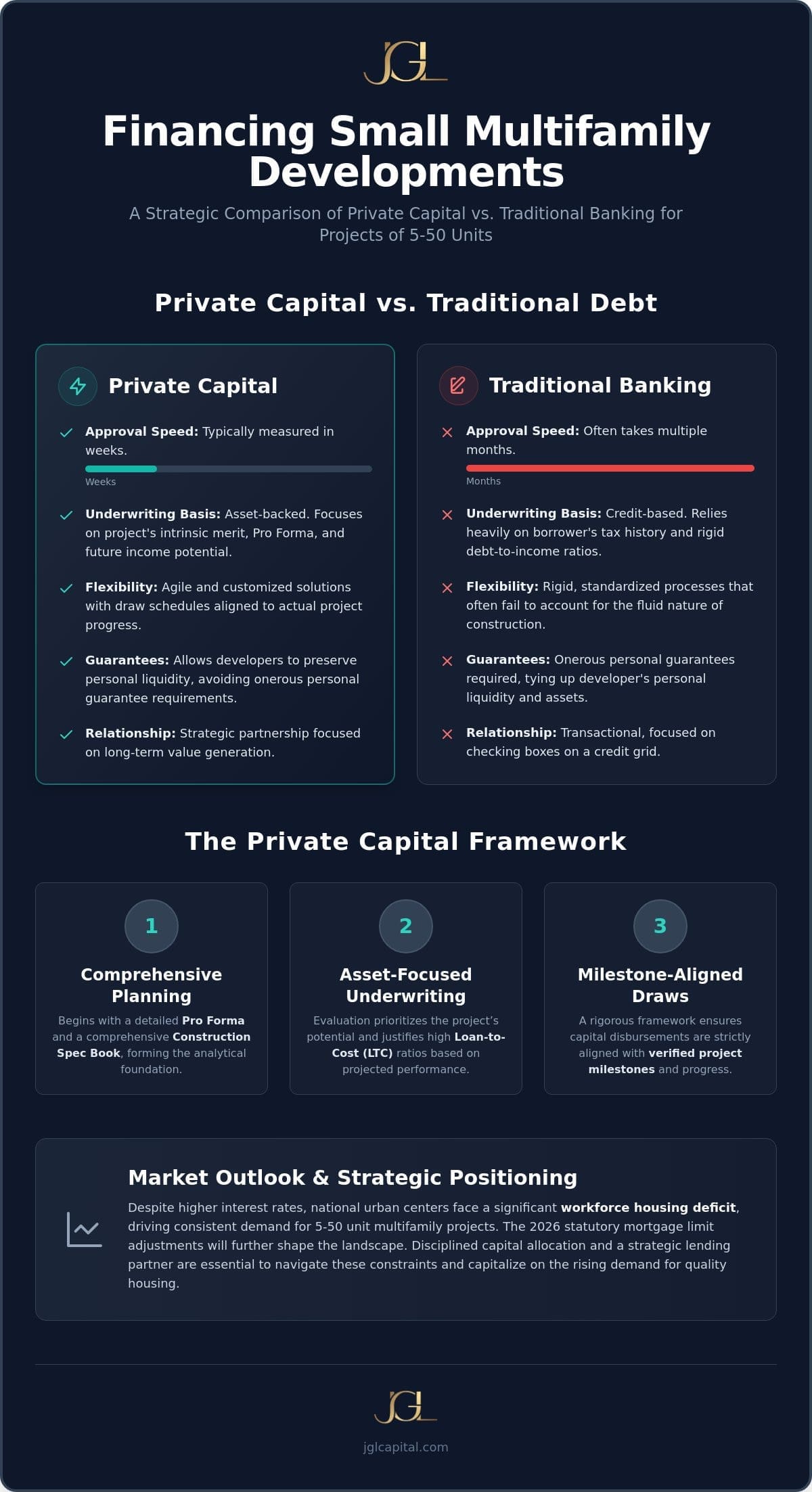
- Evaluate the operational efficiencies of private capital, which often provides approval timelines measured in weeks rather than the months required by traditional institutional lenders.
- Master the structural nuances of small apartment building construction financing by prioritizing Loan-to-Cost (LTC) metrics and the development of a comprehensive construction spec book.
- Establish a rigorous framework for the underwriting and draw process to ensure that capital disbursements remain strictly aligned with verified project milestones.
- Discover how a strategic alliance with an experienced lender can provide the customized capital solutions necessary to preserve liquidity and maximize property value.
The Strategic Landscape of Small Multifamily Construction Financing
Within the broader context of the real estate development process, the small multifamily asset class, generally defined as projects comprising 5 to 50 units, represents a unique intersection of residential utility and institutional-grade investment. Securing small apartment building construction financing is the critical catalyst that transforms a conceptual site plan into a tangible, income-producing asset. While larger developments often attract massive institutional syndications, smaller projects face a distinct set of hurdles. Traditional banking institutions have increasingly retreated from this sector, opting instead for the perceived safety of stabilized assets or larger-scale commercial ventures. This retreat is driven by rigid regulatory frameworks and a systemic aversion to the inherent risks of the construction phase, leaving a void that disciplined private capital is uniquely positioned to fill.
This shift toward private capital as a primary source for emerging and seasoned developers isn’t merely a matter of necessity; it’s a strategic choice. Private lenders operate with an agility that traditional institutions simply can’t match. By focusing on the intrinsic value of the development rather than checking boxes on a standardized credit grid, these partners provide a level of customized support that is vital for project success. In an era where speed and precision are paramount, the ability to bypass the bureaucracy of local banks allows developers to capitalize on market opportunities before they evaporate.
Asset-Backed vs. Credit-Based Underwriting
Private capital providers distinguish themselves through an underwriting philosophy that prioritizes the underlying asset value over the borrower’s personal tax history. While a local bank might stall a project due to rigid debt-to-income requirements, an asset-backed approach focuses on the project’s Pro Forma and its potential to generate long-term worth. This shift allows developers to preserve their personal liquidity for operational needs rather than tying up every dollar in onerous guarantee requirements. The project’s Pro Forma remains the most vital document in the capital stack, serving as the analytical foundation for every funding decision. It provides the necessary nuance to justify high leverage based on the projected performance of the completed building.
Market Dynamics and Capital Constraints in 2026
The 2026 economic environment presents both challenges and opportunities for the astute developer. While interest rates have stabilized since the volatility of previous years, they remain at levels that require a meticulous approach to debt service coverage. National urban centers continue to report a significant deficit in workforce housing, driving consistent demand for the 5 to 50-unit model. In this climate, disciplined capital allocation is essential to prevent over-leveraging. By aligning with a strategic partner that understands current multifamily cap rates and market nuances, developers can navigate these constraints while securing the necessary small apartment building construction financing to meet the rising demand for high-quality housing. This methodical presentation of principles ensures that every project is built on a foundation of stability and long-term viability.
Evaluating Private Capital vs. Traditional Institutional Debt
The decision between institutional debt and private capital is often framed as a simple interest rate comparison, yet such a narrow view ignores the profound impact of execution speed on project yield. When considering what is a construction loan in the context of a twenty-unit development, the delta between a three-week approval and a six-month underwriting process can represent substantial sums in carrying costs and lost revenue. For those seeking small apartment building construction financing, the efficiency of private capital provides a strategic buffer against the volatility of construction costs and shifting market dynamics. Institutional lenders often impose rigid draw schedules that fail to account for the fluid nature of site work; conversely, private lenders prioritize the alignment of capital flow with actual project milestones, ensuring that the momentum of the development team is never compromised by administrative friction.
This agility is not merely about speed, but about the preservation of opportunity. A delayed construction start forces a developer to absorb land carry costs and property taxes while the project remains unproductive. By aligning loan terms with a specific exit strategy, whether it’s a stabilized refinance or a prompt disposition upon certificate of occupancy, private capital allows for a more cohesive lifecycle management of the asset. This disciplined approach ensures that every dollar of debt is working toward the generation of worth rather than being consumed by institutional inertia.
The Speed of Execution as a Competitive Advantage
A six-month delay in breaking ground isn’t a mere scheduling inconvenience; it’s a financial liability that erodes the developer’s internal rate of return. During such periods, carrying costs continue to accumulate without the offsetting benefit of physical progress. Private capital allows developers to secure land and permits with precision, often utilizing bridge loans to cover the transitional period before the primary construction facility is fully funded. This capacity to act quickly is what distinguishes successful developers in competitive urban markets.
Flexibility in Borrower Requirements
Traditional banks frequently struggle with complex ownership structures, such as those involving multi-layered LLCs or foreign national partners, often defaulting to a rejection when faced with non-standard entities. Private underwriting shifts the focus from a borrower’s FICO score to the collective experience and track record of the development team. This approach acknowledges that the success of small apartment building construction financing depends more on the ability to deliver a finished asset than on the personal credit history of a single stakeholder. By evaluating the “experience” component through a lens of professional competence, private lenders act as disciplined stewards of value. For developers seeking to optimize their capital stack, engaging a partner that understands these nuances is essential for long-term growth.
Structural Requirements for Small Apartment Construction Loans
The structural integrity of a financing arrangement is as critical as the physical foundation of the building itself. When securing small apartment building construction financing, the primary analytical lens shifts from Loan-to-Value (LTV) to Loan-to-Cost (LTC), as the latter more accurately reflects the capital requirements of an unbuilt asset. While LTV remains relevant for the eventual stabilized valuation, LTC governs the immediate allocation of funds against the hard and soft costs of development. This distinction is vital for developers who must manage liquidity throughout the project lifecycle. A comprehensive Spec Book and a granular construction budget act as the primary risk-mitigation tools; they provide a transparent roadmap that validates the feasibility of the proposed development.
Interest reserves play a pivotal role in maintaining project solvency by capitalizing the cost of debt during the construction period when the asset generates zero revenue. This mechanism prevents technical defaults and allows the development team to focus exclusively on execution. Simultaneously, the choice between recourse and non-recourse debt obligations defines the developer’s personal risk profile. Private capital providers often demonstrate more flexibility here, offering limited-recourse structures that acknowledge the expertise of the sponsor and the inherent value of the collateral.
The Capital Stack: Debt, Equity, and Mezzanine Options
Optimizing the capital stack involves a precise calibration of debt and equity to minimize the developer’s initial cash-in-pocket. Mezzanine financing often acts as the connective tissue in this structure, bridging the gap between senior debt and the sponsor’s equity to achieve higher overall leverage. This approach is particularly effective when commercial real estate loans are structured with a view toward the eventual transition from construction to permanent financing. By layering these capital sources, developers can preserve their own resources for subsequent acquisitions or operational contingencies.
Underwriting the Pro Forma and Exit Strategy
The underwriting process meticulously examines the Pro Forma to ensure the project meets a minimum Debt Service Coverage Ratio (DSCR), typically 1.25x or higher, based on projected net operating income. A definitive take-out loan plan is a prerequisite for any disciplined lender, as it outlines the specific path for refinancing the construction debt into permanent, low-interest capital once the building is occupied. The stabilization period is the specific timeframe after construction ends during which the property must reach a target occupancy rate to qualify for permanent debt. This phase serves as the critical bridge to long-term value preservation and asset maturity.
Navigating the Underwriting and Draw Process
The transition from a formal loan commitment to the initial funding event marks the commencement of the project’s operational phase, a period requiring meticulous coordination between the developer and the capital provider. To successfully secure small apartment building construction financing, developers must adhere to a rigorous underwriting framework that extends far beyond the preliminary credit review. This phase is characterized by a technical validation of the project’s feasibility, where the lender’s team scrutinizes the alignment between the proposed timeline and the available capital. Establishing a rigorous inspection schedule is paramount, as it provides the analytical evidence required to validate progress and authorize the release of funds. This disciplined approach ensures that capital is deployed in direct proportion to the value created on-site, maintaining the project’s financial equilibrium.
Protective measures such as the systematic collection of lien waivers from subcontractors serve as an essential safeguard, ensuring that the property remains unencumbered by mechanics’ liens as construction progresses. This administrative rigor protects both the developer’s equity and the lender’s senior position. Simultaneously, the prudent management of contingency funds allows for the absorption of unforeseen material or labor cost increases without jeopardizing the overall capital stack. By maintaining a dedicated reserve for these variables, developers can navigate the inherent uncertainties of the build phase with a level of confidence grounded in financial preparedness.
Critical Documentation for Multi-Family Development
The technical review process necessitates the organization of a comprehensive documentation package, including site plans, municipal permits, and environmental reports. These documents serve as the evidentiary basis for the lender’s risk assessment, providing the necessary nuance to justify the funding commitment. The General Contractor’s contract is also scrutinized to ensure that performance bonds and liquidated damages clauses are appropriately structured to protect the project’s timeline. Because of the unique risks associated with vertical development, new construction loans require specialized insurance coverage, such as Builder’s Risk and comprehensive general liability, to mitigate potential losses during the build period.
Managing Construction Interest and Progress Draws
A significant strategic advantage of private capital is the methodology by which interest is calculated; typically, interest is only charged on the drawn balance of the loan rather than the total commitment. This structure incentivizes efficient project management and reduces the overall cost of capital during the early stages of development. To ensure consistent cash flow, developers should adopt best practices for submitting draw requests, including the provision of detailed invoices and photographic evidence of completion. A third-party inspector plays a vital role in this cycle, conducting on-site visits to verify that the work performed matches the request before funds are disbursed. For developers seeking a partner capable of navigating these operational complexities, applying for a construction facility with JGL Capital ensures that your capital deployment remains aligned with your strategic objectives. This collaborative approach fosters a sense of security for all stakeholders involved in the generation of worth.
Optimizing Capital Allocation with JGL Capital
Selecting a capital partner is a decision of profound consequence, as the chosen entity acts as the primary steward of the project’s financial viability. JGL Capital leverages thirty years of industry expertise to deliver customized capital solutions that transcend the limitations of traditional, branch-based lending. By focusing on the intrinsic property value and the strategic potential of the development, we provide a level of analytical rigor that ensures every allocation of capital is aligned with the developer’s long-term objectives. For those navigating the complexities of small apartment building construction financing, our national reach provides a distinct advantage; it allows for the seamless execution of projects in high-growth markets across the United States without the bureaucratic friction inherent in regional banking structures. It’s this commitment to stability and deep-seated expertise that instills a sense of security in our sophisticated partners.
The transition from a construction phase to a stabilized asset requires a nuanced understanding of real estate investing frameworks that prioritize longevity. We emphasize the preservation of developer wealth by ensuring that the capital stack is structured to support not just the build, but the eventual maturity of the asset into a permanent portfolio. This disciplined approach distinguishes JGL Capital as a strategic ally rather than a mere transactional provider, fostering relationships grounded in mutual accountability and the generation of worth. We don’t simply provide capital; we provide the intellectual foundation necessary for the creation of lasting legacies through careful, deliberate action.
Bespoke Financing Solutions for Emerging Developers
Tailoring loan structures to match unique project timelines and specific asset types is a hallmark of our institutional approach. We recognize that emerging developers require more than just a line of credit; they require a strategic ally who understands the bridge-to-construction-to-permanent transition. Working with a private broker who acts as a dedicated consultant ensures that every claim is qualified and every strategy is clearly defined. This level of individualization allows for the articulation of core philosophies that generic institutional debt often ignores. By streamlining these transitions, we enable our partners to focus on the execution of their vision while we manage the complexities of the capital stack.
Strategic Alliances for Long-Term Portfolio Growth
Moving beyond transactional lending, we cultivate collaborative investment relationships that prioritize long-term growth and integrity above all else. The value of a disciplined steward in the preservation of developer wealth cannot be overstated, especially in volatile market environments where precision is more valuable than speed. Our communication rhythm is measured and steady, mirroring a patient approach to your long-term objectives. We invite you to engage with JGL Capital for a sophisticated capital analysis to determine how our resources can best support your next multifamily development. Establishing a strategic partnership today is the first step toward building a resilient and high-performing real estate portfolio.
Establishing a Legacy Through Strategic Capital Deployment
The successful execution of small apartment building construction financing requires more than just a capital commitment; it necessitates a disciplined partnership rooted in technical expertise and analytical rigor. We have explored how the strategic shift toward private capital allows developers to bypass the institutional inertia of traditional banks, prioritizing the intrinsic merit of the asset over rigid personal credit metrics. By leveraging asset-backed underwriting and a national lending footprint, developers can maintain the agility required to capitalize on high-growth multifamily markets without compromising their long-term liquidity.
With over thirty years of industry expertise, JGL Capital serves as a seasoned steward for sophisticated partners who value stability and the generation of worth. Our approach transcends simple transactionality, offering a collaborative framework that supports the entire lifecycle of your development, from the initial site work to the final stabilization of your portfolio. We invite you to secure your apartment construction financing with JGL Capital today and experience the advantage of a partner that understands the gravity of your investment. We look forward to helping you build a lasting legacy through careful, deliberate action.
Strategic Inquiries Regarding Multifamily Construction Capital
What is the typical interest rate for a small apartment construction loan?
Interest rates for these facilities generally range from 5.50% to 8.75%, depending on the sponsor’s track record and the project’s specific risk profile. While these rates are elevated compared to historical lows, they reflect the current economic environment and the inherent risk of vertical development. Private capital providers often utilize floating rates tied to established benchmarks, ensuring that the cost of debt remains aligned with broader market dynamics throughout the build phase.
How much equity do I need for a 20-unit apartment building project?
Developers typically require an equity contribution of 15% to 20% of the total project cost, assuming a Loan-to-Cost ratio of 80% to 85%. This requirement ensures that the sponsor maintains a meaningful alignment of interests with the capital provider. For projects qualifying under mission-driven or affordable housing mandates, leverage may be slightly higher, though a disciplined approach to capital allocation usually necessitates a robust equity cushion to absorb potential cost overruns.
Can I get a construction loan with a low credit score if the property value is high?
Private capital providers prioritize asset-based underwriting, focusing on the project’s intrinsic value and the developer’s track record rather than a personal FICO score. While institutional banks often reject applications based on rigid credit thresholds, a sophisticated lender evaluates the project’s Pro Forma and the experience of the development team. This approach allows for the acquisition of small apartment building construction financing even when a sponsor’s personal credit profile doesn’t meet traditional banking standards.
What is the difference between LTC and LTV in multifamily financing?
Loan-to-Cost (LTC) measures the loan amount against the hard and soft costs of construction; conversely, Loan-to-Value (LTV) compares the debt to the projected market value of the stabilized asset. In the context of new development, LTC is the primary metric used during the funding phase to ensure capital is deployed in proportion to physical progress. LTV becomes critical during the refinance phase, determining the maximum permanent debt the completed building can support.
How long does it take to close a private money construction loan?
Closing a private money facility typically requires a timeline of three to six weeks, providing a significant advantage over the multi-month processes required by institutional banks. This efficiency is achieved through a streamlined underwriting process that focuses on the technical merits of the development. For developers targeting competitive urban markets, this speed of execution is vital to securing land and maintaining the momentum of the construction schedule.
Are these loans recourse or non-recourse?
While many construction facilities involve some level of recourse, private lenders frequently offer limited-recourse structures that burn off as project milestones are achieved. Non-recourse options are often available for highly experienced sponsors or projects with exceptionally strong collateral. These arrangements are meticulously defined in the loan commitment, ensuring that the developer’s risk profile remains commensurate with the project’s strategic potential and the established history of the partnership.
What documents are required to apply for a small apartment building loan?
Can I use a bridge loan for the land acquisition phase before construction?
Utilizing a bridge loan for land acquisition is a common strategy to secure a site before the primary small apartment building construction financing is fully structured. These transitional facilities provide the necessary agility to close on land opportunities quickly, allowing the developer to finalize permits and architectural plans. Once the pre-development phase is complete, the bridge debt is typically rolled into the larger construction loan facility as part of a cohesive capital plan.