

Traditional financial institutions frequently prioritize personal debt-to-income metrics over the inherent economic viability of a real estate asset, a practice that systematically stifles the expansion of sophisticated investment portfolios. Securing an optimal loan for building a duplex requires a departure from retail banking constraints in favor of institutional-grade capital that recognizes the future value of multi-unit developments. We understand the frustration of managing bureaucratic delays and rigid underwriting standards that don’t appreciate the projected net operating income of a well-conceived project.
This professional guide offers a rigorous analysis of private construction financing, specifically designed to assist investors in achieving superior capital efficiency through high-leverage funding and expedited closing cycles. It’s our objective to provide a comprehensive roadmap for those seeking to bypass traditional limitations. We’ll examine the mechanics of asset-backed lending and demonstrate how a strategic partnership provides the liquidity necessary to secure prime land and fully fund construction costs, ensuring your capital remains deployed in the most productive manner possible.
Key Takeaways
- Distinguish between restrictive retail financing and strategic, investor-focused capital to ensure the alignment of financial structures with long-term development objectives.
- Analyze the fiscal advantages inherent in multi-unit assets, specifically regarding the mitigation of vacancy risk through dual-income streams and the optimization of parcel utility.
- Gain insight into the institutional underwriting paradigm, where the assessment of a loan for building a duplex centers upon After-Repair Value and project feasibility rather than individual credit constraints.
- Navigate the operational complexities of the construction lifecycle by establishing disciplined draw schedules and leveraging professional third-party oversight for capital disbursement.
- Formulate sophisticated exit strategies that facilitate long-term value preservation, including the utilization of Debt Service Coverage Ratio (DSCR) financing for stabilized assets.
The Strategic Framework of Private Loans for Building a Duplex
A private new construction loan for duplex assets represents a specialized form of transitional capital designed to facilitate the realization of multi-unit residential projects from inception to stabilization. Unlike conventional mortgages that prioritize personal income verification, this category of financing focuses on the economic viability of the duplex building itself, evaluating its potential to generate net operating income upon completion. For the sophisticated investor, a loan for building a duplex serves as a strategic instrument to bypass the systemic inefficiencies of retail banking, where debt-to-income requirements often limit the scale of development. It’s a method of funding that aligns with the objectives of those who view real estate as a disciplined vehicle for wealth creation rather than a personal housing need.
In the current market cycle, asset-backed lending has emerged as a vital pillar for developers who value execution speed over marginal interest rate differentials. While traditional lenders may offer lower nominal rates, their protracted approval processes and rigid compliance frameworks often result in missed opportunities or stalled construction timelines. Private capital provides the necessary liquidity to secure land and initiate builds with a level of agility that mirrors the pace of competitive real estate markets; it’s a model that values precision over bureaucratic inertia. By prioritizing the asset’s future value, these loans empower developers to maximize their capital efficiency and maintain momentum throughout the project lifecycle.
Private Money vs. Traditional Bank Financing
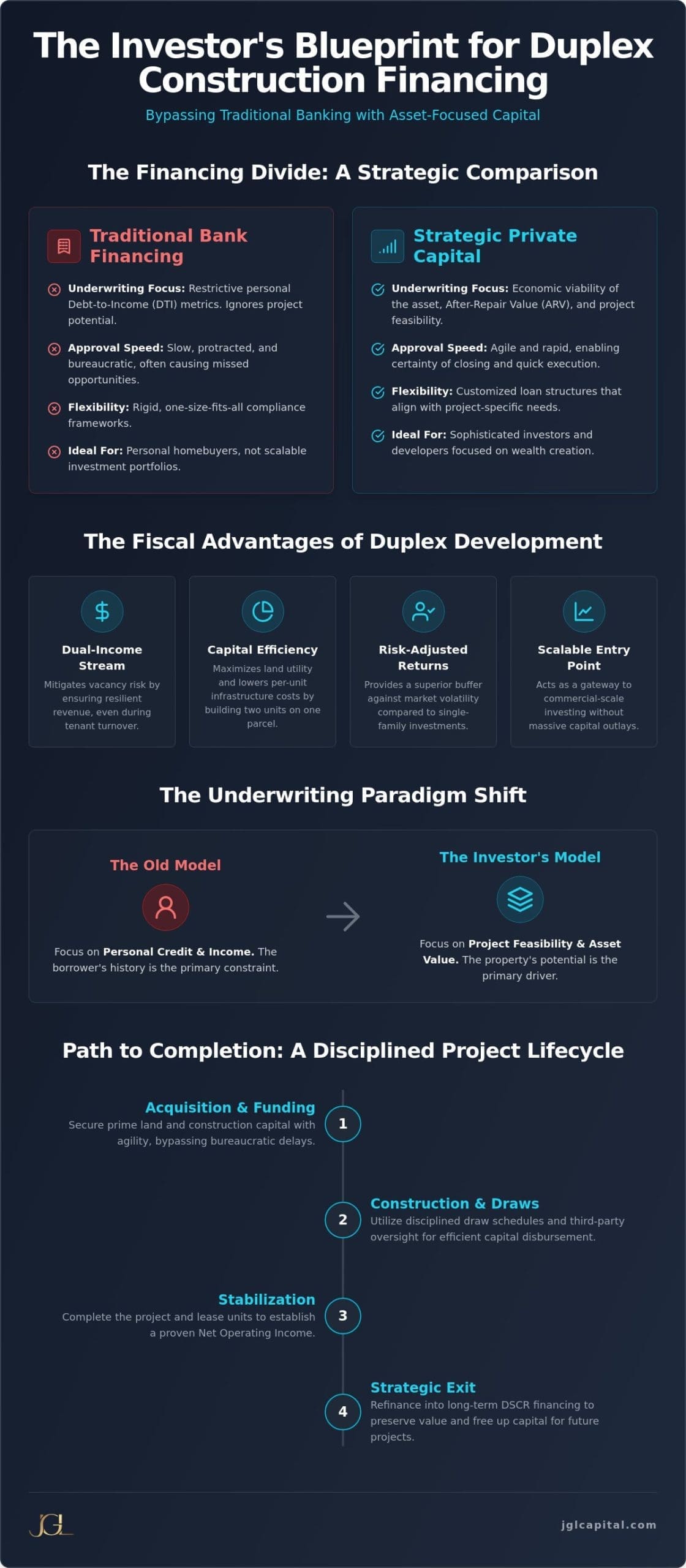
The primary distinction between institutional private capital and traditional banking lies in the underwriting philosophy. Traditional banks rely heavily on credit-based underwriting, often subjecting the borrower to exhaustive personal financial scrutiny that ignores the project’s inherent worth. In contrast, private lenders employ an asset-based evaluation, prioritizing the project’s feasibility and the developer’s track record when structuring a loan for building a duplex. This shift in focus significantly reduces loan approval timelines, allowing developers to move from application to funding in a fraction of the time required by commercial banks. Sophisticated developers prioritize this certainty of closing, as it mitigates the risk of capital withdrawal during critical phases of the development process.
The Duplex as a Strategic Multifamily Entry
Developing 2-unit dwellings offers a unique profile of risk-adjusted returns, providing a buffer against vacancy that single-family investments simply can’t match. By constructing two units on a single parcel of land, investors achieve a level of capital efficiency that maximizes the utility of the site and reduces the per-unit cost of infrastructure. This asset class facilitates a seamless transition from residential to commercial-scale investing, offering a scalable model that doesn’t require the massive capital outlays of large apartment complexes. The duplex building represents a foundational gateway asset that allows for meaningful portfolio diversification while maintaining a manageable operational footprint.
Evaluating the Fiscal Advantages of Duplex Construction Projects
The fiscal logic underpinning duplex development transcends simple residential construction, positioning the asset as a sophisticated hedge against market volatility. By leveraging a dual-income stream, developers effectively mitigate vacancy risk; the presence of two separate tenancies ensures that revenue remains resilient even during periods of turnover. This structural advantage allows for more predictable debt service coverage, a factor that’s central to securing a favorable loan for building a duplex. When one unit becomes unoccupied, the remaining unit continues to generate cash flow, maintaining the project’s solvency and protecting the investor’s capital position.
Building two units on a single parcel of land optimizes capital efficiency by distributing the fixed costs of site acquisition and infrastructure over multiple revenue-generating entities. This concentration of density enhances the overall yield on cost, providing a superior risk-adjusted return compared to detached single-family builds. Additionally, the utilization of new construction materials and modern building codes significantly reduces the necessity for immediate maintenance reserves. Investors can allocate more capital toward portfolio expansion rather than remediation, as new systems typically don’t require major capital expenditures for at least a decade.
Maximizing Loan-to-Cost (LTC) and Loan-to-Value (LTV)
Lenders specializing in private capital evaluate projects based on the “As-Completed” value, a metric that considers future income potential rather than historical costs. Understanding the interplay between land basis and vertical construction expenses is vital for minimizing initial capital outlays. While government frameworks such as the USDA Multifamily Housing Loan Guarantees offer insights into how institutional bodies quantify risk, private financing provides the flexibility to capitalize on high-growth areas where traditional appraisal models might lag. This approach allows for a more aggressive capitalization of the project’s eventual worth.
Tax Implications and Wealth Preservation
Strategic wealth preservation is further enhanced through sophisticated depreciation schedules, particularly when cost segregation is applied to new multifamily structures. Duplexes serve as ideal vehicles for 1031 exchange planning, allowing for the consolidation or expansion of portfolios without immediate tax liabilities. Investors who focus on long-term equity growth alongside short-term cash flow metrics find that a well-structured loan for building a duplex creates a robust foundation for generational wealth. Exploring institutional capital solutions can assist in aligning these fiscal advantages with your broader investment mandate, ensuring that every dollar of debt is deployed with maximum precision.
The Underwriting Paradigm: How Private Capital Evaluates Duplex Assets
Private capital underwriting for a duplex asset is a forward-looking exercise in risk assessment that prioritizes the economic outcome of the development over the historical financial state of the borrower. The primacy of After-Repair Value (ARV) serves as the fundamental anchor for the entire capital structure; a loan for building a duplex is sized according to the projected market value once the structure is stabilized and income-producing. This methodology allows for higher leverage than typically available through retail channels, provided the developer can demonstrate a clear path to project completion and subsequent occupancy. By focusing on the asset’s future worth, lenders align their interests with the developer’s objective of value creation, ensuring the project remains viable even amidst shifting market conditions.
Risk mitigation within this paradigm is achieved through a combination of conservative leverage and the establishment of robust contingency reserves. Institutional lenders require a meticulous market analysis that examines absorption rates and comparable rental metrics to validate the project’s feasibility. This scrutiny ensures that the duplex won’t only be built but will also perform as an income-generating asset in its specific micro-market. Evaluating the developer’s track record is equally critical, as past performance serves as a reliable indicator of the ability to manage the complexities of a multi-unit build while maintaining fiscal discipline.
Deconstructing the Appraisal Process
The appraisal process for new construction is notably distinct from standard residential valuations. It centers on a ‘Subject to Completion’ appraisal, which requires the appraiser to project the value based on the proposed plans and specifications. Understanding how construction loans work in this context is essential, as the valuation must bridge the gap between a residential 2-unit structure and its potential as a commercial-grade income producer. Appraisers examine local market data to determine the capitalization rate applicable to the duplex, ensuring the final valuation reflects the asset’s true income-producing potential rather than just the cost of bricks and mortar.
Borrower Requirements in an Asset-Backed Model
In an asset-backed model, a borrower’s liquidity often carries more weight than a traditional credit score. Lenders look for sufficient cash reserves to cover interest carry and unforeseen construction hurdles, prioritizing the project’s solvency over personal debt history. The ‘Experience Factor’ plays a decisive role in securing favorable terms; developers with a history of successful multi-unit projects are viewed as lower-risk partners. This alignment of interests creates a collaborative environment where the lender acts as a strategic ally, providing the capital necessary to realize a loan for building a duplex while ensuring the project’s structural and financial integrity remains uncompromised.
Operational Lifecycle: Navigating the Construction Draw and Funding Process
The transition from capital procurement to project execution requires a shift in focus toward operational discipline and rigorous fund management. A loan for building a duplex is structured as a series of progress-based disbursements rather than a singular transfer of wealth. This phased approach, codified in a meticulously defined draw schedule at the time of closing, serves as the primary mechanism for maintaining project momentum. By aligning capital release with specific construction milestones, the lender and developer create a transparent framework that ensures funds are utilized exclusively for the enhancement of the asset’s value. It’s a system designed to protect the integrity of the investment while providing the liquidity necessary for continuous work.
Central to this process is the role of the third-party inspector, who acts as an objective arbiter of project progress. Before any disbursement occurs, these professionals conduct on-site evaluations to verify that the work described in the draw request has been completed to institutional standards. This oversight protects everyone. It ensures that the general contractor is compensated fairly for work performed while preserving the lender’s security interest in the property. Managing the relationship between the general contractor and the lending institution is a critical responsibility for the developer, as efficient communication directly impacts the speed of capital flow and the overall project timeline. A well-managed loan for building a duplex relies on this triad of cooperation to reach successful completion.
The Five Stages of Construction Funding
- Foundation and site work: This initial stage involves the deployment of capital for land preparation, excavation, and the pouring of the foundation, establishing the project’s structural baseline.
- Framing and exterior: Capital is released as the structure takes shape, moving toward the ‘dried-in’ milestone where the building is protected from environmental elements.
- Systems and rough-ins: This phase focuses on the internal infrastructure, including the installation of plumbing, electrical, and HVAC systems within the framed walls.
- Finishes and landscaping: Disbursements are allocated to interior aesthetics, cabinetry, flooring, and exterior site improvements that finalize the asset’s marketability.
- Final Inspection and Closeout: The remaining funds are released upon the issuance of a Certificate of Occupancy, signaling the asset’s readiness for the stabilization phase.
Best Practices for Seamless Disbursement
Maintaining an impeccable record of documentation, including unconditional lien waivers from all subcontractors, is essential for mitigating legal risks and ensuring a smooth funding cycle. Fund disbursement isn’t instantaneous; it follows a strict logic. During this period, the use of interest-only payments allows developers to manage their carrying costs effectively while the asset remains in a non-revenue-generating state. A disciplined draw process ensures that capital is released in direct proportion to verified progress, thereby preventing project stagnation and financial misalignment. For those ready to initiate their next development, exploring New Construction Loans provides the institutional support necessary for seamless project execution.
Optimizing Exit Strategies and Long-Term Value Preservation
The successful delivery of a stabilized asset marks the commencement of the monetization phase, where the developer’s vision is translated into measurable financial performance. Selecting a sophisticated exit strategy is as critical as the initial acquisition of a loan for building a duplex, as it dictates the project’s ultimate capital velocity and yield. For institutional-grade portfolios, a Build-to-Rent strategy has become the preferred model for long-term stewardship, allowing for the retention of high-quality units while benefiting from the resilient dual-income streams inherent in multifamily assets. JGL Capital LLC facilitates this pivotal transition by providing the strategic oversight and liquidity necessary to bridge the gap between construction completion and permanent debt stabilization.
Refinancing into rental property loans through a Debt Service Coverage Ratio (DSCR) model provides a disciplined mechanism for equity extraction. This approach prioritizes the property’s net operating income over the developer’s personal debt-to-income ratio, allowing the asset’s performance to dictate the financing terms. By extracting the value created during the development process, investors can recycle their initial capital into new opportunities without the necessity of a taxable disposition. This methodical approach to capital recycling ensures that the balance sheet remains optimized for future growth while maintaining a healthy debt service coverage for the existing asset.
The BRRRR Method Applied to New Construction
The application of the Buy, Build, Rent, Refinance, Repeat (BRRRR) methodology to the development sector allows for the systematic capture of forced equity. Unlike the acquisition of existing structures, using new construction loans to create a duplex from the ground up generates a value spread that frequently exceeds standard market appreciation. This equity cushion serves as a robust defense during the refinancing stage, often facilitating the complete recovery of the developer’s initial capital deployment while maintaining a conservative loan-to-value ratio. Success in this cycle relies on a disciplined approach to both the vertical construction and the subsequent management of the stabilized multifamily asset.
Selecting a Disciplined Lending Partner
Choosing a financial partner is a decision that reflects the gravity of high-stakes management and should be grounded in the firm’s established history and intellectual capital. JGL Capital LLC offers over 30 years of industry expertise, serving as a seasoned and discreet ally for developers navigating the complexities of multi-unit projects. A strategic alliance with a private money broker provides a level of customization and professional rigor that transactional bank relationships often lack. This partnership ensures that every loan for building a duplex is structured to support the alignment of long-term objectives and the preservation of wealth. By prioritizing integrity and analytical precision, we ensure that our partners have the capital structures necessary to build lasting legacies through careful, deliberate action.
Advancing Your Multifamily Development Strategy
Synthesizing the operational and fiscal components of a development project requires more than technical proficiency; it necessitates a comprehensive alignment of capital with long-term strategic objectives. As we’ve examined, the transition from a specialized loan for building a duplex to a stabilized, income-producing asset is a complex journey that demands institutional-grade oversight and a rejection of speculative trends. Success in this sector is reserved for those who prioritize analytical rigor and maintain a disciplined approach to the creation and preservation of value throughout the construction lifecycle.
JGL Capital LLC remains a steadfast partner for sophisticated developers, offering over 30 years of industry expertise and a specialized focus on asset-backed multifamily assets. Our national reach, complemented by a localized understanding of market nuances, ensures that every project receives the customized attention it requires for successful execution. We invite you to secure your construction capital with JGL Capital LLC’s disciplined lending solutions and partner with an organization that values integrity and the generation of lasting worth. We look forward to facilitating your next milestone in multifamily development.
Frequently Asked Questions
Is it possible to get a loan for building a duplex with no experience?
Securing a loan for building a duplex without a documented history of multi-unit development is possible if the borrower partners with an established general contractor. Institutional lenders prioritize the project’s successful completion and will rely on the contractor’s track record as a primary risk mitigation factor. It’s essential to present a robust feasibility study and demonstrate significant liquidity to reassure the lender of the project’s financial stability despite the developer’s limited personal experience.
How do interest rates for private construction loans compare to traditional mortgages?
Private construction financing typically carries higher interest rates than traditional residential mortgages because it accounts for the expedited funding cycle and the increased risk associated with vertical builds. These rates are generally structured as interest-only payments during the construction phase to preserve the developer’s cash flow. Sophisticated investors accept this higher cost of capital in exchange for the flexibility and speed that traditional banking institutions can’t provide.
What is the typical down payment required for a duplex construction loan?
A typical down payment for a duplex construction project ranges between 20% and 30% of the total project cost, depending on the asset’s location and the borrower’s financial profile. This capital injection ensures an alignment of interests between the developer and the lending partner. While some government programs offer lower entry points, such as the option to explore VA Home Loans for eligible veterans, private institutional capital focuses on maintaining conservative leverage to protect the project’s solvency throughout the construction lifecycle.
Can I use the land I already own as equity for the construction loan?
Borrowers can utilize land they already own as a form of equity to satisfy the down payment requirements for a loan for building a duplex. The lender evaluates the current market value of the parcel and applies that equity toward the total capitalization of the project. If the land is owned free and clear, it can significantly reduce the amount of liquid cash a developer must contribute at closing, thereby enhancing overall capital efficiency.
How long does the approval and funding process take for a private construction loan?
The approval and funding process for private construction financing generally concludes within two to four weeks, offering a substantial advantage over the protracted timelines of retail banks. This speed is achieved through a streamlined underwriting process that prioritizes asset-based evaluation over exhaustive personal financial history. Rapid execution allows developers to secure prime land and initiate construction before market conditions shift, ensuring the project remains on its projected economic trajectory.
What happens if the construction project exceeds the estimated timeline?
If a project exceeds its estimated timeline, developers must typically negotiate a loan extension with their lender, which often involves an extension fee and continued interest-only payments. Private lenders understand that construction often encounters unforeseen hurdles and generally provide flexibility if the delay is justified by verified progress. It’s critical to maintain transparent communication with the lending partner to ensure project continuity and avoid a technical default on the agreement.
Do I need a finalized architectural plan before applying for financing?
Institutional lenders require finalized architectural plans and a detailed budget before they can provide a firm commitment for financing. These documents are essential for the ‘Subject to Completion’ appraisal, which determines the asset’s future value. Without precise specifications, the lender can’t accurately assess the project’s feasibility or the adequacy of the proposed capital structure. Providing comprehensive plans at the outset demonstrates a disciplined approach to development.
How are construction draws typically structured for a multifamily project?
Construction draws for multifamily projects are structured around pre-defined milestones such as foundation completion, framing, and interior rough-ins. Each disbursement is contingent upon a successful site evaluation by a third-party inspector who verifies that the work meets professional standards. This methodical approach ensures that capital is deployed in direct proportion to the value added to the property, protecting the interests of both the developer and the lending institution.