

Foreclosure doesn’t always end a borrower’s liability. The central distinction in recourse vs non-recourse real estate loans is whether the lender can pursue the borrower for a remaining balance after the property is taken and sold. With recourse debt, a borrower or guarantor may be responsible for a deficiency; with nonrecourse debt, recovery is generally limited to the collateral, subject to any carve-outs in the loan documents.
It’s reasonable to focus on the property securing the loan, but the contract and applicable state law can also shape what happens after default. This guide explains who may benefit from nonrecourse terms, what a lender may recover under each structure, and how partial recourse and carve-out guarantees can affect exposure. It also compares the practical trade-offs, including the role of collateral value, personal liability, and financing terms, then examines why mortgage recourse rules vary across the United States. The goal is to make the consequences clearer before you assess a real estate financing decision.
Key Takeaways
- Identify whether the loan makes a borrower or guarantor personally liable for any balance left after the collateral is sold.
- Read the loan documents for carve-outs and partial-recourse guarantees, which can change the lender’s recovery rights.
- Weigh liability exposure against financing terms and the property’s cash flow when choosing a loan structure.
- Account for state mortgage laws, which can affect whether a loan is treated as recourse or nonrecourse.
What is the difference between recourse and nonrecourse debt?
The key distinction is whether the borrower remains personally liable after the lender enforces its claim against the property. The loan documents define that exposure, subject to applicable law.
Recourse Borrower Liability
Recourse debt makes the borrower, and sometimes a guarantor, responsible for repayment beyond the pledged property. If the borrower defaults and a foreclosure sale leaves a deficiency, the lender may pursue collection under the loan documents and applicable law. That could include seeking a deficiency judgment or pursuing other assets, such as funds in accounts or wages. As a result, the borrower’s repayment obligations can extend beyond the collateral.
Non-Recourse Borrower Liability
Nonrecourse debt generally limits the lender’s recovery to the property securing the loan. The borrower may lose that collateral, and responsibility for any remaining balance can depend on the loan terms and applicable law. This places more property-value risk on the lender than recourse debt does. The contract still matters: carve-outs can create personal liability if specified conduct occurs, so the label alone does not define every obligation.
Collateral and Borrower Asset Exposure
Collateral is the asset pledged to secure repayment, such as the financed real estate. With recourse financing, the lender may pursue the property and seek a deficiency, potentially exposing other borrower assets to collection. With nonrecourse financing, recovery generally centers on the pledged asset, limiting that additional exposure. Review guarantees and carve-outs alongside the collateral description, since they can change who bears losses after default.
| Loan structure | Liability after collateral sale | Exposure |
|---|---|---|
| Recourse | Borrower may owe a deficiency | Collateral and potentially other assets |
| Nonrecourse | Generally limited to collateral | Primarily the pledged property |
IRA borrowing also has tax considerations. An IRA must report taxable income from debt-financed property using IRS Form 990-T, according to the Internal Revenue Service. Lenders assess the pledged property and repayment structure; the loan documents determine whether the borrower or a guarantor assumes liability. For an IRA investment, understand how the financing structure affects the investment’s taxable income and who signs repayment obligations.
Compare personal exposure, collateral risk, guarantees, and the financing terms in the documents.
Lender recovery after default
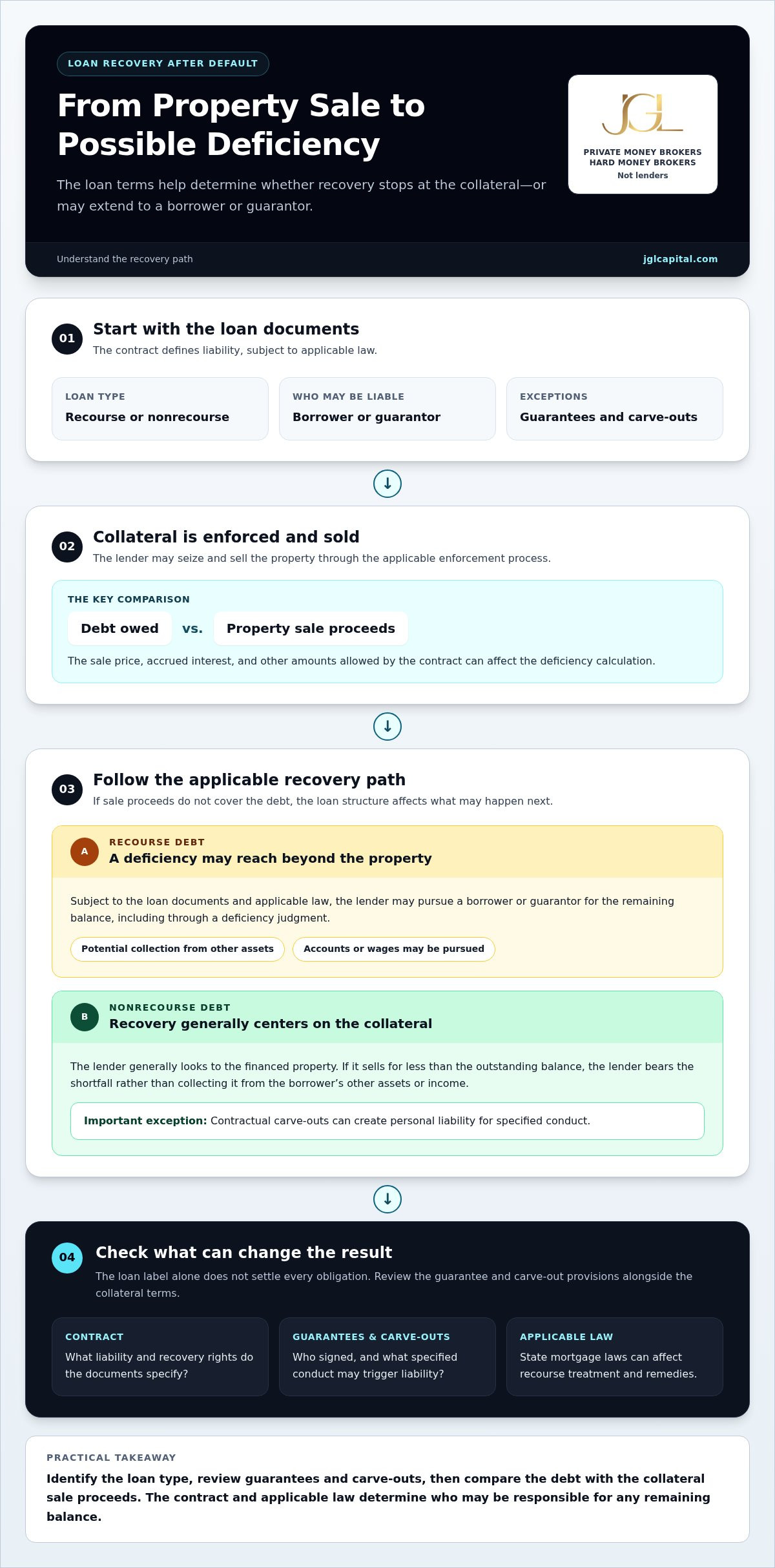
After default, recovery depends on the loan’s recourse terms, collateral, guarantees, and applicable law. The lender’s claim may be limited to the property or extend to other borrower assets.
Recovery Limited to the Collateral
With nonrecourse debt, the lender generally looks to the financed asset for repayment. If a commercial property sells for less than the outstanding balance, the lender bears the shortfall rather than collecting it from the borrower’s other assets or income. The lender can seize and sell the collateral through the applicable enforcement process. Loan documents may still contain carve-outs that expand liability for specified conduct.
Remedies and Deficiency Judgments
With recourse debt, the lender may foreclose, sell the property, and calculate any deficiency between the sale proceeds and the debt. Subject to the loan documents and applicable law, the lender may pursue the borrower or guarantor for that remaining balance, including through a deficiency judgment. The sale price, accrued interest, and other amounts permitted by the contract affect the calculation. Recourse terms may give lenders broader recovery rights, which can support lower interest rates.
Collection After Collateral Is Taken
Taking collateral does not necessarily end collection efforts on a recourse loan. If the sale leaves an unpaid balance, the lender may seek payment from a liable borrower or guarantor and pursue other assets, subject to applicable law. For example, the loan documents may make a guarantor responsible for a deficiency after a commercial property sale. Nonrecourse terms generally limit this additional collection, except when a contractual carve-out applies.
After default, identify the loan type, review the guarantee and carve-out provisions, then compare the debt with the collateral sale proceeds. Those steps clarify whether a deficiency may remain and who may be responsible. The lender’s remedies and any collection against assets or income depend on the contract and applicable law. For borrowers assessing financing structures for an investment property, commercial real estate financing is one option to consider alongside the potential recovery terms.
What Is a Non-Recourse Loan and Who Benefits From It?
Nonrecourse financing may suit investors who prioritize limiting personal exposure, particularly when ownership involves multiple partners. The trade-off is that lenders generally expect stronger property performance and lower leverage than with recourse financing.
Bad-boy carve-outs are exceptions to that protection. Specified misconduct can trigger personal liability, so before signing, borrowers should identify the conduct that triggers liability, the parties affected, and the terms of the guarantee.
Lenders may weigh the property’s cash flow, leverage, debt-service coverage, sponsor experience, and credit profile. Stabilized, income-producing real estate is generally a stronger fit for nonrecourse terms than development or value-add projects, which often rely on recourse financing or substantial sponsor guarantees.
Pricing and leverage form another trade-off: recourse loans generally have lower interest rates, while nonrecourse commercial real estate loans commonly carry loan-to-value ratios of 65%-75%. Conduit or CMBS financing and many Fannie Mae and Freddie Mac multifamily loans are common nonrecourse programs. Each program’s structure affects the borrower’s liability and the property’s financing capacity.
For an SDIRA purchase, first identify the property, intended rental use, and amount financed. Then assess how debt-financed ownership affects taxable income: the share of net income subject to unrelated debt-financed income is based on the percentage of the property financed with debt. Include that tax exposure in the investment’s projected cash flow and reporting process.
Before choosing between recourse and nonrecourse terms, compare the interest rate, loan-to-value ratio, guarantees, carve-outs, and default remedies in the agreement. Lenders choose a structure based on the property’s stability, cash flow, leverage, and sponsor strength. Also review how the agreement defines default and personal liability, and what conditions could change the nonrecourse protection.
Real estate mortgage recourse laws
In the United States, state law can affect whether mortgage debt is treated as recourse or nonrecourse. A market summary identifies 12 states allowing both recourse and nonrecourse home loans. That distinction matters: the property’s location may influence whether a lender can pursue repayment beyond foreclosure proceeds. A loan’s label alone may not settle the borrower’s exposure.
Start with the state where the mortgaged property is located, then read the promissory note, mortgage, and any guaranty together. The note describes repayment obligations, the mortgage identifies the collateral, and a guaranty may make another party personally liable. Compare their terms on default, sale proceeds, and any remaining balance. These documents and applicable state law shape the analysis.
Home-loan rules shouldn’t automatically be applied to commercial real estate. The 12-state figure concerns home loans, while commercial financing can involve different agreements and guarantees. For an investment property, identify the borrower, any guarantor, and the entity holding title. Then determine whether the documents allow collection after foreclosure or limit recovery to the secured property. A deficiency may also depend on applicable law.
State rules can affect what follows foreclosure, including whether a lender may seek a deficiency and pursue collection against accounts or other assets. Default can also affect credit, while tax treatment may depend on the transaction’s facts. Before signing, compare the property state’s rules with the loan’s recourse clause, guaranty, and default provisions. This review helps clarify who may remain responsible after the property is sold.
For a real estate investment, record the property’s state, borrower entity, guarantors, and post-foreclosure obligations in one review. Then assess how those terms align with the investment’s risk and repayment plan. To discuss financing for a commercial property, explore commercial real estate financing.
JGL Capital LLC: New Construction Loans
JGL Capital LLC is a private money broker, not a lender. It helps real estate investors explore business-purpose financing options for projects such as new construction, multifamily properties, and commercial real estate, including bridge financing where it may fit the transaction. When recourse terms are part of the financing decision, JGL Capital LLC can help borrowers organize the project details and explore potential capital sources. Each lender sets its own requirements and makes its own decisions.
Before pursuing a loan, define the project, identify the borrowing entity and any guarantors, and review how the proposed documents address repayment and default. Those details help frame the financing discussion and the personal exposure attached to the loan. For a project-specific conversation, contact JGL Capital LLC.
Make the Financing Structure Fit the Plan
Review financing terms alongside the investment plan, not in isolation. Map the project’s expected cash flow, ownership structure, repayment strategy, and tolerance for personal exposure. Then identify how each proposed agreement addresses guarantees, default, and the property’s sale proceeds. This gives you a practical basis for comparing options and spotting obligations that might otherwise be overlooked.
Choosing between recourse vs non-recourse real estate loans is part of a broader capital decision. Consider how recourse vs non-recourse real estate loans align with the project’s priorities, then bring specific questions to the financing discussion. Reviewing the documents carefully can help clarify the trade-offs before proceeding.
If you’re assessing financing for a real estate project, discuss your financing with JGL Capital LLC. A considered next step can help bring the investment plan and financing structure into closer alignment.
Frequently Asked Questions
Do Banks Make Non-Recourse Loans?
Some banks may offer nonrecourse financing, but commercial banks commonly provide recourse loans. Nonrecourse options are more closely associated with life insurance companies, CMBS lenders, and agency multifamily programs. These are market patterns, not guarantees that a particular option is available. For a specific proposal, review the promissory note and guarantees to determine whether personal liability applies, including after default or under specified carve-outs.
Can I get non-recourse financing for a value-add or development deal?
Nonrecourse financing can be difficult to obtain for a value-add or development project. These deals often rely on recourse financing or substantial sponsor guarantees because the property may not yet have stable income or completed construction. Lenders assess the project’s cash flow, leverage, construction plan, sponsor experience, and exit strategy. Compare proposed guarantee obligations with the project schedule and repayment plan.
What is a recourse real estate loan?
A recourse real estate loan makes a borrower or guarantor personally responsible for repayment beyond the pledged property, as provided in the documents and applicable law. For example, if a foreclosure sale does not repay the debt, the lender may seek the remaining deficiency from a liable party. Before signing, identify each borrower and guarantor, then review the note and guarantee to understand the obligations each accepts.
What is a non-recourse real estate loan?
A nonrecourse real estate loan generally limits the lender’s repayment claim to the secured property. The borrower’s exposure is therefore centered on that asset rather than a general promise to repay from other assets. However, loan documents may include carve-outs that create personal liability for specified conduct. Read those provisions carefully, including which actions trigger them and which borrowers or guarantors they cover.
How does borrower liability differ between recourse and non-recourse loans?
Recourse financing can expose a borrower or guarantor to collection for a remaining debt balance, while nonrecourse financing generally confines recovery to the collateral. This distinction matters when a project’s value or sale proceeds fall short of the amount owed. Compare the default, guaranty, and carve-out clauses, and consider how the property’s state may affect the loan’s treatment.
How do down payment, interest rates, fees, and loan terms compare?
Nonrecourse commercial loans commonly have lower leverage, with loan-to-value ratios of 65%-75%, and may require a larger down payment. Recourse loans generally offer lower interest rates and more favorable or flexible terms because lenders have additional recovery options. Fees and other terms vary by proposal. Compare each term sheet’s costs, reserves, covenants, maturity, extension provisions, guarantees, and recourse language together.