

The smallest monthly payment can leave the largest obligation for the end. A balloon payment loan for commercial property is structured so scheduled payments cover only part of the debt, with the remaining balance due as a lump sum when the loan term ends. The Consumer Financial Protection Bureau says mortgage loans with balloon payments generally have terms of 5 to 10 years, compared with 15 to 30 years for traditional mortgages.
This structure can support cash flow while a property is improved, leased, or repositioned, but it makes the maturity date central to the financing decision. Lower payments do not eliminate the debt; they defer a substantial part of it.
This article explains how commercial balloon loans work, how their repayment structure differs from a fully amortized loan, and what options borrowers may consider when the final payment comes due. It also explains why planning for maturity early matters, especially when refinancing depends on the property’s value and the borrower’s financial position at that time.
Key Takeaways
- Distinguish the loan term from the amortization period: monthly payments may be calculated over a longer schedule even though the full balance comes due sooner.
- Compare the lower payments of a balloon structure with the steady payoff path of a fully amortized loan, and consider how each fits the property’s projected cash flow.
- Plan for maturity well in advance by evaluating refinancing, a property sale, or a discussion with the lender as potential ways to address the remaining balance.
- For a commercial property project that needs financing, JGL Capital LLC acts as a private money broker and offers commercial real estate, new construction, multi-family, and bridge loans.
What is a Balloon Payment on a Commercial Mortgage?
A commercial mortgage balloon payment is the remaining principal due in one lump sum at the end of the loan term. Commercial balloon mortgages commonly make that balance due in the fifth year, although terms vary.
The Consumer Financial Protection Bureau says mortgage loans with balloon payments generally have terms ranging from 5 to 10 years.
Managing a Balloon Payment
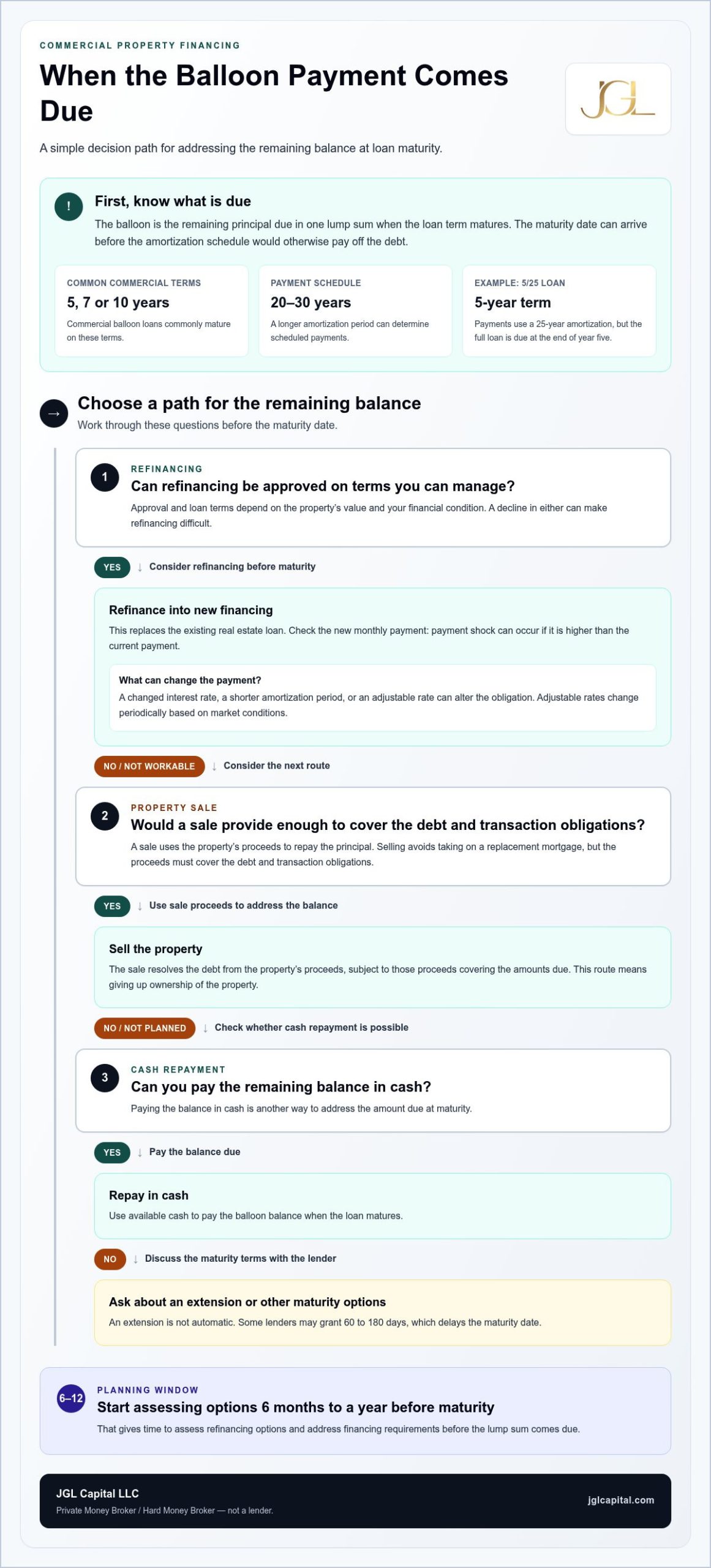
Borrowers can address the final balance by refinancing, selling the property, or discussing options with the lender. Each choice affects ownership, future debt, and when funds become available.
Refinancing replaces the existing real estate loan with new financing, while a sale uses the property’s proceeds to repay the principal. A borrower can also discuss the maturity terms with the lender. Selling avoids taking on a replacement mortgage, but the proceeds must cover the debt and transaction obligations.
Refinancing and Payment-Shock Risks
Refinancing before maturity can help manage the lump sum, but approval and loan terms depend on the property’s value and the borrower’s financial condition. A decline in either can make refinancing difficult. Starting the process 6 months to a year before the balloon mortgage ends gives time to assess options and address financing requirements.
Payment shock occurs when the replacement loan’s monthly payment is higher than the existing payment. A changed interest rate, shorter amortization period, or adjustable-rate mortgage can alter that obligation. An adjustable-rate mortgage is amortized over 15 to 25 years, with an interest rate that adjusts periodically based on market conditions. That changing rate can affect future payments.
Maturity, Renewal, and Refinancing
The balloon payment is due when the loan term matures, not necessarily when its amortization schedule would otherwise end. For example, a commercial 5/25 loan calculates principal and interest payments using a 25-year amortization, but the full loan becomes due at the end of the fifth year.
A borrower may refinance before maturity or negotiate with the lender about an extension; renewal is not automatic. Some lenders may grant an extension of 60 to 180 days, delaying the maturity date. A borrower can also sell the property or pay the balance in cash. The route taken determines whether the borrower retains the asset and assumes new debt.
How Does a Commercial Balloon Loan Work?
A commercial balloon loan separates the payment schedule from the date the full debt is due. The term, amortization period, interest rate, and maturity date determine both the regular payments and the final balance.
Commercial Loan Terms and Structure
The loan term is the period before the outstanding principal must be repaid, while amortization determines how scheduled payments reduce that principal. Commercial real estate balloon loans commonly mature in 5, 7, or 10 years, even when payments follow a longer schedule.
Terms can differ by property type and lender, and available structures can vary across states. There is no single term that applies to every commercial property; the property, transaction, and financing structure all shape the agreement. Business owners should distinguish the maturity date from the payment schedule before assessing the loan’s fit.
Amortization and Repayment Periods
Amortization spreads principal and interest payments across a stated period; a balloon loan matures before that schedule fully repays the debt. Commercial real estate balloon loans commonly use amortization periods of 20 to 30 years, while the loan itself may mature sooner.
For example, a 7/23 structure uses a 7-year balloon term and a 23-year amortization period. The lender calculates installments against the longer period, leaving principal unpaid when the loan matures. Interest rates may be fixed or variable, so borrowers should account for rate terms alongside the repayment schedule.
Lender Requirements
Lender requirements depend on the transaction and the borrower’s financial profile. Business credit can reflect payment history, existing debt, company size, industry risk, and credit history. A lender may also consider the property’s value and loan-to-value ratio. A higher ratio may affect the interest rate.
Commercial mortgage costs can include appraisal, legal, survey, and loan application fees. Some fees may be added to the loan amount, affecting its loan-to-value ratio. Because property type and state can shape the financing structure, compare the proposed term, amortization, and closing costs as a complete package. JGL Capital is a private money broker, not a lender, and its commercial real estate loans may be relevant when arranging financing for an investment property.
Balloon loans compared with fully amortized loans
Both structures finance commercial real estate, but they reduce principal differently. A 5/25 loan illustrates why the payment schedule and maturity date must be assessed separately.
Balloon and Fully Amortized Loan Structures
A fully amortized commercial mortgage schedules payments to repay principal and interest over the full amortization period. A balloon loan matures sooner, leaving part of the balance due at maturity.
That difference affects cash flow and exit planning. Balloon-loan payments may be lower, and the interest rate may also be lower than on a longer-term loan. But that does not mean the real estate costs less overall: the borrower still needs to resolve the unpaid balance when the term ends. A fully amortized structure offers a more direct payoff path, while a balloon loan puts greater emphasis on the maturity plan.
How Commercial Balloon Loans Work
Commercial balloon loans calculate regular principal-and-interest payments over an amortization period that can outlast the loan term. Commercial real estate balloon mortgages commonly use 20-to-30-year amortization periods, while maturing in 5 to 10 years.
Each installment reduces principal, but the scheduled payments do not pay off the balance by maturity. The remaining obligation depends on the original principal, interest rate, amortization schedule, and payments made. A shorter loan term can mean lower monthly payments than a fully amortized loan using the same amortization assumptions, but a substantial final amount remains due. Plan for that obligation before taking on this structure.
The 5/25 Commercial Loan
A 5/25 commercial loan uses a 25-year amortization schedule for payments, while the full balance becomes due at the end of the fifth year. The first number represents the balloon term; the second represents the amortization period.
For the borrower, the distinction is practical: installments are calculated as if repayment continued across 25 years, but the commercial mortgage matures after five. At maturity, the remaining principal must be paid, refinanced, or addressed through another agreed arrangement. Comparing a 5/25 loan with a fully amortized 25-year loan means weighing the scheduled payment against the earlier payoff deadline, not simply comparing monthly amounts.
Balloon payment at maturity
At maturity, the unpaid principal on a commercial balloon loan becomes due as a lump sum. The monthly payments made during the term do not remove that obligation.
Borrowers generally resolve the balance by paying it in cash, refinancing, or selling the property. Paying cash clears the debt without new financing; refinancing replaces it with another loan; and selling transfers ownership, with proceeds directed toward repayment. The property’s value and the borrower’s financial position affect the options available at maturity.
Timing can also affect prepayment costs. For commercial balloon loans with prepayment penalties, the penalty is generally waived during the final 90 days before maturity. That window can matter to borrowers arranging an early payoff or refinance, but it doesn’t replace reviewing the loan agreement’s terms and the payoff amount.
Commercial construction loans offer another maturity scenario: they typically last 12 to 36 months and come due as a balloon when the project is complete. If a borrower is unable to pay the lump sum or arrange another way to satisfy the debt, foreclosure may follow. Communication with the lender and preparation for the final payment are therefore central parts of managing balloon loans.
For a maturing commercial loan connected to a property investment, JGL Capital is a private money broker, not a lender. Borrowers can discuss commercial real estate loan options as part of evaluating their financing path.
JGL Capital: New Construction Loans
JGL Capital is a private money broker and capital advisor, not a lender. It helps borrowers explore business-purpose financing options for commercial real estate projects. For a new construction project, the maturity date and repayment plan should fit the development timeline and the property’s next stage.
JGL Capital helps borrowers explore New Construction Loans, Multifamily Loans, Bridge Loans, and commercial real estate financing options through prospective lenders. These may be relevant to projects involving construction, repositioning, or financing an income-producing property. The appropriate structure depends on the project and its financing objectives.
If you’re considering financing for a commercial property project, contact JGL Capital or visit jglcapital.com to discuss your plans.
Make the Maturity Plan Part of the Investment Decision
Before committing to a balloon payment loan for commercial property, consider whether its maturity date fits the asset’s business plan. Treat a projected refinance or sale as an option to prepare for, not an assumption that removes the final obligation. The property’s future performance and value, along with the borrower’s financial position, will shape the choices available as maturity approaches.
That makes financing structure part of the broader investment strategy. Consider whether the repayment timeline supports the property’s intended use, and whether your plan remains workable if circumstances change. JGL Capital is a private money broker, not a lender, and can discuss financing objectives in relation to the project. Contact JGL Capital to discuss financing and determine a considered next step for your commercial property plans.
A clear plan helps you assess the financing structure and its risks more carefully.
Frequently Asked Questions
What is the role of balloon payments for businesses?
This structure may suit a business whose capital needs are concentrated in a particular project phase. For example, a developer may need financing during construction, before the property generates income. The business plan should account for when cash flow is expected to begin, the costs to cover beforehand, and how the eventual debt obligation fits the project’s next stage.
What Are Balloon Loans?
Balloon loans are used in some business-purpose transactions, including commercial real estate. Assess the full agreement, not just the installment amount: review the maturity date, interest-rate terms, prepayment provisions, and any extension language. These details affect how the loan fits the business plan and should be understood before making a commitment.
What Should You Do if Your Balloon Loan Is Maturing Soon?
Experienced borrowers typically begin exploring refinancing options 12 to 18 months before maturity. Use that time to assemble current financial statements, property operating records, leases, and an updated business plan. A well-organized package helps prospective lenders assess the transaction. Also review the loan documents for extension conditions and prepare a backup exit, since a lender’s assessment may depend on current property and borrower information.
What are 4 things borrowers need to know about balloon loan payments?
Before choosing this structure, consider four transaction details:
- Whether the business can support payments during the property’s operating period.
- Which documents a prospective lender may use to assess the borrower and asset.
- Whether the project timeline supports the planned exit.
- What prepayment, extension, or other relevant provisions appear in the loan documents.
Reviewing these terms together provides a fuller picture than comparing installments alone.
What is a balloon payment loan for commercial property?
A balloon payment loan for commercial property is business-purpose financing secured by a commercial real estate asset, with a substantial payoff due at maturity. The property’s use matters: an operating retail building, leased office, or development site may each have a different income profile and business plan. Prospective lenders consider these details alongside borrower qualifications and documentation.
How do commercial real estate balloon loans work?
A prospective lender evaluates the request using information about both the borrower and the property. A concise deal summary can include the property type and address, requested proceeds, purpose of funds, property condition, current income, borrower experience, timeline, and intended exit. Clear, consistent information helps explain the transaction and lets prospective lenders assess it against their underwriting criteria.