

A larger pool of investors doesn’t automatically make a real estate deal easier to finance. In comparing real estate crowdfunding vs private money, start with the structure: crowdfunding can bring together investors through debt or equity, while private money commonly refers to a loan for a business-purpose real estate transaction. That difference affects repayment, ownership economics, control, and the work required from the sponsor.
Questions about control, repayment, timing, and the exit are worth addressing before you choose a capital path. A loan creates repayment obligations and may be secured by the property. An equity structure can involve sharing ownership economics and, depending on its terms, decision-making rights. Neither path guarantees capital, and each can place different demands on the sponsor.
This article compares the structures and their implications for deal control, sponsor responsibilities, timelines, risk, and exit planning. JGL Capital LLC is a private-money broker, not a lender. It helps business-purpose borrowers identify potential capital sources, organize financing requests, and compare possible structures. The goal is to assess which options may fit the transaction, not to treat either path as a universal solution.
Key Takeaways
- When comparing real estate crowdfunding vs private money, identify who contributes capital and what the project sponsor is responsible for before weighing terms.
- Assess how each funding path fits the deal’s capital needs, documentation, timeline, investor relationships, and planned exit.
- Compare repayment or distribution obligations, control, and exit requirements against the project structure instead of relying on a single factor.
- JGL Capital LLC is a private-money broker and capital advisor, not a direct lender. It helps organize financing requests and compare potential capital sources.
Real Estate Crowdfunding vs. Private Money: Two Different Capital Structures
For a sponsor choosing how to finance a project, the central distinction is who contributes capital and what they receive in return. Crowdfunding describes pooling contributions from multiple investors. Private money commonly refers to a loan for a business-purpose real estate transaction. So real estate crowdfunding vs private money compares different capital structures, not simply two ways to find a lender.
A sponsor is the person or entity organizing, managing, or operating the project. Capital contributors provide funds, but that doesn’t automatically make them sponsors or operators. Each party’s role depends on the investment structure and its documented terms.
What does real estate crowdfunding mean for a sponsor?
A crowdfunding platform or offering can bring multiple investors into a property-related investment. Investors may participate through debt, where the investment is structured as a loan, or equity, where they participate in the ownership economics of a project or property-owning entity. A sponsor may organize and operate the project while investors contribute capital, but the parties’ responsibilities and rights depend on the offering.
That distinction matters: investing in a crowdfunded property deal is not the same as raising capital to sponsor or operate one. Before proceeding, understand the offering documents, intended use of funds, investor rights, and proposed distribution or repayment arrangement. A qualified professional can review the specific offering and its requirements.
What does private money mean in a property transaction?
Private money is commonly considered as potential loan financing for an eligible business-purpose transaction. The borrower seeks capital for a defined property plan and, if a loan is made, accepts repayment obligations under its terms. For example, a sponsor planning a renovation might compare a loan structure with an equity offering, weighing scheduled repayment obligations against sharing project economics.
A private-money broker helps borrowers identify prospective lenders and organize and compare financing options. The broker is not the lender, does not provide loan proceeds, and does not make the lender’s final underwriting or approval decision. JGL Capital LLC is a private-money broker and capital advisor. Neither crowdfunding nor private money is inherently superior. Fit depends on the transaction, the sponsor’s capacity, and the objectives of all participants.
How Crowdfunding and Private-Money Financing Work in Practice
The steps depend on the structure. In crowdfunding, a sponsor presents a project and proposed investment terms, investors decide whether to participate, and capital is deployed according to the offering. In private-money financing, a borrower presents a business-purpose transaction for prospective lender review. Any financing depends on the lender’s independent decision and conditions.
Crowdfunding aggregates investor participation; private-money financing places repayment responsibility on the borrower. This distinction is central to real estate crowdfunding vs private money because it shapes what the sponsor must communicate and what the borrower must be ready to repay.
The sponsor’s role in a crowdfunding structure
A sponsor typically presents the project, explains the proposed use of capital, and communicates how investors may participate and receive distributions or repayment. The offering documents set out the details, so sponsors should not assume that one project’s documents or process apply to another. Securities and offering requirements can depend on the arrangement. The SEC’s Regulation Crowdfunding resource provides general information, while qualified legal counsel can address a specific offering.
The borrower’s role in private-money financing
A well-organized request should explain the requested proceeds, property, business plan, sponsor experience, available liquidity, supporting documents, and intended exit. For a renovation, for example, connect the planned work and use of funds to a credible repayment or refinance strategy. A prospective lender reviews the transaction and may set conditions before closing. Requirements and decisions vary by lender and deal.
A private-money broker can help package the request, identify potential sources, compare structures, and coordinate communication. The broker does not provide loan proceeds or make the lender’s final decision. For a business-purpose transaction, a concise deal summary can be a practical starting point for an initial financing-fit review with JGL CAPITAL’s private-money brokerage team.
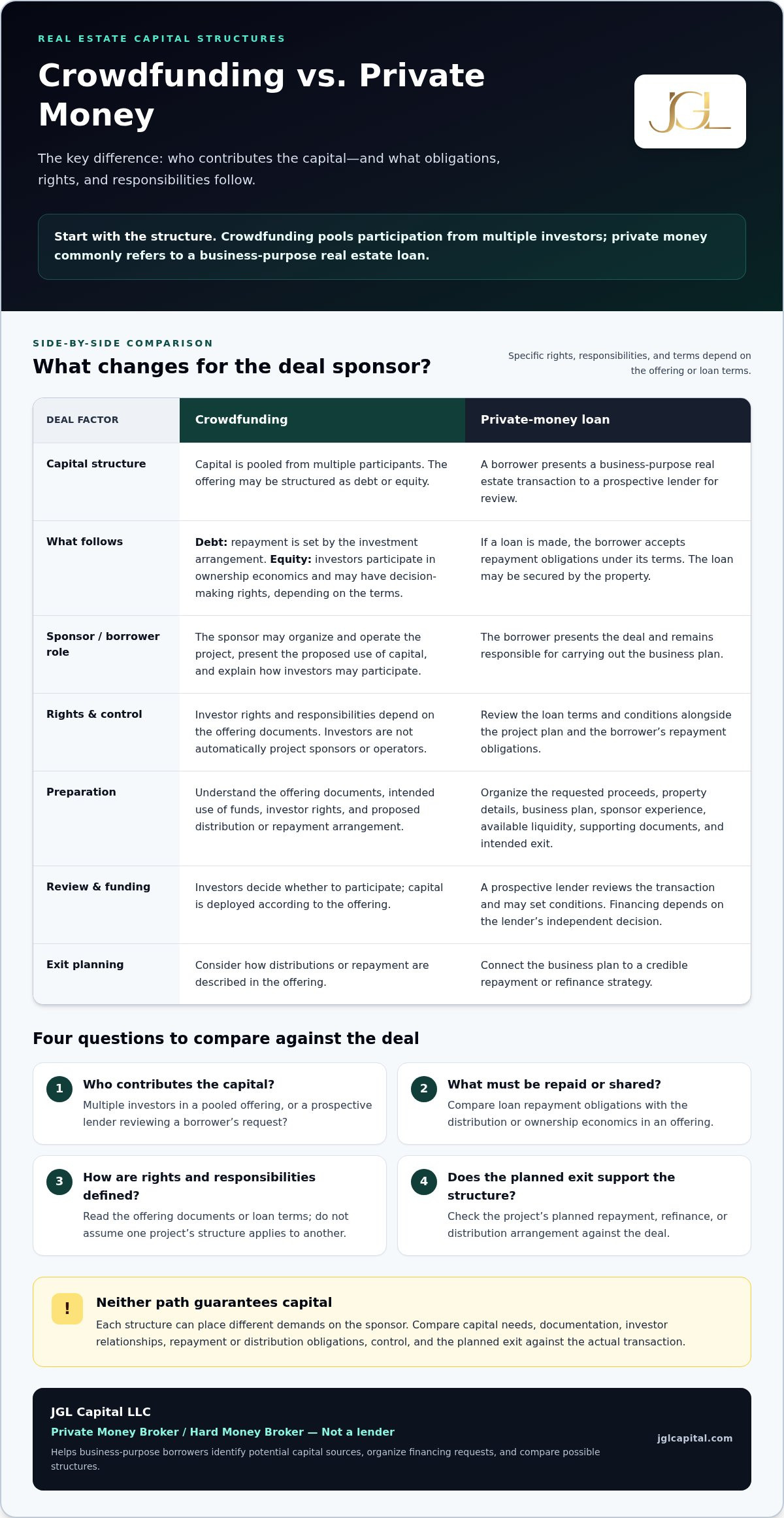
Compare Crowdfunding and Private Money Against Your Deal
Compare the structures against the transaction, not just the source of capital. When weighing real estate crowdfunding vs private money, ask who contributes funds, what obligations follow, how much control the sponsor retains, and whether the planned exit supports the arrangement.
| Consideration | Crowdfunding | Private-money loan |
|---|---|---|
| Capital structure | Capital is pooled from multiple participants; the offering may be debt or equity. | A prospective lender reviews a borrower’s request for a business-purpose loan. |
| Sponsor role | Organizes the project and communicates its proposed investment structure to participants. | The borrower presents the deal and remains responsible for executing the business plan. |
| Obligations | Distributions, repayment, and investor rights depend on the offering terms. | The borrower is responsible for repayment under the agreed loan terms. |
| Control and exit | Investor rights and the exit are governed by the project structure and offering documents. | Control and exit depend on the loan terms, business plan, and repayment strategy. |
Test each option against five practical factors: the amount and timing of capital needed, the readiness of property and sponsor documents, the project schedule, your capacity to manage investor communication, and the credibility of the repayment or distribution plan. Compare complete structures and conditions. Neither path is inherently less costly or faster. A transitional project may warrant evaluating a bridge loan alongside other options. For development, pay close attention to project assumptions, budget, schedule, and documentation.
When a pooled-investment structure may fit the sponsor
Crowdfunding may suit a sponsor prepared to present a defined opportunity, communicate with multiple participants, and manage those relationships in line with the offering. Investor participation, platform terms, and applicable offering requirements depend on the transaction, so the structure needs project-specific review.
When a private-money loan structure may fit the transaction
A loan may fit a business-purpose project when the borrower can explain the property plan and present a credible repayment or refinance exit. For development, consider the project’s financing needs alongside its construction plan. JGL CAPITAL LLC is a private-money broker, not a lender. Submit a concise deal summary for a financing-fit review to help assess potential private-money options.
How JGL CAPITAL Helps Compare Private-Money Options
JGL Capital LLC is a private-money broker and capital advisor, not a direct lender. For eligible business-purpose real estate transactions, its role includes an initial fit review, organizing the financing request, identifying potential capital sources, comparing possible structures, and coordinating communication. This can give a borrower a clearer basis for evaluating private-money options within the broader real estate crowdfunding vs private money decision. It does not mean capital is assured.
Each prospective lender makes its own underwriting and approval decisions. The selected lender determines whether to proceed and sets any rates, terms, proceeds, documentation requirements, conditions, and timing. A broker can help present the transaction clearly, but cannot commit a lender or determine the final outcome.
What to prepare for an initial financing-fit review
A concise deal summary helps clarify what the transaction requires and where questions remain. Include:
- The property, transaction purpose, requested financing, and current project status.
- The key deadline, sponsor’s relevant experience, and available capital for the project.
- Which supporting documents are ready and which remain outstanding.
- The business plan and a realistic repayment, refinance, or other intended exit strategy.
Specifics matter. For a property acquisition, explain the intended use of the property and how financing fits the sponsor’s plan. A property description alone does not show how the transaction will work.
What a broker can, and cannot, determine
JGL Capital can help package the request, identify potential lender sources, compare prospective programs, and coordinate communication during the review process. This comparison can help a borrower understand how possible structures relate to the transaction, while leaving lender-specific decisions with each lender.
Financing discussed is for business-purpose transactions, is determined by the lender, and remains subject to the lender’s final review and approval. A fit review is a starting point, not a funding commitment. Borrowers considering private-money financing can share a concise transaction summary to discuss its financing fit and potential structures.
Choose a Funding Path That Supports the Exit
The financing decision should hold up beyond the initial capital raise or closing. Before moving forward, make sure the structure aligns with the project’s operating plan, your capacity to meet its obligations, and the way capital is expected to be repaid or distributed. That is the practical test behind real estate crowdfunding vs private money: does the arrangement support the deal from execution through exit?
If private-money financing is under consideration, JGL CAPITAL LLC’s broker-first approach can help organize a business-purpose request and compare potential private and institutional capital sources. JGL CAPITAL is not a lender, and each prospective lender makes its own decisions. The aim is to clarify the available paths, not presume an outcome.
Discuss your business-purpose real estate transaction with JGL CAPITAL to explore potential capital sources and identify the financing questions your deal needs to answer.
Frequently Asked Questions
Is real estate crowdfunding a loan?
Not necessarily. Real estate crowdfunding may involve a debt offering or an equity interest, so the term alone doesn’t establish whether the project is borrowing. Review the offering documents to identify who owes repayment, whether distributions depend on performance, what rights participants receive, and how the exit is defined. For a sponsor, these details shape the project’s obligations and the capital contributors’ roles.
Can a real estate project use crowdfunding and private money together?
Potentially, but the structures must be compatible. Before arranging both, map repayment priority, collateral, cash-flow obligations, decision rights, and each capital source’s exit assumptions. For example, an existing investor distribution plan may affect the cash available for loan payments. Lender terms and offering documents may also condition additional financing, so any required approvals and the relationship between capital sources need to be addressed for the specific transaction.
Does a crowdfunding platform guarantee that a real estate project will succeed?
No. A platform or offering may provide a way for investors to participate, but it does not assure project completion, repayment, distributions, or investment returns. Outcomes can depend on execution, costs, property performance, market conditions, and the sponsor’s plan. Investors and sponsors should distinguish the platform’s role from the project’s underlying risks and consider what happens if the schedule, budget, or expected exit changes.
Is private money the same as a private-money broker?
No. Private money refers to a potential financing source or loan structure. A private-money broker helps borrowers identify and compare prospective lender programs and coordinate a financing request. JGL CAPITAL LLC is a private-money broker and capital advisor, not a lender or source of loan proceeds. Any prospective lender independently reviews the request and determines whether to proceed and on what terms.
What information should a sponsor prepare before comparing financing options?
Prepare a concise deal summary with the property type and location, transaction purpose, requested financing, project status, and key deadline. Add the business plan, sponsor experience, available capital, documentation status, and intended repayment, refinance, or sale exit. If the project is underway, note material changes to the budget or schedule. This gives you a clearer basis for comparing structures and identifying gaps in the request.