

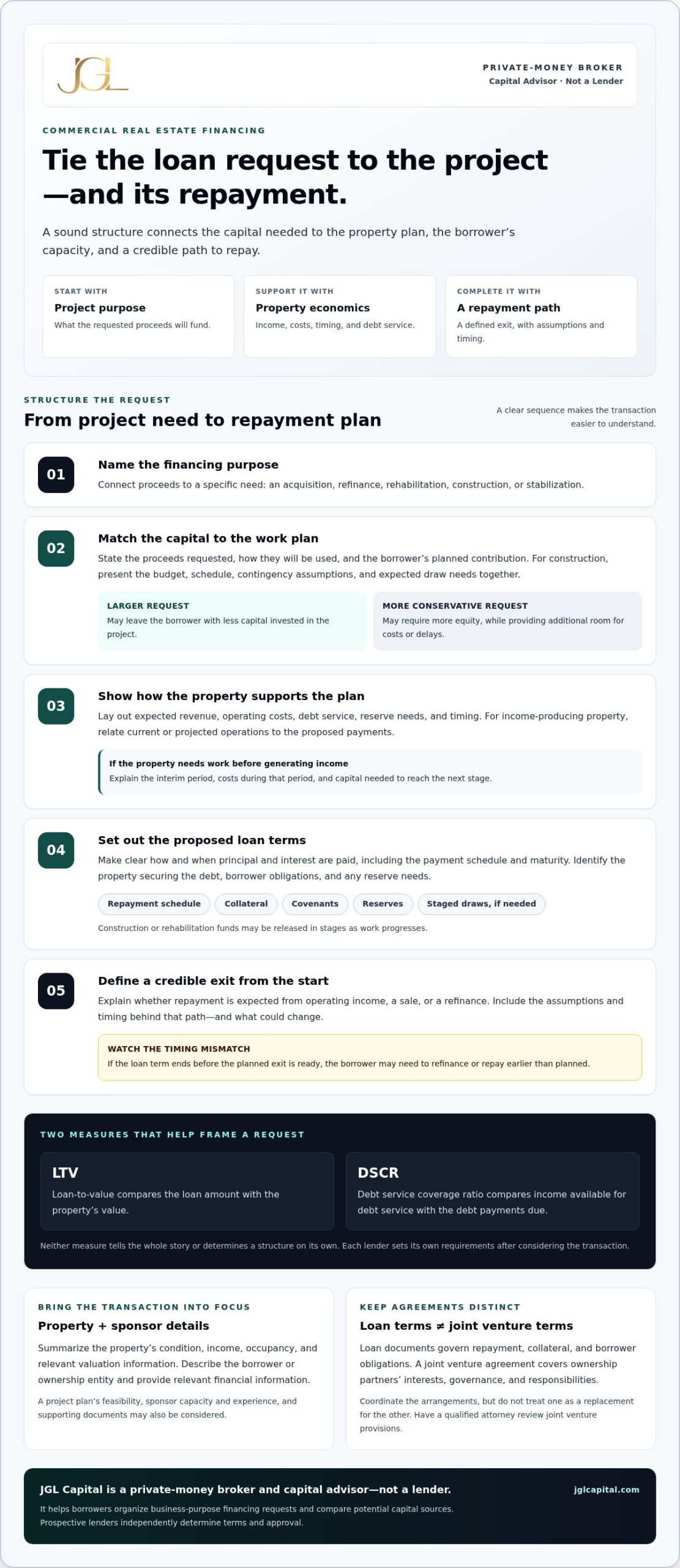
The largest loan a property can support on paper may not be the right loan for the project. To understand how to structure a commercial real estate loan, connect the requested capital to the property’s income or development plan, the borrower’s capacity, and a credible path to repayment.
Leverage, interest, and monthly payments matter, but they are only part of the structure. Timing, reserves, payment schedule, and what happens when the loan reaches maturity matter too. A mismatch between the loan term and the project timeline, for example, can leave a borrower needing to refinance or repay before the planned exit is ready.
This guide covers the main parts of a commercial real estate loan request, the documents that help explain it, and the trade-offs to consider when comparing financing structures and exit plans. JGL Capital LLC is a private-money broker and capital advisor, not a lender. It helps borrowers organize business-purpose financing requests and compare potential capital sources; prospective lenders make their own underwriting and approval decisions.
Key Takeaways
- Learn how to structure a commercial real estate loan by connecting the requested amount and repayment plan to the property’s purpose and economics.
- Separate the key elements of a proposed structure, including repayment, collateral, borrower obligations, reserves, and exit.
- Use a concise transaction summary to organize details about the property, use of proceeds, sponsor, timing, and intended repayment path.
- Understand how JGL CAPITAL, as a private-money broker and capital advisor rather than a lender, helps organize requests and compare potential capital sources.
What Does It Mean to Structure a Commercial Real Estate Loan?
A commercial real estate loan structure is the set of proposed terms for a particular business-purpose transaction. It covers more than the principal amount. It also explains how repayment is expected to work, what property secures the financing, which borrower obligations apply, whether reserves or staged draws are needed, and how the balance is expected to be repaid at maturity. A general overview of a commercial mortgage can provide context, but the structure needs to reflect the specific property, borrower, financing program, and transaction.
A sound loan structure aligns the project’s capital needs with the borrower’s capacity to repay and the property’s ability to support the plan.
Which elements make up a commercial real estate loan structure?
Proceeds identify what the financing will cover, such as an acquisition, rehabilitation, or construction. Repayment terms describe when and how principal and interest are paid, including the payment schedule and maturity. Collateral is the property securing the debt, while covenants set out obligations the borrower must meet. Reserves may cover specified project or loan needs, and a draw process may release construction or rehabilitation funds in stages as work progresses.
Two measures can help frame a request. Loan-to-value (LTV) compares the loan amount with a property’s value. Debt service coverage ratio (DSCR) compares income available for debt service with the debt payments due. Neither measure tells the whole story or determines a structure on its own. Each lender sets its own requirements after considering the transaction. When planning how to structure a commercial real estate loan, make sure the proposed terms support a clear repayment plan and exit.
Loan structure is not the same as a joint venture agreement
Loan documents govern the financing relationship, including repayment, collateral, and borrower obligations. A joint venture agreement covers a separate relationship among ownership partners, including their respective interests, governance, and responsibilities. The two arrangements should be coordinated, but one does not replace the other.
Have a qualified attorney review joint venture agreement provisions. JGL CAPITAL is a private-money broker and capital advisor, not a lender. It helps organize financing requests and compare potential capital sources, while prospective lenders independently determine terms and approvals.
How Do Property Economics and Repayment Shape the Loan Request?
A property is important collateral, but it is not the whole story. Lenders may also consider the sponsor’s financial capacity and experience, the quality of the supporting documents, and whether the project plan is feasible. The OCC Commercial Real Estate Lending Handbook provides additional context on how lenders evaluate commercial real estate risk.
Start by linking the requested proceeds to a specific need. An acquisition request supports a purchase; a refinance addresses existing debt; rehabilitation funds planned improvements; construction financing supports a build; and stabilization capital may help a property move toward consistent operations. For a construction project, present the budget, schedule, contingency assumptions, and expected draw needs together. This lets prospective lenders consider the proposed funding sequence alongside the work plan.
Match the financing purpose to the property and business plan
Use the property’s economics to explain the repayment request. Lay out expected revenue, operating costs, debt service, reserve needs, and timing. For an income-producing property, show how current or projected operations relate to the proposed payments. For a property that needs work before it can generate income, explain the interim period, the costs during that period, and the capital needed to reach the next stage.
Compare leverage and repayment trade-offs
Requested proceeds, borrower equity, reserves, and debt service affect one another. A larger request may leave the borrower with less capital invested in the project, while a more conservative request may require more equity but provide additional room to manage costs or delays. The right balance depends on the transaction, and each lender sets its own requirements.
Include a credible exit in the initial financing plan. Repayment depends on a defined path, not simply on the expectation that conditions will improve. Consider whether repayment is expected from operating income, a sale, or a refinance. Explain the assumptions and timing behind that path, and account for what could change. When organizing how to structure a commercial real estate loan, put these assumptions in the project summary. JGL CAPITAL, a private-money broker and capital advisor, helps borrowers organize requests and compare potential capital sources. Commercial real estate financing guidance can be a useful starting point.
How to Prepare a Commercial Real Estate Loan Request
A well-organized request helps a lender understand the transaction, the property, and the proposed repayment plan without having to reconcile conflicting details across documents. Use this six-part readiness sequence to assemble the core picture:
- Transaction: Identify the property and whether the request is for a purchase, refinance, or project.
- Capital: State the proceeds requested, how they will be used, and the borrower’s planned contribution.
- Collateral: Summarize the property’s condition, income, occupancy, and relevant valuation information.
- Sponsor: Describe the borrower or ownership entity and provide relevant financial information.
- Timing: Explain the project stage, key milestones, and when capital is needed.
- Exit: Set out the anticipated repayment path and the assumptions behind it.
Build a coherent transaction summary
Start with a concise account of the property, transaction purpose, requested proceeds, project status, and proposed repayment path. Then check that the narrative agrees with the supporting materials. Purchase terms, project budget, income figures, and timeline should tell the same story. This summary is a practical starting point for considering how to structure a commercial real estate loan around the actual transaction.
Depending on the property and request, relevant materials may include leases, a budget, valuation information, entity documents, and available financial records. Construction or rehabilitation plans may also need a schedule and itemized cost details.
Identify gaps before lender submissions
Review the package for missing or inconsistent details, such as title, insurance, valuation, entity, budget, or financial materials where relevant. Requirements vary by lender and transaction. An organized package makes the request clearer, but it does not determine underwriting, approval, or closing timing.
JGL CAPITAL is a private-money broker and capital advisor, not a lender. To discuss a business-purpose request and organize its key details, Discuss your business-purpose transaction.
How JGL CAPITAL Helps Borrowers Explore Financing Structures
JGL CAPITAL LLC is a private-money broker and capital advisor, not a direct lender. It does not lend its own funds or make underwriting or approval decisions. Its role is to help borrowers organize a business-purpose financing request, identify potential private and institutional capital sources, compare lender programs, and coordinate communication as the request moves forward.
The process begins with an initial fit review of the transaction. JGL CAPITAL can then help package the deal information, identify potential capital sources, and compare proposed structures in light of the property, project needs, and repayment plan. This can help clarify trade-offs, but it does not guarantee lender interest or particular terms.
What a broker contributes to the structuring process
A broker brings the deal facts into one clear presentation and helps assess how different lender programs may relate to those facts. JGL CAPITAL’s approach includes 5 Star Service, with an emphasis on attentive communication and a collaborative process. Prospective lenders independently determine underwriting requirements, proceeds, documentation, rates, terms, and closing timelines.
That distinction matters when considering how to structure a commercial real estate loan: the broker helps prepare and coordinate the request, while the selected lender evaluates it and makes the financing decision.
What to expect from an initial financing-fit discussion
Bring a concise summary of the property, transaction purpose, proceeds requested, project status, timeline, and intended exit. Clear information helps frame the initial discussion and identify what additional materials may be relevant. Financing is for business purposes and remains subject to review by a selected lender. An initial discussion does not guarantee lender interest, approval, funding, or particular proceeds or terms.
If you’re preparing a commercial real estate request, submit a concise deal summary to begin an initial financing-fit review with JGL CAPITAL.
Put Your Financing Plan on a Clear Path
Turn your project assumptions into a concise, candid account of what the transaction requires and how you expect to repay the financing. That preparation gives a capital advisor a clearer basis for discussing potential financing paths and helps identify questions to resolve before the request advances.
It connects borrowers with potential capital sources through a nationwide lender network, subject to legal and practical availability. If you’re weighing how to structure a commercial real estate loan, an initial review can help frame the request and compare potential lender programs without implying approval or a particular outcome.
Bring the property, purpose, requested proceeds, timeline, and intended exit into one short deal summary. Submit your deal summary for an initial financing-fit review, and take the next step with a clearer basis for discussion. A well-prepared request is a practical foundation for moving forward with discipline.
Frequently Asked Questions
Is a commercial real estate loan term sheet a commitment to fund?
No. A term sheet generally outlines proposed financing terms, but it is not assurance that funds will be provided. The selected lender may still require underwriting, due diligence, supporting documents, and satisfaction of closing conditions before making a final decision. When considering how to structure a commercial real estate loan, distinguish an indicative proposal from final, executed financing documents.
Can a commercial real estate loan request include multiple properties?
Yes, a request may include more than one property, depending on the lender’s program and review. For example, an investor seeking financing across several rental assets can provide a property schedule showing ownership, occupancy, income, existing debt, and requested use of proceeds for each. Keep property-level figures distinct, even when the assets share an ownership entity, so the lender can assess each asset and the combined request.
What is the difference between a commercial loan structure and a joint venture agreement?
A commercial loan structure sets the financing terms between the borrower and lender; a joint venture agreement governs arrangements among the project’s ownership partners. For example, loan documents may identify the borrower responsible for repayment, while the JV agreement addresses how partners share decision-making or project economics. These documents serve different purposes, so have a qualified attorney review JV provisions for your circumstances.
Can a commercial real estate loan be repaid through refinancing?
Yes, refinancing can be a planned repayment path, but it depends on whether a future lender is willing to extend financing at that time. A borrower might plan to refinance after renovations are complete and the property is operating. That plan is not assured: property performance, value, borrower circumstances, market conditions, and the future lender’s requirements can affect the outcome.
Does JGL CAPITAL make commercial real estate loans?
No. JGL CAPITAL is a private-money broker and capital advisor; it does not lend its own money. The company helps borrowers present business-purpose transactions to potential capital sources, while the selected lender determines whether to proceed and sets any financing terms. If you’re considering a request, prepare a concise summary of the property, transaction, requested proceeds, and intended repayment path for an initial review.