

At closing, final financing terms are documented and funds are prepared for disbursement. Knowing what to expect at a private money loan closing means understanding the costs collected, the documents you sign, and how money moves through settlement. The settlement agent typically collects and distributes funds according to the transaction terms.
It’s reasonable to want clarity before signing or wiring money, especially when closing costs and funding instructions affect the transaction. This guide covers common closing documents, costs that may appear on the settlement statement, and how loan proceeds and borrower funds are handled. It also explains how to review wiring instructions carefully, so you understand each figure and funding detail.
Key Takeaways
- Know which final loan terms and closing documents to review before signing.
- Understand the types of charges that may appear on a closing statement and how funds are distributed.
- Learn what the promissory note and security instrument establish about repayment and the property.
- See how wiring funds to the designated attorney or title company helps keep closing funds moving through the transaction.
What happens at the loan closing?
At closing, the borrower reviews final terms, signs loan documents, and arranges for funds to reach the settlement agent. Knowing what to expect at a private money loan closing begins with seeing how the proposed financing and property details appear in the final paperwork.
Reviewing Fees and Loan Details
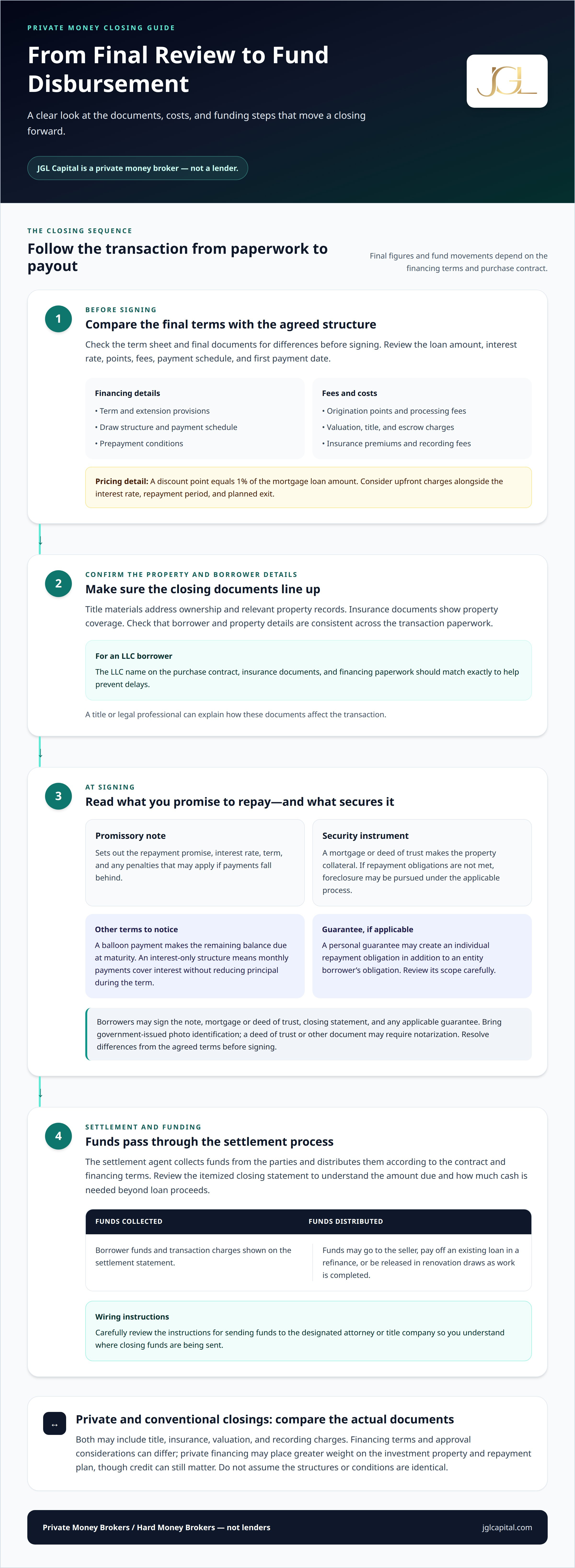
The pre-closing review compares the final proposed financing terms and closing costs with the agreed transaction. Before closing, the lender may review final fees, the loan amount, and the first payment date. A term sheet can outline the interest rate, points, term, extensions, prepayment provisions, draw structure, and estimated costs. Comparing these details with the final documents can reveal discrepancies before signing.
Title, Insurance, and Legal Review
Title, insurance, and legal reviews establish how the property and borrower are identified in the closing documents. Title materials address ownership and records relevant to securing the financing, while insurance documents show the property’s coverage. For an LLC borrower, the LLC’s name on the purchase contract, insurance documents, and financing paperwork should match exactly to help prevent delays. A title or legal professional can explain how these documents affect the transaction.
Term Sheet and Agreement Review
The term sheet summarizes proposed financing, while the final agreement sets out repayment and security terms. Before signing, compare the loan amount, rate, fees, draw provisions, extension terms, prepayment conditions, and payment schedule with the agreed structure. The note may specify penalties for default, and the security instrument may allow foreclosure if repayment obligations are not met. A balloon payment makes the remaining balance due at maturity; a personal guarantee may create individual liability for an entity borrower. Procedures and transaction costs vary by state and settlement arrangements.
Signing the Loan Papers
At signing, borrowers review and execute the note, mortgage or deed of trust, closing statement, and any applicable guarantee. A deed of trust or other document may require notarization, so bring government-issued photo identification. Resolve any term that differs from the agreement before signing. The Consumer Financial Protection Bureau lists (855) 411-CFPB (2372) for submitting a complaint about a mortgage closing.
Closing costs and disbursements
Closing costs are transaction expenses collected at settlement; disbursement is the distribution of funds by the settlement agent. Final figures and where the money goes depend on the financing terms and purchase contract.
Typical Closing Costs
Closing costs for private money financing may include origination points, lender or processing fees, valuation fees, title and escrow charges, insurance premiums, and recording fees. Each charge serves a different purpose, such as assessing the property or recording the security documents. Review the itemized statement to understand what is due at closing and how much cash is needed beyond the loan proceeds. The settlement agent collects funds from the parties and distributes them according to the contract and financing terms.
Costs and Loan Pricing
Loan pricing combines the interest rate with upfront charges such as points, so the rate alone does not show the full borrowing cost. A discount point equals 1% of the mortgage loan amount. The term sheet may also identify lender fees, estimated closing costs, and any applicable draw structure. Consider each charge alongside the repayment period and planned exit, since a lower rate can come with different upfront costs. The closing statement shows how these amounts affect the funds needed to complete the transaction.
Private and Conventional Closing Comparisons
Private money and conventional mortgage closings may share settlement expenses, such as title, insurance, valuation, and recording charges, but their financing terms and approval considerations can differ. Private lenders may place greater weight on the investment property and repayment plan, though credit can still matter. Compare the actual term sheet and settlement statement rather than assuming the structures or conditions are identical.
Once the loan is signed, the title company records the documents and sends funds to the seller, or pays off the existing loan in a refinance. If renovation financing is included, funds are usually released in draws as work is completed. A private money broker service can help align financing structure with an investment property’s objectives.
Promissory note and security instrument
These documents set out the borrower’s repayment obligation and identify the real estate securing the financing. Read together, they explain what you are committing to and how the property serves as collateral.
The Promissory Note
The promissory note is the borrower’s written promise to repay under specified terms. It sets out the interest rate, repayment term, and any penalties that may apply if payments fall behind. Because these provisions define the borrower’s financial obligations, compare them with the agreed financing structure before signing.
Some private money loans are structured as interest-only, meaning monthly payments cover interest without reducing principal during the term. In that case, the note’s maturity and repayment provisions matter because the principal remains due under the stated terms. The lender’s chosen name should also appear consistently in the loan documents: a personal lender name is paired with a Social Security number, while a business or other entity name is paired with its tax identification number.
The Security Instrument
A mortgage or deed of trust is the security instrument that makes the property collateral for the financing. By signing it, the borrower grants the lender a security interest in the real estate; if the borrower does not repay as agreed, the lender may pursue foreclosure under the applicable process. The note sets out the repayment promise, while the security instrument secures that promise against the property.
For an entity borrower, closing documents may also include a personal guarantee. It can create an individual repayment obligation in addition to the entity’s, so review its scope carefully. Confirm that the borrower and property descriptions match the purchase contract and ownership structure. The note, security instrument, and any guarantee should reflect the same transaction, with consistent parties and terms.
Wiring funds to the attorney or title company
Closing funds generally move through the attorney or title company handling settlement, rather than through the borrower. Confirm the recipient, transfer method, and funding schedule before the closing date.
Confirming Where Loan Funds Are Held
Confirming where funds are held means identifying the exact settlement recipient and the account details supplied for the transaction. This matters because private money loan proceeds should go directly to the title company or specified attorney, not to the borrower or the borrower’s company. Obtain the title company’s official name, closing date and location, funding routing number, and any special requirements for alternative funding. Use those details to determine where the lender should submit funds.
If an IRA administrator is providing funds, account for its processing requirements. Processing time can affect the closing schedule, so confirm the steps and timing with the administrator early.
Paying and Transferring Closing Funds
Closing funds include the borrower’s required contribution and the lender’s proceeds, transferred through the settlement process. A private money lender can wire funds or send a certified check to the specified attorney or title company. For closing costs, the title company accepts a cashier’s check or wired funds, but not cash, personal checks, or credit cards. Follow the recipient’s stated instructions so the funds arrive in the required form.
At settlement, the agent distributes funds according to the purchase contract and financing terms. Proceeds may be paid to the seller or used to pay off an existing loan in a refinance.
Closing Timeline and Fund Disbursement
A prepared borrower may close a hard money loan in one to two weeks, although third-party reports and unresolved conditions can affect timing. Confirming the recipient and arranging access to funds early can help avoid preventable delays.
After signing, the title company records the documents and disburses funds to the seller or, for a refinance, the existing lender. Renovation proceeds may be released in draws as work is completed. Clear funding instructions help each party determine what must be received before disbursement. To discuss funding coordination for an investment property, connect about your private money transaction.
JGL Capital
JGL Capital is a private money broker and capital advisor, not a direct lender. It helps real estate investors explore business-purpose financing for investment properties and commercial transactions. If you’re reviewing proposed terms, closing requirements, or how financing fits a property’s plan, JGL Capital can help organize the request and compare potential lender options.
JGL Capital helps investors explore private money, bridge, and commercial real estate financing, as well as options for new construction and multifamily projects. The right fit depends on the property, borrower, business plan, and exit strategy, not simply on the mechanics of closing. Contact JGL Capital to discuss your business-purpose real estate transaction.
Make Your Next Financing Decision With Clarity
A closing is one part of a larger investment decision. The financing structure should support the property’s business plan and the borrower’s intended path forward, rather than create obligations that sit at odds with the project. Knowing what to expect at a private money loan closing can help you approach that decision with greater clarity, but the right financing conversation begins earlier, with the property and investment objectives.
JGL Capital is a private money broker and capital advisor, not a direct lender. It helps investors explore financing options aligned with their real estate plans, including New Construction Loans, Multi-Family Loans, and Bridge Loans. Every project has distinct considerations, and an initial financing-fit review can help clarify potential structures before the transaction moves toward closing.
If you’re evaluating financing for an investment property, contact JGL Capital about your loan. A clear next step can help you move forward with purpose and a financing approach grounded in your objectives.
Frequently Asked Questions
What documents are signed at a private money loan closing?
Borrowers commonly sign a promissory note, a mortgage or deed of trust, and a settlement statement. Depending on the transaction, an entity borrower may also sign a personal guarantee. For example, an LLC’s authorized signer may execute documents on the entity’s behalf, while the lender’s documents identify the individual or business responsible for repayment. The closing package should accurately reflect the agreed parties and transaction structure.
What closing costs and fees are typical for a private money loan?
Costs depend on the financing structure, property review, and settlement work. Compare estimated charges in the term sheet with the final settlement statement to assess the total, rather than judging financing by its interest rate alone. Points, processing, valuation, title, insurance, escrow, and recording charges may appear separately. The final statement shows which costs are collected at closing and how they affect the funds required.
What title search, title insurance, appraisal, and property inspections are required?
The lender’s due diligence determines which title, valuation, insurance, and property-condition materials are needed for the transaction. Valuation may involve an appraisal, broker price opinion, or after-repair-value estimate supported by comparable sales. Title review examines ownership and recorded matters relevant to the property’s use as collateral. Inspections may address property condition or project scope, particularly when renovation or construction is part of the financing request.