

What if the first step in real estate development isn’t finding capital, but showing that a project is worth financing? If you’re wondering how to get started in real estate development, the process can feel difficult to sequence, especially when you’re unsure what experience, relationships, or resources you need. You don’t need every piece in place before you begin, but you do need a credible plan and a clear view of what still needs to be learned.
This guide walks through the main stages of development, from assessing an opportunity and assembling a capable team to preparing project information and considering financing options. You’ll see why a clear budget, realistic schedule, and defined exit strategy matter when presenting a first project to prospective capital sources.
Financing is one part of that preparation, not a substitute for it. A private money broker can help organize a business-purpose financing request and identify prospective lenders, but does not lend or approve funds. Understanding that distinction can help you approach capital with clearer expectations and a more disciplined project plan.
Key Takeaways
- To understand how to get started in real estate development, clarify the developer’s role and choose a first project that matches your experience and resources.
- Assess the site, market, costs, schedule, and potential exit before making major commitments.
- Education and capital needs vary. Build relevant experience and understand the financial capacity your project may require.
- Prepare a concise project summary for financing discussions. A private money broker can help organize the request and identify prospective capital sources, but does not lend or approve funds.
How to Get Started in Real Estate Development: Define the Work and Your First Move
Real estate development means coordinating a property project from concept and feasibility through construction or repositioning. It differs from passive property investment: an investor may provide capital or hold an asset, while a developer helps shape the project and coordinate the people, decisions, and resources required to advance it. The Real Estate Development Overview describes the range of professional roles involved.
What does a real estate developer do?
A developer brings together the property or land, project plan, professional team, capital strategy, and execution. The role is distinct from each specialist’s contribution: a broker facilitates a property transaction, an architect develops design plans, and a contractor carries out construction. An investor may participate financially without managing those stages. Responsibilities vary by project and experience, and developers may lead the full process or share responsibility with partners. The central task is keeping the project’s moving parts aligned.
Choose a starting path that matches your experience
There are two related but distinct ways to begin. For a career path, build familiarity through relevant work in construction, finance, architecture, or property operations. These roles can show you how decisions about scope, cost, and timing affect one another. For a business-purpose project, start with a defined opportunity and an honest assessment of your capacity to lead it. Ask yourself:
- Which skills can you contribute, and where will you need experienced partners?
- What professional relationships can help you assess and execute the concept?
- How much responsibility are you prepared to take for planning, coordination, and financial decisions?
There’s no single route into the field. A practical answer to how to get started in real estate development is to choose the path that fits your current capabilities, then identify the experience or support needed to address gaps.
The Real Estate Development Process: Test Feasibility Before Advancing
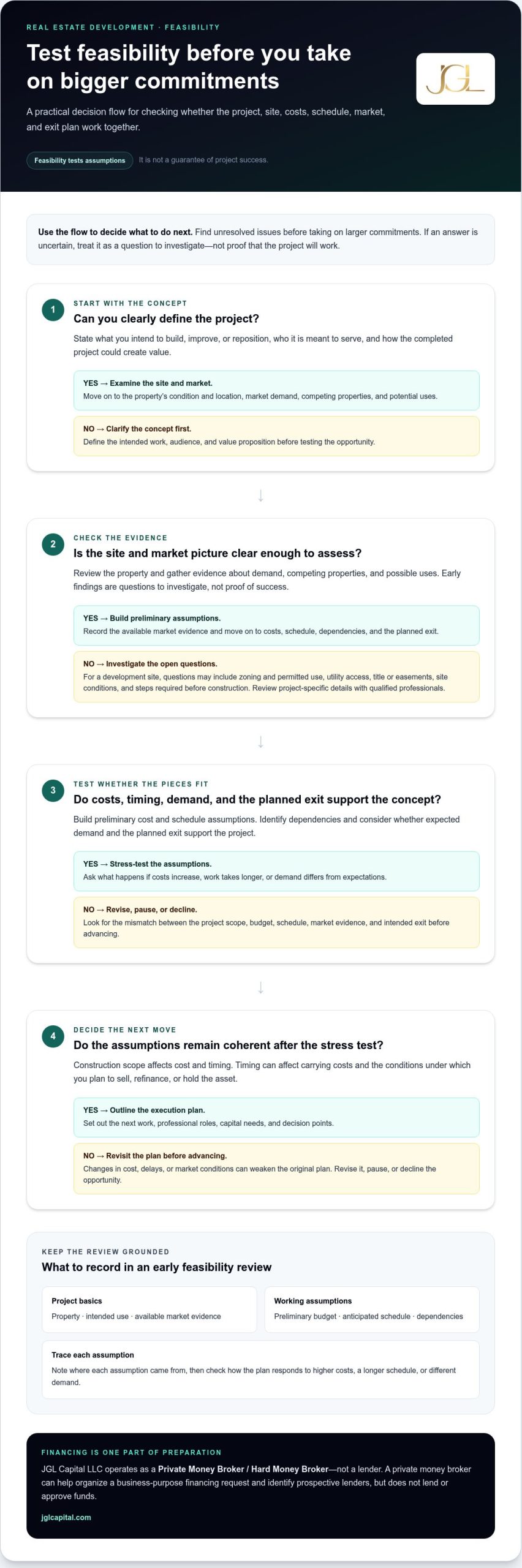
A disciplined review helps you determine whether the project concept, costs, schedule, market demand, and intended exit can work together. Feasibility is a way to test assumptions, not a guarantee of project success. For anyone learning how to get started in real estate development, the goal is to find unresolved issues before taking on larger commitments.
- Define the project. State what you intend to build, improve, or reposition, who it is meant to serve, and how the completed project could create value.
- Examine the site and market. Review the property’s condition and location. Gather evidence about demand, competing properties, and potential uses, treating early findings as questions to investigate rather than proof of success.
- Test feasibility. Build preliminary cost and schedule assumptions, identify dependencies, and consider whether expected demand and the planned exit support the concept.
- Plan execution. If the assumptions remain coherent, outline the next work, professional roles, capital needs, and decision points. Harvard’s Introduction to Real Estate Development offers additional context on the field.
What belongs in an early feasibility review?
Record the property, intended use, available market evidence, preliminary budget, anticipated schedule, and dependencies that could affect progress. Note where each assumption came from. Then test what happens if costs increase, work takes longer, or demand differs from expectations. For a development site, unresolved questions may include zoning and permitted use, access to utilities, title or easement issues, site conditions, and the steps required before construction. These details are project-specific and should be reviewed with qualified professionals.
Why do budget, schedule, and exit need to agree
Construction scope affects cost and timing. Timing can affect carrying costs and the conditions under which you plan to sell, refinance, or hold the asset. Changes in cost, delays, or market conditions can weaken the original plan. Use the review to decide whether to proceed, revise, pause, or decline. If financing is part of the plan, a documented feasibility review can help frame the opportunity for discussion with JGL Capital LLC.
Starting Real Estate: Do You Need a Degree or Capital?
A degree can build useful knowledge, but there’s no universal entry route into development. That doesn’t mean every project is within reach: the experience, documentation, financial capacity, and capital required depend on the role, project, lender, and individual circumstances. Learning the fundamentals is different from being ready to take responsibility for a specific project.
Relevant courses can provide a framework for topics such as site selection, financing, and project planning. Columbia Business School Real Estate Development Course is one educational reference. Study can strengthen your understanding, but it doesn’t replace project-specific judgment, professional input, or the resources required to execute a plan.
Which skills and relationships can help a new developer?
Project coordination, financial literacy, clear communication, market research, and disciplined recordkeeping help developers make decisions and keep responsibilities visible. An architect, contractor, broker, legal counsel, or accountant may contribute expertise, depending on the project. A practical first step is to identify what you can manage yourself and where you need experienced support.
Consider the trade-offs among three entry paths:
- Employment in a related role: Builds experience and exposes you to project work, though you may have less control over decisions.
- Partnership: Can combine complementary skills and resources, but requires clear agreement on responsibilities, authority, and risk.
- Independent project: Offers greater control while placing more demands on your experience, capacity, documentation, and capital plan.
How can you reduce avoidable uncertainty before committing?
Write down the project assumptions, each participant’s responsibilities, anticipated funding needs, contingencies, and possible exit alternatives. List the questions that remain open and get appropriate professional input before relying on assumptions that could change the project. Preparation won’t remove risk, but it can bring gaps to light before they become commitments.
There’s no universal entry route, and each project has its own demands. If you’re preparing a business-purpose development financing request, you can discuss your project with JGL CAPITAL while considering potential capital sources.
How to Prepare a Development Project for Potential Financing
A credible financing request starts with a clear account of the project, not simply a request for capital. If you’re learning how to get started in real estate development, organizing the deal information can help prospective lenders understand the opportunity, the sponsor’s role, and the intended repayment or exit plan.
Prepare a concise summary covering:
- Property: Identify the site or asset and provide relevant property information.
- Scope: Describe the proposed construction, improvement, or repositioning.
- Budget and schedule: Show preliminary project costs and the anticipated sequence of work.
- Sponsor: Summarize relevant experience and the responsibilities each participant will take on.
- Capital plan and exit: Explain the anticipated sources of capital and the intended strategy for completing the transaction.
Support the summary with available property information, budget details, a schedule, and sponsor documents. Depending on the project, useful materials may also include site plans, construction estimates, a purchase agreement, and information about site control. Requirements vary by lender, project, and financing structure, so organize what you have and clearly label estimates or outstanding items.
What may lenders review?
Lenders may assess the property, borrower qualifications, liquidity, supporting documentation, project feasibility, and exit strategy. A well-prepared summary makes these elements easier to understand, but doesn’t determine the outcome. Each lender sets its own program requirements and independently makes underwriting and approval decisions, including decisions about terms, proceeds, and closing timelines.
How can a private money broker support the process?
JGL CAPITAL LLC is a private money broker and capital advisor, not a direct lender. It helps organize business-purpose financing requests, identify prospective private and institutional capital sources, compare lender programs, and coordinate communication. JGL CAPITAL also provides 5 Star Service. Its role is to help present the opportunity and facilitate discussion; prospective lenders set their own requirements and make decisions about underwriting, approval, and final terms.
To discuss a business-purpose development project and its financing request, connect with JGL CAPITAL.
Make Your Next Development Decision Deliberately
The next step doesn’t have to be a major commitment. Choose one action that will clarify your opportunity, such as documenting an unresolved assumption, defining your role with potential partners, or identifying what must be decided before the project advances. Keep a record of what you learn and what still needs attention. That discipline can help turn an ambitious idea into a more considered business-purpose project.
Learning how to get started in real estate development is less about having every answer at the outset and more about making informed decisions as the work unfolds. Move at a pace that matches your preparation, and seek capital guidance when financing becomes part of the plan.
Discuss your business-purpose development project with JGL CAPITAL to explore a possible financing path.
Frequently Asked Questions
How do I get started in real estate development with no experience?
Start by learning how projects are evaluated before taking responsibility for one. A role with a developer, contractor, property company, or related firm can expose you to budgets, schedules, and coordination in practice. If you’re exploring how to get started in real estate development independently, seek an experienced partner and take on a clearly defined role that matches your current skills. Don’t treat a first project as a substitute for preparation.
Do you need a degree to become a real estate developer?
No single degree is required to enter the field, though education in finance, business, construction, architecture, or real estate can help build relevant knowledge. A credential alone doesn’t show whether someone is ready to lead a particular project. Consider the capabilities involved, including evaluating financial assumptions, coordinating specialists, communicating decisions, and maintaining reliable records. Practical experience and the ability to assemble suitable expertise also matter.
How much money do you need to start a real estate development project?
There’s no universal amount. Capital needs depend on the property, project scope, costs, financing structure, and lender requirements. A preliminary capital plan should account for more than construction. Consider acquisition, professional work, reserves, carrying costs, and contingencies as relevant to the project. A private money broker does not provide the capital. Prospective lenders assess financing requests, and the sponsor needs to understand their own financial capacity.
What should be included in a real estate development plan?
Include a concise explanation of the project’s purpose, the property, intended use, expected demand, scope of work, preliminary budget, schedule, team responsibilities, capital approach, and planned exit. Add the assumptions behind the numbers and note unresolved questions that could affect timing. For example, distinguish confirmed estimates from early allowances so partners can see what is established and what still needs investigation.
Can a real estate development project use private financing?
Private financing may be a potential capital path for a business-purpose development project, subject to lender requirements and underwriting. JGL CAPITAL LLC is a private money broker and capital advisor, not a lender. It can help organize a request and identify prospective capital sources. The selected lender independently decides whether to approve the request and sets any terms, proceeds, documentation requirements, and closing timeline.