

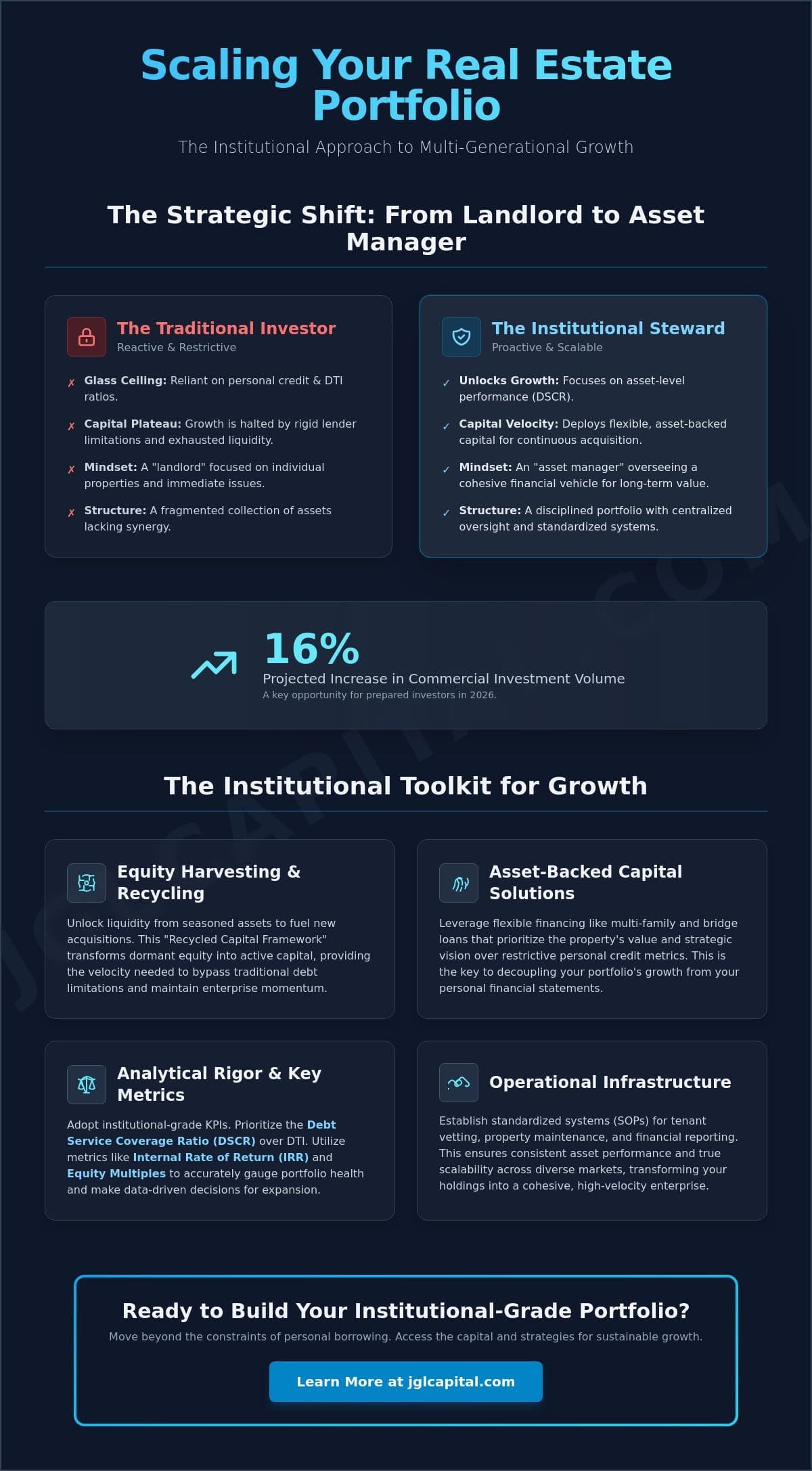
The traditional reliance on personal credit and debt-to-income ratios represents the ultimate glass ceiling for the ambitious investor, yet many remain tethered to these restrictive retail frameworks. Understanding how to scale a real estate portfolio in 2026 requires a fundamental departure from individual property ownership toward a disciplined, institutional architecture. You may have already encountered the exhaustion of personal liquidity or the rigid limitations of traditional lenders, which often hinder the ability to capitalize on the 16 percent increase in commercial investment volume projected for this year.
It’s a common realization among sophisticated partners that the operational habits which secured initial holdings are insufficient to sustain a high-velocity enterprise. This strategic guide promises to master the financial frameworks and operational disciplines required to transition from fragmented ownership to an institutional-grade portfolio. By examining the mechanics of recycling equity and accessing flexible, asset-backed capital for multi-family or new construction projects, we provide the rigorous roadmap necessary for the creation and preservation of long-term value. We’ll move beyond the constraints of personal borrowing to establish a foundation for sustainable, multi-generational growth.
Key Takeaways
- Understand the fundamental transition from reactive property ownership to a disciplined model of portfolio stewardship that prioritizes institutional-grade value preservation.
- Learn the mechanics of equity harvesting to unlock liquidity from seasoned assets, providing the necessary capital velocity to bypass the limitations of traditional debt.
- Identify the sophisticated financial frameworks and transitional capital strategies required for how to scale a real estate portfolio into higher-yield asset classes.
- Evaluate the operational infrastructure and standardized systems required to ensure consistent asset performance as your holdings expand into a cohesive enterprise.
- Discover how to leverage asset-backed capital solutions, including multi-family and bridge loans, to prioritize property value and strategic vision over restrictive credit metrics.
The Strategic Shift: Transitioning from Individual Assets to Portfolio Stewardship
Many investors mistakenly conflate the ownership of multiple properties with the management of a strategic portfolio. A mere collection of assets often lacks the synergy and centralized oversight required for institutional-grade expansion. Understanding how to scale a real estate portfolio necessitates a fundamental shift from reactive troubleshooting to proactive stewardship. This transition marks the point where personal credit metrics are superseded by asset-level performance. In the current 2026 environment, where returns are increasingly driven by rental income rather than speculative appreciation, the ability to identify and rectify underperforming assets within a stack is paramount for capital preservation.
Defining the Institutional Mindset in Real Estate
The transition from a ‘landlord’ to an ‘asset manager’ is characterized by the implementation of standardized reporting and rigorous Key Performance Indicators (KPIs). While a landlord focuses on the immediate concerns of tenant turnover and maintenance, an asset manager views each property as a component of a larger financial vehicle. The foundational principles of real estate investing often emphasize the acquisition of individual units, but institutional growth requires a broader perspective on capital stacks and risk-adjusted returns. This fiduciary perspective ensures that every decision aligns with the objective of long-term wealth creation, prioritizing stability and the delivery of customized solutions over short-term gains.
The Role of Analytical Rigor in Scalability
Scaling beyond the initial acquisition phase requires a deep commitment to analytical rigor. Investors must utilize sophisticated metrics such as Internal Rate of Return (IRR) and equity multiples to evaluate the health of their holdings accurately. A critical concept in this process is Portfolio Velocity. Portfolio Velocity is defined as the specific rate at which capital is deployed into high-yield assets and subsequently returned for reinvestment, ensuring that equity remains active rather than stagnant. Identifying the ‘capital plateau’ is equally essential. This occurs when the existing debt structure or equity stagnation prevents further acquisition. Recognizing these strategic signals allows for a timely pivot toward more flexible capital solutions, which is the core of how to scale a real estate portfolio effectively.
To facilitate this growth, we focus on the following key operational strengths:
- Standardized SOPs: Establishing uniform procedures for tenant vetting and property maintenance to ensure scalability across diverse markets.
- Risk-Adjusted Returns: Evaluating potential acquisitions based on their ability to withstand market volatility and deliver consistent income in 2026.
- Asset-Level Metrics: Shifting the focus from personal debt-to-income ratios to the property’s debt service coverage ratio to unlock institutional capital.
Financial Architecture: Leveraging Equity and Transitional Capital
The transition from credit-based borrowing to asset-backed capital velocity represents the most significant hurdle for investors seeking institutional-grade expansion. Traditional mortgage products, while sufficient for the acquisition of initial residential holdings, frequently impose debt-to-income ceilings that inadvertently stifle the momentum of a growing enterprise. To understand how to scale a real estate portfolio in the current economic climate, one must prioritize the Debt Service Coverage Ratio (DSCR) as the primary metric for leverage. This shift allows the lender to focus on the property’s ability to generate sufficient net operating income to cover debt obligations, effectively decoupling growth from the constraints of personal financial statements.
Equity Harvesting and the Recycled Capital Framework
Institutional stewards recognize that equity remaining dormant in a seasoned asset is essentially dead capital that could be better utilized to fuel further acquisitions. A disciplined equity harvesting strategy begins with a portfolio-wide audit to identify the delta between current market valuations and existing debt. With commercial mortgage rates starting at 5.56 percent as of June 2026, the decision to harvest equity must be guided by a clear understanding of the hurdle rate required for new investments. This recycled capital can be strategically redeployed into higher-yielding opportunities, such as new construction loans, which offer the potential for significant value creation in markets where inventory remains historically low. Unlike traditional cash-out refinancing, which can be slow and cumbersome, asset-backed credit lines provide the agility needed to maintain capital velocity without compromising the stability of the core portfolio.
The Strategic Utility of Bridge and Private Money Loans
Speed is often the deciding factor in securing prime assets in a competitive national market, particularly as investment volumes are forecasted to reach $562 billion this year. Bridge loans serve as a critical component of a sophisticated financial architecture, providing the transitional capital necessary to close deals within tight timeframes. Hard money acts as a strategic bridge rather than a permanent cost, offering the necessary leverage to stabilize an asset or complete a renovation before transitioning to more permanent, lower-cost debt. This approach is essential for those learning how to scale a real estate portfolio within the multifamily or industrial sectors, where the ability to close without the delays of traditional underwriting is a primary competitive advantage. For investors looking to optimize their capital stack, exploring asset-based lending solutions can provide the flexibility required to navigate the complexities of 2026 market dynamics.
The symbiotic relationship between short-term transitional debt and long-term wealth creation is the engine of institutional scaling. By utilizing bridge debt to acquire and stabilize an asset, and then transitioning to long-term commercial financing, investors maximize their capital efficiency and ensure that their equity is always working at its highest and best use.
Portfolio Diversification: Balancing Stability and High-Yield Growth
Diversification isn’t merely a defensive posture; it’s a proactive strategy for capital optimization. As an investor moves beyond the initial phase of single-family acquisition, the complexity of management necessitates a pivot toward more sophisticated asset classes. This transition is a critical component of how to scale a real estate portfolio. By integrating diverse property types, a steward mitigates the risks associated with localized economic downturns or sector-specific volatility. The objective is to achieve a disciplined equilibrium between legacy assets, which provide a stable foundation of low-yield security, and growth assets that offer higher yields through greater operational complexity. Achieving this balance requires a departure from retail-level thinking toward an institutional framework that prioritizes risk-adjusted returns across the entire stack.
The utilization of commercial real estate loans facilitates this transition by providing the necessary leverage for larger-scale acquisitions. Unlike residential financing, these institutional structures focus on the property’s performance metrics, allowing for more aggressive expansion into industrial or retail spaces. This shift in financial architecture ensures that the portfolio’s growth is supported by asset-level strength rather than personal borrowing capacity, which is essential for maintaining momentum in a competitive 2026 market.
Integrating New Construction for Portfolio Modernization
In a 2026 market defined by persistent inventory shortages, the build-to-rent model has emerged as a premier strategy for portfolio modernization. While the risk profile of development is inherently higher than simple acquisition, the long-term benefits to the net operating income are substantial. New builds significantly reduce capital expenditure (CAPEX) requirements for the first decade of the asset’s life. This allows for a more predictable cash flow and a higher valuation when the time comes to leverage the asset for further growth. By focusing on modern logistics facilities or amenitized residential builds, investors can capture a flight to quality that is currently driving demand across all major sectors.
Multi-Family Assets as a Scalability Engine
Multi-family properties serve as the primary engine for rapid expansion, primarily due to the efficiency of door-count scaling. Managing 50 units within a single location is fundamentally more efficient than overseeing 50 separate residential sites. Applying commercial loan structures to these acquisitions enables investors to treat residential assets with the same financial rigor as office or industrial holdings. Professional property management further enhances this value, as institutional-grade oversight directly correlates with improved tenant retention. While a large supply of new units in some markets, particularly the Sun Belt, has tempered rent growth recently, the sector’s long-term fundamentals remain resilient. Mastering these multi-unit dynamics is essential for anyone determining how to scale a real estate portfolio into the mid-market and beyond.
Building the Infrastructure: Systems, Teams, and Strategic Alliances
Scaling a portfolio beyond the initial acquisition phase requires the implementation of an operational infrastructure that mirrors the sophistication of institutional funds. For those determining how to scale a real estate portfolio, the transition from fragmented oversight to centralized management is a prerequisite for sustained growth. Portfolios exceeding ten units demand institutional-grade property management, where the focus shifts from basic maintenance to the optimization of net operating income through rigorous oversight. Standardizing operational procedures ensures that asset performance remains consistent across diverse markets, providing the stability required to attract high-level strategic alliances. Implementing advanced technology stacks for real-time performance tracking allows for the immediate identification of variances in cash flow, ensuring that management remains proactive rather than reactive.
Cultivating a Network of Professional Intermediaries
A sophisticated approach to real estate investing necessitates a shift away from retail banking toward dedicated private money brokers who understand the nuances of asset-backed capital. These intermediaries provide the flexibility and speed-to-close that traditional bank officers often lack, particularly when navigating complex deal structures. Specialized legal counsel is equally vital, ensuring that every acquisition is executed with the necessary precision to protect the steward’s interests. When engaging in large-scale construction, vetting developers through a lens of historical performance and financial stability is essential to mitigate the inherent risks of development. For those ready to formalize their growth strategy, engaging with a strategic capital partner can provide the intellectual and financial resources necessary to bridge the gap between individual ownership and institutional scaling.
Risk Mitigation and Asset Protection
Accelerating Growth through Asset-Backed Capital Solutions
The ultimate realization of an institutional-grade growth strategy depends upon a financing paradigm that prioritizes the intrinsic worth of the underlying asset over the peripheral credit history of the borrower. For the professional hard money user, asset-based lending serves as the premier mechanism for maintaining capital velocity in a 2026 environment where retail lenders often remain paralyzed by conservative underwriting. This methodology is essential for anyone determining how to scale a real estate portfolio while navigating the complexities of high-stakes management. By aligning the underwriting process with the property’s potential and the investor’s long-term vision, a steward can capture market opportunities that traditional institutions typically disregard. JGL Capital LLC maintains a disciplined philosophy that emphasizes analytical rigor, ensuring that each capital allocation serves the overarching goal of value preservation and long-term stability.
The Velocity Advantage of Private Money
Securing high-quality assets in a market where commercial mortgage originations are forecasted to reach $805 billion this year requires a significant reduction in the time-to-funding. Reducing the funding cycle from months to mere days doesn’t just secure the deal; it provides the necessary leverage to negotiate significant discounts on distressed or time-sensitive acquisitions. The strategic flexibility inherent in fix and flip loans allows for the rapid stabilization of assets, which is a critical phase in the high-velocity scaling model. This agility ensures that your capital remains productive, moving from acquisition to renovation and eventual refinancing without the friction of bureaucratic delays. It’s this speed that distinguishes the institutional operator from the casual investor, allowing for a more aggressive yet disciplined expansion.
Partnering for the Future of Your Portfolio
Transitioning from a transactional mindset to a high-level strategic alliance with JGL Capital LLC allows for the creation of a truly resilient enterprise. We specialize in customizing loan products to mirror the specific lifecycle of your investment strategy, whether you’re focusing on multi-family assets or new construction logistics. This collaborative approach frames financing as a form of high-level strategic alliance rather than a simple service provision, ensuring that your objectives are perfectly aligned with your capital source. By establishing a partnership grounded in stability and deep-seated expertise, you ensure that your portfolio’s capital architecture is built to withstand the maturity walls and regulatory shifts of the coming years. This disciplined approach to the creation and preservation of value is what defines a lasting real estate legacy. Consult with JGL Capital LLC to design your portfolio’s capital architecture.
Establishing a Foundation for Perpetual Portfolio Growth
Transitioning from a collection of fragmented assets to a unified, institutional-grade portfolio requires a fundamental shift in operational philosophy. By prioritizing the debt service coverage ratio over personal credit metrics and implementing a rigorous technological infrastructure, investors move beyond the inherent limitations of retail borrowing. This strategic evolution is the definitive answer to how to scale a real estate portfolio in a market that increasingly rewards stewardship and analytical rigor. Success in 2026 isn’t merely about the volume of acquisitions, but the velocity and stability of the capital stack supporting them.
Sustaining this momentum requires a financing partner that values the intrinsic worth of the asset and the clarity of your strategic vision. JGL Capital LLC provides this essential alignment, offering over 30 years of industry expertise and a national reach that facilitates streamlined closing processes. Our asset-backed lending solutions are engineered to bypass the friction of traditional underwriting, allowing you to focus on the creation of worth. Secure the Private Capital Required to Scale Your Portfolio with JGL Capital LLC and establish a legacy built on disciplined, long-term growth.
Frequently Asked Questions
What is the fastest way to scale a real estate portfolio in 2026?
The fastest methodology involves the strategic implementation of capital velocity through asset-backed lending rather than traditional credit-based borrowing. By utilizing transitional debt to acquire and stabilize underperforming assets, investors can rapidly recycle equity into new acquisitions. This disciplined approach to how to scale a real estate portfolio ensures that growth is dictated by the strength of the assets rather than the limitations of a personal balance sheet.
How many properties do I need before I should transition to commercial lending?
Transitioning to commercial lending typically becomes necessary when an investor reaches the ten-property limit imposed by many retail institutions or when total debt exceeds personal income thresholds. However, the true signal for transition is the desire for institutional-grade growth where the property’s performance serves as the primary collateral. This shift allows for the acquisition of larger assets that retail products simply cannot accommodate.
Can I scale my portfolio using only private money and bridge loans?
It’s entirely possible to scale using private money and bridge loans as the primary engines for acquisition and stabilization. These tools provide the necessary speed to capture distressed opportunities that traditional banks often overlook. While these transitional products are excellent for growth, long-term wealth preservation usually involves eventually refinancing into permanent, lower-cost commercial debt once the asset is fully stabilized.
What is a DSCR loan and why is it essential for scaling?
A DSCR loan is a financing product that evaluates the property’s ability to cover its debt obligations through its own net operating income. This metric is essential for how to scale a real estate portfolio because it removes personal debt-to-income ratios from the underwriting equation. By focusing on the property’s cash flow, investors can continue to expand their holdings indefinitely as long as each new acquisition meets the required coverage threshold.
How do I manage the risk of over-leveraging while trying to grow quickly?
Managing the risk of over-leveraging requires a disciplined commitment to maintaining substantial liquidity reserves and adhering to conservative loan-to-value ratios. Investors should prioritize the preservation of capital by ensuring each asset maintains a healthy debt service coverage ratio even in fluctuating market conditions. This analytical rigor prevents the portfolio from becoming vulnerable to the maturity walls or interest rate shifts that often distress less disciplined operators.
Is it better to scale with single-family homes or multi-family units?
Scaling with multi-family units is generally more efficient than single-family homes due to the economies of scale inherent in centralized management. Managing fifty units under a single roof reduces the per-unit operational cost and simplifies the logistics of property stewardship. While single-family residences offer stability, the door count efficiency of multi-family assets makes them the preferred engine for rapid, institutional-grade expansion.
What role does new construction play in a modern investment portfolio?
New construction serves as a modernization tool that reduces long-term capital expenditures while meeting the demand for high-quality, amenitized spaces. In a 2026 market characterized by inventory shortages, build-to-rent models allow investors to capture premium rents and improve the overall net operating income of the portfolio. This strategy is particularly effective for those seeking to mitigate the maintenance risks associated with older, commodity assets.
How can an asset-based lender help me scale when my bank has reached its limit?
An asset-based lender facilitates growth by evaluating the intrinsic value and income potential of the property rather than the borrower’s personal financial constraints. When traditional banks reach their exposure limits, asset-based solutions provide a path forward by focusing on the project’s viability. This partnership allows sophisticated investors to continue their expansion through customized solutions like bridge or multi-family loans that align with their long-term strategic objectives.