

In a high-stakes investment environment where market windows open and close with remarkable speed, the traditional reliance on retail banking institutions often results in the forfeiture of prime opportunities to more agile competitors. You’ve likely experienced the systemic delays inherent in conventional lending, where exhaustive documentation requirements and opaque processing timelines undermine the certainty of your closing dates. This guide demonstrates how sophisticated investors utilize fast real estate closing loans to transform financing from a logistical hurdle into a decisive strategic asset. By prioritizing property equity and streamlined asset-based underwriting, institutional-grade private capital provides the necessary liquidity to secure time-sensitive acquisitions without the typical bureaucratic friction.
We’ll examine the specific methodologies for achieving funding in ten days or fewer, the transition to SOFR-benchmarked bridge structures, and the strategic implications of the 2026 “Transparency-First” Commission Rule on transaction costs. This analytical overview provides the clarity required to align your capital allocation strategies with the rigorous demands of modern real estate management. Through a disciplined approach to asset-based lending, you can ensure that your execution is as precise as your initial analysis, confirming that speed doesn’t have to compromise professional integrity.
Key Takeaways
- Distinguish between the velocity of institutional private money and the inherent delays of retail mortgage origination to maintain a competitive advantage in high-stakes markets.
- Explore the asset-based underwriting frameworks that enable fast real estate closing loans by prioritizing property equity over the exhaustive documentation typically required by traditional banks.
- Implement a strategic checklist to organize deal packages that facilitate rapid internal reviews and achieve funding objectives within a ten-day window.
- Analyze how the 2026 regulatory environment, including SOFR-indexed benchmarks and commission transparency rules, impacts the strategic execution of bridge and commercial acquisitions.
- Align your investment objectives with a disciplined capital partner whose institutional expertise ensures professional execution and the preservation of long-term value.
The Mechanics of Fast Real Estate Closing Loans
Expedited private capital represents a specialized financial instrument engineered for the rapid deployment of liquidity in high-stakes environments. Unlike the standardized retail mortgage products that serve the general public, fast real estate closing loans are designed to meet the rigorous timelines required by institutional-grade investors. This capital isn’t merely a debt obligation; it’s a strategic tool that facilitates the acquisition of assets when traditional funding timelines would result in a lost opportunity. The fundamental distinction lies in the velocity of capital. While traditional lenders are often constrained by the regulatory frameworks and bureaucratic inertia that define consumer finance, private capital providers operate with a streamlined focus on asset performance and security.
Understanding The Mechanics of Real Estate Closing provides a necessary baseline for evaluating how these expedited structures deviate from conventional norms. In a standard transaction, the closing represents the culmination of weeks of administrative review. In contrast, the expedited model compresses these stages through a disciplined focus on the underlying collateral. This approach ensures that sophisticated partners can maintain their investment momentum without being tethered to the 30-day or 45-day cycles typical of the retail sector.
Asset-Based vs. Income-Based Underwriting
The primary driver of speed in private capital deployment is the shift toward asset-based underwriting. By prioritizing the Loan-to-Value (LTV) ratio, underwriters shift the analytical focus from the borrower’s personal income history to the intrinsic value and revenue potential of the collateral property. This strategic prioritization of property-specific due diligence over personal financial disclosure significantly compresses the total funding timeline. It eliminates the need for the exhaustive tax return reviews and debt-to-income calculations that characterize the document-heavy retail process. Instead, the focus remains on the property’s equity and its ability to support the debt service, ensuring a more efficient path to capital allocation.
The Strategic Advantage of Capital Velocity
Capital velocity serves as a significant force multiplier in competitive markets. When an investor can guarantee a closing timeline of seven to ten days, their offer effectively functions as a cash-equivalent in the eyes of a seller. This perceived certainty often allows investors to negotiate more favorable purchase prices, as sellers frequently prioritize a guaranteed exit over a slightly higher, but uncertain, offer from a bank-financed buyer. This advantage is particularly pronounced in the acquisition of multi-family assets, commercial holdings, and land for new construction. By utilizing bridge financing to bridge the gap between acquisition and long-term stabilization, investors can secure high-yield opportunities that would otherwise be inaccessible through traditional institutional channels.
The Underwriting Framework for Expedited Funding
The underwriting of fast real estate closing loans relies on a disciplined hierarchy of documentation that diverges sharply from traditional retail protocols. While conventional institutions adhere to rigid Federal Underwriting Procedures designed for consumer protection, institutional-grade private capital prioritizes the intrinsic worth of the collateral. This strategic shift allows for an internal review process that focuses on the viability of the project rather than the granular details of a borrower’s personal history. By concentrating on the property’s equity and the strategic alignment of the investment, lenders can deploy capital with the velocity required in high-stakes commercial environments. This methodical approach ensures that capital allocation remains both rapid and secure, providing a stable foundation for complex acquisitions.
Streamlining the Appraisal and Title Process
The compression of timelines necessitates an efficient approach to property valuation and legal verification. Utilizing desktop valuations or broker price opinions instead of traditional, weeks-long on-site inspections allows for immediate preliminary approval. Established relationships with title companies further expedite the process, as title insurance binders can be secured through prioritized channels. For multi-family or commercial assets, having pre-existing environmental reports and structural assessments ready for review ensures that the due diligence phase does not become a bottleneck. This preparation is essential for maintaining the momentum of the transaction and ensuring that all legal requirements are met without unnecessary delay.
Risk Mitigation in High-Velocity Lending
Speed does not equate to an abandonment of caution. A disciplined steward employs rigorous analytical standards to ensure the preservation of value for all parties involved, facilitating fast real estate closing loans without compromising the analytical rigor that sophisticated stakeholders expect. This involves a meticulous evaluation of the exit strategy and the property’s cash-flow potential. Transparency remains a cornerstone of this process, with clear disclosures regarding fee structures and interest rates. This methodical approach protects the interests of sophisticated partners while facilitating rapid growth. By adhering to these principles, capital providers maintain their position as reliable allies in the creation of long-term value.
Navigating the complexities of multi-family and commercial assets requires a partner who understands the nuances of capital allocation. Professional execution is paramount when time is the primary constraint. Investors seeking to align their objectives with a seasoned ally often find that engaging a strategic capital partner is the most effective way to navigate these expedited frameworks and secure the necessary liquidity for their portfolios.
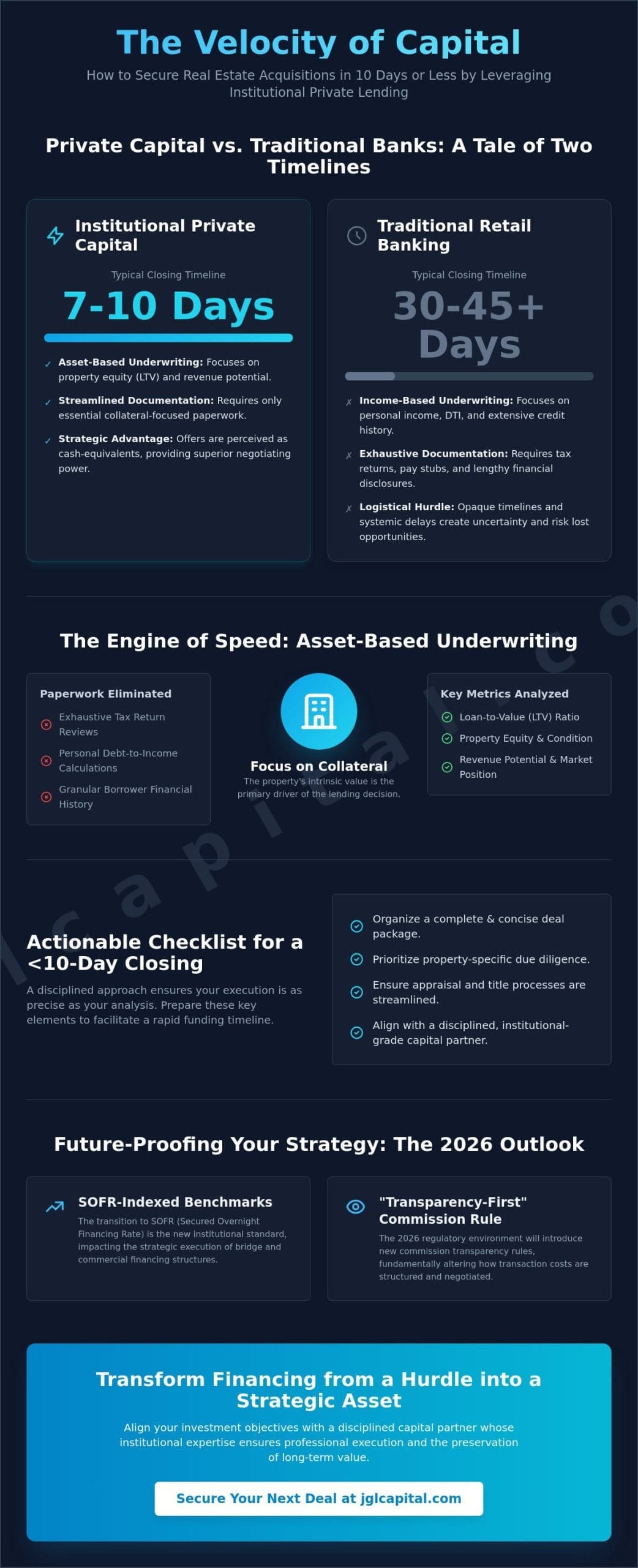
Private Capital Velocity vs. Traditional Institutional Lending
The divergence between traditional institutional lending and private capital velocity is most apparent when examining the temporal constraints of high-value transactions. Traditional banking institutions operate within a framework of rigid federal regulations that prioritize standardized consumer protection over the specialized needs of professional investors. These regulatory mandates often extend the origination process to 45 days or longer, a timeline that is frequently incompatible with the rapid pace of the modern market. In contrast, Private Lending for Real Estate offers a streamlined alternative that prioritizes the strategic alignment of capital with the asset’s intrinsic value. By utilizing fast real estate closing loans, investors can bypass the bureaucratic inertia of retail banking, securing the liquidity needed to execute time-sensitive acquisitions.
Seasoned developers particularly favor this agility when managing new construction loans. The ability to pivot quickly and secure funding without the protracted delays of traditional underwriting ensures that project timelines remain intact. This flexibility in loan terms is a hallmark of the strategic alliance between a private money broker and an investor, where solutions are customized to the specific requirements of the development rather than forced into a one-size-fits-all retail model. It’s a relationship built on mutual understanding and the shared goal of value preservation.
The Opportunity Cost of Traditional Financing
The financial implications of bank-related delays are often underestimated. When a 45-day bank delay causes a purchase contract to expire, the investor doesn’t just lose their earnest money deposit. They lose the entire projected appreciation and revenue potential of the asset. In a competitive environment, this opportunity cost can represent hundreds of thousands of dollars in lost value. Bridge capital serves as a critical stabilization tool, maintaining momentum for complex developments while traditional institutions remain mired in administrative review. The agility of private money brokers allows for a 10-day execution that preserves the deal’s integrity and ensures the investor’s capital continues to work efficiently.
Navigating the 2026 Lending Landscape
The current fiscal environment requires a sophisticated approach to real estate investing. With the transition to SOFR as the standard benchmark for pricing floating-rate loans, investors must adapt to a landscape where interest rates are generally between 9.5% and 12.5% for asset-based products. Establishing a relationship with a strategic capital partner provides a sense of security and stability amidst this volatility. By aligning with a disciplined steward, investors can ensure their capital allocation strategies remain robust, regardless of fluctuating market trends or shifting regulatory requirements. This long-term alliance facilitates a consistent flow of capital, allowing for the deliberate expansion of a high-yield portfolio.
Actionable Strategies for Securing a 10-Day Closing
The successful procurement of fast real estate closing loans is contingent upon a rigorous state of operational preparedness. While the capital provider offers the necessary liquidity, the investor must provide a comprehensive “deal package” that facilitates an instantaneous underwriting review. This dossier should transcend basic identification, offering a detailed analysis of the asset’s current state and its projected value. A disciplined investor maintains a network of trusted legal and insurance professionals who are ready to act with the same velocity as the capital source. By centralizing documentation such as entity formation papers, recent credit snapshots, and a clearly articulated exit strategy, you ensure that the internal review process proceeds without the typical administrative friction found in retail banking.
Preparing the Asset for Inspection
Immediate funding requires immediate access. Securing property access for valuations and inspections prior to the formal application is a critical step in compressing the timeline. For those utilizing fix and flip loans florida, the significance of a meticulously detailed Scope of Work (SOW) cannot be overstated. This document serves as the roadmap for the project’s value preservation and growth. Similarly, in multi-family acquisitions, having audited financial records and verified rent rolls ready for inspection allows the lender to confirm the property’s cash flow potential without delay. This level of preparation signals a sophisticated approach to resource management, instilling confidence in your capital partner from the outset.
Aligning Objectives with Your Capital Partner
Professional execution is rooted in the alignment of strategic objectives between the investor and the lender. Clear communication regarding the intended use of capital prevents delays in the funding cycle and ensures that the loan structure supports your long-term legacy. It’s often beneficial to understand what is a bridge loan and how it functions as a vital, albeit temporary, tool in your capital stack. By framing the relationship as a strategic alliance rather than a simple transaction, you foster a collaborative environment where worth is generated through deliberate, coordinated action. This commitment to professional integrity ensures that every acquisition contributes to a stable and prosperous portfolio.
If you are ready to secure the capital necessary for your next high-stakes acquisition, we invite you to initiate a professional consultation with JGL Capital to align your investment goals with our institutional expertise.
JGL Capital: A Disciplined Steward of Private Real Estate Capital
JGL Capital stands as a paragon of stability within the private lending sector, possessing a thirty-year history characterized by the disciplined allocation of strategic capital. This extensive tenure is not merely a record of longevity but a reflection of a core philosophy that prioritizes the intrinsic worth of an asset and the long-term potential of the investor over the restrictive, standardized metrics utilized by retail institutions. By functioning as a quiet expert, the firm facilitates fast real estate closing loans through a process that respects the gravity of high-stakes management while ensuring the preservation of value across every transaction. This commitment to professional integrity allows us to serve as a reliable ally for sophisticated partners who require a level of execution that traditional banks simply cannot replicate.
Our approach is particularly evident in our role among hard money lenders florida, where we deliver highly customized solutions tailored to the unique demands of that specific market. By framing our activities as a form of high-level strategic alliance rather than simple service provision, we ensure that every loan contributes to the creation of a lasting legacy. We value collaborative relationships with developers and high-net-worth stakeholders, recognizing that the alignment of objectives is the most certain path toward the generation of substantial worth in a competitive environment.
Bespoke Solutions for Complex Transactions
The firm’s capacity to structure loans for unique commercial projects and complex residential developments remains a cornerstone of its operational strength. Every underwriting decision is grounded in a level of analytical rigor that ensures both stability and growth, rejecting the speculative trends that often compromise less disciplined lenders. With a national reach, JGL Capital provides the specialized capital necessary for investors to maintain diversified portfolios across various jurisdictions. This breadth of experience allows us to provide the necessary nuance for every claim and strategy, ensuring that your capital allocation remains as precise as your initial investment analysis.
Initiating the Strategic Alliance
Beginning a professional consultation with our experienced brokers represents the first step in establishing a high-level strategic alliance. We present ourselves as a discreet partner, valuing the integrity of your investment history and the confidentiality required by high-net-worth stakeholders. For investors currently holding active contracts that demand rapid execution, the path forward is defined by a methodical presentation of property fundamentals and a clear articulation of strategic objectives. This collaborative process ensures that the transition from initial analysis to final funding is steady, logical, and entirely focused on the generation of worth. By choosing a partner with three decades of intellectual capital, you’re not just securing a loan; you’re aligning with a steward dedicated to your long-term prosperity.
Strategic Alignment for Long-Term Capital Appreciation
As the 2026 real estate landscape continues to evolve, the capacity to deploy capital with both precision and speed remains a primary differentiator for the sophisticated investor. By adopting an asset-based underwriting framework and maintaining a high state of operational readiness, you can effectively transform the financing process into a decisive competitive advantage. Utilizing fast real estate closing loans ensures that your strategic objectives are not compromised by the systemic delays of traditional retail banking, allowing for the seamless acquisition of high-yield assets. JGL Capital brings over 30 years of strategic lending expertise to every transaction, offering a national reach and bespoke solutions that prioritize long-term integrity and asset value above all else. We invite you to consult with our seasoned capital partners to secure your next acquisition and align your portfolio with a disciplined steward of private capital. Your commitment to rigorous analysis and professional execution will serve as the stable foundation for a lasting investment legacy.
Frequently Asked Questions
How long does a typical fast real estate closing loan take to fund?
Expedited capital deployment typically occurs within a window of ten business days or fewer. This velocity is achieved through a streamlined underwriting process that prioritizes the intrinsic value of the collateral over the exhaustive personal financial reviews common in retail banking. While traditional cycles often exceed thirty days, the use of fast real estate closing loans allows investors to secure time-sensitive opportunities with the speed of a cash offer.
What are the primary requirements for an asset-based real estate loan?
The primary requirements center on the property’s loan-to-value (LTV) ratio and a clearly articulated exit strategy. Underwriters focus on the asset’s equity and its capacity to support the debt service, requiring comprehensive documentation such as a clear scope of work or verified rent rolls to ensure the preservation of value. This analytical focus ensures that the transaction remains secure for all stakeholders involved in the capital allocation.
Can I use a fast closing loan for commercial or multi-family properties?
Fast real estate closing loans are ideally suited for the acquisition and stabilization of commercial and multi-family assets. These complex transactions often require the immediate liquidity provided by private capital to secure properties in competitive institutional markets where traditional financing timelines would prove prohibitive. By utilizing these instruments, developers can bridge the gap between acquisition and long-term stabilization without losing momentum to bureaucratic delays.
How do interest rates for private money loans compare to traditional bank rates?
Private money interest rates reflect the specialized nature of asset-based lending and generally range between 9.5% and 12.5% as of June 2026. While these figures are higher than traditional bank rates, the premium accounts for the rapid capital velocity and flexible underwriting that traditional institutions cannot provide. This cost of capital is often offset by the ability to negotiate more favorable purchase prices through guaranteed closing dates.
Is a personal credit check required for an asset-backed bridge loan?
While asset-backed bridge loans prioritize property equity, a review of the borrower’s credit history is typically conducted to assess overall financial responsibility. This metric remains subordinate to the property’s value, allowing for funding even when traditional credit standards might not be met by conventional lenders. The focus remains on the strategic alignment of the project and the borrower’s ability to execute their stated investment plan.
What types of properties are eligible for expedited funding through JGL Capital?
JGL Capital facilitates funding for a diverse range of non-owner-occupied assets, including multi-family complexes, commercial properties, and land for development. Our expertise extends to rental property portfolios, new construction projects, and fix and flip opportunities, ensuring that each solution is customized to the specific requirements of the investment. We do not provide financing for owner-occupied residential mortgages or unsecured personal loans.
What are “points” and how do they function in a private money transaction?
Points represent origination fees calculated as a percentage of the total loan amount, with 1.5 to 3 points serving as the industry standard in 2026. These fees are a fundamental component of the capital cost and are typically settled at the time of closing to facilitate the deployment of private liquidity. They allow lenders to manage the risk associated with rapid funding while providing investors with immediate access to necessary capital.
Can I secure a loan for new construction with a fast closing timeline?
Securing a loan for new construction with a fast closing timeline is entirely feasible through the use of private capital. This approach allows developers to maintain project momentum and secure land or materials without the protracted delays inherent in traditional construction underwriting, which often exceeds forty-five days. By focusing on the project’s long-term worth and the developer’s experience, private lenders can offer the agility required for complex ground-up developments.