

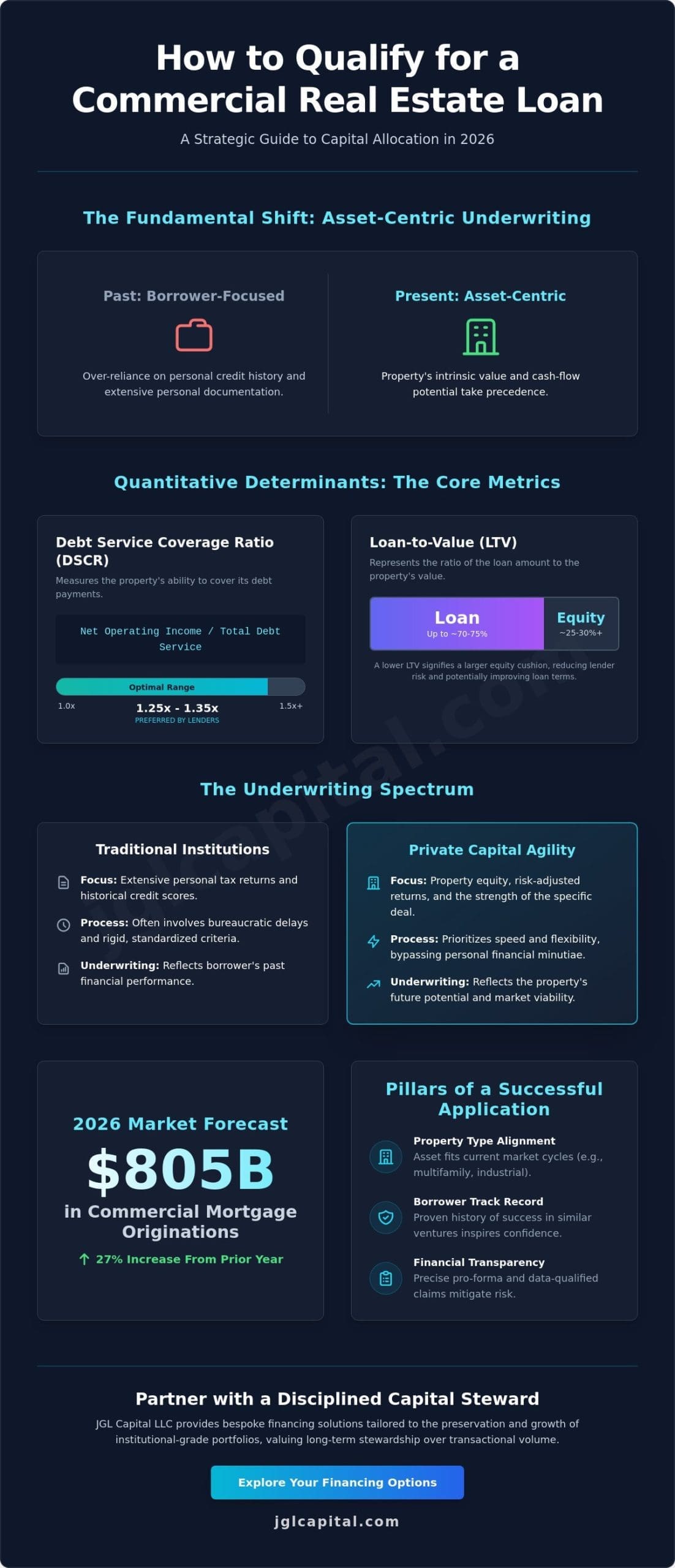
With commercial mortgage originations forecasted to reach approximately $805 billion in 2026, representing a 27% increase from the prior year, the availability of capital is undeniable; yet, the institutional criteria for access remain increasingly rigorous. You’ve likely experienced the frustration of bureaucratic delays and an over-reliance on personal credit history that fails to account for the strategic value of a high-performing asset. Determining how to qualify for a commercial real estate loan in this environment requires more than a strong balance sheet; it demands an alignment of property merit with sophisticated underwriting standards. This guide serves as a definitive resource for deciphering the complexities of institutional capital allocation and private lending benchmarks. We’ll provide a clear articulation of current DSCR and LTV requirements, such as the 1.25x to 1.35x coverage ratios preferred by modern lenders for optimal pricing. By the end of this analysis, you’ll possess a streamlined path to closing and the insight necessary to identify a capital partner like JGL Capital LLC that values long-term stewardship over transactional volume.
Key Takeaways
- Recognize the fundamental transition toward asset-centric underwriting, where the intrinsic value and cash-flow potential of the property take precedence over traditional personal credit metrics.
- Gain clarity on the quantitative benchmarks, including Debt Service Coverage Ratio and Loan-to-Value thresholds, that define how to qualify for a commercial real estate loan within the current institutional landscape.
- Evaluate the unique qualification nuances of diverse asset classes, specifically addressing the distinct standards for multi-family acquisitions and the strategic requirements for new construction projects.
- Analyze the underwriting spectrum to determine whether the rigorous documentation of traditional banking or the specialized agility of private capital best serves your strategic objectives.
- Discover the methodology of JGL Capital LLC, a disciplined capital steward providing bespoke financing solutions tailored to the preservation and growth of institutional-grade portfolios.
The Foundational Framework of Commercial Real Estate Qualification
The process of securing capital in the current fiscal environment has evolved into a meticulous exercise in strategic alignment. Understanding how to qualify for a commercial real estate loan in 2026 requires a departure from traditional, consumer-oriented mindsets. It demands a focus on institutional-grade asset performance. This foundational framework serves as the basis for all subsequent underwriting, shifting the primary lens from the borrower’s personal history to the property’s intrinsic value and its capacity for long-term wealth preservation. At JGL Capital LLC, we view this transition as essential for maintaining the stability of sophisticated portfolios.
Institutional lenders often prioritize historical credit performance and personal liquidity. However, the private capital sector has increasingly adopted an asset-centric approach that prioritizes the risk-adjusted returns of the specific deal. In this context, a Commercial mortgage is viewed as a partnership between the lender’s capital and the property’s operational potential. This “Asset-Backed” advantage allows sophisticated investors to bypass the bureaucratic delays inherent in retail banking, focusing instead on market viability and equity positions. This shift is particularly relevant in transitional real estate markets where property value transcends traditional credit metrics.
Strategic intent and a clearly articulated exit strategy have become non-negotiable qualification components. Lenders aren’t merely providing funds; they’re allocating capital based on the borrower’s ability to execute a specific value-creation plan. Whether the objective is long-term stabilization or a transitional bridge phase, the precision of the pro-forma and the alignment of the asset with market demand determine the viability of the request. To master how to qualify for a commercial real estate loan, one must demonstrate a disciplined approach to capital allocation that accounts for both current cash flow and future valuation milestones.
Institutional vs. Private Money Qualification
Traditional institutions typically demand extensive personal tax returns and maintain a rigid focus on historical credit scores. In contrast, private capital providers emphasize property equity and the strength of the specific transaction. This allows for greater flexibility in commercial real estate loans, as the underwriting reflects the property’s potential rather than just the borrower’s past. This distinction is vital for investors who require speed and a focus on deal merit over personal financial minutiae.
The Core Pillars of a Successful Loan Application
A robust application hinges on three critical elements: property type alignment, borrower track record, and financial transparency. Lenders scrutinize how the asset fits into current market cycles, favoring sectors like multifamily or industrial that show resilience. Proving a successful history in similar ventures instills confidence, while a precise pro-forma demonstrates the analytical rigor required for modern capital allocation. Every claim must be qualified with data to ensure the strategy is clearly defined and the risk is mitigated.
Quantitative Determinants: Analyzing Debt Service Coverage and Loan-to-Value
The transition from qualitative strategic intent to quantitative validation marks the most critical phase of the underwriting process. Analyzing these metrics is essential to understanding how to qualify for a commercial real estate loan in a market defined by rigorous lender scrutiny. Capital allocation decisions in 2026 are increasingly driven by a property’s ability to sustain debt service while maintaining a sufficient equity cushion. This analytical rigor ensures that both the lender and the investor are protected against market volatility and shifting interest rate environments.
Lenders evaluate risk-adjusted returns by scrutinizing the relationship between a property’s income and its debt obligations. According to the Comptroller’s Handbook on Commercial Real Estate Lending, robust risk management requires a thorough assessment of cash flow stability and collateral valuation. For stabilized assets, the primary benchmark remains the Debt Service Coverage Ratio (DSCR), which serves as a definitive indicator of a property’s financial health. Investors seeking to optimize their capital structure often benefit from a strategic partnership that understands these nuanced metrics and their impact on long-term wealth preservation.
Mastering the DSCR Calculation
The DSCR is calculated by dividing the property’s Net Operating Income (NOI) by its total annual debt service. While a minimum ratio of 1.20x to 1.25x is common for stabilized commercial loans, a preferred ratio of 1.25x to 1.35x is often necessary to secure the most competitive pricing in 2026. In high-interest environments, adjusting expectations for rental property loans is vital, as increased debt costs can compress these ratios. For transitional or bridge assets where the DSCR may be temporarily lower, qualification often hinges on the presence of interest reserves or a clearly defined path to stabilization that justifies the initial capital allocation.
LTV and LTC: The Equity Requirements
Equity requirements provide the necessary “skin in the game” that aligns the interests of the borrower with those of the capital provider. Conventional commercial mortgages typically operate within a 65% to 75% Loan-to-Value (LTV) range, though exceptional properties may still command up to 80%. For renovation or new construction projects, lenders shift their focus to Loan-to-Cost (LTC) thresholds, which measure the loan amount against the total project budget. Maintaining a disciplined equity position is a prerequisite for how to qualify for a commercial real estate loan, ensuring that the portfolio remains resilient even if market valuations fluctuate. Secondary income streams, such as parking fees or utility reimbursements in multi-family assets, can further bolster these figures by increasing the aggregate NOI and improving the overall risk profile of the transaction.
Qualifying Based on Asset Class: Strategic Nuances
Strategic capital allocation requires an understanding that underwriting standards are not monolithic. Each asset class demands a bespoke approach to risk assessment. When evaluating how to qualify for a commercial real estate loan, investors must recognize that the criteria for a stabilized industrial warehouse differ fundamentally from those applied to a retail center or a hospitality asset. For industrial properties, lenders prioritize tenant creditworthiness and the remaining duration of triple-net leases. In the retail sector, where market dynamics are more fluid, the focus shifts to co-tenancy clauses and historical sales performance. Those pursuing high-velocity strategies, such as short-term repositioning, will find that the requirements for fix and flip loans prioritize the spread between purchase price and after-repair value over long-term yield.
The institutional landscape in 2026 reflects a heightened sensitivity to sector-specific volatility. For instance, with office CMBS delinquency rates reaching 12.34% in early 2026, lenders have tightened standards for secondary office spaces while maintaining an appetite for multifamily assets. Understanding these commercial loan qualification criteria is essential for navigating a bifurcated market. Successful qualification is often a matter of presenting the asset not just as collateral, but as a strategic component of a well-diversified portfolio.
New Construction and Multi-Family Specifics
Securing new construction loans requires a level of transparency that extends beyond financial statements. Lenders demand verified entitlement status and zoning compliance as absolute prerequisites. A meticulously detailed Scope of Work (SOW) is essential to demonstrate the project’s feasibility. For multi-family properties, qualification standards center on occupancy seasoning and unit counts. With multifamily starts declining in 2026, lenders are scrutinizing market absorption rates more closely to ensure that new builds won’t face prolonged vacancies upon completion. The strength of the developer’s track record in similar jurisdictions often serves as the deciding factor in capital allocation.
The Role of the Exit Strategy
A definitive exit strategy is the cornerstone of any successful loan request, particularly for transitional capital. Lenders must see a clear “Take-out” plan, whether it involves refinancing into long-term permanent debt or the eventual sale of the asset. This requirement is mandatory for anyone asking what is a bridge loan and how it functions as a strategic tool. Proving market liquidity and demonstrating a disciplined path to stabilization instills the confidence necessary for a capital partner to commit. Without a qualified exit strategy, the risk-adjusted return profile becomes untenable, regardless of the property’s current merit. Mastering how to qualify for a commercial real estate loan ultimately depends on your ability to prove how the debt will be retired.
The Underwriting Spectrum: Institutional Rigor vs. Private Money Agility
The underwriting process represents a critical juncture where strategic vision meets analytical scrutiny. Investors seeking to understand how to qualify for a commercial real estate loan must recognize the distinct methodologies employed by institutional banks compared to private capital providers. Traditional institutions often prioritize historical borrower data, which can lead to exhaustive documentation requirements and prolonged timelines. Conversely, hard money lenders emphasize the intrinsic value of the collateral and the viability of the exit strategy. This agility is indispensable for time-sensitive acquisitions. It’s a matter of prioritizing deal merit over bureaucratic checklist adherence.
While a high FICO score remains a standard benchmark for personal creditworthiness, the institutional shift in 2026 increasingly favors asset performance. In cases where a borrower’s credit history doesn’t reflect their current financial sophistication, the merit of the deal speaks louder than the score. A professional loan request package that articulates a clear path to value creation can mitigate traditional credit objections. By positioning the asset as the primary driver of the capital allocation decision, you align your interests with those of the lender. For those seeking a partner that values precision and speed, engaging a seasoned capital steward ensures your portfolio receives the strategic oversight it deserves.
Streamlining the Documentation Process
A streamlined documentation process is essential for maintaining momentum in competitive markets. A professional package should include a concise executive summary, current rent rolls, and high-resolution property photography. Lenders differentiate between a Personal Financial Statement (PFS) and entity-level reporting. The latter often provides a more transparent view of portfolio optimization. Digital underwriting tools now allow for rapid property valuation. This reduces the friction typically associated with manual reviews. Precision in these documents signals a disciplined approach to wealth preservation.
Navigating the Appraisal and Environmental Review
The commercial appraisal and environmental review serve as the definitive anchors of the underwriting protocol. A Phase I Environmental Site Assessment (ESA) is a standard requirement to identify potential liabilities before capital is committed. Lenders also scrutinize the distinction between “As-Is” and “As-Stabilized” values. This distinction is vital for transitional assets. Ensuring appraisal accuracy through comprehensive market data is paramount. It validates the equity position and confirms the risk-adjusted return profile for the capital partner. Every data point must be qualified to ensure the strategy remains clearly defined.
Strategic Capital Allocation: The JGL Capital Methodology
Understanding how to qualify for a commercial real estate loan is a fundamental prerequisite; however, the successful execution of a sophisticated investment strategy requires a capital partner that transcends simple transactional lending. JGL Capital provides a disciplined methodology rooted in over 30 years of strategic oversight in commercial real estate loans. This extensive track record allows us to navigate complex market cycles with an analytical rigor that ensures stability for our institutional partners. We don’t merely provide capital; we provide a framework for long-term wealth preservation and portfolio optimization.
Our commitment to transparency and certainty of execution is grounded in a deep-seated expertise in high-stakes financial management. We recognize that sophisticated investors require bespoke financing solutions tailored to their specific strategic objectives. By prioritizing risk-adjusted returns and maintaining a serious, disciplined approach to capital allocation, we instill a sense of security in high-net-worth individuals and institutional entities. This philosophy ensures that every strategy is clearly defined and every claim is qualified through meticulous due diligence. It’s a standard of stewardship that values integrity and professional excellence above all else.
The Partnership Advantage
Moving beyond the limitations of transactional service provision, JGL Capital fosters a collaborative strategic alliance with every client. This partnership advantage provides you with direct access to decision-makers and seasoned capital stewards who understand the nuances of institutional-grade assets. We focus on the alignment of interests, ensuring that our financing solutions support your broader goals for value creation. By framing our activities as a form of high-level partnership, we distinguish ourselves as a collaborative ally invested in your long-term success. Our personality is that of a quiet expert, relying on intellectual capital rather than aggressive promotion.
Initiating Your Capital Request
The path to funding begins with a preliminary review process designed to provide rapid feedback on deal viability. This initial assessment allows us to conduct a high-level analysis of the asset’s merit and its alignment with our underwriting standards. From the moment of application to the final funding, the JGL Capital workflow follows a measured and steady rhythm that mirrors the patient nature of long-term investing. This deliberate pace ensures that every detail is scrutinized and every risk is mitigated. If you’re prepared to move forward with a partner that values precision and strategic alignment, connect with a JGL Capital strategist to discuss your next acquisition and discover how our methodology can streamline your path to closing.
Advancing Your Commercial Investment Strategy
Mastering the complexities of capital allocation in 2026 requires a fundamental shift from retail banking expectations toward institutional-grade asset performance. You’ve identified the critical role of rigorous DSCR benchmarks and the absolute necessity of a clearly articulated exit strategy. Understanding how to qualify for a commercial real estate loan is the essential first step toward building a lasting legacy through disciplined wealth creation. JGL Capital offers the strategic oversight necessary to navigate this sophisticated landscape with confidence and precision.
With over 30 years of industry expertise, our firm provides asset-backed lending solutions designed to minimize bureaucratic delays while maximizing portfolio optimization. We specialize in delivering tailored capital structures for complex multi-family and new construction projects that require more than a simple transactional approach. By aligning your investment objectives with our rigorous analytical standards, you ensure a streamlined path to closing and long-term stability. Secure Your Commercial Capital with JGL Capital Today and take the next step in your portfolio’s evolution with a partner committed to your strategic success.
Frequently Asked Questions
What is the minimum credit score required for a commercial real estate loan?
While traditional institutional lenders typically seek a FICO score of 680 or higher, the private capital sector often prioritizes the intrinsic value of the asset over personal credit history. Determining how to qualify for a commercial real estate loan with a lower score often depends on the property’s equity position and the borrower’s track record in similar ventures. A strong Debt Service Coverage Ratio can frequently mitigate personal credit fluctuations during the underwriting process.
How much down payment is typically required for commercial property?
Standard equity requirements for commercial acquisitions generally range from 20% to 35% of the purchase price, depending on the asset class and risk profile. This capital cushion ensures that the investor has significant “skin in the game,” which aligns interests with the capital provider. Higher leverage options may be available for exceptionally stabilized multifamily assets, while specialized properties might require a more substantial initial capital allocation.
Can I qualify for a commercial loan if the property is currently vacant?
You can qualify for financing on a vacant property by utilizing transitional capital structures like bridge loans. These facilities focus on the “as-stabilized” value and the borrower’s strategic plan for repositioning rather than current cash flow. Qualification in these instances depends heavily on the feasibility of the renovation budget and the precision of the market absorption forecasts provided in the loan request package.
What is the difference between LTV and LTC in construction financing?
Loan-to-Value (LTV) measures the debt amount against the appraised market value of a completed asset, whereas Loan-to-Cost (LTC) calculates the loan against the total project budget. In new construction, lenders use LTC to ensure the developer provides sufficient equity to cover hard and soft costs. It’s a critical distinction that defines the capital structure and the level of risk-adjusted returns expected by the institutional partner.
How long does the qualification and funding process usually take?
The timeline for capital allocation varies significantly between institutional banks and private money providers. Traditional banking institutions often require 60 to 90 days to complete their rigorous due diligence and committee reviews. Private capital stewards can often streamline this process, reaching a funding decision within two to four weeks. This speed is essential for investors who need to capitalize on time-sensitive market opportunities without sacrificing analytical rigor.
Do I need to be a U.S. citizen to qualify for a commercial real estate loan?
U.S. citizenship isn’t a strict prerequisite for securing commercial financing, as many programs are designed specifically for foreign nationals. These programs typically require a higher equity contribution and a more comprehensive review of the borrower’s global financial footprint. Successful qualification for international investors often hinges on the presence of a domestic legal entity and a clearly defined exit strategy that accounts for cross-border capital movements.
Is a personal guarantee always required for commercial financing?
A personal guarantee is a standard requirement for most middle-market commercial transactions to provide an additional layer of security for the lender. However, non-recourse debt is available for institutional-grade assets and large-scale multifamily projects where the property’s cash flow is exceptionally robust. These non-recourse options are typically reserved for borrowers with significant experience and a substantial net worth relative to the loan amount.
What are the common reasons a commercial loan application is denied?
Applications are frequently denied due to a Debt Service Coverage Ratio that fails to meet the 1.25x benchmark or an inadequate exit strategy. Understanding how to qualify for a commercial real estate loan involves recognizing that functional obsolescence or poor tenant creditworthiness can also lead to a rejection. Financial opacity or a lack of professional documentation often signals a lack of disciplined stewardship, causing lenders to decline the capital request during the preliminary review.