

The acquisition of institutional-grade capital is not a matter of persuasive rhetoric, but rather a demonstration of disciplined stewardship and analytical precision. In a lending environment characterized by prudent recovery and heightened selectivity, the ability to articulate a project’s value through a rigorous framework serves as the primary differentiator between an amateur proposal and a successful strategic alliance. Mastering how to present a real estate deal to lenders requires a fundamental shift from transactional thinking toward a philosophy of long-term value preservation and risk management. You likely understand that sophisticated partners demand absolute transparency and a meticulous alignment of objectives before committing resources to high-stakes investments. This article provides a comprehensive framework designed to elevate your deal presentations, ensuring they meet the exacting standards of private and institutional capital providers. We will examine the essential components of a professional deal package, including the precise articulation of performance metrics and the integration of comprehensive risk mitigation strategies. This structured approach will facilitate faster approval cycles and solidify your reputation as a disciplined expert in the field.
Key Takeaways
- Transition from a transactional request to a strategic partnership by framing your deal as a disciplined, asset-backed opportunity for value creation.
- Master how to present a real estate deal to lenders by constructing a comprehensive deal deck that includes rigorous property specifications and a precise executive summary.
- Articulate essential financial benchmarks, such as Debt Service Coverage Ratio (DSCR) and Loan-to-Value (LTV), to demonstrate analytical rigor and risk mitigation.
- Establish institutional credibility through the presentation of multifaceted exit strategies that account for market fluctuations and ensure the security of invested capital.
- Implement a repeatable, professional framework designed to accelerate underwriting cycles and foster enduring alliances with sophisticated capital partners.
The Strategic Framework of Real Estate Deal Presentation
A real estate deal presentation is the precise articulation of a strategic value-creation opportunity. It isn’t a mere request for financing. Instead, it represents a formal invitation to participate in a disciplined, asset-backed partnership. When you master how to present a real estate deal to lenders, you shift the narrative from a position of need to one of institutional strength. This transition is vital. Lenders don’t allocate capital out of benevolence; they do so based on the calculated probability of preservation and growth. Transparency serves as the cornerstone of this relationship, establishing the long-term trust required for sophisticated strategic alliances. A professional presentation doesn’t just improve your chances of approval. It directly correlates to expedited funding cycles by providing underwriters with the clarity they require to move with precision.
Understanding the Lender’s Perspective
Sophisticated lenders prioritize the mitigation of downside risk above all other performance metrics. Their primary objective remains the preservation of capital. In the context of a commercial mortgage, the property itself serves as the foundational security for the loan. This is the essence of asset-based lending, where the intrinsic value of the real estate provides a buffer against market volatility. While traditional banks often adhere to rigid regulatory checklists, private capital brokers may offer more flexibility if the presentation demonstrates a deep-seated expertise in the asset class. Understanding these differing motivations allows you to frame your proposal as a solution that aligns with the lender’s specific mandate for security and yield.
The Role of Professionalism in Capital Allocation
The manner in which you communicate your strategic objectives signals your operational competence to a potential partner. A disciplined, high-register presentation has a profound psychological impact on the recipient. It suggests that the borrower is a seasoned steward of capital who values analytical rigor over marketing hyperbole. By utilizing precise technical terminology and meticulously balanced documentation, you distinguish yourself from transactional competitors who often lack a clear narrative. Learning how to present a real estate deal to lenders with this level of sophistication reinforces your position as a leader in your field. It builds a case for your competence through a methodical presentation of principles. When a lender receives a clear, comprehensive package, the underwriting process moves with significantly greater efficiency. You aren’t just presenting a deal; you’re demonstrating that you’re a reliable ally in the long-term creation of worth.
Constructing a Professional Deal Deck: Essential Documentation
Documentation serves as the empirical foundation upon which institutional trust is constructed. While the strategic framework provides the philosophical alignment, the professional deal deck offers the granular data necessary for a lender’s underwriting department to validate your claims. Mastering how to present a real estate deal to lenders involves curating a package that anticipates every inquiry; this approach eliminates friction in the capital allocation process. Every document must be presented with absolute clarity, ensuring that the asset’s potential is supported by verifiable evidence rather than speculative projections. This transparency isn’t just a courtesy. It’s a requirement for those seeking to build lasting legacies through disciplined investment.
The Executive Summary: Your Strategic Thesis
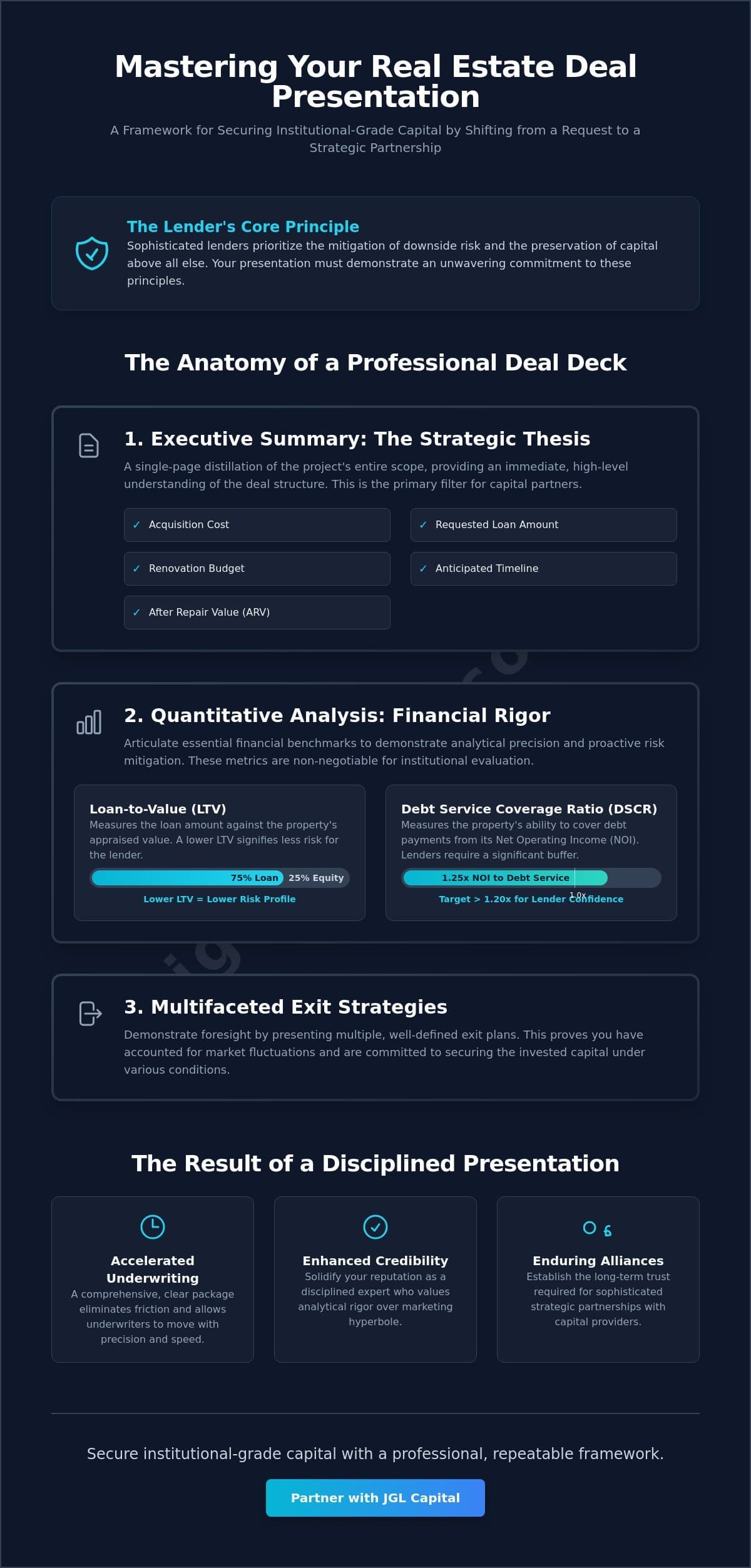
The executive summary functions as your strategic thesis. It should occupy no more than a single page, yet it must distill the project’s entire scope into a series of authoritative data points. Precise figures for the acquisition cost, the comprehensive renovation budget, and the projected After Repair Value (ARV) are non-negotiable. By clearly stating the requested loan amount and the anticipated operational timeline, you provide the lender with an immediate understanding of the deal’s structure. This document acts as the primary filter for capital partners.
Comparative Market Analysis (CMA)
A rigorous Comparative Market Analysis (CMA) is the primary tool for justifying your valuation. You must select “sold” properties within a strict geographic radius, typically within a half-mile for urban assets, to ensure data relevance. Adjustments for square footage, high-end finishes, and specific structural features should be articulated with analytical precision. This level of detail demonstrates that your exit price is rooted in market reality. When seeking to align with strategic capital partners, providing this level of data-driven confidence is essential for securing favorable terms.
The Renovation and Development Budget
A meticulous line-item breakdown is required for any renovation or development budget. Every projected cost, from structural remediation to aesthetic refinements, must be accounted for with transparency. Including a contingency fund is a vital marker of a seasoned investor, as it accounts for the inherent variables of construction without compromising the project’s viability. This budget should explicitly link capital expenditures to the ultimate appreciation of the asset’s value, showing a clear path to wealth generation.
Quantitative Analysis and Risk Mitigation Strategies
The transition from a qualitative narrative to empirical validation is where institutional trust is solidified. Quantitative analysis serves as the analytical bedrock of your proposal, transforming abstract potential into measurable security. When you understand how to present a real estate deal to lenders, you recognize that every metric must be stress-tested against market volatility. Sophisticated partners look for a margin of safety that ensures capital preservation even in adverse economic climates. This stage of the presentation isn’t about promoting profit; it’s about demonstrating a disciplined approach to risk management and the alignment of interests between the borrower and the capital provider.
LTV and LTC: The Foundation of Security
Loan-to-Value (LTV) and Loan-to-Cost (LTC) are the primary indicators of a lender’s exposure. Private capital providers typically favor lower LTV ratios, often seeking a threshold between 65% and 75% for commercial assets, to maintain a substantial equity cushion. While LTV measures the debt against the asset’s appraised value, LTC provides clarity on the project’s total capitalization requirements by comparing the loan amount to the actual cost of acquisition and development. Utilizing these metrics with precision proves that the deal remains viable despite fluctuations in market pricing. It demonstrates that you aren’t over-leveraging the asset, but rather maintaining a conservative stance that protects the partnership’s integrity.
Pro Forma Financial Projections
A rigorous pro forma must present a conservative view of future cash flows or eventual sale proceeds. This model shouldn’t rely on aggressive rent growth or speculative exit caps; instead, it should incorporate realistic holding costs, property taxes, and insurance premiums based on current 2026 data. For rental assets, the Debt Service Coverage Ratio (DSCR) is paramount. Lenders generally require a minimum DSCR of 1.20x to 1.25x for stabilized properties, ensuring the income generated comfortably exceeds the debt obligations. A meticulously constructed pro forma serves as a predictive shield that protects the financial interests of both the borrower and the lender by establishing clear operational benchmarks.
Mitigating Operational and Market Risks
Identifying potential “red flags” before a lender does signals a high level of operational competence. You must address risks such as construction delays, zoning hurdles, or interest rate shifts with proactive solutions. This includes the selection of experienced contractors and project managers who possess a proven history of execution. Demonstrating a deep understanding of real estate investing strategies allows you to frame these risks as manageable variables rather than unforeseen obstacles. Asset-based lending inherently minimizes the focus on personal credit scores, yet it amplifies the need for a borrower to show “skin in the game.” Significant capital contribution by the borrower ensures a total alignment of objectives, as both parties are deeply invested in the project’s successful conclusion. Knowing how to present a real estate deal to lenders with this level of analytical rigor distinguishes a professional steward of capital from a transactional speculator.
Operational Execution and the Criticality of Exit Strategies
Lenders prioritize the exit event above all other considerations because it represents the definitive moment of capital liquidity. While the acquisition and renovation phases are essential, a sophisticated partner is primarily concerned with the mechanism by which their capital is returned. Knowing how to present a real estate deal to lenders requires you to articulate a primary exit strategy that is both realistic and resilient. Whether you intend to sell the asset or transition into long-term financing, your proposal must demonstrate that the path to repayment is secure. This transparency builds the institutional trust necessary for high-stakes management, ensuring that all stakeholders remain aligned throughout the project’s lifecycle.
The Primary Exit: How the Capital is Returned
The primary exit strategy must be detailed with a step-by-step articulation of the requirements for a sale or refinance event. In the current economic landscape of June 2026, where 30-year fixed-rate residential mortgages average 6.48%, the feasibility of a long-term refinance must be scrutinized with analytical rigor. If the project involves a transitional phase, such as a major renovation or stabilization period, understanding what is a bridge loan becomes essential. This transitional capital provides the necessary window to enhance the asset’s value before permanent financing is secured. Your presentation should also include a “Plan B” and “Plan C,” demonstrating strategic flexibility if market conditions shift or if the primary exit timeline is delayed.
The Experience Resume: Proving Competence
Operational execution is only as reliable as the team behind it. A professional deal presentation should include an “Experience Resume” that documents past successful projects with similar scopes and budgets. This record of performance signals to the lender that you aren’t an amateur, but a seasoned steward of investment capital. Highlighting your professional alliances, including legal counsel and architectural partners, further reinforces your operational competence. By proving a history of disciplined private capital allocation, you instill a sense of security in your partners. They aren’t just funding a property; they’re investing in your ability to execute a complex strategic objective.
A realistic schedule for capital return is the final component of a successful presentation. This timeline must account for permitting, construction phases, and the time required for a traditional sale or refinance to close. Providing a cumulative flow of information regarding these milestones allows the lender to conduct a thorough analysis of the project’s pace. When you master how to present a real estate deal to lenders, you provide a narrative that values precision over speed. If you are prepared to elevate your next project through a professional strategic alliance, connect with JGL Capital LLC today to discuss your objectives.
Securing Institutional-Grade Capital with JGL Capital LLC
JGL Capital LLC represents the culmination of thirty years of specialized expertise in the field of private capital acquisition and asset-backed lending. By fostering a strategic alliance with a disciplined private money broker, investors gain access to a level of stability and analytical rigor that transactional competitors simply can’t replicate. Mastering how to present a real estate deal to lenders ensures that your project receives the attention it deserves from our seasoned underwriting team, which prioritizes the intrinsic value of the asset over bureaucratic checklists. Our national reach allows us to provide sophisticated capital solutions for a diverse range of property types, including residential, multi-family, and commercial assets. This commitment to the creation and preservation of value is what distinguishes JGL Capital LLC as a quiet expert in the high-stakes management of investment capital.
Tailored Solutions for Every Asset Class
We provide highly customized financing structures that align with your specific strategic objectives, whether you’re embarking on a large-scale development or acquiring a transitional asset. Our offerings include specialized new construction loans designed for developers who demand precision and reliability in their funding partners. In addition to development capital, JGL Capital LLC facilitates expedited funding for:
- Multi-Family and Commercial Real Estate Loans for stabilized or value-add opportunities.
- Bridge Loans and Fix and Flip Loans for transitional phases requiring rapid execution.
- Rental Property Loans and Land Loans for long-term wealth preservation and strategic land banking.
Our serious and disciplined approach ensures that every claim is qualified and every strategy is clearly defined, providing you with the security needed to execute complex projects with confidence.
The JGL Capital LLC Advantage: Speed and Reliability
The primary advantage of a partnership with JGL Capital LLC is our ability to conduct thorough analysis without compromising the speed required in competitive markets. Because our underwriting process remains rooted in property value and the borrower’s operational competence, we significantly reduce the administrative delays often associated with traditional financial institutions. Understanding how to present a real estate deal to lenders with professional documentation allows our team to move from initial review to funding with exceptional efficiency. You gain direct access to seasoned professionals who understand the nuances of high-stakes management and the importance of building lasting legacies. Take the next step in your investment journey by aligning with JGL Capital LLC, a trusted partner who values integrity and long-term growth above all else. We invite you to initiate a dialogue regarding your next project and discover the worth of a truly collaborative strategic alliance.
Elevating Your Investment Strategy Through Disciplined Partnerships
Mastering how to present a real estate deal to lenders is the definitive step toward establishing yourself as a sophisticated steward of investment capital. By shifting from a transactional mindset to one rooted in strategic partnership, you ensure that every project is backed by analytical rigor and a clear path to liquidity. This framework has demonstrated that professional documentation and a transparent articulation of exit strategies are not mere formalities; they are the foundational requirements for institutional trust. When you provide partners with a meticulously balanced deal deck and robust quantitative analysis, you eliminate ambiguity and foster the security necessary for long-term growth.
JGL Capital LLC brings over 30 years of industry expertise to your next residential or commercial project. Our commitment to asset-backed lending and a streamlined underwriting process allows for the delivery of customized solutions with minimal administrative delays. With a national reach that spans diverse asset classes, we stand as a stable ally for those dedicated to the creation and preservation of value. We invite you to Secure Your Project Funding with JGL Capital LLC and begin building a lasting legacy through careful, deliberate action. It’s a commitment to excellence that deserves a partner with the intellectual capital to match.
Frequently Asked Questions
What is the single most important document in a deal presentation?
The Executive Summary serves as the primary distillation of the strategic value-creation opportunity, making it the most vital document in your proposal. It provides a concise articulation of the project’s scope, purchase price, and projected After Repair Value (ARV) on a single page. This document allows underwriters to quickly evaluate the viability of the asset and the borrower’s request, setting a professional tone for the entire review process.
How do private lenders view borrowers with lower credit scores?
Private lenders typically adopt an asset-based approach, which values the property’s performance and the borrower’s equity position over personal credit scores. While a credit history is reviewed, it is often secondary to the project’s Debt Service Coverage Ratio (DSCR) or the security provided by a conservative Loan-to-Value (LTV) ratio. Mastering how to present a real estate deal to lenders with analytical rigor can often mitigate concerns regarding individual credit metrics by demonstrating operational competence.
What is a ‘Deal Deck’ and why is it necessary for real estate funding?
A Deal Deck is an institutional-grade document that provides a methodical presentation of an investment’s principles and operational strengths. It is necessary because it offers the cumulative data points required for a lender to conduct a thorough risk assessment, including property specifications and market comparables. A well-constructed deck ensures that every strategic objective is clearly defined and supported by empirical evidence rather than speculative trends.
How much detail should I include in my renovation budget?
A renovation budget must be presented with meticulous detail, utilizing a line-item format that accounts for every material and labor expenditure. Vague estimates often signal a lack of experience, whereas a detailed budget that includes a contingency fund demonstrates a disciplined approach to capital management. This level of transparency allows lenders to verify that the capital allocation is sufficient to reach the projected asset value without compromising the project’s stability.
Why do lenders care about my exit strategy more than my profit margin?
Lenders prioritize capital preservation, meaning the exit strategy is the most critical component of the risk mitigation narrative. While a high profit margin is beneficial for the borrower, it does not guarantee the safety of the lender’s principal if the path to liquidity is obstructed. A clearly articulated exit plan, such as a sale or refinance, provides a sense of security that the capital remains protected regardless of the final yield.
Can I present a deal to a lender before I have the property under contract?
Presenting a deal before a contract is executed is a common practice for seasoned investors seeking to confirm the alignment of objectives with their capital partners. While a formal commitment typically requires an executed purchase agreement, early dialogue allows you to gauge a lender’s appetite for a specific asset class or geographic market. This proactive approach can expedite the eventual underwriting cycle once the property is officially secured and the formal documentation is submitted.
What is the typical timeline from presentation to funding with a private lender?
The timeline for funding is significantly faster than traditional institutions, often concluding within ten to fourteen days depending on the complexity of the asset. Because private organizations focus on property value and streamlined underwriting, they bypass many of the administrative delays inherent in traditional banking. Learning how to present a real estate deal to lenders with a complete documentation package is the primary factor in achieving these accelerated funding cycles and securing transitional capital.