

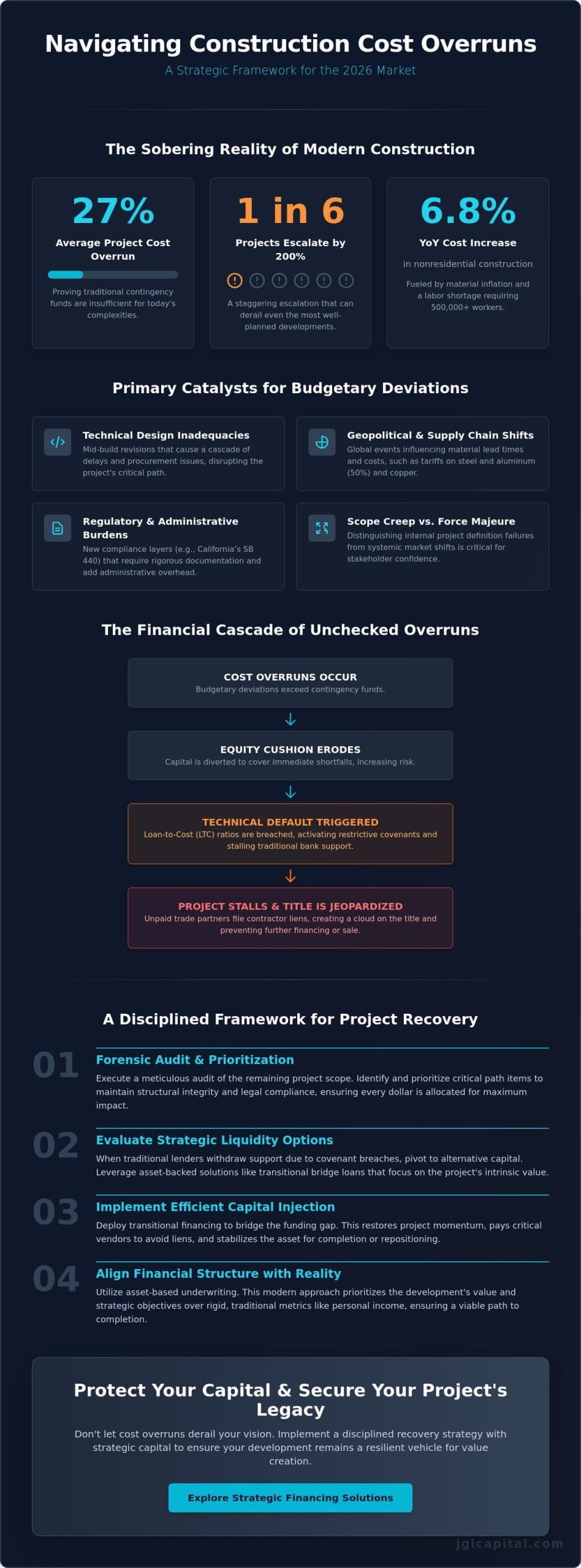
With the average construction project experiencing a 27% cost overrun and one in six projects escalating by a staggering 200%, the traditional reliance on static contingency funds has proven insufficient for the complexities of the 2026 market. As nonresidential construction costs rose by 6.8% year over year in early 2026, developers increasingly find themselves navigating the precarious intersection of labor shortages and persistent material inflation. Identifying effective construction project cost overrun solutions is no longer a matter of simple site management; it’s a fundamental requirement for capital preservation and the avoidance of technical default on existing obligations.
You likely understand that the rigidity of traditional lenders often exacerbates these fiscal pressures, leaving viable assets stalled while interest accrues and project ROI erodes. This guide provides a sophisticated framework for diagnosing the root causes of slippage and implementing disciplined recovery strategies through strategic capital allocation. We examine how transitional financing and efficient capital injections can restore project momentum, ensuring that your development remains a resilient vehicle for value creation despite the current inflationary environment. By aligning financial structures with operational realities, we provide the clarity required to secure a project’s long term legacy.
Key Takeaways
- Analyze the 2026 economic landscape to understand how material volatility and labor resource metrics necessitate a transition from traditional budgeting to disciplined recovery frameworks.
- Recognize the institutional risks associated with budgetary deviations, including the erosion of equity cushions and the activation of restrictive covenants that may lead to technical loan defaults.
- Implement sophisticated construction project cost overrun solutions by leveraging asset-backed capital and transitional bridge loans to preserve project viability when traditional bank support is withdrawn.
- Execute a meticulous forensic audit of the remaining project scope to identify and prioritize critical path items, ensuring both structural integrity and legal compliance are maintained.
- Facilitate project continuity through asset-based underwriting that prioritizes the intrinsic value of the development and the alignment of strategic objectives over traditional personal income metrics.
The Taxonomy of Construction Cost Overruns in 2026
A Cost overrun represents the quantifiable delta between a project’s finalized cost basis and its actual realized expenditures. In the fiscal environment of 2026, these deviations have become increasingly detached from traditional historical averages. Nonresidential construction costs have experienced a 6.8% year-over-year escalation, driven by a structural labor shortage requiring up to 500,000 additional workers to meet current demand. Developers must distinguish between “scope creep,” which is an internal failure of project definition, and “external force majeure” events, such as the 50% tariffs on steel and aluminum derivatives that remained a factor through the first half of the year. This distinction is critical when presenting construction project cost overrun solutions to institutional partners, as it determines whether the shortfall is perceived as a management failure or a systemic market shift. When confidence among institutional stakeholders erodes, the psychological impact can be as damaging as the financial loss, often leading to a withdrawal of support at the very moment a project requires stability.
Primary Catalysts for Budgetary Deviations
Technical design inadequacies often necessitate mid-build revisions that cascade through the procurement schedule. These are compounded by geopolitical shifts that influence global supply chain lead times. For instance, while certain tariffs on steel and copper saw temporary reductions in June 2026, the baseline global tariff of 10% through July 2026 maintains a high floor for material procurement. Regulatory shifts, such as California’s SB 440, have introduced standardized change-order dispute processes for large projects. This adds a layer of administrative compliance that, while designed for clarity, requires rigorous documentation to avoid stalled progress. It’s often these quiet, regulatory burdens that push a budget past its breaking point.
Quantifying the Impact on Project ROI
Measuring budget slippage requires a formulaic approach that accounts for the erosion of the internal rate of return (IRR). When a project enters a state of budgetary deviation, the “sunk cost” fallacy often tempts stakeholders to persist with inefficient capital structures rather than pivoting to more agile construction project cost overrun solutions. A disciplined assessment of the remaining project scope must be conducted to determine if the projected value at completion still justifies the additional capital injection. If the IRR falls below the institutional hurdle rate, a strategic partner might suggest transitional financing to bridge the gap until the asset can be stabilized. Persistence without a clear recovery framework is rarely a viable strategy for the preservation of value.
The Financial Cascades of Budgetary Deviations
Financial overruns in the 2026 climate are rarely isolated events; they initiate a sequence of fiscal pressures that can compromise the entire capital stack. As equity cushions are eroded to cover immediate shortfalls, the risk of technical default on existing debt becomes a tangible reality that requires immediate intervention. A comprehensive analysis of cost overrun causes suggests that these financial failures often stem from a misalignment between initial projections and the volatile realities of material procurement or labor scarcity. Implementing proactive construction project cost overrun solutions is the only way to mitigate the risk of technical default. This erosion of equity not only threatens project completion but also jeopardizes title integrity, as unpaid trade partners may resort to contractor liens to secure their interests, creating a cloud on the title that prevents further financing or eventual sale.
Lender Covenants and Default Triggers
Institutional lenders in 2026 maintain stringent Loan-to-Cost (LTC) ratio thresholds, typically requiring a rigorous rebalancing of the loan if the budget deviates beyond established parameters. When a project exceeds its finalized cost basis, lenders frequently issue rebalancing requests, demanding that the borrower inject fresh equity to maintain the agreed-upon leverage and risk profile. A budget overrun of sufficient magnitude effectively forces a capital call from partners to bridge the liquidity gap and satisfy the mandatory covenants of the prime lender. In such high-stakes scenarios, identifying sophisticated construction project cost overrun solutions becomes essential to prevent the total withdrawal of bank support and the subsequent foreclosure of the asset.
The Opportunity Cost of Stalled Projects
Beyond the immediate capital shortfall, stalled progress introduces significant carrying costs that compound the original deficit and strain the project’s long-term viability. The cost of capital during extended construction timelines is not merely the interest accrued on the debt; it’s the lost potential of the asset’s intended cash flow and the depreciation of the internal rate of return. Current overruns exert a secondary impact on future liquidity, as a distressed project record can severely diminish a developer’s borrowing capacity for subsequent ventures within the same market. For multi-family or commercial developments, these delays disrupt lease-up schedules and tenant occupancy dates, pushing the stabilization date further into the future and potentially missing favorable market windows for permanent refinancing.
Evaluating Liquidity Options: Traditional vs. Asset-Backed Capital
The Limitations of Institutional Refinancing
Traditional banks are governed by exhaustive underwriting protocols that can extend for 60 to 90 days, a timeline that’s entirely incompatible with a job site facing an immediate work stoppage. Even when substantial equity exists within the project, “cash-out” options are rarely accessible until the asset is fully stabilized and a certificate of occupancy is issued. For developers who established their initial capital stack through new construction loans, the inherent rigidity of those institutional facilities often leaves little room for the mid-build adjustments required to address the inflationary pressures seen throughout 2026. The institutional lender’s focus on historical credit data rather than current asset potential often leads to a withdrawal of support at the most critical juncture of the build.
Strategic Advantages of Asset-Backed Bridge Loans
Asset-backed bridge loans offer a strategic advantage through their speed to close, often providing the necessary liquidity in a fraction of the time required by traditional institutions. These loans prioritize the underlying collateral, allowing for a more nuanced assessment of the project’s “as-completed” value. The availability of interest-only structures during the final stages of a build ensures that capital remains directed toward construction rather than debt service. A disciplined approach to private capital allocation allows professional developers to navigate these high-stakes recovery scenarios with the agility that the current market demands. While the interest rates for transitional financing are higher than conventional debt, the premium paid for this capital serves as a necessary insurance against the catastrophic loss of equity that accompanies a stalled development. Speed is the ultimate currency in project recovery.
A Strategic Framework for Project Recovery and Completion
Recovery from a significant budgetary deviation requires a departure from the optimism that often characterizes initial project planning. When a development faces fiscal instability, the implementation of effective construction project cost overrun solutions must begin with a clinical, forensic audit of the remaining scope. This process involves a rigorous examination of every line item to distinguish between the essential requirements for structural integrity and those discretionary design elements that may be deferred or eliminated to preserve the remaining capital. By prioritizing critical path items, developers ensure that the project reaches legal and structural completion even as the economic landscape of 2026 remains volatile. This disciplined stewardship is the only method to restore the project’s internal rate of return and protect the interests of the capital stack.
The Forensic Audit and Re-Baselining
The transition into a recovery phase necessitates a realistic “Cost to Complete” (CTC) certification, which serves as the new financial baseline for all future activities. This audit must account for the persistent labor cost escalation, which saw specialized trades increasing by up to 11% in high demand markets throughout early 2026. Re-baselining serves as the systematic recalibration of the project’s financial and temporal benchmarks to provide a transparent, updated foundation for future performance monitoring. Establishing this new baseline allows for the renegotiation of vendor contracts and procurement schedules, ensuring that every dollar of the injected capital is directed toward the most critical remaining milestones.
Stakeholder Management and Trust Preservation
Maintaining the confidence of high-net-worth stakeholders and institutional partners is as vital as the physical construction itself. Developers should formalize a reporting cadence that emphasizes transparency and analytical rigor, presenting the acquisition of transitional financing as a proactive strategic move rather than a reactive measure. This approach frames the injection of capital as a tool for value preservation, ensuring that the asset eventually stabilizes to a point where commercial real estate loans can be utilized for long term refinancing. By providing partners with a clear, data driven path to completion, you reinforce your position as a disciplined steward of their investment.
The successful execution of a recovery framework hinges on the alignment of operational goals with a robust capital structure. If your current project is facing a liquidity gap that threatens its completion, you should evaluate the benefits of a strategic bridge to bridge the shortfall. Secure the necessary funding to finalize your development by exploring our asset-based financing solutions today.
- Audit Scope: Scrutinize remaining expenditures against the 2026 market metrics.
- Prioritize Critical Path: Focus capital on structural integrity and legal certificates of occupancy.
- Renegotiate Procurement: Adjust for current material tariffs and labor wage increases.
- Maintain Transparency: Provide equity partners with a certified Cost to Complete (CTC) report.
Strategic Capital Alignment: How JGL Capital LLC Facilitates Project Continuity
JGL Capital LLC operates at the intersection of institutional rigor and entrepreneurial agility. When developers require effective construction project cost overrun solutions, the most significant hurdle is often the structural rigidity of traditional banking institutions. Our firm addresses this by utilizing asset-backed underwriting, a process that prioritizes the intrinsic value and “as-completed” potential of the development over historical personal income metrics. By removing the friction of exhaustive personal verification, we facilitate a rapid injection of capital that is essential for maintaining project momentum. This approach is grounded in thirty years of seasoned expertise, allowing us to evaluate distressed timelines with a level of sophistication that transactional lenders simply cannot replicate. We don’t just provide capital; we provide a strategic alliance designed to preserve equity.
Customized Financing for New Construction
We recognize that every recovery framework requires a unique financial architecture. Our tailored bridge solutions are meticulously aligned with specific project milestones, ensuring that liquidity is available precisely when the critical path demands it. This alignment is informed by a deep understanding of the developer’s perspective, recognizing that a stalled site is a depreciating asset that requires immediate stabilization. For those navigating the broader complexities of the 2026 market, integrating these transitional tools with sophisticated real estate investing strategies ensures that the current recovery phase leads to a sustainable long term position. Our focus remains on the preservation of value and the generation of worth for our partners through disciplined stewardship.
Securing Your Project’s Legacy
The volatility of the 2026 economic environment, characterized by labor shortages and material inflation, demands a streamlined alternative to the slow moving protocols of traditional bank lending. JGL Capital LLC provides the necessary agility to bridge the liquidity gap, positioning the project for a successful exit into permanent financing or a strategic sale from a position of strength. We offer flexible exit strategies that allow developers to pivot as market conditions evolve, ensuring the project’s long term viability is never compromised by short term fiscal pressures. Our focus remains on the preservation of value and the generation of worth for our partners through disciplined stewardship.
Initiating a consultation for a strategic bridge or construction loan is a deliberate step toward stabilizing your development and fulfilling your project’s original vision. By aligning your capital needs with a partner who understands the gravity of high-stakes management, you secure more than just funding; you secure your project’s future. It’s time to transition from crisis management to project completion with a partner who values integrity and analytical rigor. Contact JGL Capital LLC for a strategic capital consultation to explore how our asset-based solutions can restore your project’s momentum.
Restoring Project Viability through Strategic Capital Alignment
The complexities of the 2026 construction market require a transition from reactive crisis management to a disciplined, forensic approach to capital allocation. Successfully navigating budgetary deviations hinges on the ability to distinguish between systemic market shifts and internal scope failures, followed by the implementation of a rigorous recovery framework that prioritizes the critical path to completion. By identifying sophisticated construction project cost overrun solutions, developers can preserve their equity and protect the internal rate of return against the erosion caused by institutional lender rigidity.
JGL Capital LLC stands as a seasoned partner in these high-stakes scenarios, offering over thirty years of industry expertise and a commitment to asset-backed underwriting that focuses on the intrinsic value of your property rather than restrictive credit metrics. With national coverage for residential and multi-family projects, we provide the stability and analytical rigor necessary to bridge the liquidity gap and secure your development’s legacy. Secure the transitional capital your project requires for completion at JGL Capital LLC and ensure your asset reaches its full potential through our strategic alliance. Your vision deserves a capital structure that is as resilient as the structures you build.
Frequently Asked Questions Regarding Construction Overrun Frameworks
What are the most common causes of construction cost overruns in 2026?
The primary catalysts for budgetary deviations in 2026 include persistent labor scarcities and the volatility of material procurement costs. Nonresidential construction costs have experienced a 6.8% year over year escalation, while the industry continues to face a deficit of approximately 350,000 to 500,000 workers, which drives trade wages significantly higher. These systemic pressures necessitate a more agile approach to resource management than traditional contingency planning allows.
How do I calculate the exact percentage of my construction cost overrun?
To determine the exact percentage of a budgetary deviation, subtract the original finalized cost basis from the actual realized expenditures and divide the result by the initial budget. This formulaic approach provides a clear metric for assessing the magnitude of the slippage and is essential for implementing construction project cost overrun solutions that satisfy institutional equity partners. Meticulous calculation ensures that all stakeholders understand the delta between projected and actual costs.
Can I refinance my construction loan if I am already over budget?
Refinancing a project that has exceeded its initial budget is possible, though traditional banking institutions often withdraw support once a project violates its Loan-to-Cost (LTC) covenants. In these high-stakes scenarios, developers typically pivot to asset-backed bridge loans that prioritize the property’s “as-completed” value over the borrower’s historical credit profile. These construction project cost overrun solutions provide the necessary liquidity to stabilize the asset and reach a point of eventual permanent refinancing.
What is a bridge loan and how can it solve a funding gap in construction?
A bridge loan is a form of transitional financing designed to provide immediate liquidity until a more permanent capital structure can be established. It serves as a vital tool for project continuity, allowing developers to settle outstanding trade liens and complete the build before transitioning into a long term commercial real estate loan. Because these loans are underwritten based on asset value, they offer a speed to close that traditional institutional refinancing cannot match.
Does a cost overrun automatically mean I am in default with my bank?
A budget overrun often triggers a technical default, as it represents a breach of the financial covenants established in the original loan agreement. While this doesn’t always lead to immediate foreclosure, it usually prompts a rebalancing request from the lender, requiring the developer to inject fresh equity to maintain the required leverage ratios. Failure to address this rebalancing can lead to a freeze on further disbursements, effectively stalling the project’s progress.
How can I prevent scope creep from further inflating my construction budget?
Preventing further inflation of the budget requires a rigorous forensic audit of the remaining project scope to eliminate non-essential design elements. By establishing a certified Cost to Complete (CTC) and adhering to a disciplined re-baselining process, developers can ensure that every remaining dollar is directed toward critical path items necessary for structural completion. This strategic recalibration provides the financial transparency required to maintain the confidence of high-net-worth partners and institutional investors.
Are private money loans significantly more expensive for construction recovery?
Private money loans typically carry higher interest rates, often ranging from 9% to 12% or more in the 2026 market, compared to the 6.5% to 9.5% found in traditional bank financing. However, when weighed against the catastrophic loss of equity associated with project abandonment or foreclosure, the premium paid for this capital serves as a necessary insurance for value preservation. The flexibility and speed of private capital often result in a higher net ROI than a stalled institutional project.
What documents are required to secure an asset-backed loan for a mid-build project?
Securing asset-backed financing for a mid-build project requires a comprehensive documentation package, including a certified Cost to Complete report and an updated construction schedule. Lenders also require a current title report to assess any existing contractor liens, along with finalized architectural plans and proof of active building permits to verify the project’s legal standing. Providing this data with analytical rigor allows the lender to accurately assess the remaining risk and the asset’s ultimate worth.