

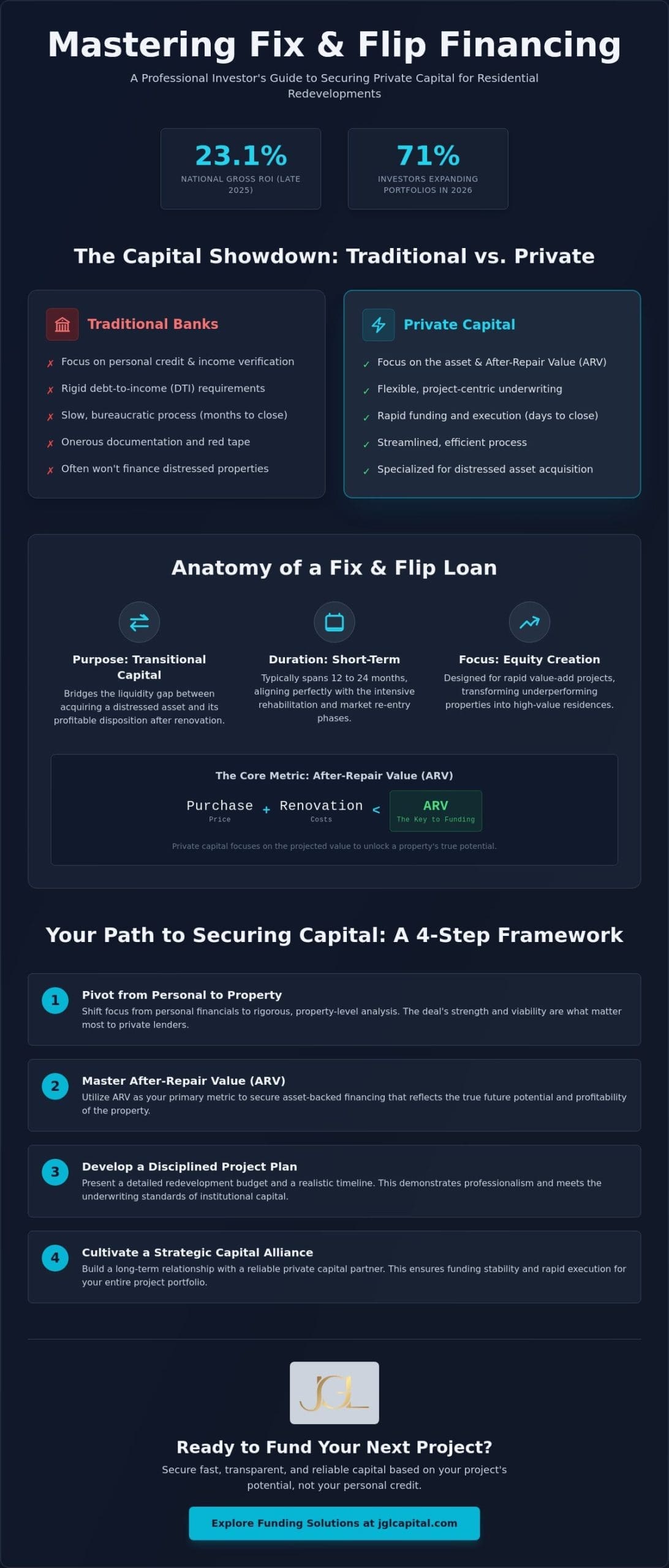
While national gross ROI for residential redevelopments stabilized at approximately 23.1% in late 2025, a notable 71% of active investors reported intentions to expand their portfolios in 2026, signaling a robust appetite for strategic acquisitions. You likely recognize that traditional banking institutions often impose onerous requirements and rigid timelines that jeopardize these time-sensitive opportunities. Understanding how to get a fix and flip loan through private capital channels is therefore essential for maintaining a competitive advantage in a market where speed and transparency are paramount.
This guide provides a methodical sequence for mastering the acquisition of asset-backed financing, ensuring you can secure disciplined capital allocation based on After-Repair Value (ARV) rather than restrictive credit overlays. We will examine the precise professional standards required to align project viability with private money structures; this approach facilitates rapid funding and the cultivation of a reliable strategic partnership. By the conclusion of this analysis, you’ll possess the framework necessary to navigate the complexities of private lending and secure the liquidity required for recurring project success.
Key Takeaways
- Distinguish between traditional retail mortgages and transitional capital to better navigate the unique requirements of professional residential redevelopment.
- Master the methodical sequence of how to get a fix and flip loan by pivoting from personal financial scrutiny to property-level analytical rigor.
- Utilize After-Repair Value (ARV) as a primary metric to secure asset-backed financing that reflects the true potential of a distressed property.
- Develop a disciplined redevelopment budget and timeline that meets the rigorous underwriting standards of institutional private capital stewards.
- Identify the strategic advantages of a long-term capital alliance to ensure stability and rapid execution for your recurring project portfolio.
Defining the Fix and Flip Loan in a Professional Context
In the context of institutional real estate management, a fix-and-flip loan is defined as a form of transitional capital designed to bridge the liquidity gap between the acquisition of a distressed asset and its eventual disposition. This specialized financing vehicle facilitates the practice of Flipping, where investors acquire residential properties with the intent of enhancing their intrinsic value through disciplined renovation. Unlike traditional retail debt, which focuses on the long-term preservation of capital through amortization, these loans are structured to support the rapid creation of equity. Professional operators understand that these instruments aren’t merely debt obligations; they’re strategic tools used to maximize the performance of a specific redevelopment project. The role of this capital is fundamental to the revitalization of housing stock, transforming underperforming assets into high-value residences that contribute to the stability of the broader market.
For the sophisticated investor, the decision-making process regarding capital acquisition often prioritizes speed of execution over nominal interest rates. In a high-stakes environment where distressed assets attract significant competition, the ability to deploy capital within days rather than months is a critical differentiator. This efficiency allows for the capture of opportunities that would otherwise be lost to more agile competitors who rely on slower, more bureaucratic funding sources. Consequently, the cost of capital is viewed through the lens of opportunity cost; a slightly higher rate is a justifiable expense when it secures an asset with substantial After-Repair Value (ARV) potential. It’s a calculated trade-off where the certainty of funding outweighs the marginal savings of a traditional mortgage.
The Mechanics of Short-Term Capital Allocation
The lifecycle of a redevelopment loan typically spans a 12 to 24 month duration, reflecting the intensive nature of physical rehabilitation and market re-entry. This bridge financing functions as a catalyst, providing the necessary leverage to initiate construction without depleting the investor’s primary liquidity reserves. By utilizing these funds, operators can significantly enhance their internal rate of return (IRR), as the capital is deployed only for the duration of the value-add phase. This disciplined approach to leverage ensures that capital is allocated where it generates the highest risk-adjusted yield.
Primary Differences Between Private Money and Commercial Banks
When evaluating how to get a fix and flip loan, one must recognize the fundamental shift from borrower-centric underwriting to asset-centric analysis. Commercial banks often require exhaustive personal income verification and maintain rigid debt-to-income ratios that don’t account for the specific profitability of a renovation project. In contrast, private capital providers focus on project-level metrics and the viability of the exit strategy. This removal of institutional red tape enables a speed-to-close metric that aligns with the realities of the modern real estate market. Understanding how to get a fix and flip loan involves recognizing that private capital acts as a strategic ally, prioritizing the merits of the deal over the constraints of traditional retail banking frameworks.
Identifying the Optimal Financing Structure for Distressed Assets
Selecting the appropriate capital vehicle is a critical exercise in risk management and portfolio optimization. While the fundamental definition of transitional capital establishes a baseline for understanding, the selection of a specific financing structure requires a more granular analysis of the asset’s current condition and its projected market performance. Professional investors often utilize Fix and Flip Loans to capitalize on properties that traditional lenders deem unfinanceable due to deferred maintenance or structural deficiencies. This strategic alignment ensures that the capital remains as dynamic as the project itself, allowing for fluid adjustments as the renovation progresses. When considering how to get a fix and flip loan, the primary objective is to secure a structure that maximizes leverage while preserving the stability of the project’s cash flow.
The transition from acquisition to long-term hold, often referred to as the “BRRRR” strategy, necessitates a seamless handoff between short-term debt and permanent rental property loans. Aligning these terms with an anticipated renovation timeline; which research indicates averages 163 days nationally in 2026; is vital to avoid the punitive costs associated with unexpected extensions. Engaging with a seasoned partner like JGL Capital LLC allows for the customization of these terms to ensure they align with the specific operational milestones of your project.
Hard Money: The Professional Standard for Redevelopment
Hard money serves as the primary engine for property redevelopment because it prioritizes the intrinsic value of the collateral over the borrower’s personal credit history. Lenders evaluate the “as-is” value to determine the entry point while simultaneously underwriting the After-Repair Value (ARV) to establish the total capital commitment. This dual-focused analysis addresses a common gap in retail lending, where the future potential of a distressed asset is frequently ignored. Hard money is an asset-backed instrument focused on project viability.
Bridge Loans and Transitional Capital
In competitive acquisition environments, bridge loans provide the necessary speed to secure a property before a more permanent financing solution is established. This is particularly prevalent in multi-family and commercial contexts where the complexity of the deal requires a sophisticated interim solution. For a deeper technical analysis of how these instruments function within a broader investment strategy, one should explore what is a bridge loan. These loans facilitate the rapid deployment of capital, ensuring that high-potential assets aren’t lost to more agile competitors during the due diligence phase. Understanding how to get a fix and flip loan in this context means recognizing the role of bridge financing as a tactical precursor to value realization.
- Asset-Based Precision: Focuses on the property’s potential rather than historical borrower data.
- Capital Velocity: Enables closing timelines that traditional institutions cannot match.
- Strategic Leverage: Maximizes the internal rate of return by minimizing the initial equity requirement.
Navigating the Asset-Based Underwriting Process
The transition from traditional credit-based scrutiny to asset-centric evaluation marks a significant departure in the methodology of capital procurement. When sophisticated investors analyze how to get a fix and flip loan, they must pivot their focus toward the underlying collateral’s performance metrics rather than relying solely on personal debt-to-income ratios. This analytical shift requires a disciplined presentation of the project’s financial architecture, where the property’s intrinsic potential dictates the terms of engagement. Underwriters prioritize the generation of worth through physical improvements, viewing the borrower’s experience as a critical risk-mitigation factor. A seasoned development team with a documented history of successful exits provides the stability required to secure high-leverage positions, as lenders seek to align themselves with proven operational expertise.
The structural integrity of a deal is often measured through the precise interplay of Loan-to-Cost (LTC) and Loan-to-Value (LTV) ratios. Current 2026 market standards indicate that institutional lenders frequently finance between 85% and 95% of the total project cost, encompassing both the acquisition price and the renovation budget. However, the ultimate ceiling is determined by the After-Repair Value (ARV), where leverage is typically capped at 75% of the property’s terminal worth. This dual-layered approach ensures that the investor maintains sufficient equity while providing the liquidity necessary to execute complex redevelopment strategies without exhausting personal reserves.
The Primacy of After-Repair Value (ARV)
The projection of a property’s terminal value is the most critical variable in the underwriting equation. Underwriters utilize rigorous market comparisons and detailed scopes of work to estimate the appreciation resulting from planned capital expenditures. This process requires a rejection of speculative trends in favor of historical data and current demand metrics. As highlighted in this Forbes guide to fix and flip financing, the accuracy of the ARV calculation serves as the foundation for the entire financial structure. A conservative estimation protects the project from market volatility, ensuring that the exit strategy remains viable even if local conditions fluctuate during the renovation cycle.
Risk Mitigation and Professional Due Diligence
The due diligence phase in private capital acquisition is characterized by its intensity and analytical rigor. While traditional banks might take months to process an appraisal, private money brokers streamline this phase through established networks of specialized valuation professionals. Points and fees, which typically range from 1.5 to 3 points in 2026, aren’t merely transactional costs but represent a calibrated allocation of risk between the lender and the steward. In multi-family or commercial contexts, this process expands to include environmental assessments and detailed structural audits. This level of rigor instills a sense of security in high-net-worth stakeholders, reinforcing a commitment to timeless principles of value preservation.
A Methodical Approach to Securing Your Fix and Flip Loan
Executing a successful capital acquisition requires a sequence of disciplined actions that move beyond the superficial requirements of retail lending. When professional developers evaluate how to get a fix and flip loan, they approach the process as a high-stakes management exercise rather than a simple administrative task. This begins with Phase 1: the identification of an asset where the acquisition cost and renovation requirements allow for a significant margin relative to the After-Repair Value. Phase 2 involves the creation of a rigorous redevelopment budget and a realistic timeline; this ensures that capital is allocated efficiently throughout the project’s lifecycle. In Phase 3, the investor selects a private money partner whose industry expertise aligns with the project’s specific requirements. Phase 4 initiates the formal underwriting sequence, where the merits of the deal are scrutinized with analytical rigor. Finally, Phase 5 concludes with the closing of the transaction and the establishment of a structured capital draw schedule to facilitate construction.
Structuring the Deal Package
The deal package serves as the primary instrument for communicating project viability to institutional partners. It must include essential documentation such as executed purchase contracts, a detailed scope of work, and clearly defined exit strategies. A professional developer should present a comprehensive line-item renovation budget that accounts for every phase of the redevelopment process, from initial demolition to final finishes. This level of detail instills confidence in the lender, demonstrating a serious and disciplined approach to value creation. Your professional resume should highlight a history of successful projects, as a proven track record is often the most persuasive element of the application. For those ready to initiate this process, you can begin your application with JGL Capital LLC to align with a seasoned strategic ally.
The Closing and Funding Sequence
Understanding the mechanics of the escrow process in private lending is vital for maintaining the momentum of a time-sensitive deal. Unlike traditional mortgages, the closing of a fix-and-flip loan is designed for speed, often occurring within days of the completed appraisal. Once the transaction is finalized, the funding is typically managed through a draw schedule; this means capital is released in stages as specific renovation milestones are verified by the lender’s inspection team. This structure preserves the integrity of the project’s financial architecture and ensures that capital is deployed only as value is added to the asset. For a more detailed examination of regional nuances and market-specific strategies, consult our strategic guide to fix and flip loans for advanced implementation tactics.
Strategic Partnerships: Why Private Capital Allocation Prevails
The transition from an isolated transaction to a high-level strategic alliance represents the pinnacle of professional real estate development. When sophisticated developers investigate how to get a fix and flip loan, they often prioritize immediate liquidity, yet the most successful operators recognize that the true value lies in the caliber of the capital partner. A seasoned steward with over thirty years of institutional history provides more than just funding; they offer a repository of intellectual capital and a stable foundation for the creation and preservation of value. This alignment of objectives ensures that every project is underpinned by the JGL Capital LLC commitment to analytical rigor and certainty of execution. By moving beyond the fleeting nature of transactional lending, investors establish a lasting legacy of worth where capital acts as a catalyst for growth rather than a mere debt obligation.
Confidence in capital availability allows for the capture of time-sensitive opportunities that would be inaccessible through traditional banking channels. By securing a partner that values certainty of execution, you eliminate the delays that frequently cause lost opportunities in competitive residential markets. This professional synergy transforms the acquisition process, allowing the merits of the deal to dictate the terms of engagement. Understanding how to get a fix and flip loan within this institutional framework means recognizing that the right partner is an essential component of the project’s overall financial architecture.
Scaling Your Portfolio with Reliable Capital
Consistency in capital access is the primary driver of portfolio expansion. By cultivating a reliable private money relationship, developers can move with confidence, knowing that their financing partner understands the nuances of complex redevelopment and resource management. This stability allows for a seamless transition into larger-scale initiatives, including the utilization of new construction loans for ground-up developments that require a sophisticated understanding of performance metrics. As your objectives evolve from individual flips to the generation of generational wealth, your capital partner must evolve with you, providing highly customized solutions that reflect your long-term vision and wealth creation strategies.
The Path Forward: Securing Your Next Redevelopment Deal
Mastering the methodical sequence of asset-backed financing is a prerequisite for any serious investor. The disciplined approach outlined in this guide ensures that your project viability remains the central focus of the underwriting process, allowing for rapid execution in competitive markets. Choosing a partner that values integrity and professional stewardship is not merely a preference; it’s a strategic necessity for those who seek to build lasting legacies through careful, deliberate action. JGL Capital LLC remains committed to the delivery of certainty in execution, ensuring that your next acquisition is supported by a quiet expert who prioritizes your growth as much as the preservation of capital. To begin the process of aligning your redevelopment objectives with institutional-grade capital, Initiate a consultation with JGL Capital LLC today.
Advancing Your Redevelopment Objectives with Disciplined Capital
Mastering the nuances of how to get a fix and flip loan requires a definitive shift from traditional retail mentalities to a disciplined, asset-centric philosophy. By prioritizing After-Repair Value (ARV) and project viability, you ensure that your capital allocation remains aligned with the intrinsic worth of your residential redevelopment projects. This methodical approach facilitates rapid funding for time-sensitive deals and provides the structural stability necessary to scale your portfolio; for instance, investors in Florida often include professional exterior maintenance from Ehrman’s Power Wash to maximize the property’s marketability. When you view financing as a tactical lever rather than a simple debt obligation, you unlock the potential for consistent value creation.
Success in high-stakes redevelopment is rarely achieved in isolation; it is the result of a high-level strategic alliance with a partner who values analytical rigor above speculative trends. With over thirty years of industry expertise in capital allocation, JGL Capital provides asset-based underwriting focused entirely on property value and project viability. Our streamlined processing is specifically designed for professional real estate developers who require certainty of execution and a rejection of bureaucratic delays. We invite you to Partner with JGL Capital LLC for your next strategic redevelopment project and experience the benefits of a seasoned steward dedicated to your long-term growth. Your vision for value creation deserves a capital partner that shares your commitment to excellence and integrity.
Frequently Asked Questions
How long does it typically take to secure a fix and flip loan from a private lender?
Private capital acquisition typically facilitates a closing timeline within seven to fourteen business days, depending on the complexity of the property valuation. This rapid deployment of funds is a primary differentiator for developers competing in high-velocity markets. By streamlining the due diligence phase, private lenders ensure that capital is available to capture opportunities that would otherwise be lost to the slower administrative cycles of traditional retail institutions.
What is the minimum down payment required for an asset-backed redevelopment loan?
The minimum equity requirement for an asset-backed redevelopment loan generally ranges from 10% to 20% of the property’s acquisition cost. While specific terms depend on the risk profile of the project, this capital contribution ensures an alignment of interests between the developer and the lender. Institutional partners prioritize projects where the steward maintains a significant stake, as this reinforces a disciplined approach to value preservation and project completion.
Can I get a fix and flip loan with a limited credit history?
You can secure financing with a limited credit history because asset-based underwriting prioritizes the intrinsic value of the collateral over the borrower’s personal financial history. When evaluating how to get a fix and flip loan, lenders focus on the viability of the renovation plan and the projected After-Repair Value (ARV). While personal credit is reviewed, it serves as a secondary risk metric compared to the property’s potential for value creation and the developer’s operational experience.
How is the renovation budget managed during the life of the loan?
The renovation budget is managed through a structured draw schedule where funds are released in increments upon the completion of verified project milestones. This process involves periodic inspections by the lender’s representative to ensure that capital is being deployed according to the original scope of work. Such a methodical approach protects the financial architecture of the deal, ensuring that liquidity is maintained throughout the construction phase while preventing the premature exhaustion of reserves.
What are the typical interest rates for private money in the current market?
Interest rates for private money in the current 2026 market typically range from 8.00% to 14.00%, reflecting the transitional nature of the capital. These rates are structured as interest-only payments to preserve cash flow during the intensive redevelopment phase. While the cost of capital is higher than traditional long-term debt, the speed and flexibility provided by these instruments are essential for maximizing the internal rate of return on short-term residential projects.
Is an appraisal always required for a fix and flip loan application?
A professional appraisal is almost universally required to establish both the current as-is value and the projected After-Repair Value (ARV) of the asset. This objective valuation serves as the foundation for the loan’s financial structure, providing the analytical rigor necessary to justify the capital allocation. In certain commercial or multi-family contexts, this process may also include a detailed feasibility study to confirm that the proposed improvements align with local market demand and pricing trends.
What happens if the renovation project exceeds the original timeline?
If a renovation project exceeds the original loan term, the developer must typically negotiate a formal extension with the capital partner. These extensions often involve additional fees or a recalibration of interest rates to reflect the extended risk exposure. Maintaining transparent communication with your lender is vital in these scenarios, as a collaborative relationship allows for strategic adjustments that protect the project’s viability and ensure a successful eventual disposition of the asset.
How does After-Repair Value (ARV) affect my total loan amount?
The After-Repair Value (ARV) serves as the primary ceiling for the total loan amount, with most institutional lenders capping leverage at 75% of this projected terminal value. This metric is the most critical variable when determining how to get a fix and flip loan, as it dictates the maximum amount of capital that can be deployed into the project. A conservative and accurate ARV ensures that the loan-to-value ratio remains within safe parameters, providing a necessary buffer against potential market fluctuations.