

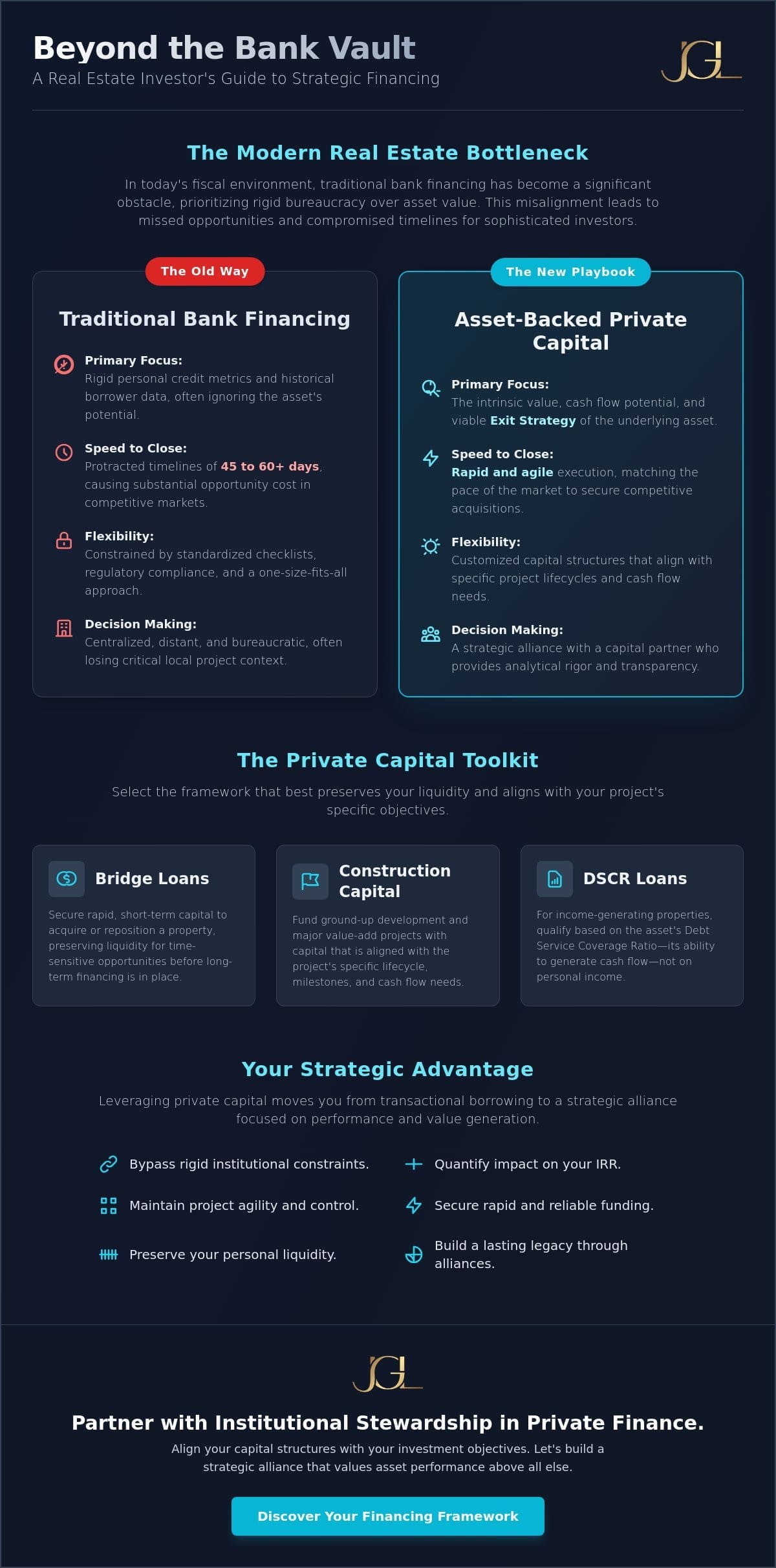
For the sophisticated real estate steward, the traditional bank vault has transitioned from a reliable gateway into a significant bottleneck within the 2026 fiscal environment. You likely understand that institutional lenders often prioritize rigid personal credit metrics and protracted bureaucratic oversight over the intrinsic value of the underlying asset; this misalignment frequently results in missed opportunities and compromised project timelines. By identifying and mastering the most effective alternatives to bank financing for real estate, you’ll discover how to leverage asset-backed private capital to bypass these institutional constraints while maintaining the agility required for complex project execution.
We’ll examine how disciplined investors utilize specialized structures such as bridge and construction capital to preserve liquidity and secure rapid, reliable funding. This guide provides a comprehensive analysis of private capital frameworks that align with your project’s specific cash flow needs, allowing you to move beyond transactional borrowing toward a long-term strategic alliance that values asset performance and the generation of worth above all else.
Key Takeaways
- Analyze the shift in institutional risk appetite to recognize when traditional depository-based underwriting no longer serves your project’s requirement for speed and agility.
- Discover how to leverage asset-backed alternatives to bank financing for real estate to secure reliable capital based on property value rather than rigid institutional constraints.
- Quantify the strategic impact of various leverage structures on your Internal Rate of Return (IRR) to ensure your capital allocation remains disciplined and performant.
- Distinguish between the specific mechanical requirements of DSCR, bridge, and new construction loans to select the framework that best preserves your liquidity.
- Establish criteria for identifying a capital partner who provides the analytical rigor and transparency necessary for building a lasting legacy through strategic alliances.
The Limitations of Traditional Banking in Modern Real Estate Markets
The 2026 financial environment has witnessed a profound contraction in institutional risk appetite, leaving many sophisticated developers to grapple with an increasingly rigid banking sector. While traditional lenders once provided a cornerstone for property acquisition, their current operational models are defined by a systemic prioritization of regulatory compliance over the fundamental economic viability of a project. This shift is not merely a reaction to market volatility; it’s a structural realignment where depository institutions have become increasingly detached from the nuances of high-performance real estate. Consequently, the search for alternatives to bank financing for real estate has transformed from a contingency plan into a primary strategic objective for those who value asset-specific performance over generic credit metrics.
The fundamental misalignment in conventional lending lies in the excessive focus on personal credit history rather than the intrinsic value and cash flow potential of the asset. For the professional investor, this creates a friction point where personal liquidity is often sidelined by institutional inertia. By shifting toward asset-backed private capital, developers can ensure that their financing structures are as disciplined and strategic as the projects they intend to execute.
The Regulatory Constraints on Conventional Lenders
The imposition of stringent, Basel-style capital requirements has forced many commercial banks to adopt a defensive posture, particularly regarding speculative development and value-add acquisitions. These regulations mandate higher capital reserves for assets deemed to be high-volatility, effectively de-prioritizing the very projects that drive significant market growth. When underwriting is centralized in a distant corporate office, the local context of a project is often lost in a sea of standardized checkboxes. This institutional friction makes it difficult for banks to support Creative financing techniques that might otherwise unlock substantial value in complex urban redevelopments or niche multi-family assets. The result is a lending environment that favors safety over sophisticated value creation.
The Opportunity Cost of Delayed Funding
In a competitive acquisition environment, the duration of the funding cycle is often as critical as the cost of capital itself. Traditional banks frequently require 45 to 60 days to reach a closing, a timeline that is increasingly incompatible with the pace of modern real estate transactions. When a capital provider cannot match the speed of the market, the developer incurs a substantial opportunity cost, often losing the asset to more agile competitors. Even when banks offer their own versions of bridge financing, these products frequently suffer from the same bureaucratic delays and exhaustive documentation requirements as their long-term counterparts. High-net-worth investors don’t seek alternatives to bank financing for real estate because of a lack of personal credit; they do so to ensure that their liquidity remains unencumbered and their project timelines remain under their own disciplined control.
The Mechanics of Asset-Backed Private Capital
The underwriting process in private finance is anchored by a meticulous analysis of the “Exit Strategy,” which serves as the primary metric of success for both the lender and the borrower. While a bank might focus on historical tax returns, a private capital partner evaluates the feasibility of the project’s stabilization or eventual disposition. This forward-looking perspective is essential when exploring Non-mortgage financing alternatives that require a more nuanced understanding of market dynamics and asset management. By focusing on the asset’s future performance, investors can secure funding that supports their broader strategic objectives. Success is measured by execution.
Bridge Financing as a Transitional Tool
A sophisticated understanding of what is a bridge loan reveals its utility as more than a short-term fix; it’s a strategic bridge that facilitates property stabilization. These transitional structures are particularly effective for multi-family or commercial assets where immediate capital is required to implement value-add improvements before transitioning to permanent financing. The inclusion of interest-only periods is a critical feature, as it preserves project liquidity during the most capital-intensive phases of a renovation or repositioning. This flexibility ensures that cash flow is directed toward asset enhancement rather than premature debt amortization.
Hard Money: Agility in High-Stakes Acquisitions
In the high-stakes environment of property acquisition, the speed of execution is often the most significant differentiator. Hard money, when utilized by experienced professionals, provides the agility to fund transactions in days rather than months. By prioritizing the Loan-to-Value (LTV) ratio over the borrower’s Debt-to-Income (DTI) metrics, asset-based lenders can offer capital that reflects the true potential of a Fix and Flip Loans or land acquisition. This responsiveness allows investors to capitalize on distressed assets or time-sensitive opportunities without the delays inherent in traditional channels. For those seeking a disciplined partner in these endeavors, establishing a strategic relationship with a private capital provider ensures that liquidity is always available when opportunity arises.
Strategic Evaluation of Alternative Financing Frameworks
The strategic evaluation of alternatives to bank financing for real estate necessitates a fundamental shift from simple interest rate comparisons to a holistic assessment of capital efficiency. Sophisticated investors recognize that while the nominal cost of private capital may exceed that of a traditional mortgage, the ability to secure higher leverage directly enhances the Internal Rate of Return (IRR) by reducing the initial equity requirement. This dynamic is particularly evident when comparing the capital requirements of rapid-cycle rehabilitation projects with the stabilized cash flow objectives of multi-family portfolios. A disciplined approach treats origination points and fees as essential components of the total cost of capital, weighed against the certainty of execution and the preservation of personal liquidity.
When structuring debt for diverse portfolios, the choice between multi-family and single-family rental (SFR) frameworks depends on the specific project risk profile and the desired level of asset-level autonomy. Private capital allows for the following strategic alignments:
- Fix and Flip: Prioritizes high loan-to-cost (LTC) ratios to maximize the velocity of capital during the renovation phase.
- DSCR Portfolios: Focuses on the property’s ability to cover debt obligations, enabling long-term holds without the friction of personal debt-to-income (DTI) analysis.
- New Construction: Requires a structured capital stack that supports both vertical construction and horizontal infrastructure development.
New Construction and Development Capital
Securing new construction loans through private channels offers a level of operational efficiency that institutional lenders cannot match. Private lenders streamline the draw schedule process, allowing for faster inspections and more consistent funding of project milestones. This agility is vital for managing land acquisition and infrastructure costs without the administrative delays typical of depository institutions. By aligning the financing with the construction timeline, developers can focus on execution rather than managing lender bureaucracy.
Commercial and Multi-Family Strategic Loans
The deployment of commercial real estate loans in the private sector is often centered on value-add opportunities where property stabilization is the primary goal. In these scenarios, the Debt Service Coverage Ratio (DSCR) becomes the primary underwriting metric, allowing for non-recourse alternative lending that protects the investor’s personal wealth. For large-scale residential projects, syndicated private funds offer a robust alternative to traditional commercial mortgages, providing the scale and flexibility required for complex urban developments or extensive multi-family acquisitions.
Aligning Capital Structures with Investment Objectives
Selecting a capital partner is a decision that extends far beyond the immediate liquidity requirement. For the sophisticated developer, this choice is rooted in a partner’s institutional expertise and their demonstrated ability to navigate complex market cycles with analytical rigor. Transparency in fee structures and a streamlined closing process are not merely conveniences; they’re essential indicators of a firm’s operational maturity and professional integrity. By integrating alternatives to bank financing for real estate into a broader capitalization strategy, investors ensure that their debt obligations are precisely calibrated to the project’s performance timeline. This level of alignment mitigates the risk of capital calls or premature refinancing pressures during the critical stabilization phase of a development.
A disciplined approach to capital allocation requires matching the duration of the debt with the anticipated lifecycle of the asset. When loan maturity dates are out of sync with projected asset stabilization, the resulting friction can jeopardize the project’s overall Internal Rate of Return (IRR). Strategic partners work to ensure that every facet of the capital stack serves the long-term objective of value preservation.
Assessing Lender Reliability and Stewardship
The Exit Strategy: The Core of Alternative Underwriting
A clearly articulated path to repayment forms the foundation of every disciplined private loan. Unlike traditional mortgages that may rely on perpetual amortizing debt, alternative structures require a definitive plan for either refinancing into permanent debt or asset liquidation upon stabilization. Each path has its own strategic merits; refinancing preserves ownership and long-term appreciation, while liquidation optimizes the velocity of capital for subsequent acquisitions. The exit strategy is the primary covenant in asset-backed lending. To secure a partner who understands these complexities, you should evaluate our institutional-grade capital solutions to ensure your next project is backed by seasoned expertise and a commitment to shared success.
Aligning loan maturity dates with projected asset stabilization is a vital risk mitigation strategy. If a bridge loan matures before the property reaches its target Net Operating Income (NOI), the developer may face unfavorable terms in a rushed refinancing environment. A disciplined partner works collaboratively to structure maturity dates that provide a sufficient buffer for unforeseen construction delays or shifts in market demand. This proactive approach to capital management ensures that the investment remains resilient and performant throughout its entire lifecycle.
JGL Capital: Institutional Stewardship in Private Finance
JGL Capital operates as a disciplined steward of private finance, leveraging more than three decades of analytical rigor to facilitate high-stakes real estate capital allocation for a discerning clientele. Our organization distinguishes itself by rejecting the speculative trends that often characterize transactional lending, choosing instead to prioritize the timeless principles of value preservation and strategic growth that define lasting legacies. By providing sophisticated alternatives to bank financing for real estate, we empower professional developers to execute complex visions without the rigid constraints and protracted timelines of traditional institutional banking. This commitment to professional stewardship ensures that every project is supported by a partner who values the intrinsic worth of the asset as much as the generation of long-term value.
The JGL advantage is rooted in a streamlined underwriting philosophy that bypasses the friction of depository-based compliance while maintaining a serious and disciplined approach to risk management. We recognize that for the high-net-worth stakeholder, liquidity is a strategic asset that must be preserved through intelligent capital structures. By positioning your next project within our framework of private capital, you’ll benefit from a level of agility and expertise that traditional banks simply can’t provide in the current fiscal environment.
Our National Reach and Specialized Expertise
While our perspective is institutional, our execution remains highly localized, serving professional investors across the United States with a steadfast focus on property value over generic credit metrics. Our proficiency in specific high-growth regions, including our established presence as hard money lenders Florida, allows us to navigate regional market dynamics with a level of precision that transactional competitors can’t replicate. The JGL broker model is a central component of this expertise, as it ensures that our partners have access to the most competitive and diversified private capital pools available in the 2026 fiscal landscape. This structure allows us to deliver customized solutions that align with the specific risk profiles and timelines of our stakeholders, reinforcing our role as a quiet expert in the field.
Engaging with JGL Capital for Your Next Acquisition
The process of securing capital through JGL begins with a comprehensive initial consultation, a stage designed to ensure the absolute alignment of our resource management capabilities with your specific strategic objectives. We move beyond simple service provision by framing our involvement as a high-level strategic alliance, ensuring that every capital structure we facilitate supports the long-term preservation of your capital. Our documentation process is meticulously streamlined for asset-backed origination, focusing on the clarity of the exit strategy and the performance metrics of the underlying property rather than administrative checkboxes. We invite you to contact JGL Capital to discuss your 2026 development pipeline and discover how a disciplined approach to private finance can secure your next acquisition through professional capital stewardship. By establishing a collaborative relationship now, you’ll position your future projects for success through a partner dedicated to the creation and preservation of value.
Securing Future Asset Value Through Disciplined Capital Alliances
The transition toward private capital frameworks represents a fundamental realignment of how sophisticated investors approach property acquisition and development. Speed and agility are now paramount. You’ve discovered that the most effective alternatives to bank financing for real estate are those that prioritize the intrinsic value of the asset and the viability of the exit strategy over generic institutional metrics. By embracing asset-backed structures, you ensure that your liquidity remains preserved and your project timelines remain unencumbered by the friction of traditional depository oversight.
Establishing a long-term strategic alliance with a capital provider who possesses a national reach and specialized focus on high-stakes commercial and residential development is essential for building a lasting legacy. With over 30 years of industry expertise, our firm provides the analytical rigor and professional stewardship required to navigate the complexities of the 2026 fiscal landscape. We invite you to align your capital strategy with a seasoned partner at JGL Capital to ensure your next acquisition is backed by disciplined expertise. Your future projects deserve a partner committed to the generation and preservation of worth.
Strategic Inquiries into Private Real Estate Capital
What are the primary advantages of alternative financing over traditional bank loans?
The primary advantages include enhanced speed of execution, a prioritized focus on asset value rather than personal credit, and highly customized repayment structures. These alternatives to bank financing for real estate allow sophisticated developers to secure capital without the rigid constraints and regulatory friction associated with traditional depository institutions. By emphasizing the property’s performance, private capital provides a level of agility that is often unavailable through institutional channels.
How do interest rates for private real estate loans compare to conventional mortgages in 2026?
In June 2026, private capital rates reflect a premium for agility and asset-based risk, with hard money loans typically ranging from 8% to 15% annually depending on borrower experience. This compares to conventional 30-year fixed mortgage rates averaging approximately 6.47% to 6.55%. DSCR loan rates remain more competitive for long-term holds, with fixed options ranging from 6.125% to 7.5% for qualified projects.
Is alternative financing suitable for long-term rental property investments?
Alternative financing is highly suitable for long-term rental portfolios, particularly through Debt Service Coverage Ratio (DSCR) loan structures. These loans prioritize the property’s rental income over the investor’s personal debt-to-income metrics, facilitating the acquisition and preservation of multi-family and single-family assets. This approach allows for the creation of lasting legacies through disciplined, asset-focused capital allocation that avoids the limitations of personal credit underwriting.
What documentation is typically required for an asset-backed bridge loan?
Asset-backed bridge loans typically require a purchase agreement, a professional appraisal, entity organizational documents, and a detailed project budget for any planned stabilization. Unlike traditional banks, these lenders emphasize the property’s value and the developer’s track record rather than exhaustive personal financial histories. This streamlined documentation process supports the rapid deployment of capital in competitive acquisition environments where time is a critical factor.
Can alternative financing be used for ground-up new construction projects?
Private capital is a robust solution for ground-up new construction projects where traditional banks may hesitate due to speculative risk or regulatory exposure. Specialized new construction loans provide structured draw schedules and horizontal development financing that align with the specific milestones of a development project. This ensures that developers maintain the necessary liquidity to execute complex builds without the administrative delays typical of depository institutions.
How does a bridge loan exit strategy impact the underwriting process?
The exit strategy serves as the primary covenant in alternative underwriting, as it defines the definitive path to capital repayment. Lenders evaluate the feasibility of refinancing into permanent debt or asset disposition to determine the loan’s term length and risk profile. A clearly articulated exit strategy demonstrates the analytical rigor necessary to secure institutional-grade private capital and ensures that the loan remains performant throughout its lifecycle.
Are there prepayment penalties associated with private money real estate loans?
Prepayment structures vary significantly between short-term bridge capital and long-term rental products. While many bridge and hard money loans offer the flexibility of no prepayment penalties to support capital velocity, long-term DSCR loans often include declining penalty schedules. Investors should review these terms during the initial consultation to ensure the capital structure aligns with their broader investment objectives and projected asset hold times.
How quickly can a private capital loan be funded for a real estate acquisition?
Private capital providers can fund a real estate acquisition in as little as 5 to 10 business days, provided that the appraisal and entity documentation are readily available. This speed of execution is a defining characteristic of alternatives to bank financing for real estate, providing a significant tactical advantage over the 45-day cycles typical of traditional banking. This agility allows professional investors to close transactions with the certainty of a cash buyer.