

The traditional paradigm of real estate acquisition often dictates that capital preservation must be sacrificed for portfolio expansion; however, the most sophisticated institutional players recognize that liquidity is a strategic asset that shouldn’t be unnecessarily exhausted. You likely recognize the constraints that traditional lender restrictions and significant out-of-pocket equity requirements place on your ability to scale a high-performing portfolio. This guide clarifies the institutional frameworks and strategic mechanics required to utilize a hard money loan for down payment on rental property to effectively bridge the equity gap while maintaining your capital reserves.
We’ll examine the precise structuring of private capital within your capital stack and the alignment of short-term debt obligations with your long-term wealth preservation objectives. By treating this bridge financing as a deliberate tool for capital allocation rather than a mere necessity, you can achieve successful acquisitions with minimal immediate equity outlay. This methodical approach ensures your growth remains disciplined and your capital stays productive. Through careful analysis of these specialized instruments, you can secure the assets required to build a lasting legacy without compromising your firm’s liquidity position.
Key Takeaways
- Understand how to preserve institutional liquidity by integrating private capital as a transitional layer within a sophisticated capital stack.
- Analyze the strategic mechanics of utilizing a hard money loan for down payment on rental property through gap financing and the cross-collateralization of existing equity.
- Evaluate the quantitative trade-offs between short-term debt costs and the projected return on investment achieved through preserved equity and accelerated portfolio scaling.
- Navigate complex institutional underwriting requirements by mastering the nuances of sourcing and seasoning to ensure deal compliance and structural integrity.
- Align your acquisition objectives with a disciplined, seasoned partner to secure bespoke financing solutions that prioritize long-term value preservation and growth.
Strategic Capital Allocation: The Role of Hard Money in Rental Acquisitions
The utilization of private capital has undergone a significant transformation, evolving from a niche alternative for distressed situations into a primary component of a sophisticated capital stack. For the institutional investor, a hard money loan overview reveals a tool designed for agility and precision rather than a mere substitute for conventional financing. This transitional capital allows for the rapid deployment of funds, ensuring that high-value opportunities aren’t lost to the protracted timelines of traditional banking institutions. By viewing hard money as a strategic layer within a broader allocation framework, investors can effectively manage the trade-off between the immediate cost of capital and the long-term opportunity cost of exhausted equity.
Sophisticated portfolio scaling requires a rejection of the binary choice between high-interest debt and high-equity requirements. Instead, a disciplined approach prioritizes speed and certainty of execution. In competitive markets where closing times of 3 to 7 days are often the prerequisite for deal acceptance, the higher interest rates associated with private capital are mitigated by the immediate capture of asset appreciation and rental yield. The focus remains on the generation of worth through the preservation of liquid reserves, which can then be deployed across multiple concurrent acquisitions.
The Liquidity Challenge in Modern Real Estate Markets
Traditional lending frameworks typically demand a down payment of 25% to 35%, a requirement that creates significant liquidity constraints for even the most well-capitalized firms. This equity trap often hinders portfolio velocity, as capital remains locked in a single asset rather than fueling broader growth. Maintaining robust cash reserves is a strategic necessity for operational contingencies and the pursuit of distressed opportunities that require immediate action. Private money facilitates these high-stakes acquisitions by providing the necessary leverage to overcome traditional equity hurdles. This approach ensures that a firm’s liquidity remains an active asset rather than a static contribution to a single property’s equity line.
Hard Money as a Strategic Bridge to Long-Term Financing
The successful integration of a hard money loan for down payment on rental property requires an unwavering commitment to a clear exit strategy. This short-term instrument serves as a bridge, allowing the investor to secure the asset before transitioning into stabilized rental property loans. Asset-backed lending focuses on the inherent value of the property, providing a flexible framework that traditional income-based underwriting cannot match. By establishing a disciplined debt-to-equity ratio at the outset, investors can align their short-term obligations with their long-term wealth preservation goals. This methodical alignment ensures that each acquisition contributes to a lasting legacy of value without overextending the firm’s balance sheet during the initial acquisition phase.
Mechanics of Gap Financing: How Hard Money Facilitates Down Payment Requirements
Gap financing represents the strategic alignment of secondary capital to bridge the delta between senior debt and the total acquisition cost. While traditional lenders often restrict the use of borrowed funds for equity requirements, a sophisticated approach involves a hard money in real estate investing framework that prioritizes the asset’s intrinsic value. This requires a nuanced understanding of Loan-to-Cost (LTC) versus Loan-to-Value (LTV). LTC measures the loan amount against the total acquisition and renovation expenses, while LTV focuses on the appraised worth. For investors seeking a hard money loan for down payment on rental property, this distinction is vital. It determines whether the capital stack is rooted in current purchase metrics or future valuation potential.
It’s vital to distinguish between a simple unsecured loan and a structured secondary lien. Institutional-grade transactions require that all debt be properly collateralized and disclosed. This transparency ensures that the senior lender’s position isn’t compromised by undisclosed liabilities. By formalizing the debt through a secondary lien, the investor maintains a disciplined capital structure that satisfies the rigorous standards of all stakeholders involved in the acquisition.
Utilizing Cross-Collateralization for Down Payment Support
Cross-collateralization allows an investor to leverage the unrealized equity within an existing portfolio to secure capital for a new acquisition. Instead of injecting cash, the investor offers a secondary lien on a performing asset. This mechanic reduces direct out-of-pocket equity requirements while maintaining a disciplined approach to total portfolio leverage. It effectively transforms static equity into a dynamic tool for expansion. To explore how these structures can be tailored to your specific portfolio, you might consider consulting with experienced capital partners. This strategy minimizes the impact on liquidity while allowing for the capture of new, high-yield assets.
Gap Funding and Second Lien Positions
Securing a hard money loan for down payment on rental property often involves placing the private lender in a subordinate position. This second lien position requires a robust intercreditor agreement that defines the rights and priorities of each capital partner in the event of default. Many private lenders are willing to accept this subordinate status if the overall Debt Service Coverage Ratio (DSCR) remains strong and the exit strategy is clearly defined. This structural precision instills confidence in all parties, ensuring the acquisition proceeds without friction. It’s a calculated arrangement that balances risk across the capital stack while facilitating growth that would otherwise be hindered by liquidity constraints.
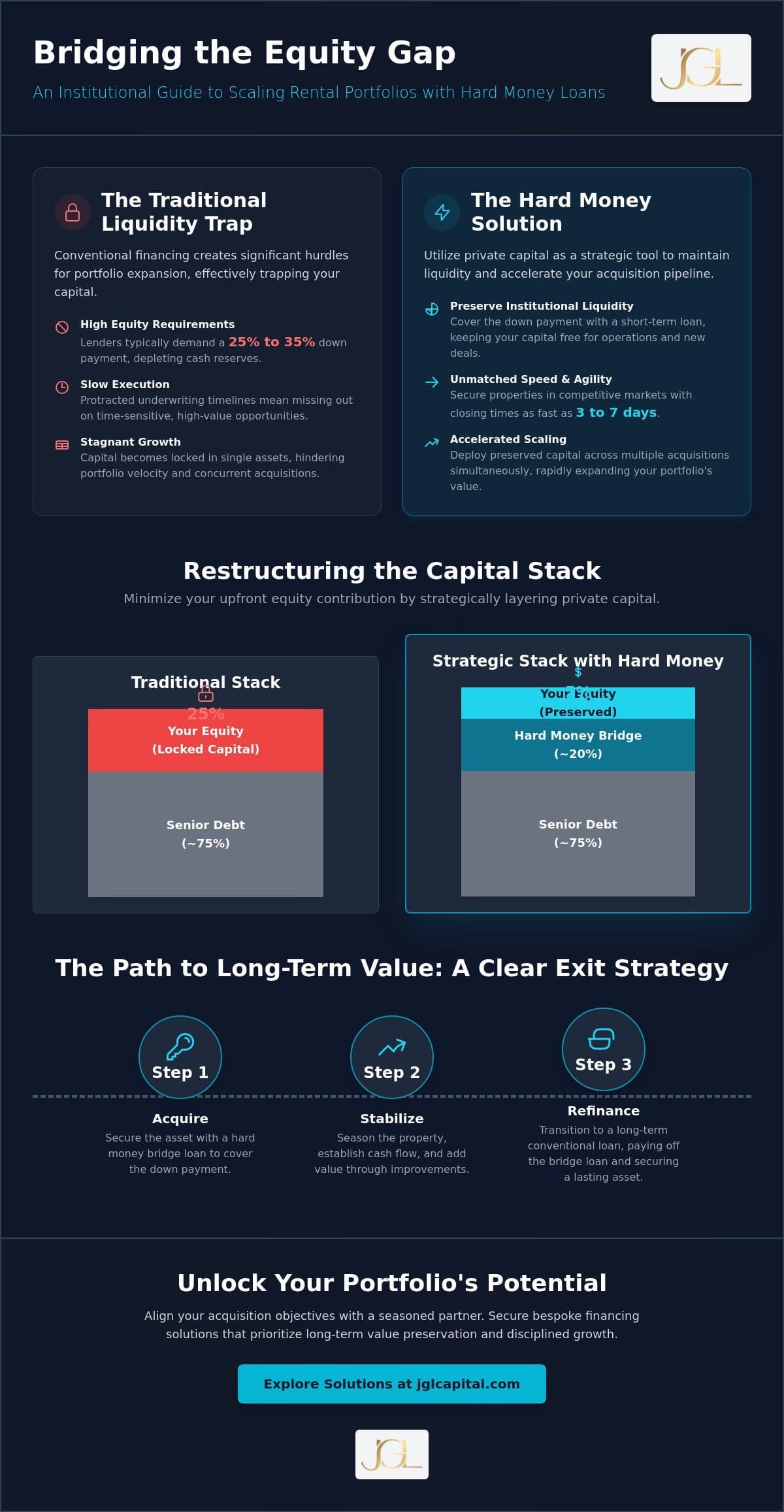
Analyzing the Capital Stack: Hard Money vs. Traditional Equity Contributions
A rigorous quantitative analysis of the capital stack reveals that the nominal interest rate of a Hard money loan is often secondary to the strategic preservation of liquid equity. While conventional wisdom prioritizes the lowest possible cost of debt, sophisticated investors recognize that the opportunity cost of exhausted equity can be far more punitive than the interest expense of private capital. By utilizing a hard money loan for down payment on rental property, an investor can maintain a high degree of liquidity, allowing for the concurrent pursuit of multiple high-yield assets. The focus shifts from a simple interest-rate comparison to a comprehensive evaluation of risk-adjusted returns across the entire portfolio.
Maintaining a robust Debt Service Coverage Ratio (DSCR) remains the primary safeguard in these highly leveraged structures. Even when the capital stack approaches 100% financing, the property’s net operating income must comfortably exceed the total debt service requirements. The prevalence of interest-only payment structures in private lending serves as a critical cash-flow buffer, ensuring that operational stability isn’t compromised during the initial phase of the acquisition. This disciplined approach to cash flow management allows the investor to focus on asset stabilization and long-term value creation without the immediate pressure of principal amortization.
Leverage and Its Impact on Internal Rate of Return (IRR)
Modeling IRR scenarios with varying levels of private capital participation demonstrates the power of equity efficiency. When an investor minimizes their direct capital contribution, the resulting IRR can be significantly amplified, provided the asset’s performance remains strong. However, one must remain vigilant against the leverage trap, which occurs when the blended cost of debt exceeds the property’s capitalization rate. Strategic use of bridge loans allows for a more flexible capital allocation, ensuring that each dollar of equity is deployed where it generates the highest possible return. This methodical optimization of the capital stack is what distinguishes institutional-grade management from transactional investing.
Risk Mitigation in Highly Leveraged Rental Deals
Stress-testing the capital stack against potential market volatility or unexpected vacancy is a prerequisite for any disciplined acquisition. A highly leveraged deal requires a precise exit strategy, whether through a long-term refinance into stabilized debt or a strategic sale upon reaching a valuation milestone. Maintaining institutional discipline in asset selection ensures that the underlying property possesses the intrinsic value necessary to support the debt load. By prioritizing assets with strong fundamental demand and clear paths to appreciation, investors can mitigate the inherent risks of high leverage. This commitment to analytical rigor ensures that the pursuit of growth never compromises the firm’s long-term stability or its reputation for disciplined stewardship.
Navigating Underwriting Constraints: Structuring Deals for Institutional Approval
The primary challenge in integrating private capital within a senior debt structure often resides in the rigorous sourcing and seasoning requirements imposed by institutional underwriters. When an investor employs a hard money loan for down payment on rental property, the transaction must be structured with absolute transparency to ensure that the primary lender’s lien priority and debt-to-income thresholds remain uncompromised. Most institutional entities require a clear audit trail for any equity contribution, often seeking to verify that funds have been held in a liquid account for a minimum of sixty to ninety days. Structuring a deal that utilizes borrowed capital for the down payment requires a sophisticated understanding of these compliance windows and the ability to present the capital stack as a deliberate, risk-mitigated strategy rather than a liquidity deficiency.
Maintaining integrity in the capital stack is not merely a legal requirement; it’s a foundational principle for building long-term institutional relationships. A private money broker plays a critical role in this ecosystem by aligning the interests of all capital partners and ensuring that the subordinate debt is structured to meet the primary lender’s guidelines. This alignment often involves the creation of comprehensive disclosure packages that detail the terms of the bridge financing and the projected exit strategy. By proactively addressing the primary lender’s concerns regarding debt serviceability, an investor can secure the necessary leverage without jeopardizing the deal’s approval.
The 100% Financing Framework
Sophisticated investors often leverage the After-Repair Value (ARV) of an asset to reduce or eliminate the need for traditional cash down payments. In this framework, the lender provides capital based on the projected value of the property following a specified renovation period. Many firms utilize fix and flip loans as a transitional instrument, allowing them to acquire and stabilize an asset before transitioning into a permanent rental hold. This approach effectively uses the property’s forced appreciation to satisfy the equity requirements of long-term debt, creating a pathway to 100% financing that remains compliant with institutional standards.
Working with Private Money Brokers for Custom Solutions
Bespoke capital sourcing offers a distinct advantage over standardized loan products by aligning the specific risk profile of a transaction with a lender’s unique appetite for complexity. Experienced brokers who specialize in commercial real estate loans understand the nuances of intercreditor agreements and the importance of maintaining a balanced capital stack. They provide the intellectual capital necessary to navigate the intersection of private and institutional finance, ensuring that each acquisition is structured for maximum efficiency. To ensure your next acquisition is structured for institutional-grade approval, consult with the strategic advisors at JGL Capital to explore customized capital solutions.
JGL Capital: Bespoke Financing Solutions for Sophisticated Real Estate Investors
JGL Capital operates at the intersection of institutional experience and strategic innovation, leveraging over 30 years of expertise within the private capital markets. Our firm doesn’t view financing as a mere transaction; we approach each engagement as a disciplined steward of our partners’ long-term objectives. This philosophy is rooted in analytical rigor and a commitment to customized capital allocation. We recognize that sophisticated investors require more than generic loan products. They need a strategic ally capable of navigating the complexities of a highly leveraged capital stack. Whether you’re seeking a hard money loan for down payment on rental property or a comprehensive bridge solution, our national reach ensures we can source asset-backed capital that aligns with your firm’s specific portfolio requirements.
Our underwriting process reflects a serious and disciplined approach to the preservation of value. We prioritize the property’s intrinsic value and its strategic potential for yield generation rather than relying on the restrictive, often arbitrary metrics of traditional credit-based lending. This streamlined, asset-focused methodology allows for the rapid execution necessary in competitive acquisition environments. It’s a level of precision grounded in decades of navigating diverse market cycles, providing the stability and security that high-net-worth stakeholders and institutional partners demand. By focusing on the fundamental worth of the asset, we ensure that every deal is structured to support sustainable growth.
A Strategic Alliance for Portfolio Growth
Building lasting legacies requires a departure from transactional relationships toward collaborative partnerships that value integrity above all else. JGL Capital provides access to a broad spectrum of programs, ranging from seasoned hard money lenders to comprehensive funding for new construction and multi-family assets. We offer expert guidance on structuring the ideal capital stack, ensuring that every acquisition is optimized for both immediate performance and long-term equity efficiency. This collaborative framework allows investors to scale with confidence, knowing their debt structures are meticulously balanced and strategically sound. It’s an alliance designed to facilitate the creation of worth through careful, deliberate action.
Engaging with JGL Capital
The path to successful capital allocation begins with a consultative approach that emphasizes precision over speed. We don’t offer standardized solutions; instead, we engage in thorough analysis to understand your firm’s unique mission and operational strengths. Initiating the evaluation process for your next rental property acquisition involves a measured, steady flow of information designed to ensure alignment of objectives from the outset. We invite you to contact JGL Capital to discuss your strategic capital needs and discover how a hard money loan for down payment on rental property can be integrated into your broader investment strategy. Our team is prepared to provide the intellectual capital and institutional-grade solutions required to preserve and grow your wealth in an evolving market.
Mastering the Capital Stack for Sustainable Portfolio Expansion
The strategic integration of private capital into a rental acquisition framework represents a sophisticated rejection of capital stagnation. By prioritizing liquidity preservation and meticulous deal structuring, investors can effectively bridge equity gaps without compromising their overall portfolio velocity. This disciplined approach ensures that a hard money loan for down payment on rental property serves as a precise instrument for growth rather than a mere short-term necessity. You’ve explored how institutional-grade underwriting and the mechanics of cross-collateralization provide the stability required to scale high-performing assets in competitive markets.
Navigating these complex capital requirements demands a partner with a deep-seated history in resource management and performance metrics. JGL Capital offers over 30 years of industry expertise and national coverage for asset-backed lending, providing the analytical rigor necessary to create lasting legacies. Our customized, institutional-grade financing solutions are designed to instill security in sophisticated partners and high-net-worth stakeholders. We invite you to Secure Your Strategic Capital Allocation with JGL Capital and initiate a collaborative alliance grounded in integrity and long-term value creation. Your path to optimized asset acquisition is supported by a legacy of disciplined stewardship.
Frequently Asked Questions
Can I use a hard money loan for the entire down payment on a rental property?
Yes, achieving a 100% financed acquisition is possible by utilizing a hard money loan for down payment on rental property through cross-collateralization of existing assets or specialized high-leverage programs. These structures allow you to bridge the equity gap by leveraging the unrealized value in your current portfolio. It requires a disciplined assessment of your total debt-to-equity ratio to ensure that the increased leverage doesn’t compromise your firm’s long-term stability or liquidity.
How do primary lenders view hard money loans used for equity?
Primary institutional lenders typically require comprehensive disclosure regarding the source of all equity contributions to ensure clear lien priority. While many conventional banks restrict borrowed down payments, sophisticated private capital partners can structure intercreditor agreements that satisfy senior debt requirements. Maintaining transparency throughout the underwriting process is vital for securing institutional approval and establishing a compliant, institutional-grade capital stack.
What are the typical interest rates for gap financing in 2026?
Current market data for 2026 indicates that interest rates for gap financing in a second-position typically range between 12% and 14%. These rates reflect the increased risk profile associated with subordinate debt layers within the capital stack. For first-position hard money instruments, rates generally remain in the 9.5% to 12.5% range, depending on the asset’s performance metrics and the borrower’s established track record.
Is cross-collateralization a safer alternative to borrowing a down payment?
Cross-collateralization is often viewed as a more strategically sound alternative to unsecured borrowing because it’s rooted in the intrinsic value of performing assets. While it reduces the need for immediate cash outlays, it effectively links the performance of multiple properties, which necessitates a serious approach to risk management. This mechanic allows for portfolio scaling while preserving cash reserves for operational contingencies and high-stakes opportunities.
What is the minimum credit score required for a hard money down payment loan?
Minimum credit score requirements for private capital usually fall within the 620 to 660 range, although the underwriting remains primarily asset-based. Hard money lenders prioritize the property’s value and the viability of the exit strategy over personal credit history. However, a stronger credit profile can often secure more favorable terms and higher Loan-to-Value (LTV) ratios, especially when structuring complex gap financing deals.
How does using hard money for a down payment affect my DSCR?
Utilizing a hard money loan for down payment on rental property will naturally decrease the Debt Service Coverage Ratio (DSCR) as the total monthly debt obligation increases. It’s essential to model these cash flow scenarios to ensure the property’s net operating income can still comfortably support the combined debt service. Maintaining a DSCR above institutional thresholds is a critical component of a disciplined capital allocation strategy.
What happens if I cannot refinance the hard money loan into a traditional mortgage?
If a refinance isn’t achievable, the investor must pivot to alternative exit strategies such as a strategic asset sale or a bridge loan extension. Sophisticated lenders require a clearly defined secondary exit plan during the initial underwriting phase to mitigate the risk of a maturity default. This disciplined approach to capital preservation ensures that the firm’s long-term legacy isn’t jeopardized by short-term liquidity constraints.
Are there specific property types that qualify for 100% hard money financing?
100% hard money financing is most commonly available for distressed assets with high After-Repair Value (ARV) or multi-family properties with significant value-add potential. These property types allow lenders to base the loan amount on the projected future valuation rather than the current purchase price. This structure is particularly effective for investors who can demonstrate a history of successful asset stabilization and professional-grade management.