

The true cost of capital is rarely found on a term sheet; it’s measured in the opportunity cost of a delayed acquisition. For the sophisticated developer, the friction inherent in traditional banking delays and restrictive credit-based underwriting often serves as a barrier to the execution of high-stakes, distressed, or high-growth projects. You likely recognize that the ability to move with precision and speed is what distinguishes a disciplined steward of value from a mere market participant. This analysis provides a rigorous comparison of seller financing vs private money loan structures to determine which vehicle best facilitates the preservation of equity and the acceleration of portfolio scaling.
We offer an institutional-grade evaluation of these alternative debt instruments to identify the optimal capital structure for your next acquisition. This guide examines how different funding sources influence debt service and portfolio velocity, specifically considering the 8% to 15% interest rate environment observed in early 2026. By dissecting the nuances of origination fees, which can reach 5% for private capital, and the shifting landscape of IRS reporting requirements for the 2026 tax season, we empower you to determine which source offers the most cost-effective path toward the generation of long-term worth and the fulfillment of strategic objectives.
Key Takeaways
- Define the strategic distinction between vendor-provided credit and professional asset-based financing to ensure the selected capital source aligns with your project’s risk profile.
- Evaluate the structural trade-offs in leverage and duration, specifically comparing the flexibility of seller-held notes against the immediate execution capabilities of short-term bridge debt.
- Determine the most efficient vehicle for your acquisition by analyzing the nuances of seller financing vs private money loan structures in the context of tax efficiency and speed.
- Apply a disciplined decision framework that weighs the cost of capital against the cost of execution delays to preserve equity and maintain project momentum.
- Learn how to leverage professional brokerage to transition toward institutional-grade commercial real estate loans for systematic and scalable portfolio growth.
Defining Seller Financing and Private Money Loans in Strategic Real Estate
Sophisticated real estate development necessitates a nuanced understanding of transitional capital. While traditional banking remains a pillar of the industry, the rigid underwriting and extended timelines often fail to align with high-velocity opportunities. Investors must distinguish between consumer-grade owner financing and institutional-grade private debt. This distinction is central to the debate of seller financing vs private money loan utility. Transitional capital serves as a strategic bridge, allowing for the acquisition or stabilization of assets before permanent financing is secured. It’s a tool for the disciplined steward who values execution over the convenience of standard credit markets.
The Mechanics of Seller Financing
Seller financing operates as a vendor-provided credit facility where the property owner effectively acts as the lender. In this arrangement, the buyer provides a down payment and executes a promissory note and a deed of trust in favor of the seller. To understand what is seller financing in a professional context, one must recognize it as a strategic deferral of equity. Sellers often agree to carry paper to mitigate immediate capital gains tax liabilities through installment sale treatment or to generate a yield superior to traditional fixed-income instruments. This structure typically requires the property to be held free and clear of existing institutional liens. Most underlying mortgages contain “due-on-sale” clauses that prohibit such transfers, making high-equity positions a prerequisite for these structures.
The Mechanics of Private Money Loans
Private money loans represent asset-based financing provided by professional, non-institutional lenders who prioritize project viability over the borrower’s personal credit history. These lenders focus on the after-repair value (ARV) and the strength of the exit strategy. When considering what is a bridge loan, investors often look to these professional sources to facilitate rapid deployment in competitive or distressed markets. Speed of execution serves as a primary competitive advantage; while a bank might require sixty days to process a commercial application, a private lender can often fund within two weeks. This agility allows investors to capture value in time-sensitive scenarios where institutional capital is too slow to react.
- Asset-centric underwriting: Prioritizing the property’s intrinsic value and income potential.
- Strategic alignment: Tailoring loan terms to specific project milestones and renovation schedules.
- Professional sourcing: Utilizing experienced brokers to access exclusive capital pools and institutional-grade private debt.
The choice between a seller financing vs private money loan often depends on the seller’s specific financial motivation. If a seller is motivated by tax-deferred growth, they may offer terms that private lenders cannot match. Conversely, if the seller requires immediate liquidity, private money becomes the essential vehicle for the transaction. Understanding these underlying mechanics ensures that the investor remains a disciplined steward of capital, choosing the path that maximizes long-term worth.
Structural Comparison: Terms, Leverage, and Execution
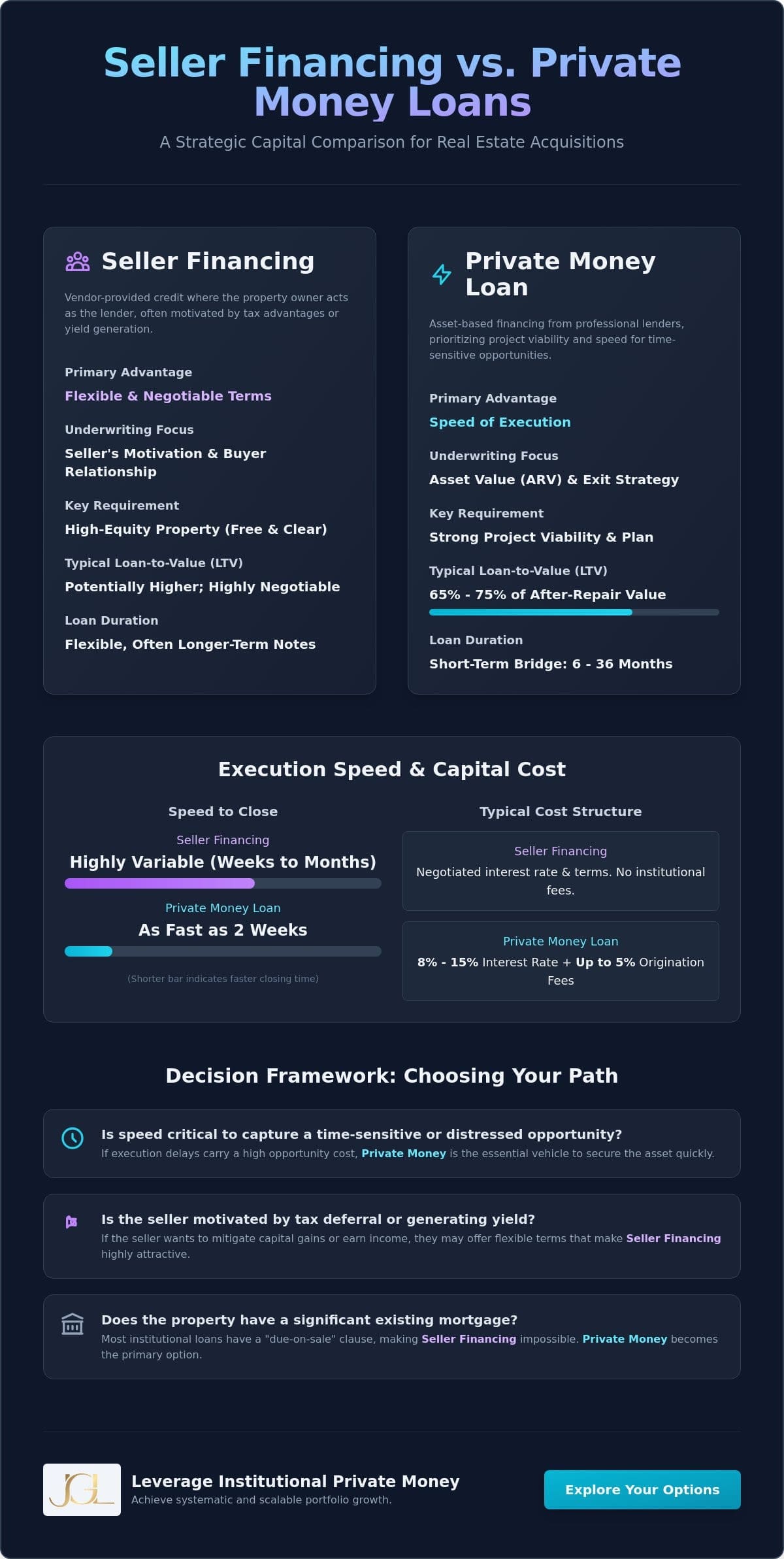
The selection between a seller financing vs private money loan necessitates a rigorous evaluation of how capital duration and leverage interact with project profitability. Loan-to-Value (LTV) ratios vary significantly across these models. Seller-backed arrangements often permit higher leverage if the vendor is motivated to divest, whereas professional private lenders typically cap LTV at 65% to 75% of the after-repair value to maintain a disciplined risk profile. The duration of capital also dictates the strategic utility of each instrument. Private money functions as short-term bridge debt, typically ranging from 6 to 36 months. In contrast, seller notes often provide medium-term stability through five to ten-year terms, though they lack the institutional rigor found in professional lending environments.
Interest Rates and Fee Structures
A primary distinction lies in the upfront cost and the nominal interest rate. Seller financing rates in 2026 generally range from 8% to 12%. While these rates may appear lower than other alternative sources, the absence of origination fees often coincides with an inflated purchase price for the underlying asset. Conversely, professional hard money lenders structure their capital with origination fees, or points, ranging from 2% to 5% of the total loan amount. Understanding private money lending for real estate requires calculating the effective interest rate, which accounts for these fees over the anticipated hold period. The 8% to 15% interest rates associated with private money reflect the premium placed on speed and the absence of restrictive credit-based underwriting.
Amortization vs. Interest-Only Payments
Debt service structure directly influences Internal Rate of Return (IRR) and monthly cash flow. Private money is almost exclusively structured as interest-only. This maximizes liquidity during the high-growth or stabilization phase of a project. Seller financing may follow a standard 20-year amortization schedule, which facilitates equity build-up but increases the monthly debt service burden. Both models frequently utilize balloon payments, necessitating a disciplined exit strategy. Investors often transition from these transitional structures into long-term commercial debt once the asset is stabilized. Those seeking to optimize their capital stack should evaluate how these structures impact their long-term portfolio stability and overall debt service coverage ratios.
The Investor’s Dilemma: Analyzing Strategic Advantages and Risks
The strategic tension between seller financing and private money loans often centers on the alignment of capital deployment speed with the complexity of the underlying asset. While previous sections detailed the structural differences in debt service, the investor’s dilemma involves a rigorous assessment of risk and the opportunity cost of time. Private money remains the superior choice for competitive bidding environments where the ability to close within fourteen days is a prerequisite for securing deep purchase discounts. The resolution of the seller financing vs private money loan debate often hinges on whether the transaction requires the creative flexibility of a vendor or the systematic, institutional scalability of a professional lender.
Underwriting flexibility is another critical differentiator. Professional asset-based lenders utilize sophisticated valuation models to evaluate new construction loans, focusing on the feasibility of the project rather than the seller’s personal balance sheet. This institutional approach provides a level of certainty that’s often absent in informal seller-held arrangements. However, the risk of default carries different implications in each model. Navigating foreclosure and maintaining lien priority requires a disciplined legal strategy, particularly when a seller holds a secondary position or when wrap-around mortgages are utilized. Investors must ensure that every claim is qualified and every strategy is clearly defined before committing to a capital structure.
When Seller Financing Is the Superior Choice
This vehicle becomes a strategic asset when acquiring properties with significant deferred maintenance that fail traditional bank inspections. In these scenarios, the seller acts as the bridge to stabilization. Understanding how seller financing works allows investors to utilize installment sale treatment to mitigate capital gains liabilities for the vendor, often resulting in more favorable terms. Creative structures such as subject-to acquisitions facilitate low-down-payment entries into high-value markets. These arrangements are particularly effective when the seller’s primary motivation is the generation of long-term interest income rather than immediate liquidity.
When Private Money Is the Strategic Necessity
For those scaling a fix and flip loans business, velocity is the primary driver of ROI. Private money provides the reliable liquidity needed to fund ground-up development or rapid acquisitions where a seller lacks the capacity to provide construction draws. It’s a strategic necessity when the asset requires rapid closing to secure significant purchase discounts. By choosing professional private debt, developers ensure they have the capital depth required to execute on high-volume, time-sensitive acquisitions. This approach avoids the friction of individual seller negotiations and provides a clear, documented path toward future institutional refinancing, solidifying the brand’s position as a leader in its field.
Decision Framework: Choosing the Optimal Path for Your Portfolio
Professional capital allocation requires a rigorous quantification of the opportunity cost associated with deployment delays. While previous sections detailed the structural mechanics, the decision to utilize seller financing vs private money loan structures must be rooted in the project’s specific lifecycle and the seller’s liquidity requirements. If a transaction involves a complex multi-family asset requiring immediate stabilization, the speed of private capital often outweighs the interest savings of a seller note. Conversely, if the vendor possesses a high-equity position and seeks to defer capital gains, the investor can negotiate terms that significantly enhance the project’s cash-on-cash return. A disciplined firm evaluates the necessity of professional draw management; if the project involves ground-up development, the institutional oversight of a private lender is often indispensable.
The Role of the Exit Strategy
The exit strategy dictates the long-term viability of transitional debt. For rental portfolios, Debt Service Coverage Ratio (DSCR) loans serve as the institutional successor to both bridge debt and seller-held notes. Managing the transition requires a keen awareness of balloon dates and the potential for interest rate volatility. Professional private money contracts provide essential clarity on prepayment penalties, which allows firms to exit into long-term financing once the asset reaches stabilized occupancy. This disciplined approach to real estate investing ensures that the capital stack remains resilient against market fluctuations. It’s a matter of aligning current debt with future valuation targets.
Negotiation Tactics for Seller Financing
Negotiating seller financing requires framing the offer as an investment in the seller’s financial future. By highlighting the potential for consistent passive income through a structured note, investors can often secure acquisitions that would otherwise be out of reach. The two-price offer strategy is particularly effective. It presents the seller with a choice between a lower cash price and a higher purchase price supported by vendor financing. In 2024, the average seller-financed note was approximately $271,655 with a down payment of 27%, illustrating that these deals require significant equity but offer substantial flexibility. Rigorous due diligence remains mandatory to validate the security instruments and ensure the note doesn’t trigger existing institutional acceleration clauses. For those seeking to accelerate their acquisition timeline, securing institutional-grade bridge capital often provides the most reliable path to closing.
A sophisticated investor recognizes that the cheapest capital is not always the most profitable. The friction of a protracted negotiation can cost more in lost appreciation than the spread between an 8% seller note and a 12% private loan. By applying this decision framework, you ensure that every financing choice serves the long-term strategic objectives of your firm. Precision in capital selection is the hallmark of a seasoned partner.
Leveraging Institutional Private Money for Scalable Growth
Scalability serves as the ultimate differentiator between the tactical investor and the institutional developer. While previous sections illustrated the situational utility of seller financing vs private money loan structures, the transition toward a systematic acquisition strategy requires a reliable, repeatable source of capital. Seller financing is fundamentally opportunistic; it depends entirely on the unique tax position and liquidity needs of an individual vendor. For a firm focused on building a lasting legacy, relying on the chance alignment of seller motivations is a barrier to growth. JGL Capital LLC provides the capital depth necessary to execute multiple high-stakes projects simultaneously, transforming debt from a transaction-specific tool into a strategic engine for portfolio expansion.
The complexity of modern resource management necessitates a collaborative alliance with a professional broker. Navigating the intricacies of commercial real estate loans requires more than a simple credit application. It demands a sophisticated articulation of project viability and risk mitigation. JGL Capital LLC prioritizes the intrinsic value of the asset and the strength of the development plan over traditional, restrictive credit metrics. This asset-centric approach allows sophisticated partners to secure funding for distressed or high-growth projects that institutional banks often overlook due to rigid underwriting standards. By aligning capital with project milestones, JGL Capital LLC ensures that every dollar deployed serves the generation of long-term worth.
The JGL Capital LLC Advantage
Our firm provides a disciplined framework for capital allocation, offering access to a diverse range of bridge, fix and flip, and multi-family loan programs on a national scale. We leverage over thirty years of specialized expertise in asset-based lending to provide the analytical rigor that high-net-worth stakeholders expect. JGL Capital LLC operates as a seasoned, strategic, and discreet partner, valuing integrity and long-term stability above the transactional nature of more aggressive competitors. This commitment to timeless principles ensures that our partners have a stable foundation for capital preservation and growth.
Taking the Next Step in Your Investment Journey
Transitioning to institutional-grade debt requires a methodical approach to deal presentation. A professional loan package should include comprehensive property data, detailed renovation or construction budgets, and clear feasibility studies that validate the anticipated exit strategy. Asset-backed lending relies heavily on the quality of professional appraisals and the precision of the underlying data. We invite you to contact JGL Capital LLC to discuss a customized capital solution tailored to your specific strategic objectives. Whether you are stabilizing a multi-family asset or initiating ground-up development, our team provides the intellectual capital and financial depth required to secure your project’s success in a competitive market.
Advancing Your Capital Strategy for Institutional Growth
The strategic selection between seller financing vs private money loan structures ultimately determines the velocity at which a firm can scale its portfolio. While seller-held debt provides unique tax advantages and potential interest income for the vendor, it lacks the systematic reliability required for institutional-grade development. Sophisticated investors prioritize the institutional rigor and asset-centric underwriting of professional private lenders to ensure that capital deployment remains unhindered by traditional banking delays. By focusing on the intrinsic value of the property rather than restrictive credit metrics, you maintain the agility necessary to capture value in competitive markets. A disciplined approach to capital selection ensures that every transaction serves as a secure foundation for long-term worth, which is why many developers also engage Flex Legal, PLLC to secure their legacy through comprehensive estate planning.
JGL Capital LLC serves as a seasoned ally for developers seeking to build lasting legacies through disciplined capital allocation. With over 30 years of specialized industry expertise and a national reach for both residential and commercial projects, we provide the intellectual capital required for high-stakes management. Our approach prioritizes project viability and property value, ensuring that your strategic objectives are met with precision and security. We invite you to Secure Strategic Capital for Your Next Project with JGL Capital LLC. We look forward to facilitating your next acquisition with the discipline and expertise your portfolio deserves.
Frequently Asked Questions
What is the primary difference between seller financing and a private money loan?
The fundamental distinction lies in the origin of the capital and the relationship between the parties involved in the transaction. Seller financing involves the property owner extending credit directly to the buyer by deferring the receipt of equity; conversely, a private money loan is provided by a non-institutional professional lender who prioritizes the asset’s intrinsic value. While one is a vendor concession, the other is a strategic deployment of third-party professional capital.
Is seller financing legally safer than a private money loan for the borrower?
Legal security is not inherent to either vehicle but is instead a function of the underlying documentation and regulatory compliance. Sophisticated borrowers must ensure that all security instruments are properly recorded to maintain lien priority and prevent future title disputes. While business-purpose loans are generally exempt from consumer protection laws like the Dodd-Frank Act, the institutional rigor of professional private debt often provides a more standardized and predictable legal framework.
Do I need a high credit score to qualify for a private money loan in 2026?
Professional asset-based lenders prioritize project viability and property value over traditional personal credit metrics. While a borrower’s financial history provides some context, the lender’s primary focus remains on the after-repair value (ARV) and the feasibility of the exit strategy. This allows for the funding of high-growth or distressed projects that might be rejected by conventional institutions due to their rigid, credit-based underwriting standards.
Can I use seller financing for a ground-up new construction project?
Utilizing seller financing for ground-up development is exceedingly rare because individual vendors typically lack the institutional infrastructure required to manage construction draws and site inspections. For these complex developments, professional capital sources are the strategic necessity. They provide the necessary oversight and liquidity to ensure project completion, which is a service individual sellers are rarely equipped to provide during the seller financing vs private money loan evaluation.
What are the typical interest rates for private money bridge loans in the current market?
In the current 2026 market, interest rates for professional private capital generally range from 8% to 15%. These rates reflect the premium placed on rapid deployment and the absence of restrictive, traditional underwriting. Borrowers should also anticipate origination fees ranging from 2% to 5% of the total loan amount. These costs must be factored into the effective interest rate to ensure the preservation of project profitability and long-term worth.
How long does it take to close a deal with private money vs. seller financing?
Private money loans often facilitate closing within fourteen days, providing a critical competitive advantage in high-velocity or distressed markets. While seller financing can also be expedited, the timeline is frequently extended by the complexities of individual negotiations and the need for the seller to confirm their own tax positions. The institutional process of a professional lender is designed for speed; whereas, seller-backed deals rely on the vendor’s personal timeline.
Are there specific tax benefits to using seller financing for real estate investors?
The primary tax advantage resides with the seller, who may utilize installment sale treatment to defer capital gains liabilities over the term of the note. For the investor, the choice of seller financing vs private money loan may influence the interest deductibility and reporting requirements. It’s essential to consult with a tax professional regarding the more stringent IRS reporting requirements implemented for the 2026 tax season to ensure full compliance.
What happens if I cannot pay the balloon payment on a private money loan?
Failure to satisfy a balloon payment necessitates immediate strategic action, typically involving a refinance into long-term institutional debt or the divestment of the asset. Disciplined developers maintain a secondary exit strategy to mitigate the risks of interest rate volatility or market shifts. Professional lenders may offer extensions under specific conditions, though this often requires a reassessment of the project’s current valuation and the remaining equity within the capital stack.